


Quick answer
A Google review with no text attached is not removable just because it is blank. Google usually removes a star-only review only when it appears to breach the Google Business Profile review policy, such as spam, fake engagement, conflicts of interest or other prohibited content signals. Your best route is to flag it inside Google Business Profile, attach evidence that links the account or timing to a policy issue, and escalate if the first report stalls. In live removal work, policy-based evidence decides these cases. Google’s review decisions often take several days, and some drag on longer.
This page answers How to remove a Google review with no text attached from actual removal handling, not from copying Google Help threads. The useful detail starts after you hit report: blank-review cases live or die on the evidence you attach, the policy hook you choose, and whether Google leaves the case sitting at “decision pending” or closes it with no action.
BGR Review handles review removals on a pay-after-success basis at $449 per removed review link with $0 upfront, so the process only works for us when the evidence is strong enough to move Google. That makes the weak spots obvious fast: a missing comment means nothing on its own, screenshots without context usually go nowhere, and timing patterns often matter more than the star rating itself.
Quick answer
Yes, Google can remove a blank-star review if it violates the Google Maps User Contributed Content Policy, and you can flag it from Google Maps or your Google Business Profile in under 2 minutes.
The strongest removal evidence is rarely the missing text itself. What matters is whether you can tie the reviewer to no transaction, no appointment, no site visit, or an obvious spam pattern such as a fresh profile reviewing unrelated businesses in different cities. A blank rating with no written comment can still breach Google's rules on fake engagement or off-topic content.
If Google rejects the first report, the DIY route usually ends there unless you escalate with cleaner evidence. That is the point where some owners use a service like BGR Review's Google review removal help, which runs on a pay-after-success model at $449 per removed review link with $0 upfront.
Why trust this guide on blank Google review removals
This guide is trustworthy because it deals with one narrow problem: Google reviews that show a star rating with no written text, not generic review disputes. You will get the DIY flagging route, the escalation path after a denial, and the point where outside help can help or cannot. That matters because blank-review cases turn on the Google Business Profile review policy and the evidence behind the account, not on wording that does not exist.
BGR Review sells both review services and removals, so the commercial line should be clear. If self-service works, that is the cheaper route; if it fails, agency help still has limits, and our own removal model is $0 upfront and $449 per removed review link. The useful part here is the operational detail most guides skip: what status changes usually appear after you file, what weak evidence gets ignored, and which policy hooks give a blank-star report a real chance.
What a Google review with no text attached actually is
A Google review with no text attached is a star-only rating, usually anywhere from 1 to 5 stars, that publishes without a written comment. You can see it in Google Search, Google Maps, or inside your Google Business Profile reviews panel, and it still counts toward your visible rating. This is the exact review type clients send to BGR Review before deciding whether to use our Google review removal service, which runs on a $0 upfront, pay-after-success model at $449 per removed review link.
No text does not place the review outside Google’s rules. Google still applies its Google Maps User Contributed Content Policy and Google Business Profile review moderation standards to star-only ratings, so a blank review can still be removed if it breaks policy. The practical difference is evidence: with no wording to quote, you have to prove the account, timing, transaction gap, or policy issue another way, which is why these cases often stall after a basic flag.
When Google may remove a blank-star review under its policy
Google may remove a blank-star review only if the rating itself appears to breach its review policy, because a no-text 1-star is allowed unless Google can tie it to spam, fake engagement, harassment, off-topic content, or account misuse under the Google Business Profile prohibited and restricted content rules.
A star rating with no words is not automatically removable. Google allows negative opinion, including a bare 1-star, if the account looks real and the rating relates to an actual experience with your location. The policy hooks get stronger when the reviewer never had any genuine interaction with you, when several empty ratings land together from connected accounts, or when the profile shows signs of impersonation, purchased activity, or other fake engagement that Google’s spam systems treat as inauthentic.
Most owners misread this point and report the review as “unfair” or “has no text”. Those arguments usually go nowhere because “blank” is not a policy violation by itself. What tends to matter is whether you can connect the rating to a non-customer, a coordinated burst, or a compromised account.
If that evidence exists, the case moves from opinion to policy. That is also the line agencies work on: BGR Review only takes removal work where there is a policy basis, and the removal model is $0 upfront and $449 per removed review link after success.
What to check before you flag the review
Check the review against your own records before you flag it, because Google Business Profile reports with vague or mistaken facts usually go nowhere.
Start with the date on the blank-star review and match it against bookings, invoices, call logs, delivery notes, sign-in sheets, and visitor records from that day. Then widen the search a little. In practice, we tell clients to check whether the reviewer name, or any close variation of it, appears anywhere in the CRM within the last 12 months, because an old lead, cancelled booking, or walk-in often gets missed on the first pass.
- Confirm the exact review date against your trading records for that day.
- Search your CRM for the reviewer name and close spelling variants within 12 months.
- Save screenshots of the star rating, reviewer profile, review date, and the full business listing before you report it.
Take the screenshots before anything changes. A profile rename, listing merge, or later edit can muddy the timeline, and that weakens the case if you escalate it or hand it to a removal service such as BGR Review's pay-after-success model at $449 per removed review link with $0 upfront.
How to flag a no-text Google review step by step
To flag a no-text Google review, open your Google Business Profile or Google Maps listing, find the blank-star rating, click the three-dot menu, choose Report review, and submit the policy reason that fits the case.
Start inside your Business Profile while signed into the Google account that manages the listing. Go to your reviews, locate the star-only review, open the menu beside it, and select Report review. Google will push you into its reporting flow, where you pick the violation category under the Google Business Profile review policy. A blank review does not break policy just because it has no text, so choose the reason based on the account, the transaction history, or the review pattern, not on the missing comment.
If you are working in Google Maps, the route is similar. Open your business profile in Maps, scroll to the review, hit the three dots, and submit the violation reason there. On some accounts, Google now shows a review status tracker after submission, usually inside the reviews management area, so you can see whether the report is logged rather than guessing if the form went through.
Keep the first report clean. One accurate submission from the listing owner usually carries more weight than repeated flags from staff accounts, and duplicate reports do not strengthen weak grounds for removal.
What evidence works when there is no written comment
The evidence that works on a blank Google review is proof that no real customer interaction happened, plus any signal that the rating forms part of a wider spam pattern under Google’s fake engagement rules.
Start with the transaction gap. If the reviewer name, profile photo, or timing does not match any booking, receipt, invoice, call log, chat transcript, CRM entry, visitor log, or point-of-sale record, say that plainly and attach the records that cover the relevant date range. A weak note like “we cannot find this person” usually gets ignored. A stronger note is specific: “We checked bookings, till receipts, inbound calls and site visits for 12-14 July 2026 and found no matching interaction.”
Pattern evidence helps because a blank one-star rating often fails on context rather than wording. If the same Google account dropped identical star-only ratings across five local businesses on the same day, include dated screenshots of each profile page and the visible review timestamps. That gives Google a fake engagement angle instead of a customer service dispute.
Keep your written summary short. The best evidence packs use 3 to 6 attachments, label each screenshot with the capture date, and add a timeline under 150 words. If you send the case to BGR Review after self-reporting fails, that compact file is what lets a pay-after-success removal case stay focused at $449 per removed review link, with $0 upfront.
Realistic success odds for removing blank-star reviews
Removal odds for a blank-star Google review are moderate at best, and they drop fast when the rating could plausibly come from a real customer visit with no written comment. Google usually leaves ratings alone unless your report matches a named rule in the Google Maps user-contributed content policy, such as spam, conflict of interest, off-topic content, or a review posted on the wrong business profile. A one-star review with no text can still survive if Google thinks the user had a real experience and simply chose not to write anything.
Most first reports fail because the submission says the review is “unfair” or “fake” without tying it to a policy ground and evidence. Odds improve when you document the mismatch clearly: no customer record for the name shown, proof the reviewer targets multiple unrelated listings, screenshots of duplicate rating behaviour, or evidence the review landed on the wrong location after a profile merge. If you ask an agency to step in after that, the useful test is whether it can build a policy-based file, not whether it promises certainty; our own removal work is pay-after-success at $449 per removed review link with $0 upfront for that reason.
What happens after you submit a report
After you submit a Google review report, Google usually runs an automated policy check first and only sends harder cases to human moderation if the signals are mixed or the account history needs a closer look.
Blank-star reviews often sit in that grey area because there is no text to match against the Google Maps user-contributed content policy. A clean fake-account signal can lead to removal without any back-and-forth. A weak report often gets rejected automatically, and another common outcome is no visible change after several days even though the form submitted correctly. That last one matters because silence is not approval, and it is not a removal either.
| What you see | What it usually means | What to keep |
|---|---|---|
| Review disappears | Google removed it after policy review | Before/after screenshots and date removed |
| Review stays live | Report was rejected or no action yet | Case ID, submission date, profile URL |
| No update after several days | Queue delay or no visible notice issued | Confirmation email, screenshots, account used |
Keep the case ID, your screenshots, and the exact submission date in one file from day one. If you later ask Google for follow-up or bring in a paid removal service, those three items save time because the review may change, the profile may refresh, and the original blank-star state is harder to prove after the fact. At BGR Review, this is also the minimum record set we ask for before taking a $0-upfront removal case priced at $449 per removed review link.
When a public response helps even without review text
A public reply helps when a blank-star Google review stays live because it shows future customers you take complaints seriously even before Google decides a report under its Google Business Profile review policy.
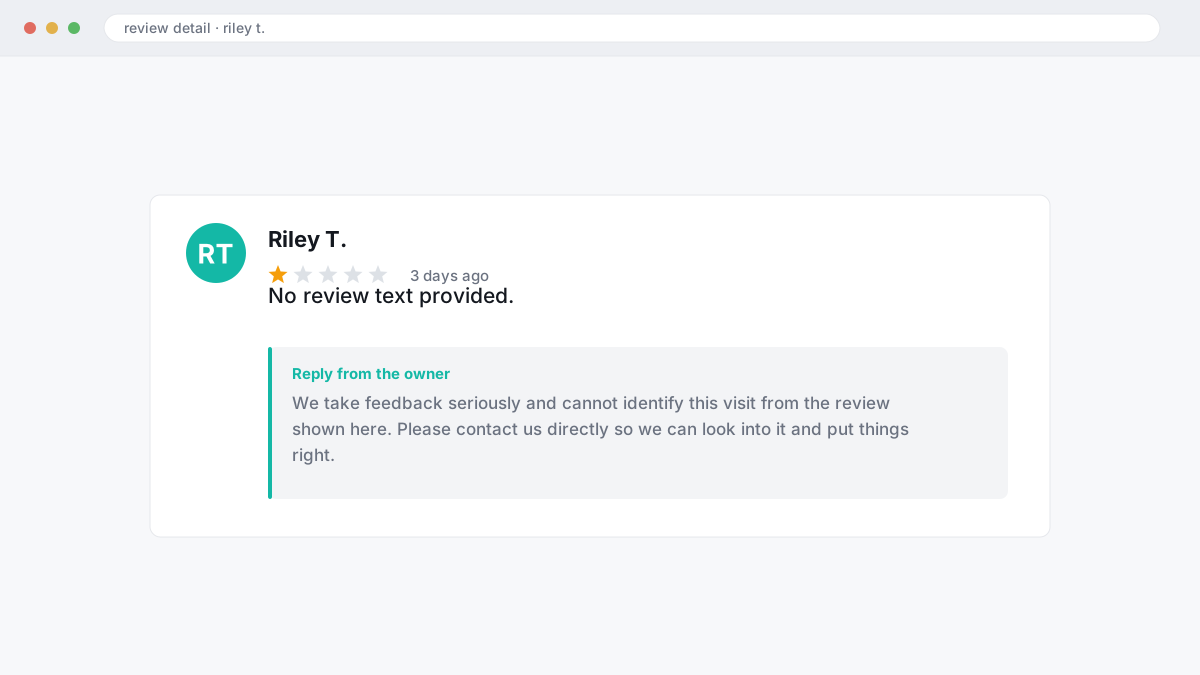
Keep the reply calm, brief and under 80 words. A good format is: “We take feedback seriously and cannot identify this visit from the review shown here. Please contact us directly so we can look into it and put things right.” Do not call the reviewer fake, a competitor or abusive unless you have proof strong enough to support a fraud report. If your flag is still unresolved after Google’s review, BGR Review handles removals on a pay-after-success basis: $0 upfront, $449 per removed review link.
Your escalation options if flagging fails
The next step after a denied flag is to check the case in Google’s Reviews Management Tool, then file an appeal quickly if the status shows no action taken or rejected.
The tool matters because it ties your report to a specific review URL and shows whether Google actually processed it. If the blank-star review is still live, open the original case, confirm the policy reason, and add tighter evidence instead of rewording the same complaint. For no-text reviews, Google Business Profile review policy arguments usually land only when you show a clear mismatch: no customer record, staff never handled the person, or the rating came from a profile linked to obvious spam activity. Weak notes such as “this looks fake” or “we don’t recognise the name” usually go nowhere.
If the appeal still stalls, Google Business Profile support can sometimes help when the first reviewer or form missed policy evidence already submitted. Do that within days of the denial, not months later, because older reports tend to lose momentum unless you bring something new. If you want outside help after that, our removal work is pay-after-success at $0 upfront and $449 per removed review link, but this is one of the few cases where a fast DIY appeal is usually the cheaper first move.
What agencies can and cannot do with blank-review cases
No agency can guarantee that Google will delete a blank-star review, because Google Business Profile enforcement and the final policy decision sit with Google, not with the firm you hire.
A good agency helps in three places: it tightens the evidence, matches the facts to the right part of Google’s prohibited and restricted content policy, and times the escalation properly after an initial flag fails. That matters more on no-text reviews because there is no written abuse to quote, so weak submissions often get ignored if they only say “this looks fake” without proof of no customer record, wrong location, staff roster mismatch, or a duplicate profile issue.
| What you’re paying for | Typical market range |
|---|---|
| DIY guidance or one-off report drafting | About $250 to $500 |
| Managed escalation on a harder case | About $500 to $1,500+ |
| BGR Review removal model | $0 upfront, $449 per removed review link after success |
If an agency promises guaranteed removal, treat that as a red flag. What a legitimate firm can do is improve the file you send, reduce avoidable rejection reasons, and tell you when the cheaper route is to handle the first flag yourself instead of paying for managed work.
What blank-review cases look like in real removal work
Blank-review removal work usually splits into two very different files: a lone anonymous 1-star with thin evidence, or a same-day burst across several locations that fits Google Business Profile review policy spam signals far more clearly.
| Scenario | What usually decides it | Removal outlook |
|---|---|---|
| Single blank 1-star on one profile | A policy-based trail: no matching customer record, no booking, no invoice, no message history, and a dated screenshot of the review URL | Often weak unless you can tie it to fake engagement or a prohibited conflict |
| Blank 1-stars hitting multiple locations within 24 hours | Timestamp spread, reviewer profile overlap, repeated geography, and a location list in one submission set | Stronger if it reads as coordinated spam |
The weak cases are the ones most owners expect to win. A long complaint saying “this person never visited us” usually gets ignored if the attachment set is thin. Google’s forms respond better to exact records than emotion: order lookup result, staff rota if it was an appointment business, CCTV retention note if relevant, and the direct review link captured on the day it posted.
The cleaner wins come from documentation that lets support map the review to a policy hook fast. That is why BGR Review builds removal files around timestamps, profile links and missing transaction evidence, then only takes the removal work on a pay-after-success basis at $449 per removed review link with $0 upfront.
Practical next step if the blank review remains live
If the blank review stays live, your next move is to document it properly, post a short public reply, and watch for repeat activity over the next 7 to 14 days.
Save screenshots of the star rating, profile URL, review date, and any mismatch between the reviewer and your customer records. Then post a brief response that avoids blame and invites offline contact. If Google Business Profile policy evidence exists, such as conflict of interest, spam, or a reviewer tied to a competitor, submit one tighter escalation with cleaner proof instead of sending the same flag again.
If more blank-star reviews start appearing, stop treating it as a one-off. Repeated cases can drag down rating averages fast. That is the point to get an expert review before the damage compounds. BGR Review handles removals on a pay-after-success basis at $449 per removed review link, with $0 upfront, if you want a second look at the evidence.
Where to go from here
A blank-star rating only comes down when you can tie it to a Google Business Profile review policy breach; the lack of text by itself does nothing. In live removal work, the cases that move are the ones built around evidence Google can verify: no matching customer record, timing that lines up with a competitor burst, or account patterns that suggest spam. Cases built on “this feels unfair” usually stall in the same status for days and then die quietly.
If your report has gone nowhere and that rating is hurting calls, bookings or form fills, the next step is a case-level assessment. Pull the review link, your customer ledger for the relevant date range, screenshots of the profile, and any notes that show why the reviewer could not have dealt with you. Then decide whether you have a real policy angle or whether a public owner response is the cheaper route.
BGR Review handles that as a pay-after-success removal service: $0 upfront and $449 per removed review link. If there is no workable policy hook, you should hear that early rather than burn more time resubmitting the same weak flag.