


Quick answer
For local SEO, review count, average rating and recency do different jobs. Higher review volume usually strengthens Google Business Profile prominence more than a small star gap, while rating tends to shape click choice once you appear in the map pack. In a common side-by-side, 4.6 stars from 200 reviews will often hold stronger pack visibility than 4.9 from 20, and still look credible enough to win calls. Google Business Profile Help says local results depend on relevance, distance and prominence, and prominence includes review count and review score. Fresh reviews are the tie-breaker many guides skip.
This page is written for owners comparing live competitors on Google Maps, because review count vs rating seo only makes sense when you separate ranking from click behaviour. In our work across 15,000+ businesses, the mistake we keep seeing is owners chasing a prettier average while the rival across town keeps adding recent reviews and owner replies, which makes the profile look active in Maps.
We also see what happens after people use Google’s basic “Report review” button and stop there: across 12,000+ negative review cases logged June 2025 to June 2026, most failed self-filed attempts came with no supporting evidence beyond the in-platform flag. That matters here because the same shallow approach shows up in growth plans too — people count stars, ignore recency, and never benchmark the real competitor gap.
Which matters more locally: review count, star rating, or recent activity?
Review count, average star rating, and review recency do different jobs in local search. Count supports Google Business Profile prominence, rating changes who clicks, and recent activity keeps your listing credible now instead of looking stale.
Generic guides bundle reviews into one signal. That fails because rank and click are separate decisions. In BGR Review's dataset of 1,485 businesses observed from February to July 2026, new trades and local service businesses that reached 20-30 reviews in the first three months were associated with better local visibility, which points to review count helping prominence more than a tiny rating edge does. Once two listings sit in the same Maps shortlist, the CTR versus rank trade-off takes over: a 4.9 profile often attracts the tap, but a thin profile with 18 older reviews can still lose trust against a 4.7 profile with 120 reviews spread across the last few weeks.
This is the cleaner way to compare nearby profiles before you spend anything on outreach or on BGR Review's review packages, which carry a 30-day free replacement guarantee.
| Profile | What helps rank | What helps the click |
|---|---|---|
| 4.9 stars, 18 reviews, last review 5 months ago | Light proof of prominence | High rating, weaker credibility |
| 4.7 stars, 120 reviews, several this month | Stronger prominence signal | Slightly lower stars, stronger trust |
| 4.6 stars, 200 reviews, no recent activity | Can still rank well | Stale profile can lose clicks to fresher rivals |
How does review count actually help you appear in Google Maps?
Review count helps your Google Maps visibility through Google Business Profile prominence, not through a simple rank switch. More legitimate reviews give Google stronger evidence that your business is active and known locally, which can help pack visibility when relevance and distance are already close.
Google states in Google Business Profile Help that local results rely mainly on relevance, distance and prominence. The wrong approach is treating review count like a direct ranking button: buy a burst, add 20 reviews, expect position one. That fails because Maps still weighs how well your listing matches the query and how near you are to the searcher, and Google’s systems can ignore low-trust or filtered reviews. The right approach is to use steady, policy-compliant review growth to strengthen prominence, because a higher review count supports the profile’s real-world credibility alongside your category, location and listing completeness.
That is why local pack leaders often sit above the category median review count in their immediate area. In BGR Review’s dataset of 1,485 businesses observed from February to July 2026, new trades and local service businesses that reached 20–30 reviews over the first three months were associated with improved local visibility, though other ranking factors were active at the same time. Review count also affects local pack click behaviour once you appear: searchers read volume as proof that people actually use you, even before they compare star rating in detail.
When do higher stars win the click even if they do not win the rank?
Higher stars do not always lift your map rank, but they often lift your clicks. In Google Maps, people scan the visible average star rating before they open a profile, so a lower listing can still win the visit if its score looks safer.
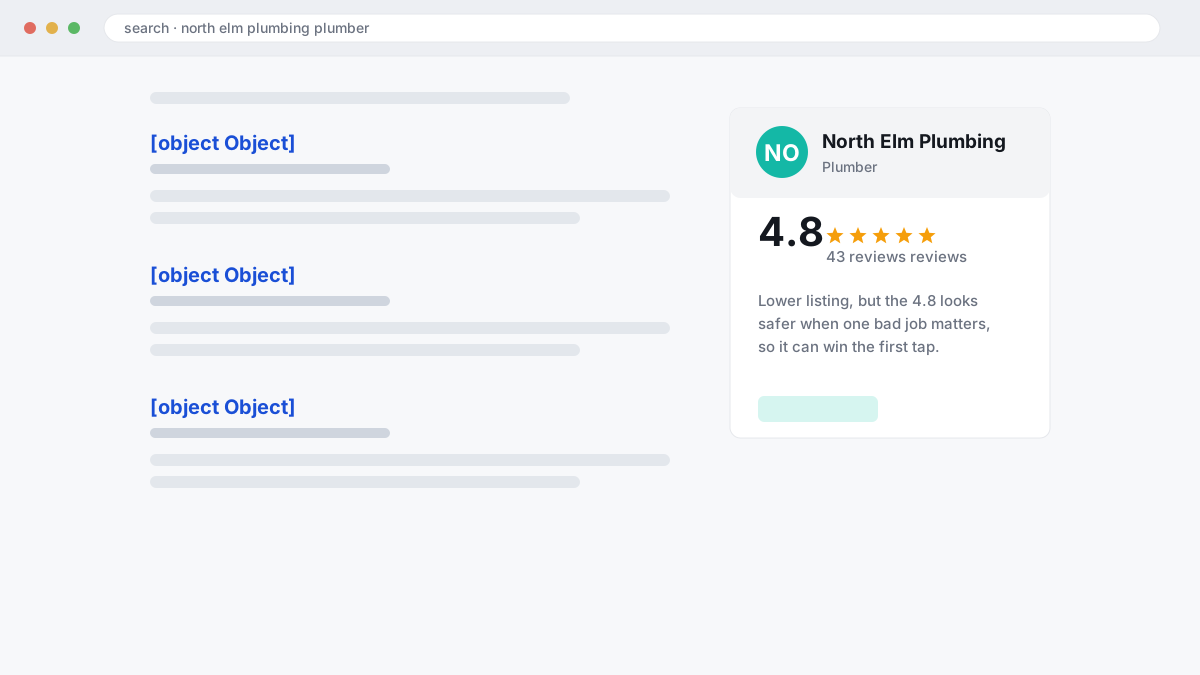
The wrong approach is chasing pack position alone and assuming rank 1 gets the most attention. That fails because local pack click behaviour is a trust shortcut: a 4.3 can sit above a 4.8 and still lose the first tap if the searcher reads the stars as risk, especially for plumbers, dentists, and other high-stakes local services where one bad job matters. The right approach is to manage the CTR versus rank trade-off directly, because the listing that looks safest often gets chosen before the user reads review text or opens photos.
Those shifts usually happen around visible trust thresholds rather than tiny decimal changes. A move from 4.2 to 4.5 changes how your profile reads at a glance, and 4.8 often feels meaningfully stronger again, while 4.6 versus 4.7 rarely changes first-impression behaviour on its own. If you use BGR Review to build verified Google review packages, that is why the practical target for click gain is often the next threshold, with a 30-day free replacement guarantee if delivered reviews drop, rather than chasing rank movement you cannot force.
Who usually wins: a 4.6 rating with 200 reviews or a 4.9 with 20?
A profile sitting at 4.6 from 200 reviews usually beats a 4.9 from 20 in local discovery because Google Business Profile prominence leans on thicker proof, not just a prettier average star rating. The 4.9 profile tends to win when the niche is thin, the search is branded, or the click depends on looking premium at first glance.
The wrong read is to chase the higher number and assume 4.9 always wins. That fails because review count does two jobs at once: it narrows the competitor review gap in Maps and gives searchers more confidence that the rating reflects a real customer base rather than a small sample. When owners ask BGR Review whether a light-profile 4.9 needs help, this is usually the first comparison we make before recommending any Google review package with our 30-day free replacement guarantee or telling them to wait.
This side-by-side is the practical way to judge the CTR versus rank trade-off on a live map pack.
| Profile | Likely rank effect | Likely click effect |
|---|---|---|
| 4.6 rating / 200 reviews | Usually stronger for local discovery because the proof base is deeper | Still wins many clicks if nearby rivals have similar stars but fewer reviews |
| 4.9 rating / 20 reviews | Can rank fine in low-competition categories or branded searches | Often wins the click when buyers want the cleanest-looking option fast |
| 4.7 rating / 120 reviews with fresh reviews this month | Often the safest all-round profile if both rivals look credible | Recent activity helps it look active rather than stale |
Recent review flow often decides the close call. If the 200-review profile has been quiet for months and the 20-review profile picked up believable new reviews over the last few weeks, the smaller profile can take the click even if it does not take the higher Maps position. That is why BGR Review separates profile strength from click appeal before advising on Google reviews or whether a stale profile needs attention first.
How recent do your reviews need to be before your profile still looks alive?
Review recency tells both searchers and Google whether your profile still reflects the business as it operates now. A steady flow of current feedback usually beats a profile with a strong lifetime total that has been quiet for months.
Big lifetime volume is the wrong thing to rely on when nearby profiles sit on similar star ratings and review counts. It fails in local pack click behaviour because searchers read the date before they read the long history: 180 reviews with the last one seven months ago looks neglected, while 95 reviews with three posted in the last 30 days looks active and safer to call. The better approach is a simple monthly cadence. If you use BGR Review for review growth, delivery starts in 24-48 hours and review packages carry a 30-day free replacement guarantee, but the stronger long-term signal is still consistent new proof rather than one burst.
Category differences change how fast “stale” sets in. Plumbers, locksmiths and other urgent-demand services feel old quickly because people choosing in Google Maps want current proof that you are responsive today; destination dining and experience-led venues can carry older praise for longer if the rating stays strong and the photos still look current. In BGR Review’s dataset of 1,485 businesses observed February-July 2026, new trades and local service firms typically got first reviews within about two weeks, which fits the faster freshness cycle in urgent local categories.
How many reviews do you need before you are truly competitive nearby?
You need enough reviews to look credible against the nearby leaders, not against a national average. The target is usually the top-three local pack median, then a steady flow of fresh reviews so your Google Business Profile prominence keeps pace with the businesses already winning the map.
The wrong approach is copying a national benchmark like “get 100 Google reviews”. It fails because your competitor review gap is set by the three profiles ranking in your postcode, not by an average pulled from another city or category. If the local pack shows 42, 55 and 61 reviews, the useful target is the median, 55, and a practical first push is often to reach about seven to nine-tenths of the leader’s review count rather than chase an arbitrary round number.
That works because Google Business Profile prominence is comparative nearby. In BGR Review’s dataset of 1,485 businesses observed from February to July 2026, established practices such as dentists, lawyers, accountants and roofers typically needed 30–50 reviews before profiles performed consistently. That is a category clue, not a universal quota.
Count still loses force if your rating trails the pack by 0.4 stars. A profile on 4.4 with 70 reviews often looks weaker to searchers than nearby profiles on 4.8 and 4.9 with fewer reviews, which hurts click choice even if rank holds. If you need to close the gap fast, BGR Review review campaigns start in 24–48 hours and include a 30-day free replacement guarantee on package losses.
Can getting too many reviews too quickly make Google filter or distrust them?
Yes. Unnatural review velocity can create filtering risk. A sudden burst from low-activity accounts, repeated wording, or prohibited incentives can make reviews disappear, carry less weight, or raise trust concerns inside Google Business Profile.
The wrong approach is forcing fast growth that your normal customer volume does not support: 20 reviews in three days after months of silence, near-identical phrasing, or a gated review request that only sends happy customers to Google. Google review policies prohibit fake engagement and misleading review collection, including review gating and incentivised manipulation, so a sharp spike can break trust even when the average star rating looks strong. Fast growth works when it is believable growth instead: steady review recency after real jobs, mixed wording, mixed reviewer histories, and timing that fits how often you actually serve customers.
If your reviews vanish after a burst, the in-platform report button rarely fixes the cause on its own; across 12,000+ negative review cases logged by BGR Review from June 2025 to June 2026, roughly 90% of businesses that came to us after a failed attempt had filed only the basic report, with no supporting documentation, and 70–80% of those initial requests had been rejected. Rules also change by platform and country. In the US, the FTC requires disclosure for incentivised endorsements; false factual accusations can raise defamation issues; in the UK and EU, consumer-protection rules on misleading commercial practices still apply. That is general information, not legal advice. If a review breaches policy and you need removal help, BGR Review handles Google removals on a pay-after-success basis at $449 per removed link with $0 upfront.
Why do dentists, plumbers, and restaurants need different review targets?
Dentists, plumbers and restaurants need different review targets because Google Maps users judge risk differently by category: diners scan for social proof fast, plumbing buyers want current activity, and dental patients put more weight on a high average star rating before they call.
A one-size target like “get 50 reviews” fails because category differences change what the profile has to prove. In BGR Review’s dataset of 1,485 businesses observed from February to July 2026, established practices including dentists typically needed 30–50 reviews before profiles performed consistently, which fits how cautious patients compare trust signals before booking. A dentist sitting at 4.6 with visible complaints will often lose the click to a nearby 4.9 even if both have enough review count to rank.
This comparison is the more useful target by category.
| Category | What usually matters most | Practical target |
|---|---|---|
| Restaurants | Higher review count plus solid stars | Build volume steadily so your profile does not look thin beside busy nearby options |
| Plumbers | Review recency with credible rating | Keep fresh reviews coming each month because urgent buyers favour a profile that still looks active today |
| Dentists | Stronger average star rating backed by enough proof | Protect rating quality first, then add depth until the profile no longer looks under-reviewed |
The right approach works because it matches local pack click behaviour. A restaurant can survive a slightly lower average star rating if hundreds of diners have weighed in, a plumber with stale reviews looks abandoned during an urgent search, and a dentist needs both quantity and a cleaner rating profile because treatment risk feels higher to the buyer.
What should you do first if competitors already show more reviews or better ratings?
If rivals already look stronger, fix the gap that costs you the next click first: lift a sub-4.3 average star rating, restart recent review flow within the next 2-4 weeks, then work on count to close the wider competitor review gap.
The wrong move is copying a competitor with 150 reviews when your profile sits at 4.1 and the latest feedback is three months old. That usually fails twice. Google Maps may still treat the larger review count as a prominence signal, while searchers skip the weaker rating because 4.1 reads like unresolved service issues. In BGR Review's dataset of 1,485 businesses observed from February to July 2026, new trades and local service businesses typically got first reviews around two weeks after launch, and reaching 20-30 reviews over the first three months was associated with better local visibility, with other ranking factors active at the same time.
The right move is narrower. If you are under 4.3, fix delivery problems and ask happy customers for fresh Google reviews before chasing volume. If your rating is already healthy but stale, close the recency gap first so the profile still looks alive. Then use owner responses to answer repeat negative themes in plain language, offer service recovery where justified, and stop the same complaint appearing again. If you also need help removing policy-breaking reviews, BGR Review handles removals on a pay-after-success basis at $449 per removed link with $0 upfront.
What does a useful local review tracking template need to show each week?
A usable local review tracker puts nearby profiles’ review count, average star rating, review recency and rank position in one sheet. Update it weekly so you can see whether your real competitor review gap sits in Google Business Profile prominence, click trust on Maps, or both.
A one-day snapshot fails because local profiles move. One rival can hold a lower average star rating but add fresh reviews every week and keep looking active, while another sits on an older 4.9 and starts losing clicks. Track the top five rivals, then log total reviews, star rating, reviews in the last 30 days, primary category, rank position for your main term, and any repeated negative themes such as “no call-back”, “late arrival” or “overpriced”. If you are running a review campaign with BGR Review, including packages backed by our 30-day free replacement guarantee, keep the same sheet for 8 to 12 weeks before changing your target.
This is the layout worth using each week.
| Business | Core metrics | Context | What it tells you |
|---|---|---|---|
| You + top 5 rivals | Total reviews, average star rating, reviews in last 30 days | Primary category, Maps rank position | Whether the gap is volume, trust, or recency |
| Each profile weekly | New reviews added, rating change | Notable negative themes, owner responses | Whether competitors are improving faster than you |
How do review text and owner responses help when count and rating are already close?
When review count, average star rating and recency are already close, natural review text and fast owner responses usually decide click confidence in Google Maps more than they shift rank on their own.
The wrong move is pushing customers to cram review text keywords into every review: “best emergency plumber in Brooklyn”, “top boiler repair near me”, repeated line after line. That fails because the wording looks coached, thin and less believable to searchers, and Google Business Profile relies on user-generated content that reads like a real experience, not ad copy. The better approach is to request reviews after a completed job using a simple prompt tied to the work BGR Review already helps clients structure, so people naturally mention the service, the area and the outcome in their own words.
Owner responses work the same way. A calm reply within 24 to 72 hours often repairs trust after a negative review because local pack click behaviour is heavily visual: searchers scan the stars, then the latest criticism, then whether the owner answered like a real operator or went silent.
Where to go from here
Pull up the top three Google Maps profiles in your category and compare four things on one sheet: total review count, average star rating, how many reviews landed in the last 30-90 days, and whether the owner replies look current. That gives you the real gap. If you are sitting at 4.9 with 18 reviews and the leaders are at 4.7 with 140 and fresh activity every week, chasing a perfect score will not close the visibility problem on its own. You need a review-growth plan tied to your Google Business Profile, with requests triggered after completed jobs, steady review velocity, and replies that keep the profile looking active.
Expect that plan to change two things first: how credible your profile looks in the local pack, and how often searchers choose you once they see the listing. In BGR Review’s dataset of 1,485 businesses observed February-July 2026, new trades and local service businesses that reached 20-30 reviews over the first three months were associated with stronger local visibility, though other ranking factors were active at the same time. If you want help, BGR Review handles verified review growth for Google and other platforms, with delivery starting in 24-48 hours and a 30-day free replacement guarantee on review packages.