


Quick answer
You can get a Yelp review removed only if it breaks Yelp’s Content Guidelines, such as conflicts of interest, hate speech, threats, privacy violations, impersonation, or content that is clearly not based on a real first-hand experience. The normal route is to flag the review in Yelp for Business, select the closest policy reason, and submit evidence that proves the breach. Yelp will not remove a review because it is harsh or damaging. If the first report fails, send one cleaner follow-up with stronger proof. Paid help usually makes sense after a failed report on a review with a real policy issue.
If you want to know how to get yelp review removed, the useful part is the decision-making: what Yelp is likely to act on, what usually gets rejected, and when a failed DIY report is still worth escalating to a pay-after-success service at $449 per removed link with $0 upfront.
Start with Yelp’s actual removal standards
Yelp removes reviews that breach its rules, not reviews that are simply harsh, unfair, or low-rated. A 1-star post can stay live if it reads as a real customer opinion, while a 5-star post can come down if it breaks Yelp’s Content Guidelines or Terms of Service. That is the first filter to apply before you spend time flagging anything.
Read Yelp’s Content Guidelines and Terms of Service against the exact wording of the review. The removal grounds that usually matter are conflicts of interest, harassment, hate speech, privacy breaches such as posting personal contact details, and promotional content written to advertise another business or push a special offer. “This was overpriced and the service was rude” is usually protected opinion; “Call this number for a cheaper plumber instead” or a review posted by a competitor, employee, or close relative sits in a different category.
This is also where you set a sensible threshold for escalation. BGR Review only takes removal matters on a pay-after-success basis at $0 upfront and $449 per removed review link when there is a credible policy issue to argue, because policy-based removals have a path and taste-based complaints usually do not. If you have not matched the review to a named Yelp rule yet, stop there and read the policy pages first.
Match the review to a valid removal ground
Match the review to one clear Yelp policy ground before you report it, because one precise allegation gives moderators something they can verify and a list of weak complaints usually gets ignored.
The strongest fits are usually a fake reviewer identity, a competitor review, an ex-employee review, or doxxing that exposes private personal information. Pick the single ground with the best proof. If you call the review fake, competitor-written, defamatory and abusive all at once, you dilute the report and make Yelp do extra interpretation. Across 12,000+ negative review cases logged by BGR Review between June 2025 and June 2026, reviews raised within 28 days and tied to an identifiable policy issue resolved successfully in roughly 90% of cases; beyond 28 days, the observed success rate fell to approximately 25–30%. That is our case-file outcome profile, not a Yelp rule.
A false factual claim only helps if it also breaks Yelp’s content rules. “The food was awful” is opinion. “The clinic posted my home address” points to doxxing. “I worked there and management steals tips” raises the ex-employee issue. “I am a customer” from a rival nearby points to a competitor conflict.
Build the evidence pack before you flag anything
A usable Yelp evidence pack is a single folder that lets a moderator check your claim against dates, records and platform policy in under a minute. Pull the review URL, full-page screenshots, the posting date, any receipt or invoice, booking logs, CRM notes, call records, staff rota and CCTV timestamps into one place before you press Report. In BGR Review’s negative review case file, roughly 90% of businesses who came to us after a failed attempt had used only the in-platform flag with no supporting documents, and 70–80% of those first requests had been rejected.
Add a one-page timeline. List the alleged visit date, the review date, who was on shift, what your booking system shows, and the exact mismatch: no booking under that name, cancelled appointment before arrival, wrong branch, or a time the premises were closed. “This customer never existed” usually fails because Yelp cannot verify a negative claim without something concrete behind it.
Redact private data before submission because Yelp’s Privacy Standards still apply. Mask card numbers, home addresses, medical details, passport data and any staff personal information, but leave enough visible to prove the mismatch, such as order number, service date, branch location and first name or initials.
Check whether the reviewer appears to be a real customer
A real-customer check means testing the review against records Yelp moderators could actually verify: orders, bookings, invoices, staff rota, service date, and location. Start with the date and shift first. If the reviewer says they came in on a Tuesday at 8:30 pm, but your Yelp-listed site was closed or the named staff member was not on the rota, that is a concrete conflict Yelp can assess far more easily than a bare claim that “this customer never existed”.
Pull the basic trail before you report it: reservation log, POS receipt history, CRM entry, phone log, delivery record, and any CCTV timestamp if you have it. Check whether the complaint matches the right branch as well. A review with no reservation, no invoice, and the wrong location is much stronger than a single mismatch on its own.
This is where weak DIY reports usually fall apart. In BGR Review’s logged negative-review cases from June 2025 to June 2026, roughly 90% of businesses who came to us after a failed self-attempt had used only the in-platform report button with no supporting documentation. Yelp can remove policy-breaking content, but it will not fill evidential gaps for you.
Document conflicts of interest Yelp is more likely to act on
A Yelp conflict-of-interest report works when you prove the reviewer had a reason to harm or promote your business outside a normal customer experience. Yelp's content rules prohibit reviews from competitors, current or former employees, and people with a personal conflict, so your job is to tie the account to one of those named grounds with public evidence Yelp can verify. One clear conflict usually beats a long emotional explanation.
Save source material before you flag the review: a LinkedIn profile showing the reviewer works for a rival, a company website team page, a public bio linking them to a supplier dispute, or a court filing that names the person in an active case against you. If the review came from an ex-staffer, keep the staff record, rota entry, resignation email, or payroll screenshot that places them inside your business.
Match each exhibit to a single sentence: "Reviewer is employed by direct competitor X", "Reviewer was terminated on [date]", or "Reviewer is named in claim number [reference] against the business". Do not upload ten screenshots if one company bio and one matching name are enough.
Use Yelp’s flagging tool the right way
Yelp’s flagging tool works best when you file one short, evidence-led report from your Yelp Business account and tie the review to a named rule in Yelp’s Content Guidelines. Choose the closest violation category inside the report flow, then explain the breach in roughly 150 to 250 words. Ask for one outcome only: removal for a policy breach such as conflict of interest, impersonation, threats, hate speech, or a clearly unverifiable customer claim. Do not ask Yelp to remove it because it hurts bookings, looks unfair, or drops your rating.
Keep the wording plain enough for a moderator to verify fast. State the review date, quote the line that breaks policy, and point to the evidence you already gathered: booking log shows no matching visit on that date, staff rota confirms the named employee was not working, CCTV timestamp places no customer interaction in that time window, or screenshots show the reviewer is a competitor. In BGR Review’s own negative-review dataset, roughly 90% of businesses who came to us after a failed first attempt had used only the basic in-platform report with no supporting documents. That is why vague wording like “fake review, please delete” usually goes nowhere.
Write a report Yelp moderators can verify fast
A fast-verifiable Yelp report starts with the exact policy issue, then gives proof a moderator can check in under a minute. Write the first line like this: “This review appears to breach Yelp’s Relevance or Conflict of Interest standard because the reviewer claims service on 3 March 2026, but our business was closed that day.” Then add four parts in order: the violation, the proof, the date sequence, and the action you want Yelp to take. Skip the backstory. Skip how unfair it feels.
Use short sentences and attach only evidence that matches the point. A clean example: “Reviewer states they visited on 3 March at 2:15 pm. Our booking log shows no appointment under that name, the staff rota shows no front-desk cover after 1:00 pm, and CCTV timestamp confirms the premises were closed.” End with a direct request: “Please review for policy compliance and remove if in breach.” Across 12,000+ negative review cases logged by BGR Review, weak reports often failed because they led with opinion and no documents. If you plan to escalate later, keep the exact text you submitted and save screenshots of every attachment.
Decide whether to post a public owner response first
A public owner response is worth posting when your Yelp flag may take days to review or may be denied, because it gives future readers your side while the review stays live. Keep it under 100 words. In BGR Review’s case file of 12,000+ negative review matters logged June 2025 to June 2026, reviews raised within 28 days and backed by a clear policy issue resolved far more often than older cases, but that still does not make the review disappear immediately.
If you reply, stay calm and stick to safe facts. Do not call the reviewer a liar, fake, or extortionist unless you can prove that cleanly with records you would be comfortable showing Yelp or a solicitor. Do not post booking details, invoice numbers, health information, or anything else that identifies the customer. A simple line works better: “We take feedback seriously and could not match this account to a recent visit. Please contact us directly so we can review it.”
Track outcomes, follow up once, and avoid weak repeats
Tracking a Yelp report means watching for three realistic outcomes: the review stays live, Yelp removes it, or Yelp’s recommendation software stops recommending it and pushes it out of the main profile feed. Give Yelp a reasonable window before you chase it; in practice, that usually means waiting at least 7-10 business days after your first report unless you have a clear policy issue and fresh proof ready sooner. Check the review URL, take dated screenshots, and note any change in visibility, because a review that is no longer recommended can look “still there” if you only view it while logged in or through an old browser session.
If nothing changes, send one follow-up and make it tighter than the first. Add new evidence only: a booking log, staff rota, CRM record, or CCTV timestamp that maps to the date in the review. Across 12,000+ negative review cases logged by BGR Review, roughly 90% of businesses that came to us after a failed attempt had used only the platform report button with no documentation, and 70-80% of those first requests had been rejected. Repeating the same claim three times does not strengthen it. It usually tells a moderator there is nothing new to verify.
Know when DIY is unlikely to work
DIY is unlikely to work when a Yelp review is damaging but framed as personal opinion, because Yelp usually removes reviews for policy breaches rather than harsh but subjective criticism. “Rude staff”, “overpriced”, or “worst service I’ve had” will often stay live unless you can tie the post to a named Yelp policy issue such as a conflict of interest, impersonation, harassment, or a fake customer trail backed by records. Across 12,000+ negative review cases logged by BGR Review from June 2025 to June 2026, reviews raised within 28 days and backed by an identifiable policy issue resolved successfully far more often than older cases, so delay works against you.
If several suspicious reviews land within 24 to 72 hours, escalate quickly. That cluster can point to coordinated posting, especially if the accounts are new, use similar wording, or target the same staff member, and a single in-app flag rarely explains that pattern well enough on its own. A Yelp denial can also be a dead end for DIY if you hold strong conflict evidence such as competitor links, staff rota mismatches, booking gaps, or CRM records that rule out any customer relationship.
Compare DIY reporting with pay-after-success removal help
DIY means you spend your own time pulling screenshots, booking logs, rota records, CRM notes and any CCTV timestamps that line up with the date in dispute, then rewriting the report if Yelp rejects the first pass. In BGR Review's case file, across 12,000+ negative review cases logged June 2025 to June 2026, roughly 90% of businesses who came to us after a failed attempt had used only the in-platform report button with no supporting documentation. That matters because a rejection often reflects weak evidence, not a valid review.
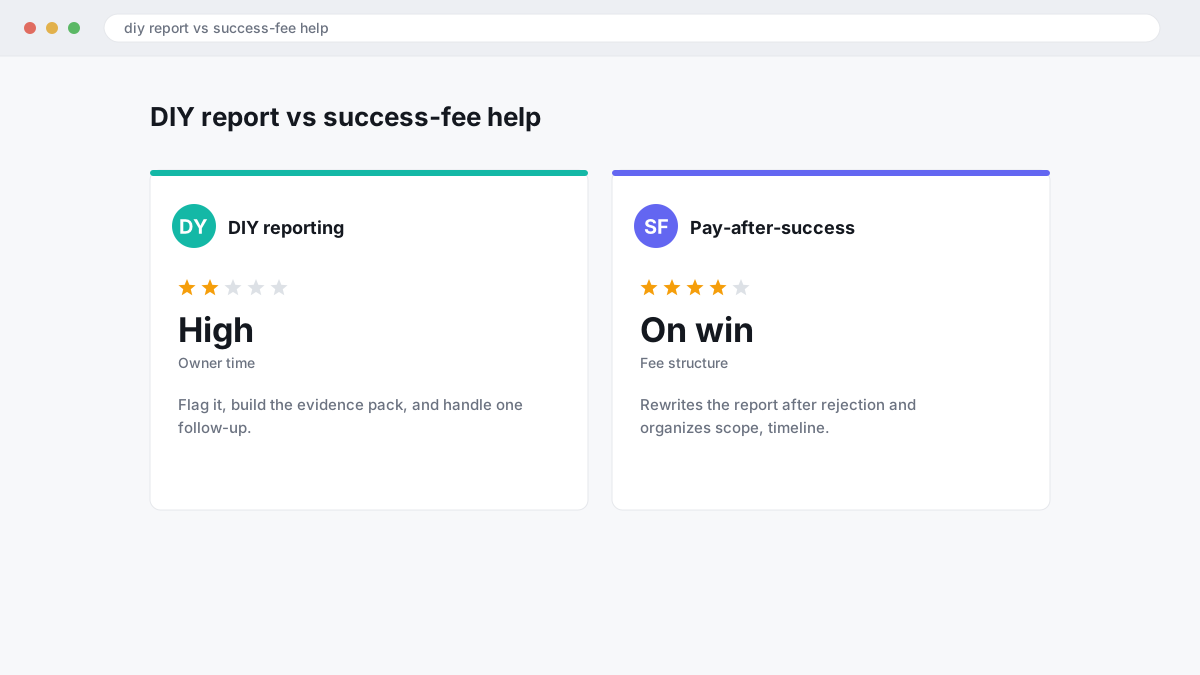
| Route | Fee structure | Scope and timeline | Refund terms |
|---|---|---|---|
| DIY reporting | No agency fee. Your cost is owner or manager time. | You handle the flag, evidence pack and one follow-up yourself. Timeline depends on Yelp's moderation cycle and can stretch if you keep resubmitting weak reports. | No refund issue because you paid no service fee. |
| Fixed price per removed link | Fixed price per removed link | We prepare the evidence file, frame the policy ground, and manage the escalation path rather than stopping at the first flag. This suits reviews already rejected once. | No removal means no fee. That aligns cost to outcome, unlike large monthly retainers billed whether Yelp acts or not. |
BGR Review sells removal help, so the trade-off is simple: use DIY first if the breach is obvious and your proof is clean; escalate when the review is damaging, evidence-heavy, or already stuck after one proper submission.
Where to go from here
Start with a policy check, then build your proof before you touch Yelp’s report button. The strongest files are specific: screenshots of the review, booking or CRM records, staff rota, CCTV timestamps, call logs, and any message trail that shows the reviewer was never there or that the post contains a clear policy issue. In our own case file of 12,000+ negative review disputes logged between June 2025 and June 2026, reviews raised within 28 days and backed by an identifiable policy issue resolved successfully far more often than older, weaker reports. That is our observed outcome profile, not a Yelp rule.
Your next move is simple: pull the review URL, match it to the exact Yelp guideline it appears to break, and save the evidence in one folder before you report it. If Yelp rejects or ignores a valid report, ask for a professional assessment rather than resubmitting the same vague claim.