

Quick answer
Replying to Google reviews can help your Google Business Profile perform better, but the gain usually shows up in trust, click-through rate and lead conversion rather than a direct jump in local pack rankings. Google’s local ranking guidance names relevance, distance and prominence; it does not list owner replies as a primary ranking factor. The parts you can control are review response rate, response speed and owner response tone. Measure the effect over a 30-day observation period using calls, website clicks and direction requests, not rankings alone.
We handle Google review acquisition and fake-review disputes every week, so this page approaches replying to google reviews seo the way an operator does: what changes on the profile, what stays noise, and what you can actually track. The practical split matters. A calm public reply can steady buyer trust, but a policy-breaching fake review often needs a flag, an evidence pack and patience while Google Business Profile support works through the case.
One detail generic SEO posts miss: the basic “Report review” button rarely tells the full story. Across 12,000+ negative review cases logged by BGR Review from June 2025 to June 2026, most rejected requests came from businesses that filed with little or no supporting documentation, which is why this guide separates reply decisions from removal decisions.
Will replying to Google reviews move Maps rankings or mainly improve conversion?
Replying to Google reviews can help your Google Business Profile, but the lift usually shows up in trust, click-through and enquiry quality before it shows up in local pack rankings. Review volume, review recency and star rating usually have a stronger relationship with Maps movement than review response rate on its own.
The wrong approach is treating replies as a ranking hack and expecting position gains after a few polite responses. That fails because Google can read owner activity, but a profile with thin review volume, stale feedback and a weaker average rating still gives weaker freshness and trust signals than a profile collecting new reviews every week. The better approach is to use replies to reduce hesitation once a searcher lands on your profile, then judge visibility over an 8-12 week observation period instead of a few days of rank watching.
If you want movement, fix the bigger levers first: ask for more legitimate reviews, keep review recency healthy, and keep your Google Business Profile details complete. In BGR Review's own dataset of 1,485 businesses observed from February to July 2026, new trades and local service businesses that reached 20-30 reviews within the first three months were associated with better local visibility, though other ranking factors were active at the same time. That is why a high review response rate can be useful without being the main driver.
You should read replies as an operations tool. A measured owner response tone can improve profile interaction, reassure people comparing two similar listings, and make a negative review look contained rather than ignored; if you need more genuine review volume rather than cleaner wording, BGR Review's review packages include a 30-day free replacement guarantee, but for a DIY owner the principle stays the same: more recent, real reviews usually move the needle faster than more replies.
Why do owners over-credit review replies when other profile signals are doing the heavy lifting?
Owners often start replying during a wider Google Business Profile clean-up, so the replies get blamed or praised for movement caused by fresher reviews, profile fixes or seasonal demand. Without an A/B observation period, correlation passes for causation.
The wrong read is simple: rankings rose after you replied, so replies caused the rise. That fails because reply activity usually arrives alongside stronger review recency, corrected categories, new photos, updated services, a promotion, or a busier month. In BGR Review's dataset of 1,485 businesses observed February-July 2026, local visibility improved as review volume and recency increased, but other ranking factors were active at the same time. Replies were part of the clean-up, not a clean isolated test.
The better read is to isolate one change. Hold your Google Business Profile steady for an 8-12 week A/B observation period, reply consistently, and avoid changing hours, categories, offers or review requests halfway through unless you log the date. That works because you can compare calls, clicks and direction requests against a cleaner baseline instead of crediting a busy season or a profile overhaul to owner responses.
Which local SEO signals usually beat review replies for actual pack movement?
For local pack rankings, your primary category, proximity, review volume, review recency and overall prominence usually outweigh owner replies. Treat replies on your Google Business Profile as a supporting signal; they can help trust, but they rarely drive Maps movement on their own.
The wrong focus is polishing a high review response rate while the profile basics stay weak. That fails because Google still frames eligibility around relevance, distance and prominence, so a half-complete Google Business Profile with loose categories, patchy services, old photos and thin review volume often stays stuck even if every review gets a polished answer. In BGR Review's dataset of 1,485 businesses observed from February to July 2026, trades and local service firms that reached 20-30 reviews in their first three months were associated with better local visibility, with other ranking factors active at the same time.
The right focus is to fix the profile inputs Google can read clearly first, then keep replying consistently. Accurate primary and secondary categories, complete business information, service areas, opening hours and a steady flow of recent reviews usually move visibility faster than improving reply activity from, say, occasional answers to full coverage. Once those basics are in place, replies help more on click-through and lead confidence than on rank position.
How should you reply to Google reviews when speed and consistency matter most?
A practical reply workflow is simple: triage by risk, answer negative reviews first, then clear recent positives in batches. For most locations, a 24-72 hour response speed target for new negative reviews gives you enough time to check the facts, keep the owner response tone calm, and still meet customer expectation.
The wrong workflow is oldest-first backlog clearing. It feels tidy, but it leaves fresh 1-star, 2-star and 3-star reviews sitting unanswered while you spend time on six-month-old praise. That fails because review recency shapes what new searchers see first on your Google Business Profile, and a stale unanswered complaint can cut trust before anyone clicks your site, calls, or asks for directions. If the review looks fake or breaches Google review policies, do not force a public back-and-forth; flag it and keep records. If you need outside help on removals, BGR Review handles Google review removal on a pay-after-success basis at $449 per removed link with $0 upfront.
The better workflow is risk-first, recency-aware triage. Reply to all new 1-star to 3-star reviews before you touch the positive backlog, then batch recent 4-star and 5-star reviews once or twice a week so your review response rate stays credible without turning every reply into admin. Use the same three-part structure every time: acknowledge the issue, address the point you can verify, then give a next step such as a phone call, email, or invitation to continue privately. That structure keeps the tone consistent across staff and stops rushed replies from sounding defensive, sarcastic, or copied from a template.
Do faster and more complete responses increase clicks, calls or direction requests?
Faster, fuller review replies can lift clicks, calls and direction requests because they increase confidence when a searcher is comparing local profiles. Those gains usually show up before any clear movement in Maps positions, especially on branded searches and other high-intent Google Business Profile views.
The wrong way to judge this is to watch rank trackers alone. That fails because local pack rankings move for bigger reasons than owner replies: review volume, review recency, rating, category fit and profile completeness usually do more of the heavy lifting, so you can reply diligently for three weeks and see no ranking jump at all. In BGR Review's own dataset of trades businesses with complete enquiry-source data, observed February to July 2026, 70-80% of calls and bookings were attributed to a Google Business Profile or Yelp listing rather than a website, which is why profile-level actions matter more than vanity positions for many local operators.
The better test is to measure whether your Google Business Profile gets a higher click-through rate into calls, website visits and direction requests after you tighten response speed and quality. Use GBP insights and your call tracking number to compare a clean pre/post period, then read the lead quality as well as the count: a short, accountable reply to a complaint often improves trust faster than it improves visibility. We use an 8-12 week observation window on operational changes because week-to-week swings are noisy; if actions rise while rankings stay flat, the replies are still doing useful work.
When is replying to reviews a lower priority than getting more reviews?
If your profile has thin review volume or a weak star rating, earning more legitimate reviews usually does more than polishing replies. Replies start paying off after you already have enough recent feedback to look credible in Google Business Profile.
The wrong priority is replying to every old review on a profile with 12 reviews and expecting local pack rankings to move. That fails because a high review response rate cannot hide weak review recency, limited review sentiment data, or a thin evidence base for searchers deciding whether to call. In BGR Review's dataset of 1,485 businesses observed February to July 2026, new trades and local service businesses that reached 20-30 reviews in the first three months were associated with improved local visibility, though other ranking factors were active at the same time.
A 4.2-star profile has a different problem. You need reputation repair first: generate more genuine positive reviews, improve service issues behind the negatives, and stop feeding fresh bad sentiment into the profile. Once volume is healthy and recent reviews are coming in steadily, owner replies help more because they make the listing look active, accountable and safer to click.
This is the practical split we use before anyone spends hours writing responses.
| Profile state | Better use of effort | Why |
|---|---|---|
| 12 reviews, mixed recency | Get more recent reviews first | More review volume and fresher sentiment usually change how the profile looks faster than backfilling old replies |
| 4.2 stars | Repair rating before polishing responses | Thoughtful replies do little if the score itself is warning people off |
| Healthy volume, steady inflow | Maintain consistent replies | At this stage, response rate can lift trust and profile attractiveness |
Can your replies hurt local SEO, trust or compliance if the tone is wrong?
Yes. A bad owner response can cut trust faster than it helps visibility, especially when it sounds hostile, exposes customer details or turns into a public argument. The reputational damage is usually bigger than any possible SEO gain.
The wrong approach is blame: “You never paid”, “You missed your appointment”, “You were removed from our clinic list”, or a sarcastic reply that attacks the reviewer’s credibility. That owner response tone tells every future searcher how you handle conflict. Your local pack rankings may stay flat, but click-through rate, calls and direction requests can still drop because the visible exchange makes your review sentiment look worse than the original complaint did.
The compliance risk is separate and more serious. Google review policies prohibit spam, harassment and conflicts of interest, and that standard applies to your public replies as well as the review itself. Do not reveal private booking notes, payment status, health information or any detail that identifies the customer journey. If the dispute touches medical treatment, legal advice, account balances or anything sensitive, keep the reply generic and move the resolution offline.
The better response is short, calm and specific enough to show accountability: acknowledge the issue, avoid debating facts in public, and give one offline path such as phone or email. If the review sentiment suggests a real service failure, reply once and fix it privately. If it looks fake or policy-breaking, do not argue at length; document the issue, flag it under Google’s review policy route, and keep the public reply neutral while that process runs.
Which reply templates work for positive, mixed and negative Google reviews without sounding scripted?
Good Google review replies are short, specific and human. The safest structure is simple: thank the reviewer, mention the service they actually used, and add one next step only if the issue needs follow-up.
Most guides push copy-paste thanks. That fails because the owner response tone sounds automated, adds no useful review keywords, and ignores the actual review sentiment the next reader is scanning for on your Google Business Profile. A better reply names the job or visit type, stays brand-safe, and avoids stuffing town names or sales language.
Use these as patterns, then rewrite them in your own voice.
| Review type | Weak reply | Better reply |
|---|---|---|
| Positive | “Thanks for your feedback.” | “Thanks for choosing us for your boiler service, Sarah. Glad the same-day visit helped.” |
| Mixed | “Sorry you feel that way.” | “Thanks for flagging the wait time. We’ve checked your booking and our manager will review the handover process today.” |
| Negative | Long defence in public | “We’re sorry this happened. Please email team@bgrreview.com with the booking name so we can check the record and resolve it offline.” |
Keep negative replies to 1-2 sentences. If a review looks false or policy-breaching, don’t argue in public; post the short holding reply, then decide whether it needs a standard flag or a pay-after-success removal route at $449 per removed link with $0 upfront.
What should you measure for 8 to 12 weeks after you start replying consistently?
Treat review replies as an operating change, not a hunch. For an 8-12 week A/B observation period, compare your pre-change baseline with the post-change period on local pack rankings, click-through rate, calls and direction requests, response speed, response rate and review sentiment, and keep other Google Business Profile edits to a minimum.
A one-week rank check fails because Maps moves for other reasons: new reviews land, competitors change categories, photos get updated, and review recency shifts. A controlled observation period works better because you can see whether replies changed visibility, or whether they changed what happened after the impression: more clicks, more calls, or more direction requests. In BGR Review's dataset of trades businesses with complete enquiry-source data, observed February-July 2026 within a wider 1,485-business dataset, 70-80% of calls and bookings were attributed to a Google Business Profile or Yelp listing, which is why owner actions on the profile deserve measurement beyond rankings alone.
Use one sheet and update it weekly. Record baseline rankings for your main non-branded terms and branded searches separately where possible, then log Google Business Profile performance metrics and your review handling metrics side by side.
| Metric | How to record it weekly | Why it matters |
|---|---|---|
| Rankings | Track 3-5 priority non-branded searches plus your business name | Separates discovery movement from branded demand |
| Clicks and click-through rate | Log profile views against website clicks | Shows whether replies improve trust at the decision stage |
| Calls and direction requests | Pull from your profile insights on the same weekday each week | Captures conversion, not just visibility |
| Response speed, response rate, sentiment | Note median days to reply, % replied, and positive/mixed/negative review sentiment | Confirms you actually changed the operating behaviour |
What should you do when fake reviews keep appearing and replies are not enough?
If fake reviews keep appearing, treat it as a removal workflow inside your Google Business Profile, not a reply habit. Post one short owner response only if silence would mislead real customers, then preserve evidence, flag the review under Google review policies, and escalate if the pattern looks coordinated or competitor-led.
Repeatedly arguing under fake reviews is the wrong move. It keeps the false claim visible, invites more back-and-forth, and can push you into saying too much about a person you cannot even verify as a customer. A better public line is brief: “We cannot match this account to any booking or transaction. Please contact us directly so we can verify and investigate.” Then stop.
Your private file matters more than your public reply. Save screenshots, the review URL, posting date, reviewer name, any no-customer-record check from your CRM or till system, and conflict clues such as a rival brand name, copied wording across locations, or a profile that only reviews competitors. Google Business Profile flags land better when you point to a policy issue such as spam, off-topic content, impersonation, or conflict of interest under Google’s prohibited and restricted content rules.
Across 12,000+ negative review cases logged by BGR Review between June 2025 and June 2026, roughly 90% of businesses that came to us after a failed attempt had used only the basic in-platform report button, with no supporting documentation, and 70–80% of those initial requests had been rejected. If the same fake reviews keep returning, standard profile management has run out.
What does a practical reply priority system look like for one busy location or a multi-location brand?
The efficient system is not “reply to every review at once”. It is a triage ladder: urgent negative reviews first, mixed reviews next, then positive reviews in scheduled batches so response speed stays high and owner response tone stays consistent across one site or fifty.
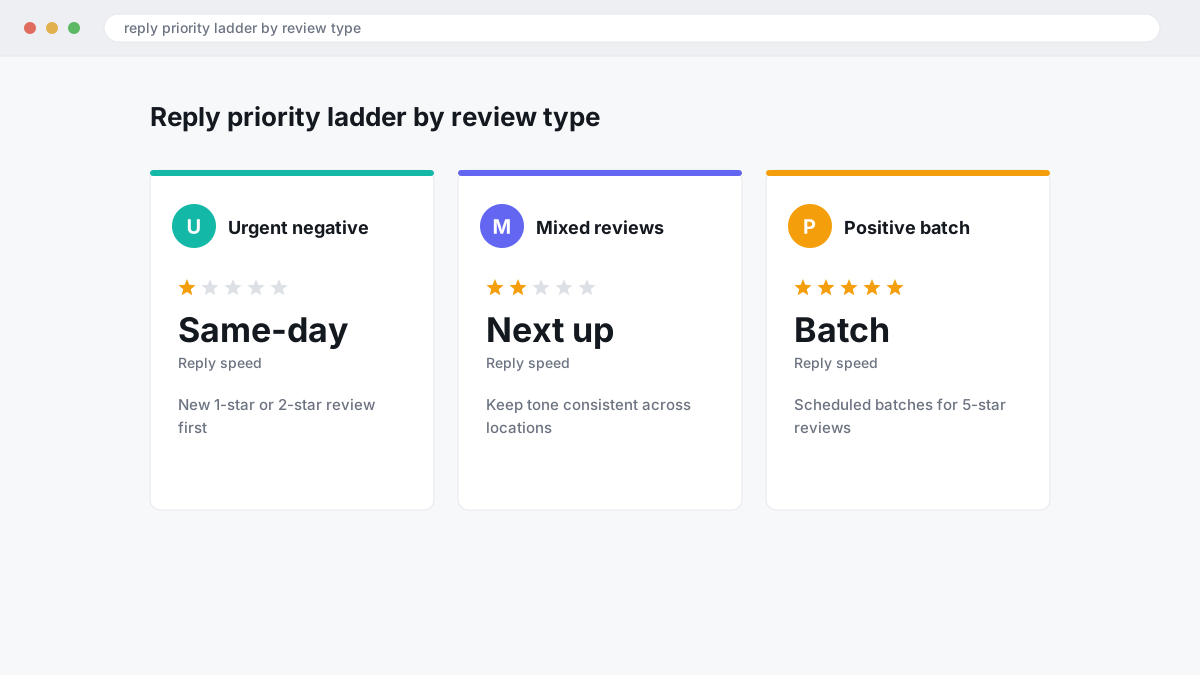
Equal effort on every review fails because it gives your best time to the lowest-risk feedback. A same-day reply on a new 1-star or 2-star review can steady trust while the complaint still looks current on your Google Business Profile, but burning that same effort on every 5-star review drags your review response rate down where it matters most. Multi-location teams usually break here: one branch replies warmly, another sounds defensive, and the profile ends up looking unmanaged.
This ladder keeps the work practical.
| Priority tier | What to reply to | Target timing |
|---|---|---|
| Tier 1 | New 1-star and 2-star reviews, especially service complaints or accusations | Same day when possible |
| Tier 2 | Recent 3-star reviews with mixed sentiment or unanswered questions | Within 72 hours |
| Tier 3 | 4-star and 5-star reviews | Batch weekly by location |
It works because you match effort to business risk and conversion impact. Tier 1 needs a calm, specific reply from the owner or manager, with no argument and no copied template; Tier 2 needs clarification and a fix; Tier 3 needs short, human acknowledgements batched every week so one location does not run at a 90% response rate while another sits silent. If a Tier 1 review looks fake or breaches Google review policies, move it out of the reply queue and into the flagging workflow instead of debating it in public.
Where to go from here
Reply to Google reviews because they help the profile convert, not because a canned owner response will suddenly move your local pack rankings. A fast, human reply improves trust, gives searchers context, and can lift click-through rate, calls and direction requests in ways you can actually track inside Google Business Profile over a simple A/B observation period. If the review is genuine, answer it. If it contains a false factual claim, impersonation, conflict of interest or other policy issue, switch from replying to the proper dispute route under Google review policies.
Your next step is simple: tag your last 30 reviews by sentiment, mark which ones need a public reply, which ones need both a reply and evidence gathering, and which ones should be flagged instead of argued with in public. Then track response speed, response rate, calls and direction requests for the next 4-6 weeks. That gives you something useful to judge.