
Section 1
Why this research exists
Most published guidance about online reviews is written by people who have never had to file a removal request, wait out a platform decision, or explain to a business owner why a review that clearly breaks policy is still sitting on their profile. The advice repeats itself, the numbers are recycled between blogs, and almost none of it is grounded in records of what actually happened to real businesses.
BGR Review works on this problem every day. Since 2019 we have supported more than 15,000 businesses across review growth, review response, and negative review removal on Google, Trustpilot, Yelp, Clutch and Tripadvisor. That work leaves a paper trail: dated cases, platform responses, profile snapshots and outcome notes. This page reports what that trail shows.
The purpose here is documentation, not persuasion. Everything below describes what BGR Review observed inside its own dataset during a defined period. It is first-party operational data from one provider, and we treat it that way throughout — as evidence about our customers, not as a rule about how review platforms behave for everybody.
- Research type
- First-party operational observation
- Primary observation period
- February 2026 – July 2026
- Negative review case window
- June 2025 – June 2026
- Businesses observed
- 1,485
- Negative review cases handled
- 12,000+
- Publisher
- BGR Review
This research reports patterns BGR Review observed in its own operational records. It does not describe how review platforms behave universally, and it should not be read as a prediction of outcomes for any individual business.
Section 2
Who conducted this research
BGR Review is an online reputation management practice founded in 2019, with teams in New York, London and Thornhill. We work on three things: helping businesses earn and manage review volume, responding to review activity, and pursuing removal of reviews that appear to breach platform policy. Removal work is run on a pay-after-success basis, so our records contain a clean outcome marker for every case we take.
That operating model is the reason this dataset exists. Because we are only paid on a removal that actually completes, every case in our system carries a dated decision — the review came down, the platform declined, or the outcome could not be confirmed. Six years of that discipline produced the case history summarised on this page.
Author

Robiul has worked in SEO, Google Business Profile optimisation and reputation strategy since 2013 and founded BGR Review in 2019. He chairs the weekly escalation review where high-risk removal cases are examined before any request is filed, and he owns the internal policy rulebook the specialist team works from. He compiled and reviewed the observations published on this page.
Contact: team@bgrreview.com · More about the team
Section 3
Dataset and observation period
The primary dataset covers 1,485 businesses that BGR Review actively worked with or monitored between February 2026 and July 2026. A separate and larger case file — more than 12,000 negative review cases handled between June 2025 and June 2026 — supports the removal observations in sections 9 through 13.
| Parameter | Detail |
|---|---|
| Primary observation period | February 2026 – July 2026 (6 months) |
| Businesses observed | 1,485 |
| Negative review cases | 12,000+ (June 2025 – June 2026) |
| Total businesses served since 2019 | 15,000+ |
| Platforms covered | Google Business Profile, Trustpilot, Yelp, Clutch, Tripadvisor |
| Regions represented | United States, United Kingdom, Canada and other markets |
| Collection method | BGR Review internal operational records |
Business categories represented
- New trades and local service businesses — plumbers, electricians, HVAC, cleaning, mobile services
- Website, digital marketing and creative agencies
- Established professional practices — dentists, lawyers, accountants, roofers
- Hospitality, retail and automotive service businesses
- SaaS, fintech and other online-first companies
Variables recorded
- Time from launch or onboarding to first review received
- Review volume growth over the observation window
- Platform mix and where new reviews appeared
- Reported source of enquiries, calls and bookings
- Negative review case type, review age and evidence available
- Case outcome and platform response
- Local SEO or marketing spend band, where disclosed
- Program duration and reason for ending, where disclosed
Not every variable was available for every business. Some accounts shared complete call tracking and enquiry attribution; others shared none. Where a figure below refers to a subset — for example, only the businesses with usable enquiry-source data — that subset is named in the sentence itself. Percentages are calculated against the businesses that supplied the relevant data, not against all 1,485.
Section 4
How BGR analysed the data
Records were grouped by business category and then compared across a fixed set of dimensions so that a plumber launching in March could be read against a plumber launching in May, and an agency against another agency. Where categories behaved differently, we report the difference rather than averaging it away.
Dimensions compared
- Time to first review after launch or onboarding
- Review accumulation rate over the six-month window
- Sentiment split of early reviews
- Platform distribution of review activity
- Reported enquiry and booking sources
- Dependence on a standalone website versus a profile listing
- Negative review frequency and case type
- Age of the review at the point a case was opened
- Evidence available when the case was filed
- Marketing spend band and program duration, where disclosed
- ✓What BGR Review observed across 1,485 customer businesses in a defined six-month window
- ✓How outcomes differed between business categories inside that dataset
- ✓How the age and evidence quality of a review related to case outcomes in our records
- ✓Which patterns recurred often enough to be worth a business owner's attention
- —How review platforms behave for businesses outside our customer base
- —Causation — an association observed here is not proof that one thing caused another
- —A guaranteed outcome for any individual review, profile or case
- —Anything about platform decision-making beyond the responses we received
Throughout the sections that follow, ranges are reported as ranges. Where our records show a spread — first reviews appearing somewhere between week four and week eight, for instance — we publish the spread rather than a single tidy average, because the spread is the finding.
Section 5
New trades and local service businesses
Trades businesses were the fastest-moving category in the dataset. Plumbers, electricians, HVAC engineers, cleaners and mobile service operators who launched a Google Business Profile during the observation window generally received a first review around two weeks in — often from a customer who had already been served before the profile existed.
Early sentiment skewed heavily positive. In BGR Review's records, roughly 90% of the first reviews these businesses received were positive, which is consistent with owners asking their most satisfied early customers first. That early skew tends to soften as volume grows and the review base widens beyond people the owner personally served.
Businesses that reached 20–30 reviews across their first three months were the ones we most often saw becoming visible in local search results for their service area. We report that as an association. Profile completeness, service-area accuracy, category selection, photo activity, response behaviour and ordinary local competition were all moving at the same time, and our records cannot isolate review count from the rest.
- First review typically observed around week two after launch
- Approximately 90% of early reviews were positive
- 20–30 reviews across three months was the common threshold before visibility improved
- Established trades businesses in the dataset were adding 15–30 reviews per month
- Profile completeness and category accuracy moved alongside review growth
- Local competition density varied widely between service areas
Review count was one visible variable among several. A business that reached 30 reviews in three months was usually also the business responding to enquiries quickly, keeping its hours accurate and adding job photos. We can report that these things travelled together in our dataset. We cannot report which one did the work.
Across new trades and local service businesses in the dataset, first reviews typically appeared around two weeks after launch, and roughly 90% of those early reviews were positive. Reaching 20–30 reviews over the first three months was associated with improved local visibility, though other ranking factors were active at the same time.
- Dataset
- New trades and local service businesses (n subset of 1,485)
- Period
- February 2026 – July 2026
- Source
- BGR Review internal operational dataset
If you want to model what a specific review volume does to your visible star rating, our Google reviews calculator runs the arithmetic against your current profile.
Section 6
How trades customers were actually acquired
Not every business in the dataset had usable attribution. Among trades businesses that did share complete enquiry-source data — call tracking, booking form records or a consistent intake log — 70–80% of calls and bookings were attributed to a Google Business Profile or a Yelp listing rather than to a website visit.
The remainder came predominantly from referrals and returning customers. Word of mouth was still doing real work in this category, and in several accounts the referral share grew as the review base grew, which is what you would expect when a recommended name is then verified by a stranger reading the profile.
Around 60% of the trades businesses we observed were operating without relying on a standalone website at all. Their profile was the storefront. That has a direct consequence: for those businesses, a damaged profile is not a marketing inconvenience, it is the entire acquisition channel.
| Source | Observed share | Note |
|---|---|---|
| Google Business Profile or Yelp listing | 70–80% | Calls and bookings attributed directly to a profile listing |
| Referral and returning customers | Most of the remainder | Share tended to grow alongside review volume |
| Standalone website | Minor | Around 60% of this group had no meaningful website dependency |
Among trades businesses that shared complete enquiry-source data, 70–80% of calls and bookings were attributed to a Google Business Profile or Yelp listing. Around 60% of trades businesses in the dataset were operating without relying on a standalone website.
- Dataset
- Trades businesses with complete enquiry-source data
- Period
- February 2026 – July 2026
- Source
- BGR Review internal operational dataset
Section 7
Agencies and digital service firms
Website builders, digital marketing agencies and creative studios behaved differently from trades in almost every dimension. First reviews generally arrived between weeks four and eight rather than week two, which tracks with longer project cycles — a client who signs in January may not have anything to review until March.
About half of the agencies in the dataset reached 20–30 reviews within the six-month window. Critically, that volume was spread across Google, Clutch, Yelp and Trustpilot rather than concentrated on a single profile, so no individual listing looked as strong as a trades profile with the same total count.
Established firms in this category carried far deeper histories — commonly 200 to 500 lifetime reviews accumulated across platforms over many years. Enquiry attribution also inverted: roughly 70% of enquiries were attributed to the firm’s own website and around 30% to review platform listings, the reverse of the trades pattern.
| Dimension | Trades and local services | Agencies and digital firms |
|---|---|---|
| First review | Around week 2 | Weeks 4–8 |
| 20–30 reviews within 6 months | Common | Around half of the group |
| Platform concentration | Mostly one profile | Spread across 3–4 platforms |
| Lifetime volume, established firms | 15–30 new reviews per month | 200–500 total |
| Primary enquiry source | Profile listing (70–80%) | Own website (~70%) |
SEO and reputation programs in this category typically ran three to six months, with a meaningful minority continuing past a year. Section 15 covers program duration and the reasons engagements ended in more detail.
Website, digital marketing and creative agencies in the dataset generally received their first review between weeks four and eight. About half reached 20–30 reviews within six months, spread across Google, Clutch, Yelp and Trustpilot rather than concentrated on one profile.
- Dataset
- Website, digital marketing and creative agencies
- Period
- February 2026 – July 2026
- Source
- BGR Review internal operational dataset
Section 8
Dentists, lawyers, accountants and roofers
Established professional practices sat between the two patterns above. First reviews appeared between weeks two and four, but the volume needed before a profile performed consistently was higher: businesses in this group generally accumulated 30–50 reviews before their listings behaved reliably in competitive local searches.
Unlike trades, this group depended on both channels. The Google Business Profile carried discovery, and the practice website carried conversion — prospective patients and clients read the profile, then checked the site before booking. Removing either one visibly hurt enquiry flow in the accounts we monitored.
Tooling observed in this category
- Google Local Services Ads, used by around 40% of this group
- SMS review request flows tied to appointment completion
- Email follow-up sequences after service delivery
- Third-party reputation monitoring and alerting platforms
- Manual response workflows handled by front-desk or practice staff
Practices running structured request flows accumulated reviews more steadily than those asking ad hoc. That is unsurprising, but it showed up clearly enough in the dataset to be worth stating: consistency of the ask mattered more than the channel used to make it.
Dentists, lawyers, accountants and roofers in the dataset saw first reviews between weeks two and four, and typically accumulated 30–50 reviews before their profiles performed consistently. Around 40% of this group were using Google Local Services Ads alongside organic profile activity.
- Dataset
- Established professional practices
- Period
- February 2026 – July 2026
- Source
- BGR Review internal operational dataset
Section 9
The negative review management dataset
Between June 2025 and June 2026, BGR Review handled more than 12,000 negative review cases. This is a separate and larger dataset from the 1,485-business observation set, and it is the basis for everything in sections 10 through 13.
What each case record contained
- The platform the review appeared on
- The age of the review when the case was opened
- The category of policy concern identified, if any
- The evidence available to support the case
- Whether the business had previously filed its own report
- The platform response received
- The final recorded outcome
Outcome terminology
Outcome language matters more than most published removal statistics acknowledge, so we define ours explicitly. Every case in the file resolves into one of three states, and the third state is never quietly folded into the second.
- Removal success
- The review was no longer visible on the public profile and the change was confirmed in a dated check by our team.
- Unresolved
- The platform declined, or the review remained visible at the point the case was closed. Recorded as a negative outcome.
- Unknown
- The final state could not be confirmed — access lapsed, the profile changed hands, or the case closed without a verifiable check. Never counted as either a success or a failure.
Cases logged as unknown are excluded from outcome rates rather than absorbed into them. Counting an unconfirmed case as a failure would understate results; counting it as a success would be dishonest. We exclude it and say so.
Across 12,000+ negative review cases, outcomes were recorded as removal success, unresolved, or unknown. Cases where the final state could not be confirmed were logged as unknown and were never counted as failures, which keeps the outcome profile honest about what our records can and cannot show.
- Dataset
- 12,000+ negative review cases
- Period
- June 2025 – June 2026
- Source
- BGR Review internal operational dataset
Section 10
Review age and observed outcomes
The single strongest pattern in the entire case file is age. Cases opened while a review was recent resolved successfully far more often than cases opened months later, even when the underlying policy concern looked comparable.
Where a review was raised within 28 days of posting and an identifiable policy issue was present, BGR Review recorded a successful outcome in approximately 90% of cases. For comparable cases raised beyond that window, the observed success rate fell to roughly 25–30%.
| Review age at case opening | Observed success rate | Typical evidence | Platforms |
|---|---|---|---|
| Under 28 days | ≈90% | Identifiable policy issue with supporting documentation | Google, Trustpilot, Yelp |
| Beyond 28 days | ≈25–30% | Comparable policy issue, older trail, weaker corroboration | Google, Trustpilot, Yelp |
| Star-only rating, any age | Materially lower | Little or no reviewable content to assess | Google, Yelp |
No review platform publishes a 28-day threshold, and none of them has told us one exists. The 28-day boundary is a pattern in BGR Review’s own records, most likely reflecting how much corroborating material is still available when a case is filed early. Treat it as a reason to act quickly, not as a guarantee attached to a date.
Our removal service works on the same timing logic and is priced pay-after-success — $0 upfront, $449 per review link that comes down. The mechanics are set out on the Google review removal page.
In BGR Review's case file, reviews raised within 28 days of posting and supported by an identifiable policy issue resolved successfully in roughly 90% of cases. For comparable cases raised beyond 28 days, the observed success rate fell to approximately 25–30%. This is BGR Review's observed outcome profile, not a published platform rule.
- Dataset
- 12,000+ negative review cases
- Period
- June 2025 – June 2026
- Source
- BGR Review internal operational dataset
Section 11
What was difficult to resolve
Star-only ratings — a one or two star score with no written text — were consistently the hardest cases in the file. There is very little for a platform reviewer to assess: no claim to test, no language to examine, no detail to contradict. Cases of this type resolved at a materially lower rate than cases involving written content, at every age band.
That is not the same as saying such reviews can never come down. Some did, usually where the reviewer’s account behaviour rather than the review itself carried the signal. The honest summary is that a rating without text removes most of the evidentiary surface a case would normally be built on.
Factors that appeared to shape outcomes
- Whether the reviewer's account showed signals consistent with a genuine customer
- Patterns in the reviewing account's wider activity
- Whether the review text contained an assessable, testable claim
- Which specific policy the concern mapped to
- The strength and dating of the supporting evidence supplied
- The platform's own detection and enforcement systems, which we do not have visibility into
Enforcement decisions belong to the platforms. BGR Review can document a concern thoroughly and file it correctly; what happens next is a platform judgement we observe rather than control.
Section 12
How businesses reported reviews before contacting us
A large majority of the businesses that reached BGR Review after a failed attempt had done the same thing: clicked the in-platform report button, chosen the nearest category from a short dropdown, and submitted nothing else. In our records that accounted for roughly 90% of prior attempts, against about 10% that had followed a documented, evidence-backed process.
Within that basic-report group, 70–80% of initial requests had been rejected. Cases that arrived with dated records, transaction history, correspondence or other corroborating material had visibly better outcomes when refiled.
| Approach taken by the business | Share of prior attempts | Observed result |
|---|---|---|
| Basic in-platform report only | ≈90% | 70–80% of initial requests rejected |
| Documented process with supporting evidence | ≈10% | Better outcomes than the basic-report group |
When a platform declines a report, that decision means the material submitted did not establish a policy breach to the reviewer’s satisfaction. It is not a finding that the review is genuine, and it is not a finding that the business was wrong. Several cases in our file were declined on a first pass and resolved later once the concern was documented against a specific policy.
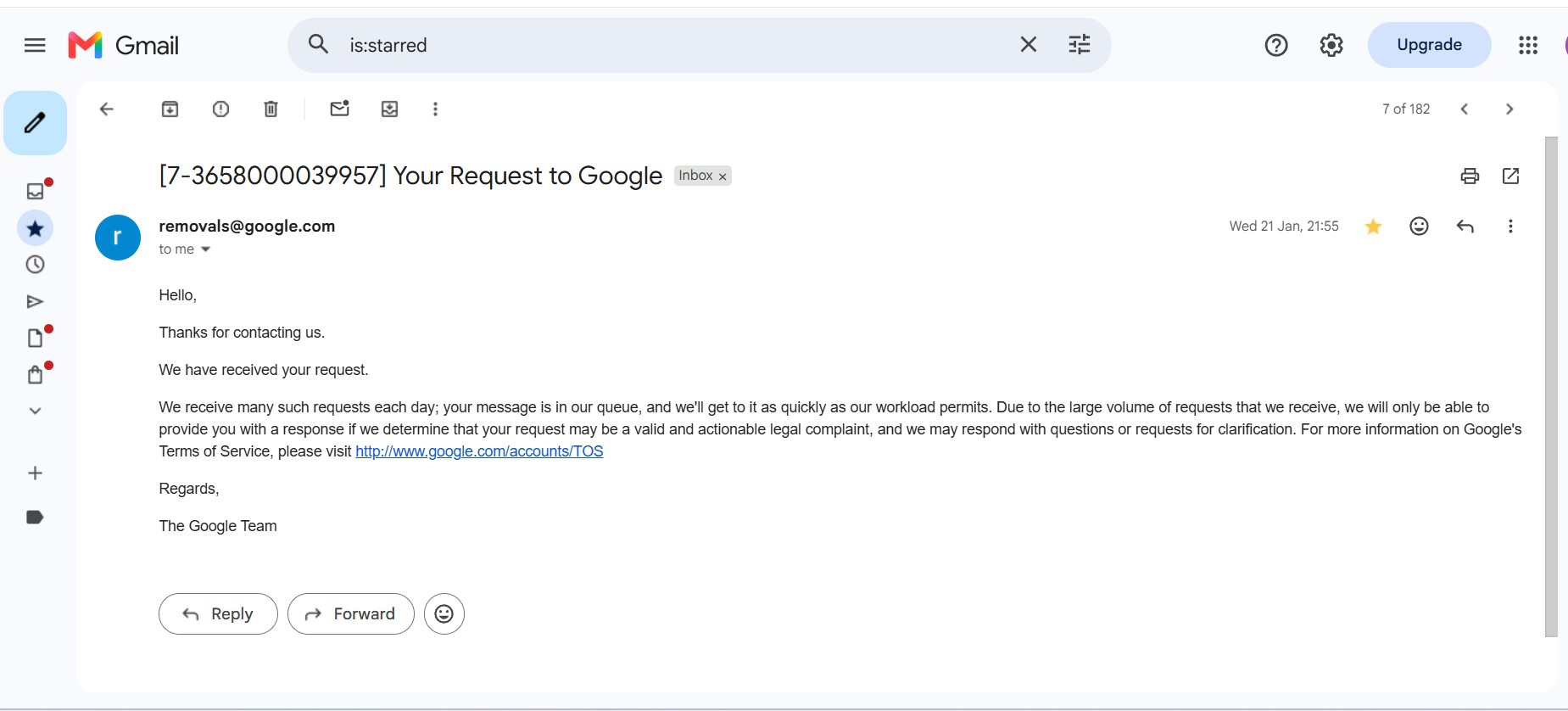
This is the reply most businesses receive after submitting a request through Google's public form: the request is queued, and Google states it will only respond where it determines the request may be a valid and actionable legal complaint. It confirms receipt. It is not an outcome.
- No case assessment is communicated at this stage — only that the request is in a queue
- Google states explicitly that a response follows only for requests it treats as valid and actionable
- In our file, this acknowledgement was the last contact many self-filed businesses ever received
- It is the practical reason a documented, policy-mapped submission behaves differently from a dropdown report
Exhibit A. Screenshot supplied from BGR Review's own correspondence, reproduced unedited apart from the ticket reference remaining visible. Reference [7-3658000039957], received 21 January.
Roughly 90% of businesses that approached BGR Review after a failed attempt had used only the basic in-platform report button, with no supporting documentation. In that group, 70–80% of initial requests had been rejected. A rejection was not treated as proof that a review was legitimate.
- Dataset
- Negative review cases with prior self-filed attempts
- Period
- June 2025 – June 2026
- Source
- BGR Review internal operational dataset
Section 13
Platform policy and the role of evidence
Every case BGR Review files is built against a platform’s own published rules, using that platform’s official channels. Nothing in this research describes a workaround, and nothing here should be read as one.
| Platform | Framework relied on | Channel used |
|---|---|---|
| Google review and prohibited content policies | Official Google reporting and escalation channels | |
| Yelp | Yelp content guidelines | Official Yelp reporting channels |
| Trustpilot | Trustpilot guidelines for reviewers and businesses | Official Trustpilot flagging and compliance channels |
| All platforms | Published intellectual property procedures | Each platform's official IP process |
A subset of cases involved images published inside reviews. Where a business held genuine rights in an image that had been reused without permission, the concern was raised through the relevant platform’s official intellectual property procedure, with real documentation of ownership. Those procedures exist for rights holders, and they are only appropriate where a real rights claim exists.
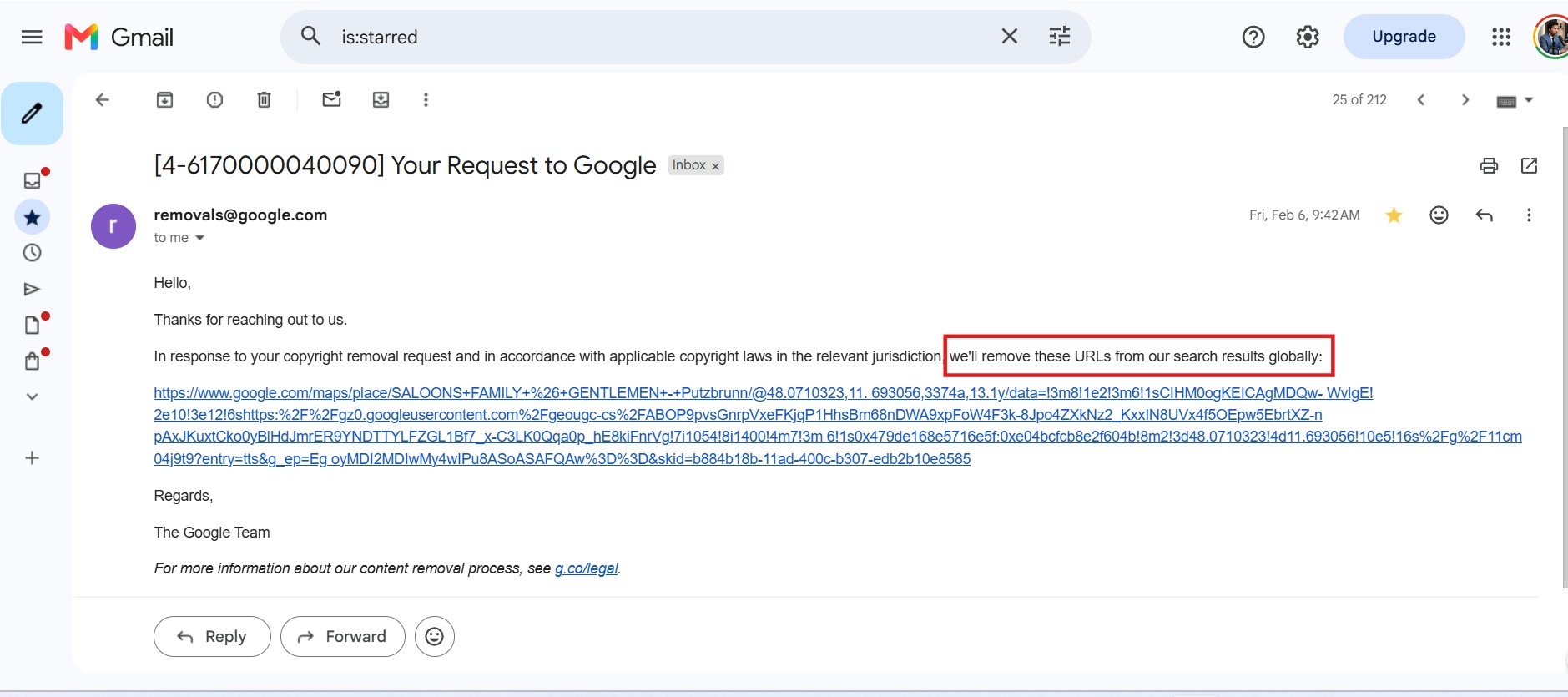
A confirmed outcome on an intellectual property case. Google states that, in response to the removal request and in accordance with applicable copyright law in the relevant jurisdiction, the listed URLs will be removed from its search results globally. This is what a resolved case looks like in writing.
- The route used here is Google's published intellectual property procedure, not a general complaint
- It applied because the business held genuine rights in material that had been reused without permission
- Confirmation names the specific URLs affected, which is how outcomes in the case file were verified
- This procedure is only appropriate where a real rights claim exists, and we decline cases where it does not
Exhibit B. Screenshot from BGR Review's own correspondence, reproduced unedited. Reference [4-6170000040090], received 6 February. One confirmed case; not representative of every outcome.
We do not publish techniques for evading platform detection, gaming filters, or removing reviews that do not breach policy. Requests of that kind are declined at intake. This page documents observed outcomes from policy-based casework and nothing else.
Section 14
Observations on artificial review activity
Google, Yelp, Trustpilot, Clutch and Tripadvisor all prohibit fake, incentivised and manipulated reviews in their published policies. Businesses in our dataset encountered this from both directions: some were targeted by review activity they believed to be fabricated, and some had previously bought volume elsewhere and came to us dealing with the aftermath.
The pattern worth reporting is about pace. Profiles that gained a sudden concentrated burst of reviews were more likely, in our records, to encounter platform scrutiny than profiles that grew gradually from ordinary customer activity. That observation is published as a caution.
We are not describing how to make artificial reviews survive, and we will not. The practical takeaway for a business owner is the opposite: growth that mirrors real trading activity attracts less scrutiny because it reflects real trading activity. If your review pattern would look strange to a human reading your profile, it will look strange to a platform system too.
Section 15
Local SEO spend and program duration
Where businesses disclosed what they were paying for local SEO or marketing support, the most common band was $199 to $499 per month, typically with a freelancer or a small agency. This is a description of the businesses BGR Review worked with, not a pricing survey of the market.
Typical program duration was three to six months. A meaningful minority ran past a year, usually where reporting was clear enough that the business could see what it was buying.
Reasons programs ended
- Results did not appear within the timeframe the business expected
- Budget was reallocated or reduced
- Expectations were never aligned at the start of the engagement
- The business changed direction, ownership or service area
- Seasonal trading made the spend hard to justify in quieter months
- Communication from the provider dropped off
- No tracking was in place, so the effect could not be evaluated at all
The last item recurred often enough to be worth calling out. Several businesses could not say whether a program had worked because nothing had been measured — no call tracking, no enquiry attribution, no baseline. Those engagements tended to end on sentiment rather than evidence.
Section 16
Case study: Waltham Abbey Tyre
Waltham Abbey Tyre — automotive tyre and service centre, London / Hertfordshire, UK
Audit window: May 2026 – August 2026. BGR Review ran local SEO, citation research, keyword research, Google Business Profile optimisation and ongoing reputation management for the account across the period.
| Metric | Month 1 baseline | End of audit window |
|---|---|---|
| Reviews received in month | 10 | Part of 86 total across four months |
| Calls from profile | 15 | 131 |
| Direction requests | Not separately tracked at baseline | 169 |
| Dominant discovery surface | Mixed | Google Maps, around 90% of activity |
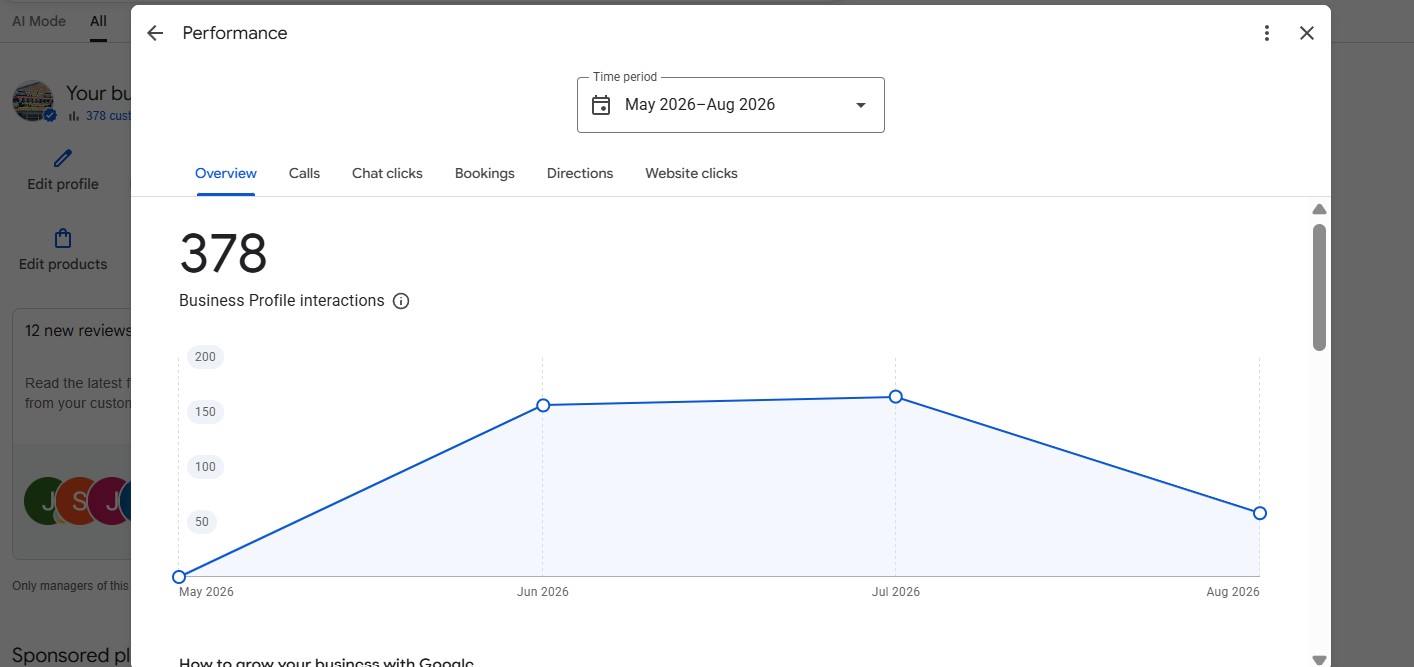
The customer's own Google Business Profile performance panel for the audit window. It records 378 Business Profile interactions across May to August 2026, rising sharply from the May baseline before easing back in August.
- 378 total profile interactions across the four-month window
- The steepest rise falls between May and June, alongside profile and citation work in months 1 and 2
- August eases from the July peak, which is consistent with ordinary seasonal trading rather than a reversal
- Interaction counts here sit alongside the 131 calls and 169 direction requests recorded in the same account
Exhibit C. Google Business Profile insights supplied by the customer and published with permission. One account, one trade, one local market — not a projection for other businesses.
What the four months looked like
- Month 1 — profile audit, category and service correction, baseline of 10 reviews and 15 calls
- Month 2 — citation research and cleanup, keyword research applied to services and descriptions
- Month 3 — structured review request flow running alongside ongoing profile optimisation
- Month 4 — 86 five-star reviews accumulated, 131 calls and 169 direction requests recorded
This is one account, in one trade, in one local market, over four months. The figures are what the customer’s own profile insights recorded, and they are published with the customer’s permission. They describe what was observed alongside the work performed — they are not a projection of what another business would achieve, and they are not offered as proof of causation.
Section 17
What we learned
Ten observations recur often enough across the dataset to be worth stating plainly. Each one describes BGR Review’s records during the stated period, not a universal rule.
- Business category shaped review timing more than anything else we measured
- Trades businesses accumulated reviews fastest and depended on profile listings most heavily
- Agencies accumulated more slowly and spread activity across several platforms at once
- Established practices needed higher volume before their profiles performed consistently
- Early reviews skewed positive across every category, then normalised as volume grew
- Case age was the strongest single correlate of removal outcomes in the file
- Evidence quality separated successful cases from rejected ones more than case type did
- Star-only ratings left the least evidentiary material to work with
- Sudden review bursts drew more scrutiny than gradual, trading-consistent growth
- Businesses without tracking could not evaluate their own marketing spend at all
Section 18
Limitations of this research
- This is first-party operational data from a single provider. It describes BGR Review’s customers, not the wider market.
- The sample is self-selected. Businesses in the dataset chose to work with a reputation specialist, which is not typical of businesses generally.
- The primary observation window is six months. Longer-term effects are outside its scope.
- Not every variable was available for every business, so several figures describe a subset rather than all 1,485 accounts.
- Attribution data came from the businesses themselves and varies in quality and method.
- Associations reported here are not causal claims. Multiple variables moved at once in nearly every account.
- Platform decision-making is not visible to us. We observe responses, not the reasoning behind them.
- Platform policies and enforcement systems change, and observations from this window may not hold later.
- Cases with unconfirmed outcomes are excluded from outcome rates, which means the rates describe confirmed cases only.
- Nothing on this page is legal advice, and none of it should be treated as a predicted outcome for a specific review, profile or business.
Section 19
How to cite this research
Journalists, researchers and other publishers are welcome to cite this page. Please reference the observation period alongside any figure, so readers can see what the number describes.
Full citation
BGR Review (2026). BGR Review Research Methodology: Six Months of First-Party Local Reputation Data. Observation period February 2026 – July 2026. Retrieved from https://bgrreview.com/methodology
Short citation
BGR Review (2026), First-Party Local Reputation Data. https://bgrreview.com/methodology
Recommended attribution sentence
According to BGR Review's first-party research across 1,485 businesses observed between February 2026 and July 2026, reviews raised within 28 days of posting resolved successfully in approximately 90% of cases in their internal case file.
For data questions, corrections or interview requests, email team@bgrreview.com or use the contact page.
Section 20
Citable findings index
Each finding below carries a permanent identifier and anchor so it can be referenced directly. Anchors will not change.
Across new trades and local service businesses in the dataset, first reviews typically appeared around two weeks after launch, and roughly 90% of those early reviews were positive. Reaching 20–30 reviews over the first three months was associated with improved local visibility, though other ranking factors were active at the same time.
- Dataset
- New trades and local service businesses (n subset of 1,485)
- Period
- February 2026 – July 2026
- Source
- BGR Review internal operational dataset
Website, digital marketing and creative agencies in the dataset generally received their first review between weeks four and eight. About half reached 20–30 reviews within six months, spread across Google, Clutch, Yelp and Trustpilot rather than concentrated on one profile.
- Dataset
- Website, digital marketing and creative agencies
- Period
- February 2026 – July 2026
- Source
- BGR Review internal operational dataset
Among trades businesses that shared complete enquiry-source data, 70–80% of calls and bookings were attributed to a Google Business Profile or Yelp listing. Around 60% of trades businesses in the dataset were operating without relying on a standalone website.
- Dataset
- Trades businesses with complete enquiry-source data
- Period
- February 2026 – July 2026
- Source
- BGR Review internal operational dataset
Across 12,000+ negative review cases, outcomes were recorded as removal success, unresolved, or unknown. Cases where the final state could not be confirmed were logged as unknown and were never counted as failures, which keeps the outcome profile honest about what our records can and cannot show.
- Dataset
- 12,000+ negative review cases
- Period
- June 2025 – June 2026
- Source
- BGR Review internal operational dataset
In BGR Review's case file, reviews raised within 28 days of posting and supported by an identifiable policy issue resolved successfully in roughly 90% of cases. For comparable cases raised beyond 28 days, the observed success rate fell to approximately 25–30%. This is BGR Review's observed outcome profile, not a published platform rule.
- Dataset
- 12,000+ negative review cases
- Period
- June 2025 – June 2026
- Source
- BGR Review internal operational dataset
Dentists, lawyers, accountants and roofers in the dataset saw first reviews between weeks two and four, and typically accumulated 30–50 reviews before their profiles performed consistently. Around 40% of this group were using Google Local Services Ads alongside organic profile activity.
- Dataset
- Established professional practices
- Period
- February 2026 – July 2026
- Source
- BGR Review internal operational dataset
Roughly 90% of businesses that approached BGR Review after a failed attempt had used only the basic in-platform report button, with no supporting documentation. In that group, 70–80% of initial requests had been rejected. A rejection was not treated as proof that a review was legitimate.
- Dataset
- Negative review cases with prior self-filed attempts
- Period
- June 2025 – June 2026
- Source
- BGR Review internal operational dataset
Over a May 2026 – August 2026 audit window, this UK tyre and service centre recorded 86 five-star reviews, 131 calls and 169 direction requests, with roughly 90% of profile activity attributed to Google Maps, against a month-one baseline of 10 reviews and 15 calls. Published with the customer’s permission.
Related reading: BGR Review insights, Google review growth, and about BGR Review.