


Quick answer
Review velocity on Google Maps is the rate at which your profile picks up new reviews, and faster growth only helps when it matches real customer flow, normal trading activity and a believable mix of reviewers. Google does not publish a safe daily limit, but its Spam and fake content policy and Fake engagement policy prohibit reviews used to manipulate ratings. In live campaigns, steady, customer-led growth usually sticks. Sudden bursts from one ask blast, one source mix or one location often trigger filtering, delayed drops or missing reviews even when the profile itself stays live.
We deal with the messy part after the burst: reviews that publish, sit for days, then vanish; profiles that look stable until the next batch from the same source pattern lands and gets hit harder. Across 12,000+ negative review cases logged from June 2025 to June 2026, one repeated failure pattern is thin evidence and platform-first assumptions, which is why this page stays close to what Google review systems tend to do rather than what generic local SEO posts claim.
If you are checking review velocity google maps risk before pushing a campaign, this is the practical question: does your acquisition pattern look like normal customer behaviour on a map listing, or like a ratings event. That distinction usually decides whether growth compounds or starts leaking reviews.
What review velocity means on Google Maps
Review velocity on Google Maps is the pace at which your Google Business Profile gains new reviews over time, not the total number sitting on the profile. A profile adding 10 reviews across a month can look steady, while a profile that sits dormant and then gets the same 10 in two days creates a very different signal. Google’s review systems and the Google Business Profile review policy care about authenticity and spam patterns, so timing matters as much as count.
Direction matters as well. A rising pattern usually means customer activity is growing, a flat pattern means demand is steady, and a bursty pattern can look like an ask campaign, a seasonal rush, or a manipulation attempt depending on the rest of the profile. The same number can read differently in context.
That is why a healthy acquisition plan tracks reviews by week or month, not by headline totals. In BGR Review’s own delivery work, campaigns that begin in 24-48 hours still need pacing that matches real customer flow, because “more reviews” and “credible review growth” are not the same thing on Google Maps.
When faster review growth can help local visibility
Faster review growth helps local visibility when a short burst matches real customer demand and strengthens Google's prominence signals on your Google Business Profile. Google Business Profile Help names prominence as one of the local ranking factors, and fresh reviews can feed that signal when they arrive from normal trading activity rather than a forced ask blast. In BGR Review's own 2026 dataset of 1,485 businesses, new trades and local service firms that reached roughly 20-30 reviews over their first three months were associated with stronger local visibility, but the gain sat alongside other factors such as category fit, proximity and profile completeness.
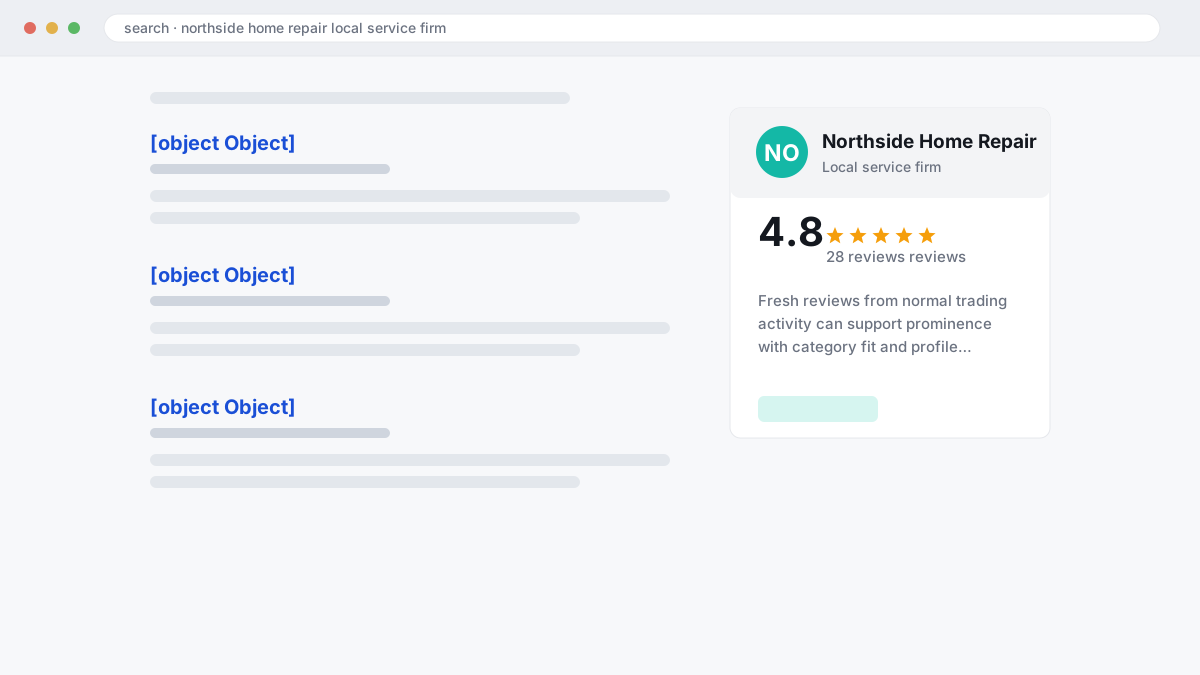
A 30-day lift usually does more than the same number of reviews spread thinly across 12 months because recency changes what searchers and Google see right now. A plumber who completes 40 jobs in a busy month and earns a cluster of detailed Google Maps reviews from that work often sends a cleaner signal than a dormant profile picking up one short rating each month. The reviews that help most tend to look like real customer records: some 5-star, some 4-star, written text that mentions the job, and occasional photos. Uniform star ratings, no text, and no media are weaker inputs even when the count rises.
The spike patterns that look normal to Google
Google usually treats a review spike as normal when the timing lines up with a real increase in completed visits, bookings or jobs. A restaurant that was full over Valentine’s week can plausibly publish 15 reviews in 3 days, just as a roofer can collect a tight cluster after storm repairs or a salon can see a burst after opening a second treatment room. The compression matters less than the business activity behind it.
Seasonal peaks, relocations and grand openings all create review timing that bunches up. A moved Google Business Profile often gets a short burst once regulars find the new listing and leave feedback from recent visits, while a new opening can stack reviews across the first weekend if staff asked at checkout and the venue was actually busy. In BGR Review’s 2026 dataset of 1,485 businesses, new trades and local service firms typically saw first reviews around two weeks after launch, which supports the point that early clustering can be natural when work starts landing quickly.
The cleanest “normal” spikes match signals you can verify offline: fuller tables, a booking surge, more invoices closed, more jobs marked complete. If your review count jumps but your booking calendar, call volume or footfall did not, Google has less context to trust the burst. That is where a harmless spike stops looking organic.
The spike patterns that trigger filtering risk
A filtering-risk spike on Google Maps is a burst that looks coordinated rather than earned, such as 20 near-identical 5-star reviews landing within 24 hours on a profile that was quiet the week before. Google Business Profile review policy bans fake engagement, but the practical trigger is usually a stack of weak trust signals rather than one obvious rule break. At BGR Review, the review packages that end up using the 30-day free replacement guarantee most often are the ones pushed too fast from a cold start.
The account quality behind the burst matters. Reviews from profiles with no photo, no prior contributions, no local place history, and no mixed activity across Maps look thinner than reviews from accounts that have rated shops, uploaded images, and moved around the same city over time. A sudden one-channel burst makes that thinner still: all Google, no Trustpilot, no Yelp, no Clutch, then silence again. That shape reads manufactured even before wording is checked.
Stacked signals push risk up fast. Repeated phrases like “highly recommend”, “best service”, and the same service keyword across a same-day batch, paired with no new 1-star or 3-star reviews getting through, creates the kind of imbalance that often leads to partial publication first and delayed drops later. That matters if you are paying for review growth, because replacing filtered reviews after publication is harder than avoiding the spike in the first place, even with BGR Review’s replacement window starting from the original delivery.
How Google likely judges velocity in context
Google appears to judge review velocity on Google Maps against the normal demand pattern of your category, location and profile history, not against one fixed daily cap.
That is why the same number can read two very different ways. Three Google reviews in one day can look routine for a city-centre hotel, busy restaurant or attraction that serves walk-in traffic all week. The same three can look synthetic on a solo locksmith profile that sat quiet for months and then suddenly collected near-identical praise in a 24-hour window. Google does not publish a safe limit in the Google Business Profile content policies, and that gap matters because businesses keep looking for a number that does not exist.
Baseline volume gives Google one signal, not the whole answer. In BGR Review's own dataset of 1,485 businesses observed from February to July 2026, trades and local service firms typically got their first reviews around two weeks after launch, while agencies often took four to eight weeks. A burst that matches real customer flow can hold. A burst that ignores the profile's previous pace, service type and market size gets examined harder.
Reviewer quality often outweighs raw speed. Older Google accounts, local history, varied writing style, different device and location patterns, and reviews that mention specific services tend to publish more cleanly than a stack of short, generic posts from accounts with little visible activity. If ten reviews arrive fast but all use the same tone, same keywords and same source mix, the speed is only part of the problem.
Why reviews disappear after a fast burst
Reviews disappear after a fast burst because Google does two different checks: some reviews get filtered on publication, while others post first and drop later when the platform recalculates trust across the batch.
The first type is immediate filtering. You see the review email or the reviewer sees the post on their account, but the public profile count never moves. The second type is delayed moderation: reviews stay live for a day or two, then vanish after Google re-scores the cluster for spam signals, reviewer-account quality, or unusual overlap in timing and wording. On Google Maps, that delayed drop is common after a dormant profile suddenly collects a stack of near-identical reviews in one push.
Google's published enforcement route sits inside the Google Business Profile review policy and its prohibited content rules. Reviews can be removed for spam, conflicts of interest, or incentives that cross the line into prohibited review gating or undisclosed reward offers. If your ask campaign promises vouchers, discounts, or staff bonuses tied to positive reviews, you create a policy problem before velocity even enters the picture.
A 48-hour batch drop usually points to account-level or pattern-level scrutiny rather than one weak review. That is why BGR Review gives a 30-day free replacement guarantee on review packages: some reviews publish cleanly, then disappear once Google re-checks the burst. If only one or two vanish, think reviewer quality. If half a burst drops together, look at the whole acquisition pattern.
Customer flow changes what safe growth looks like
Safe review growth on Google Maps depends on how many real customers each location actually serves over a rolling 90-day period. A supermarket, busy cafe or chain gym can support dozens of new Google reviews in a week without looking strange, because the footfall exists to explain that pace. A B2B consultancy, software agency or accountancy practice usually cannot. In BGR Review's own 2026 dataset of 1,485 businesses, agencies and digital service firms generally received their first review between weeks four and eight, and about half reached 20-30 reviews only within six months.
| Business model | What Google can plausibly accept | What to compare against |
|---|---|---|
| High-volume retail | Dozens weekly can fit normal walk-in volume | Store's own last 90 days |
| B2B / professional services | Slow, uneven accumulation is normal | Closed jobs or completed projects |
| Emergency services | Burstier waves after weather or callout surges | Lead spikes by week |
Multi-location brands get this wrong when head office applies one review target to every branch. Google evaluates each profile in context, so compare Manchester against Manchester, not against your busiest London site. A branch with five reviews in the previous 90 days jumping to 40 needs a cleaner explanation than a branch that already averages 25 a month.
If you run locksmith, towing, plumbing or water damage services, burstier demand is normal after storms, breakdown clusters or seasonal callout peaks. Dentists and accountants usually build reviews on a steadier cadence; in our dataset, established practices commonly needed 30-50 reviews before profile performance settled into a more consistent pattern. The safer rule is simple: tie asks to real transaction volume per branch, then pace follow-ups to match that reality.
Review source mix matters as much as review speed
Review source mix shapes how natural your Google review growth looks, because a burst from one channel on one day creates a much narrower trust profile than the same volume spread across several customer touchpoints.
One QR poster at the counter, one email blast to your full list, and one SMS send after a promotion can cluster reviews into the same short window with similar wording, similar device context, and the same landing path into Google Maps. That does not prove the reviews are fake, and Google Business Profile does not publish a rule that says “one channel equals spam”, but concentration makes the burst easier for Google’s spam systems to score as coordinated activity. A campaign that starts delivery in 24-48 hours still needs staggered asks.
| Acquisition setup | How it lands on the profile |
|---|---|
| Single QR poster or one-off blast | Reviews cluster on one day from one prompt and one source path |
| Receipts, follow-up emails, staff asks, staggered SMS | Reviews arrive across different days and customer moments |
If you want faster growth, spread the ask across receipts, day-after follow-ups, and staff prompts tied to completed jobs rather than one mass push. That is how you reduce mixed-signal spikes without slowing the campaign to a crawl, and it fits the same practical rule behind BGR Review’s 30-day free replacement guarantee on review packages: steady publication holds better than concentrated bursts.
A safer acquisition pattern for aggressive campaigns
A safer pattern for an aggressive Google Maps review push is to spread requests over 2 to 6 weeks, starting with your newest happy customers and adding older ones in smaller waves.
| Window | Who to ask | What to watch |
|---|---|---|
| Week 1-2 | Recent customers with completed jobs or purchases | Normal publication speed, mixed wording, mixed posting times |
| Week 3-4 | Another recent batch, then a small older satisfied segment | No same-day clustering from one outreach blast |
| Week 5-6 | Older satisfied customers in controlled follow-ups | No delayed drops or sudden unpublished reviews |
The order matters. Recent customers usually leave more natural reviews because the transaction is fresh, the wording varies, and the timing matches real customer flow. Older customers still help, but asking all of them on one day creates the dormant-profile-to-burst pattern that often leads to partial publication first and removals later.
Pause the campaign if you start seeing repeated phrasing, tight same-day clusters, or reviews vanish after appearing live. That is the point to slow the send volume, change the request template, and widen the timing between asks. If you use a paid review package, the same rule applies; at BGR Review we stage delivery rather than dumping everything at once, and our replacement cover on review packages is 30 days, not longer.
A practical review-spike diagnostic workflow
A practical review-spike diagnostic starts by comparing your Google Business Profile review timeline against the last 30, 90 and 180 days, because a “spike” only means something when you measure it against your normal pace and your real customer volume.
| Window | What to check | What usually explains the jump |
|---|---|---|
| Last 30 days | Review dates versus ask campaign sends, SMS reminders, invoice emails | A short burst after one organised push |
| Last 90 days | Bookings, completed jobs, till traffic, seasonal footfall changes | A real demand increase that supports faster review growth |
| Last 180 days | Long dormant periods, profile edits, reopening, relocation, merged listings | Why Google may treat the same burst as mixed-signal activity |
Match every review date to something operational: booked jobs, paid invoices, appointment volume, event traffic or a review request batch. If 18 reviews land in 4 days but your invoicing and footfall stayed flat, velocity is not the only issue. Google Business Profile review policy enforcement usually reacts to context, so a dormant profile followed by a mass ask blast is far riskier than the same count spread across genuine daily transactions.
Audit the reviewers next. Check profile age, review history, star distribution, wording overlap, location mismatch and whether later reviews disappeared after earlier ones were removed or filtered. That post-removal timing pattern matters: once a source mix starts getting distrusted, later reviews from similar accounts often publish, sit for days, then drop. If your audit shows a clear policy breach rather than a pacing problem, the cheaper route is to document it properly first; using only the in-platform report button fails often, and BGR Review handles removals on a pay-after-success basis at $449 per removed link with $0 upfront.
Where policy and legal lines get crossed
Policy and legal lines get crossed when you create, filter or reward reviews in ways that break platform rules or consumer-protection law. Google Business Profile policies prohibit fake engagement, review gating and incentives that depend on posting a review, so a discount, refund or gift card offered only after a Google review is a bad setup even if the wording looks soft. If you buy any review service, keep that boundary clear; BGR Review sells review packages with a 30-day free replacement guarantee, but that guarantee does not change Google’s rules.
The legal risk depends on where you trade and which platform you use. In the US, the FTC’s rules on endorsements and its 2024 fake review rule focus on undisclosed paid endorsements and fabricated consumer content; in the UK, the CMA and the DMCC Act target misleading commercial practices around reviews; across the EU, consumer-protection rules vary by member state and platform enforcement. False factual claims inside a review can also raise defamation issues, especially where the post alleges conduct that did not happen, but the route there is legal, not a Google ranking tactic. BGR Review’s removal model is $0 upfront and $449 per removed review link after success, yet some reviews still need a solicitor, not a flag. This is general information, not legal advice.
Where to go from here
Forced bursts usually create mixed signals before they create trust. The pattern is familiar in live profile work: a quiet Google Business Profile gets an ask blast, a cluster of reviews lands within days, some publish, some sit in moderation, then a few disappear later and the next batch from the same source mix struggles harder. Steady, customer-matched momentum holds up better, especially when your review requests follow real transactions, normal staff workflows and the volume your location can plausibly generate.
If reviews are dropping, or your next campaign feels aggressive, pause and audit three things first: where reviews are coming from, how tightly they are landing together, and whether any request method risks breaching Google Business Profile review policy or endorsement rules in your country. Expect that audit to show one of two outcomes: keep going with a slower cadence, or cut the risky source entirely. At BGR Review, that check is usually the first step before any package or any removal work, because a 30-day free replacement guarantee does not fix a bad velocity pattern.