


Quick answer
Star rating recovery is the change in your displayed average after a policy-violating review is removed and genuine new reviews dilute the damage. On Google Business Profile, the visible score usually shifts only after the review is actually taken down, then after Google's own refresh catches up. The size of the lift depends on your published review count, the average star rating formula, and rating rounding display, so one removal can move a 12-review profile fast and barely affect a 300-review profile. If the review is removable, BGR Review works on $0 upfront and $449 per removed review link.
This page is written from live removal work, not theory. In the cases we handle, the result often turns on the evidence pack rather than the first flag: screenshots, order records, message logs, policy-match notes, and the exact review URL usually matter more than a short complaint typed into the default report form.
That matters because generic guides treat star rating recovery as automatic. Across 12,000+ negative review cases logged by BGR Review from June 2025 to June 2026, outcomes were tracked as success, unresolved or unknown, and reviews raised within 28 days with a clear policy issue resolved successfully in roughly 90% of cases in our file.
Why didn’t your visible stars jump after one bad review vanished?
A removed review does not guarantee an instant public lift. Your visible stars move only after the platform recalculates the average from the published review count and then applies its rating rounding display, so one deleted 1-star can change the maths without changing what people see.
The wrong approach is to assume “one bad review gone” means “my score should jump now”. That fails for two reasons. First, the average may move by too little: if you had 200 published reviews and one 1-star disappears, a displayed 4.3 can stay 4.3 because the new average still sits on the same rounding threshold. Second, the display layer can lag behind the underlying count. Google Business Profile can update the review total before the visible stars settle, and Google Maps or cached surfaces can keep showing the older figure for days after the review itself has vanished.
The right approach is to separate math changed from displayed rating changed. Recalculate the average from the live published review count, then check whether the new number actually crosses the platform’s visible rounding line; if it does not, recovery is real but hidden. If it should have crossed and still has not, treat that as a recalculation delay and audit each surface separately: the Business Profile, Maps, branded search results, and any embedded widgets you use for click-through rate and conversion pages.
That distinction matters before you buy help. At BGR Review, removal work runs on a pay-after-success model at $0 upfront and $449 per removed review link, so the first question is whether one eligible removal can materially change the score you show in the local pack or whether you are chasing a mathematical lift the rounding display will mask anyway.
How does star rating recovery actually work once a review is removed?
Star rating recovery starts as a maths change and ends as a display change. The platform removes the review from the published set, recalculates the weighted average using the remaining reviews, and only changes the visible stars if the new number crosses the platform’s rating rounding display threshold.
Generic reputation advice treats removal like an automatic bounce. That fails because the average star rating formula is simple and unforgiving: total stars divided by published review count. If your profile sits on a large review count, one deleted 1-star review may improve the underlying score while leaving the public rating exactly where it was, which is why a Google Business Profile or Trustpilot profile rating can look stuck even after the review has gone.
The right way to estimate recovery is to run the numbers before you file anything. If you have 20 published reviews at a 4.5 average, your total is 90 stars; remove one 1-star review and the new weighted average becomes 89 divided by 19, or 4.68. If you have 500 reviews at the same 4.5 average, the total is 2,250 stars; remove one 1-star review and the new average becomes 2,249 divided by 499, or about 4.51. Same bad review, very different lift.
Rating rounding display is the part most guides skip. 25 can produce different visible stars where a platform rounds to one decimal place, so the recovery you feel in click-through from the map pack or in conversions from profile visits may lag behind the removal itself.
How much damage can one bad review really do to clicks, leads, and urgency?
One bad review costs the most when your review count is thin or your score sits on a display threshold. The same 1-star can barely dent a mature profile, yet visibly drag stars, clicks and lead confidence on a smaller Google Business Profile.
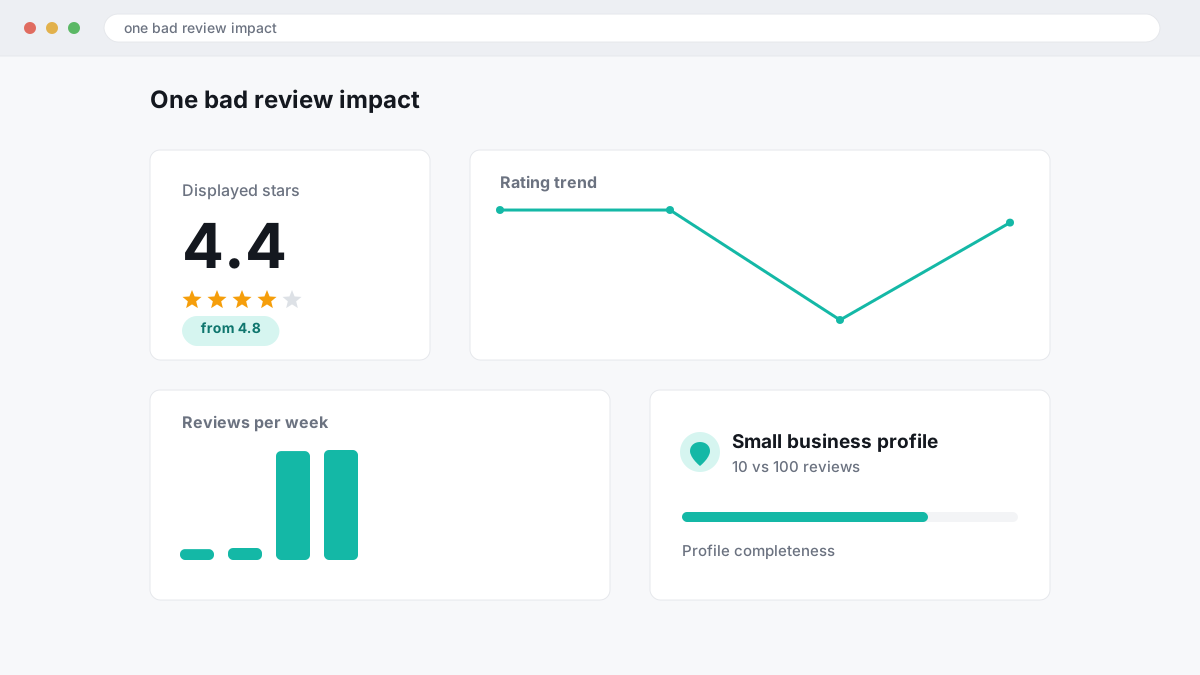
The maths is blunt. On a 10-review profile sitting at 4.8, one new 1-star takes the average to about 4.45, which usually shows as 4.4 or 4.5 depending on the platform’s rating rounding display. On a 100-review profile at 4.8, the same review lands you around 4.76, which often still displays as 4.8, so the visible damage is far smaller even before any removal request starts.
Most guides focus on star loss alone. That misses where the money goes first: conversion loss. A drop from 4.3 to 4.2 often bites harder than 4.8 to 4.7 because the lower score changes how your sentiment mix reads at a glance, especially if the negative review is recent and mentions service failure, delays or billing. People click, then hesitate. Calls slow before map-pack position moves.
You can see that effect most clearly on profile-led businesses. In BGR Review’s dataset of trades businesses with complete enquiry-source data, observed February-July 2026, 70-80% of calls and bookings were attributed to a Google Business Profile or Yelp listing rather than a website. If your leads come through the profile, urgency drops the moment the review snippet makes the next buyer think twice, even while your rank still looks unchanged.
Which removed reviews produce the fastest rating recovery—and which barely matter?
The fastest visible lift usually comes from a recent 1-star review that breaks platform policy and sits close to a rounding threshold. An older 3-star complaint can still improve sentiment mix when it goes, but it often changes how readers feel more than it changes the displayed score.
Most owners chase the most offensive review. That fails because the ugliest wording is not always the review doing the most damage to trust, map-pack click-through, or conversions. The better target is the review with clear review removal eligibility: a fake rating with no text, an impossible visit, impersonation, or false statements that clash with your records. Google Business Profile and Trustpilot both allow action on policy breaches even when the review is only a star rating, so a blank 1-star can be removable if the account behaviour or transaction record does not line up.
A removed 2-star buried inside 300 published reviews may do almost nothing to rating rounding display if your average stays on the same visible tenth. In that case, the gain is usually cleaner sentiment mix and slightly better conversion quality, while the faster commercial recovery comes from removing a recent low-star review that sits near the next display threshold and is still shaping first-click trust.
When should you handle removal yourself, and when is paid help the smarter move?
Handle it yourself when the policy breach is clear and your proof is already organised. Paid help makes more sense when the review is hurting calls or bookings, review removal eligibility is arguable, or your earlier support route has already stalled.
The cheap DIY move is filing a bare report on your Google Business Profile and calling the review “unfair”. That usually fails because platforms judge policy match, not annoyance: conflict-of-interest, impersonation, defamation with false statements, or a reviewer who was never a customer are stronger than “this feels harsh”. Across 12,000+ negative review cases logged by BGR Review from June 2025 to June 2026, roughly 90% of businesses that came to us after a failed attempt had used only the in-platform report button, with no evidence pack, and 70–80% of those initial requests had been rejected.
This is the practical split.
| Route | Best fit | Cost and trade-off |
|---|---|---|
| DIY filing | Obvious policy breach, reviewer identity issue, duplicate content, or clear non-customer proof already in hand | Lower cash cost, higher time cost; weak submissions often stall at the first review stage |
| Evidence-led paid escalation | Revenue-impacting review, disputed facts, conflict-of-interest, fake-review indicators, or prior support dead end | Fixed price per removed link |
The better approach is matching the claim to the rule, then building an evidence pack before you escalate. If your owner reply has sat unanswered beyond one review cycle and the bad review is still shaping map-pack click-through, branded search behaviour, or form-fill hesitation, a stronger filing usually beats repeating the same report. Paid help is the smarter move there because the work is in the escalation logic, not the button click.
What should a strong evidence pack include before you file any removal request?
A strong evidence pack gives support a named policy breach they can verify quickly. Screenshots help, but they rarely prove review removal eligibility on their own; transaction records, CRM notes, booking data and a clean timeline log give the reviewer something concrete to check.
The weak approach is telling Google Business Profile or Trustpilot that the review is “unfair” or “obviously fake”. That usually fails because support teams do not remove posts for being harsh. They remove posts that breach a named rule, such as impersonation, conflict of interest, prohibited content, defamation built on false statements, or a review from someone you cannot match to any job, booking or invoice. In BGR Review’s case file of negative review cases with prior self-filed attempts, logged June 2025 to June 2026, roughly 90% of businesses that came to us after a failed attempt had used only the basic in-platform report button with no supporting documentation, and 70–80% of those initial requests had been rejected.
Your file should include the review URL, the profile URL, dated screenshots of the live review, the posting time, the reviewer name, and the exact policy line you are citing. Add transaction records, CRM logs, call logs or booking records showing no customer match, then keep a timeline log with every flag date, your public reply, any follow-up email, and each support ticket ID. That pack does two things: it shortens escalation time, and it stops the case drifting into a vague argument about tone instead of evidence.
How long should recalculation take on Google and Trustpilot before you worry?
Visible stars rarely update everywhere at the same moment. If the review has gone but your score still looks stuck after several days, save proof of removal, compare Google Search with Maps and desktop with mobile, then build a dated timeline before you contact support.
The wrong approach is to refresh one screen for an hour and assume the removal failed. That fails because a Google Business Profile can show different states across Search and Maps while Google syncs review count, rating rounding display and cached profile data. A temporary recalculation delay is normal; a genuine rating problem is more likely when the review is absent on every surface, the published review count has changed, and the visible stars still have not moved after several days.
Trustpilot behaves differently. You can see reporting status on the review first, yet the Trustpilot profile rating may stay unchanged until the profile recalculates and republishes the aggregate score. If that lag runs past several days, document the removed review URL, the old and new review count, device screenshots and timestamps before you go to owner support; support teams act faster when you show the timeline cleanly instead of saying the rating “looks wrong”.
| Platform | What usually updates first | When to start documenting for support |
|---|---|---|
| Google Business Profile | Review disappearance on one surface before stars match everywhere | After several days, especially if Search and Maps still disagree |
| Trustpilot | Reported or removed review status before profile rating visibly shifts | After several days with no change in the profile rating |
If you later hand the case to BGR Review, this dated audit trail is the first thing we ask for before any owner support escalation or paid removal review. It separates sync lag from an actual rating issue, which saves you from chasing support too early.
Why can a platform remove the review but still leave your score effectively stuck?
A removed review can leave your visible rating looking stuck because the platform recalculates against the full published review count, then applies its own rating rounding display, so a real average change can be too small to alter the public number.
The wrong approach is to see the review disappear and assume the stars should jump at once. That fails on profiles with heavy review volume: remove one 1-star review from 201 published reviews and the average may move only a few hundredths, which often leaves click-through rate, map pack appeal and lead urgency looking flat even though the underlying score improved.
The right approach is to check the maths and the visible count together. A profile moving from 4.24 to 4.29 can still show the same displayed rating, because rating rounding display hides small changes; the review vanished, but the score shown to searchers did not cross the next threshold.
Missing reviews complicate this further. If older reviews are filtered, delayed, or no longer included in the visible published review count, your back-of-envelope average will be wrong, so compare the live count first and only then judge whether recovery actually stalled.
How can you estimate recovery before you file the dispute or buy help?
You can estimate star rating recovery with three inputs: your current average, your published review count, and the star value of the review you want removed. The planning step that matters is whether the recalculated average crosses the next rating rounding display threshold, not whether it rises on paper.
Use the average star rating formula in reverse: current average × published review count = total stars. Then subtract the removed review, and divide by the new published review count. Example: 4.24 across 50 published reviews means 212 total stars. Remove one 1-star review and the profile becomes 211 ÷ 49 = 4.306, which usually displays higher; remove one 3-star review and it becomes 209 ÷ 49 = 4.265, which may still leave the visible score unchanged depending on the platform’s rating rounding display.
Most buyers make the wrong comparison. 25, model how many new 5-star reviews would do it instead.
Use this quick check before you file anything or buy help.
| Starting point | After removing one review | New 5-stars needed instead |
|---|---|---|
| 4.24 from 50 | Remove 1-star = 4.306 | 1 new 5-star gives 217 ÷ 51 = 4.255 |
| 4.24 from 50 | Remove 3-star = 4.265 | 1 new 5-star may be the cheaper path |
Can removal requests backfire through policy, legal, or credibility risk?
Yes. A badly framed removal request can backfire. Weak evidence, reviewer contact that looks retaliatory, or a complaint built on opinion rather than a clear policy breach can burn support credibility, and any legal point depends on country and platform rules, so this is general information rather than legal advice.
The wrong approach is to call every harsh review “fake” or “defamation” because you dislike the sentiment mix on your profile. That fails because review removal eligibility turns on a named rule breach, such as impersonation, conflict of interest, hate speech, or a false factual claim you can evidence, not on the fact that the review hurts your conversions or local pack click-through rate. In BGR Review’s case file of 12,000+ negative review cases logged June 2025 to June 2026, roughly 90% of businesses that came to us after a failed self-filed attempt had used only the basic in-platform report button with no documentation, and 70–80% of those initial requests had been rejected.
The better approach is narrower: dispute the policy breach, not the criticism. If a reviewer says “I waited 40 minutes” and you think they were rude, that is usually opinion and support will rarely remove it; if they state a false factual claim such as treatment received by someone who was never a patient, the issue shifts toward defamation and false statements, but the legal standard still turns on provable falsity and local jurisdiction. That distinction matters because support teams read overclaiming as noise, and the next ticket can get less traction.
A separate risk sits outside the dispute itself. If you offered discounts, gifts, or refunds for positive reviews and did not disclose them, the FTC endorsement guides can create a different problem from the original complaint, and platforms may treat the profile as less trustworthy even if one review disappears.
What recovery plan works if removal only lifts the score a little—or not at all?
If removal barely changes the displayed score, your next move is controlled review acquisition. Aim at the next visible rating threshold, improve the recent sentiment mix, and keep review velocity after removal close to normal customer flow so the profile regains trust without triggering filters or compliance problems.
The wrong reaction is a panic burst: 15 review asks in one week after one bad review disappears, all pushed to your Google Business Profile from the same customer list. That often fails twice. First, rating rounding may still leave you on the same visible star line, so the public score does not look better. Second, the spike looks unlike your usual demand pattern, which raises filtering risk and can weaken credibility if the review stream suddenly turns unnaturally perfect. The steadier plan is to map your threshold first, then ask gradually from real, recent customers in the order they naturally complete jobs or purchases.
Prioritise the profile that is one positive review away from the next visible step, because that is where a small lift can improve map-pack click-through fastest. If you run more than one profile, put effort into the listing where conversions already happen and where the sentiment mix in the last few reviews still looks believable rather than scrubbed clean. In BGR Review’s dataset of 1,485 businesses observed from February to July 2026, trades businesses reached early review momentum quickly and profile-led enquiries dominated, which is why a stable post-removal cadence on Google usually matters more than a short campaign blast.
Keep the two jobs separate. Remove what is eligible, then rebuild at a pace your normal customer flow can support.
Where to go from here
Calculate the gap first: your current average, your published review count, the platform’s displayed rounding, and the exact lift you would get if one, two or three harmful reviews disappeared. That tells you whether removal changes the public score now or whether you also need fresh verified reviews to cross the next visible threshold and recover click-through from the map pack, calls and form fills.
If the damaging reviews look removable, your next move is a review-link assessment. Pull the live URLs, note the policy issue on each one, and gather the evidence pack before you file anything. In practice, the result is usually clear quite quickly: either the reviews match a named policy problem such as false statements, impersonation or conflict of interest, or they do not. If they do, you can expect a submission route, a wait period, and then a recalculation check rather than an instant star jump.