

Quick answer
Google Business Profile reinstatement usually takes 3-5 business days at the fastest and 1-3 weeks in many real cases. Google Business Profile Help materials often frame appeal reviews as taking a few business days, but the clock stretches when the suspension involves business name compliance, address and service area settings, duplicate profiles, or weak proof of ownership. A denied reinstatement form adds more time because Google expects the underlying guideline issue fixed before another submission. The fastest route is simple: correct the profile first, then send one clean evidence pack that matches the live profile exactly.
This page answers How long does Google Business Profile reinstatement actually take from the operator side, not the forum-thread side. At BGR Review, our team handles profile disputes alongside review removal work, and the delays usually come from four avoidable faults: mismatched documents, duplicate support tickets, uncorrected name spam, and address proof that does not match the suspended listing line for line.
That friction is easy to miss if you have only read Google’s public help pages. We sell review and reputation services openly, including negative review removal at $449 per removed link with $0 upfront, so the advice here stays practical: what you can fix yourself, what Google will refuse, and where the timeline really slips.
Why does one Google Business Profile reinstatement take 3 days while another takes 5 weeks?
Google Business Profile reinstatement does not run on one average clock. The fast cases are usually clean soft suspension appeals with exact-match proof, while the slow cases are usually hard suspension appeals where a guideline issue is still live, the documents do not match the profile, or Google asks for more verification before anyone clears the listing.
Most guides quote one average, then blame Google’s queue for everything. That fails because the queue is only one variable. A profile suspended for a minor edit or verification problem can come back in days, but a hard suspension tied to business name compliance, address problems, or other Google Business Profile guidelines issues often stretches into multiple weeks because Google checks the fix first and the paperwork second. If the underlying problem is still visible on the profile, the reinstatement form lands in a slower loop of rejection, follow-up, or silence.
The longest delays usually come from bad submissions, not from the first suspension itself. A weak evidence pack slows the case when the licence shows one business name, the utility bill shows another address format, the service area setting conflicts with the proof, or the live profile still carries keyword-stuffed name spam that should have been cleaned before filing. Duplicate tickets make this worse. The right approach is boring but faster: fix the trigger first, submit one reinstatement form, and make every document match the profile exactly as Google sees it on the day of review.
How long should you realistically expect by suspension type, support route, and evidence quality?
A realistic reinstatement timeline is a range, not a promise: a soft suspension can clear in several days, a hard suspension often runs into weeks, and denied or escalated cases usually stretch further when your documents, ownership proof or profile edits raise fresh questions.
Most guides quote one average. That fails because Google reviews different problems through different routes. A DIY reinstatement form usually sits in one queue, while support case escalation adds follow-up gaps between replies, extra document requests and occasional video verification before the profile returns to the map pack and starts earning clicks and calls again.
The useful way to estimate timing is to match the suspension type to the route you are using and the quality of your evidence pack.
| Case type | Typical route | Realistic timeframe | What speeds it up |
|---|---|---|---|
| Soft suspension | Reinstatement form | Several days to around 2 weeks | Licence, utility bill and storefront signage that match the live profile exactly |
| Hard suspension | Reinstatement form, sometimes video verification | 2 to 5 weeks | Clear ownership proof, compliant business name, correct address or service area settings |
| Denied first appeal | Second submission after fixes | 1 to 3 more weeks after resubmission | A rebuilt evidence pack that answers the denial reason directly |
| Escalated case | Support case escalation | Several weeks, sometimes longer | One clean ticket, no duplicate threads, exact-match proofs |
Exact-match evidence shortens review because it removes avoidable questions. Weak screenshots, cropped bills, signage photos without context and documents showing a different business name often trigger another review cycle. That delay costs more than visibility: your local pack presence drops, click-through rate softens, and conversions from calls or form fills usually do not recover until the profile is live and stable again.
What should you fix before you appeal so the clock does not restart?
The fastest reinstatement usually comes from filing after you clean the profile up. Fix business name compliance, address or service area settings, and duplicate listings first, because Google often reviews the live violations it can still see and leaves the profile suspended while you wait.
The slow approach is appealing the same day and hoping the documents will carry it. That fails when the name still breaks Google Business Profile guidelines with city terms, service keywords, or marketing add-ons that are missing from your real-world branding. If your live profile says “Emergency Locksmith Brooklyn 24/7” but your utility bill, registration and signage show a different business name, Google treats the evidence pack as a mismatch rather than proof.
Fix the location settings next. A staffed storefront needs an address that matches the documents exactly, while a service business should usually hide the address and set its service area settings correctly before you submit the reinstatement form; mixing both is a common reason the review stalls or bounces back to video verification. The same goes for duplicate profiles and categories: if two listings exist for one location, or the primary category does not match what the business actually does, Google can read the account as manipulated even when the paperwork is genuine.
Clean first, then appeal once. That sequence gives Google one compliant profile to assess, helps the listing return to the map pack faster, and avoids the wasted cycle where you fix the profile after submission and effectively hand support a new set of facts to recheck.
How do soft and hard suspensions move through different reinstatement paths?
Soft and hard suspensions do not move through the same queue. A soft suspension usually turns on profile edits and Google Business Profile guidelines compliance, while a hard suspension usually triggers a fuller eligibility review with proof of ownership, location legitimacy and, in some cases, video verification before Google restores access.
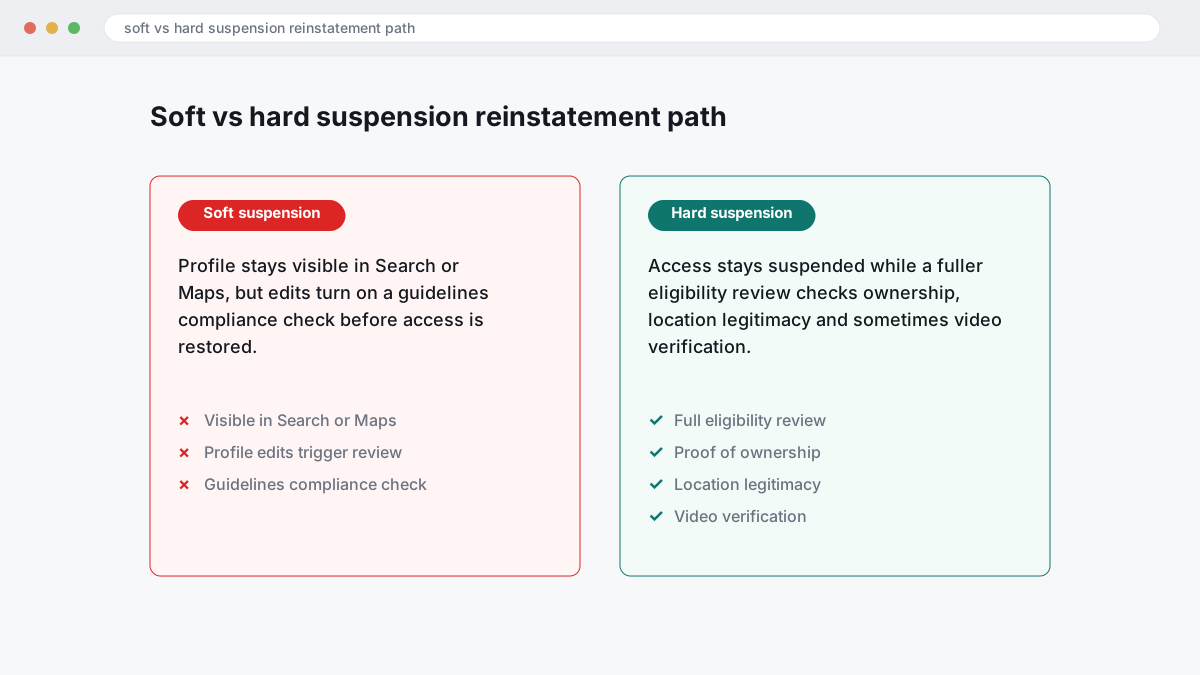
The wrong move is to treat both as a simple visibility issue and send the same reinstatement form with a licence or utility bill attached. That fails because a soft suspension often leaves the profile visible in Search or Maps but strips management access or weakens ranking functions, so Google is checking whether your business name, category, address and service area settings match its rules. In that route, fixing the live profile first often matters more than sending extra files.
A hard suspension is different. Visibility loss is immediate: the listing disappears, branded search drops, map pack exposure falls away and Google is more likely to ask for stronger evidence, including storefront signage, permanent address proof or a video verification walk-through showing tools, stock, branded vehicles or access to the premises. If you appeal a hard case before the profile matches the documents exactly, Google often treats it as a full eligibility review rather than a quick correction, and that is where timelines stretch.
Which Google rules usually triggered the suspension in the first place?
Most Google Business Profile suspensions start with a guideline mismatch, not a random edit: the profile stops matching Google Business Profile guidelines on eligibility, truthful representation, or real-world presence, and the fastest cases are usually the ones where that mismatch gets fixed before appeal.
The common triggers are plain. Your business name includes extra keywords, your address is a virtual office or mailbox, your service area settings conflict with a visible address, or the listing suggests a presence you cannot prove in the real world. BGR Review sees the timeline slip most when the owner treats this as a minor edit problem, submits the reinstatement form, and leaves the underlying guideline violation live; Google then reviews a profile that still fails business name compliance or still shows an ineligible location, so the case stalls or comes back denied.
The better approach is to match the profile to the operating model first, then appeal. A storefront needs a staffed, customer-facing location during stated hours; a hybrid service-area business can show an address if customers are genuinely served there; a pure service-area business usually needs the address hidden and the service area settings cleaned up so the profile reflects how the business actually trades. If you use a virtual office, shared mailbox, or lead-gen style location page as proof, Google often treats the suspension as a guideline issue rather than a simple verification delay, which is why ranking recovery in the map pack and click-through rate usually wait until the profile itself is compliant.
What makes an evidence pack strong enough to move the case faster?
A strong evidence pack proves three things at once: your business exists, you control the location, and the Google Business Profile details are accurate. Exact-match documents move faster than cropped screenshots, social posts, website banners, or old paperwork because Google can verify them against the live profile and the Google Business Profile guidelines.
The weak approach is sending marketing material that only shows you trade under a name. A Facebook page, invoice template, van wrap mock-up, or a screenshot of your website does not prove legal ownership or location control, so support often stalls or asks for more. The stronger route is a business licence, utility bill, lease, tax document, or bank statement that shows the exact legal name and address already displayed on the profile, plus current photos of your storefront signage if customers visit you there.
Video verification needs the same logic in motion. Google may ask you to show exterior signage, the street context around the entrance, tools or stock that match the category, and access to the workspace or service area base so the location looks operational rather than rented for the appeal. In BGR Review’s dataset of 12,000+ negative review cases logged June 2025 to June 2026, roughly 90% of businesses that came to us after a failed first attempt had used only the basic in-platform report button with little or no supporting documentation; that finding is about review disputes, not reinstatement, but the support friction is the same: thin proof slows everything down.
How do you submit the reinstatement form without creating avoidable delays?
A fast submission uses one complete reinstatement form, tied to the right case ID, with no duplicate tickets and no fresh profile edits afterwards unless Google support tells you to make them inside that same thread.
The wrong approach is filing the reinstatement form, then opening more tickets to get attention. That usually fails because the support queue does not reward volume; it fragments your evidence across separate threads, creates conflicting case IDs, and can leave the reviewer looking at an incomplete record. The right approach is one clean submission with your final business details, your full evidence pack, and the correct case ID copied exactly from the email trail or support screen.
Hold the profile steady after you submit. If you change the business name, address and service area settings, categories, or opening hours while the appeal is pending, you give support a moving target and invite another compliance check against the Google Business Profile guidelines. In practical terms, some of the longest delays start with duplicate tickets, then get worse when the live profile no longer matches the documents already attached to the original case ID.
Why was your Google Business Profile appeal denied, and what usually fixes the second try?
Most denied Google Business Profile appeals fail for three reasons: your documents do not match the live profile, the profile still breaks Google's rules, or your business eligibility is still unclear. A second attempt works when you change both the profile and the evidence pack, instead of sending the same files again.
The wrong read is “Google made a mistake, so I will re-submit the same appeal.” That usually fails because the denial often points to unresolved appeal denial reasons under the Google Business Profile guidelines: business name compliance, address and service area settings, the primary category, or whether the business should show an address at all. If your licence says Suite 4, your utility bill says Unit 4, and the profile shows Ste 4B, support treats that as a mismatch, not proof.
Read the denial against four fields first: name, address, category, and eligibility. In BGR Review’s case file of negative review matters where businesses had already tried the basic in-platform route, roughly 90% approached us with minimal supporting evidence, and 70–80% of those first requests had been rejected; that dataset covers negative review cases with prior self-filed attempts logged June 2025 to June 2026, and it shows the same support friction point clearly: weak documentation gets dismissed fast. Reinstatement denials behave the same way when the evidence pack does not line up with the profile exactly.
The right re-file strategy is surgical. Fix the profile first, remove any name spam, close or merge duplicate profiles if they confuse the address signal, then submit a fresh evidence pack with matching registration, signage, address proof, and, where Google asks for it, video verification that shows the real premises and branding. If you need outside help, be clear-eyed about what is being sold: BGR Review handles review removal on a pay-after-success basis at $449 per removed link with $0 upfront, but no agency can make Google approve a reinstatement that still conflicts with policy.
When is DIY enough, and when does agency help actually reduce risk or delay?
Agency help does not make Google review your case faster, because no provider controls Google's queue. It reduces self-inflicted delay by fixing the diagnosis first, cleaning the profile before appeal, building a tighter evidence pack, and stopping duplicate or contradictory support submissions.
DIY is usually enough for a first suspension on one location when the issue is plain: one storefront, one owner, one set of matching documents, and an obvious fix under the Google Business Profile guidelines. The wrong approach is paying someone who promises a 3-day reinstatement; that fails because the queue is still Google's, and the same weak reinstatement form with the same bad proof still lands in it. The better use of help is after appeal denial reasons start stacking up: name spam left live, address and service area settings that conflict, duplicate profiles, or a video verification trail that does not match the business details you submitted.
This comparison is where agency vs DIY GBP reinstatement becomes practical rather than theoretical.
| Scenario | DIY usually fits | Agency help usually reduces risk |
|---|---|---|
| First-time, one-location suspension | Yes, if documents match the live profile exactly | Only if you are unsure what triggered it |
| Appeal already denied | Risky | Yes, because the second filing needs cleaner fixes and tighter evidence |
| Multiple issues or conflicting profiles | Usually slow | Yes, especially where support case escalation is needed |
| Bulk or multi-location account | Only with strong internal controls | Yes, to avoid one location's fix creating another location's conflict |
Across 12,000+ negative review cases logged by BGR Review from June 2025 to June 2026, roughly 90% of businesses that came to us after a failed first attempt had used only the basic in-platform report route with no supporting documentation, and 70-80% of those initial requests had been rejected. Reinstatement is a different workflow, but the same support friction shows up: thin evidence, duplicate tickets, and escalation requests filed before the underlying profile problem is fixed. If you want outside help, pay for fewer preventable errors, not for a speed guarantee nobody can honestly give.
How should multi-location brands handle reinstatement without creating cross-location conflicts?
Multi-location reinstatement moves fastest when you treat each suspended profile as its own evidence file, fix any chain-wide guideline breach across every branch before filing, and stop regional teams from opening duplicate tickets that force Google support into conflicting case histories.
Bulk and multi-location accounts still need location-level proof. A head-office certificate, parent-company utility bill, or national franchise agreement rarely resolves a suspension if the affected listing shows a different trading name, phone, address or service area setting. For each branch, match the live Google Business Profile exactly: storefront signage, local business registration where available, branch utility or lease evidence, and a branch-level phone line if that is what the profile shows. Video verification can also split by location, so one compliant branch does not validate the rest.
Shared naming conventions create the biggest chain-wide delays. If 24 listings use the same city-stuffed business name, one rule breach can trigger hard suspensions across the account under Google Business Profile guidelines on business name compliance. Fix the naming issue everywhere first. Filing reinstatement for only the suspended locations while leaving the same spam pattern live on active profiles often leads to denial, weak map pack recovery after reinstatement, and slower return of click-through rate, calls and bookings.
This workflow keeps support case escalation clean across regions.
| Task | Wrong chain approach | Safer multi-location approach |
|---|---|---|
| Documents | Upload only brand-level paperwork | Build one evidence pack per branch |
| Naming fixes | Edit only suspended listings | Correct every duplicate naming error account-wide |
| Support contact | Let agencies, franchisees and staff open separate cases | Use one owner-led reinstatement form route and one ticket log |
If you need outside help, keep the remit narrow: evidence assembly, duplicate profile cleanup and case sequencing.
Where to go from here
Fix the cause before you file again. Start with the profile itself: remove business name spam, correct the address and service area settings, close or merge duplicate profiles, and make sure your licence, utility bill or registration matches the live Google Business Profile exactly. Then build one evidence pack, submit one reinstatement form, and wait. Duplicate tickets and fresh edits after submission are where straightforward cases turn into week-after-week delays.
If Google has already denied the appeal, move up a level and review the suspension cause instead of changing documents at random. The useful order is simple: identify whether you are dealing with a soft suspension or hard suspension, map the issue against Google Business Profile guidelines, rebuild the evidence pack, then decide whether support case escalation makes sense. That is also the point to read the broader suspension pillar, because reinstatement timing and denial recovery depend on the trigger.
If you want a second pair of eyes before another appeal, ask for a professional review of the suspension cause first. At BGR Review, that means checking the profile against the submitted documents, spotting the mismatch that support will reject, and telling you whether the next step is DIY or managed help before anything new is filed.