


Quick answer
Local SEO is the work of improving how your business appears in Google Search and Google Maps for nearby searches. A proper 2026 audit starts with five checks: your Google Business Profile setup, review volume and response quality, location-page quality, NAP and citation consistency, and local link authority. Start with Google Business Profile first because it usually affects map pack visibility and conversion fastest. If reputation problems sit underneath the ranking issue, keep review growth separate from removal work. At BGR Review, removal runs on a $0 upfront, pay-after-success model at $449 per removed review link.
This page comes from operators who work on review generation, platform policy checks and negative review removal across Google, Trustpilot, Yelp, Clutch and TripAdvisor, not from a general SEO content desk. We see the practical failure points: profile edits that trigger auto-rejection after weak evidence, review flags that go nowhere without a policy match, and listings that rank acceptably but lose calls because the review profile looks uneven.
BGR Review sells review and reputation services, so the commercial interest is obvious. DIY auditing is enough when your profile is claimed, your citations are clean and you only need to fix obvious gaps; paid help makes sense when you are dealing with fake reviews, suppressed profiles or policy-sensitive review acquisition that has to stay inside platform rules.
What local SEO actually covers in 2026
Local SEO in 2026 means improving your visibility for location-based searches in Google Search and Google Maps, with your Google Business Profile acting as the central asset Google reads first.
Google still frames local visibility around relevance, distance and prominence in Google Business Profile Help, and that remains a useful audit lens in 2026 because it tells you where a problem sits: weak category and service setup hurts relevance, poor address or service-area alignment affects distance matching, and thin reviews or weak web mentions drag prominence. Most guides stop at the definition. Your audit needs to turn those three words into checks you can actually fix.
For most local businesses, the work splits into three systems: profile signals, website signals and reputation signals. That matters if you are deciding what to fix first, because a polished site rarely rescues a thin profile, and review growth often changes click behaviour before rankings move.
Measure outcomes that lead to revenue: calls, direction requests and website clicks from your profile, then compare them against pack rankings and map impressions. More map views alone do not pay for the work, which is why any serious local SEO audit should judge visibility and action together.
What ranks for local searches now
Local searches now split visibility across the local pack, Google Maps, organic location pages, review snippets and, on some queries, directory results such as Yelp, Trustpilot, Clutch or TripAdvisor.
Google Business Profile usually decides whether you show in the map pack, especially on mobile, while your site tells Google which services you actually offer and where you are relevant. That split matters in practice: a weak profile can keep you out of Maps even if your location page is decent, and a thin site can limit category relevance even when the profile is complete. Google’s own Business Profile Help and Search Central documentation make that division fairly clear.
Query type changes the battlefield. A brand search often shows your profile and your own site first. A category search like “dentist near me” usually leans on the pack and strong location pages. An urgent search such as “emergency plumber” tends to favour mobile-first results where click-to-call behaviour matters more than a polished desktop page.
Audit desktop and mobile separately. On high-intent local terms, the mobile map result often drives more calls than the blue links below it, so a business with average organic rankings can still win leads if its Maps presence is stronger.
Audit your Google Business Profile before anything else
Your Google Business Profile is the first asset to audit because one wrong field can suppress local relevance in Google Search and Google Maps before your website ever gets a fair chance.
Start with the fields that define eligibility and relevance: primary category, secondary categories, address or service area, phone number, website URL, hours, attributes, services and business description. The primary category carries the most weight because it tells Google which market you belong in; if a dental implant clinic is set as “Dentist” when the local pack is dominated by “Dental implants provider”, completeness will not rescue it. Accuracy beats fullness every time.
Google Business Profile rules are stricter than most owners realise. Keyword stuffing the business name, city-stuffing the description, or adding services you do not actually offer can trigger edits, soft suppression or suspension under Google Business Profile content guidelines. A half-empty profile with clean data is safer than a fully filled profile built on invented terms.
Profile edits often publish fast when they match trusted data sources such as your website, signage and existing citations. We see the same pattern on disputed edits and review-related flags: the first pass is often an auto-rejection or a temporary publish that later reverts, especially when the evidence is weak, cropped, or does not clearly tie the business name, address and real-world proof together. Screenshots, utility bills, storefront photos, service licences and the exact live URL matter because edge cases can sit in review for days before Google decides.
| Check | Storefront | Service-area business |
|---|---|---|
| Location setting | Real customer-facing address shown | Address usually hidden; service area set by actual coverage |
| Eligibility risk | Virtual office and co-working misuse | Using a staffed office you do not serve from |
| Audit priority | Pin accuracy, signage, hours, categories | Service area, categories, phone, website landing page match |
| Common failure | Wrong suite, duplicate listing, old hours | Hidden address with weak local signals and overbroad areas |
If you run a service-area business, audit it as a different model, not a weaker storefront. SABs usually fail on overbroad service areas, category mismatch and thin website evidence, while office-based locations fail on address legitimacy and duplicates.
Check whether your reviews help rankings or just sit there
A review profile helps local SEO when it stays recent, specific and believable enough to lift click-through and lead intent, even before your map position changes.
Audit five things: recency, volume trend, rating distribution, wording in the reviews, and owner response rate. A 4.9 average with no new reviews for six months often converts worse than a slightly lower rating with steady monthly activity, detailed service mentions and replies from the owner. Star score matters, but it is a weak audit shortcut on its own.
Review text gives you local relevance signals that generic scores do not. Look for place names, service terms and transaction detail in the wording: “emergency plumber in Brooklyn” tells Google and the searcher more than “great service”. We see the same pattern repeatedly in review growth work at BGR Review: when new reviews arrive on a natural, policy-compliant cadence, the first visible change is usually better click-through from the local pack and more call intent from profile visitors; rankings can sit flat for a while and then move later.
| Pattern | Healthy signal | Risk signal |
|---|---|---|
| Review pace | Steady additions over weeks | Sudden burst in 24-72 hours |
| Review wording | Specific jobs, staff names, locations | Repeated phrasing across multiple reviews |
| Rating mix | Mainly positive with believable spread | Near-perfect profile with no variance |
| Owner responses | Consistent replies to recent feedback | Months of silence or copy-paste replies |
Keep the compliance side tight. Google bans fake engagement and review manipulation in its Google Business Profile policies, and the FTC’s endorsements and testimonials rules in the US make deceptive review practices a legal issue, not just a spam issue. In the UK, fake review enforcement now sits under the DMCC regime, so buying misleading praise or suppressing genuine criticism can create platform risk and regulatory risk at the same time.
Know when a bad review is a reputation issue and when it is a removal case
A bad review is a removal case only when it breaks platform policy; if it reflects a real customer experience, Google usually leaves it live even when the wording feels unfair.
For a local SEO audit, separate ordinary reputation work from policy work fast. On Google, check the review against the Google Business Profile review policy for spam, impersonation, off-topic content, conflicts of interest or prohibited content. A one-star review with harsh tone is rarely enough. A review from a competitor using a staff name, or a post pushing another business, gives you something policy-based to work with.
The field that usually decides an appeal is the evidence tie-back, not the complaint itself. We see vague claims like “this person was never a customer” get auto-rejected because the submission does not connect the policy breach to anything Google can verify: no order record window, no staff roster match, no booking gap, no explanation of why the content is off-topic or conflicted. Weak evidence fails quietly. The status often stays at “not removed” with no useful detail.
If the review clearly breaches policy, escalation can be worth the time. If it does not, your local search fix is different: write a measured public response, then add fresh compliant reviews through normal customer requests so the bad review carries less weight in click decisions. That route changes conversion more reliably than repeated flags on a review that does not qualify for removal.
BGR Review treats removals as specialist work, not a guaranteed DIY outcome. The model is pay after success: $0 upfront and $449 per removed review link. If the review is genuine and policy-clean, the cheaper answer is usually response strategy and compliant review generation, not another appeal.
Audit your location pages for local intent, not generic SEO
A local landing page supports local SEO when it proves three things on one URL: what you do, where you do it, and why a real person should trust you enough to call or book.
Audit each page for service relevance, location relevance and business legitimacy. That means unique service detail for that place, clear contact data, and page elements that match how you actually operate, whether you meet customers at a storefront or travel to them from a service-area base. If every city page uses the same copy with one place name swapped, treat it as a liability, not an asset.
Thin city pages fail because they answer nothing a local searcher needs. A strong page explains areas served, booking steps, expected turnaround, parking or access notes where relevant, and gives the reader a next action above the fold. For reputation-sensitive firms, local proof matters here too: review snippets, case examples by area, or platform badges from Google, Trustpilot or Clutch, provided they are accurate and compliant with the platform's own display rules and the FTC's endorsement guidance.
Check the basics, then stop before they take over the page: title tag, H1, internal links from service and contact pages, and schema markup such as LocalBusiness where it fits the real setup. An embedded map or directions context helps a genuine storefront; a service-area page usually needs coverage details and response radius instead. Google Business Profile and the page should tell the same story.
| Page type | What it includes | Risk level |
|---|---|---|
| Real location page | Unique local service detail, real contact data, directions or access context, local proof, clear booking path | Low |
| Service-area page | Named areas served, dispatch or travel logic, turnaround expectations, phone or form CTA, no fake storefront signals | Medium if vague |
| Doorway page | Near-duplicate copy across cities, swapped place names, no real presence or service logic, weak or hidden contact details | High |
Fix NAP and citation inconsistencies that still cause confusion
NAP means your business name, address and phone number, and fixing wrong versions still matters in local SEO because bad data confuses Google, map providers and real people.
In 2026, citations are weaker as a growth lever than your Google Business Profile, reviews and location-page quality. Bad citation data still causes trust and indexing problems. Start by matching your core details to your Google Business Profile and the contact details on your site, then check the main data aggregators, Apple Maps, Bing Places and the vertical directories that send actual leads in your sector.
Ignore tiny formatting differences first. “Street” versus “St” rarely needs a cleanup sprint. Wrong suite numbers, old call-tracking numbers, duplicate listings and listings pointing to a previous address are the fixes that deserve your time because they trigger wrong-direction calls, user edits and duplicate-entity confusion.
If you changed your brand name, phone system or office address in the last 12 months, move citation cleanup up the queue. That is when conflicting signals tend to surface as customer complaints, suggested Google Business Profile edits and support headaches. If you run review generation or removal work like we do at BGR Review, old phone numbers and legacy addresses also make verification harder across platforms, including Google, Trustpilot and Yelp.
Check local keyword targeting at page level
Page-level local keyword targeting means giving each keyword cluster one clear home, so Google does not have to choose between your homepage, service page, location page and Google Business Profile for the same search.
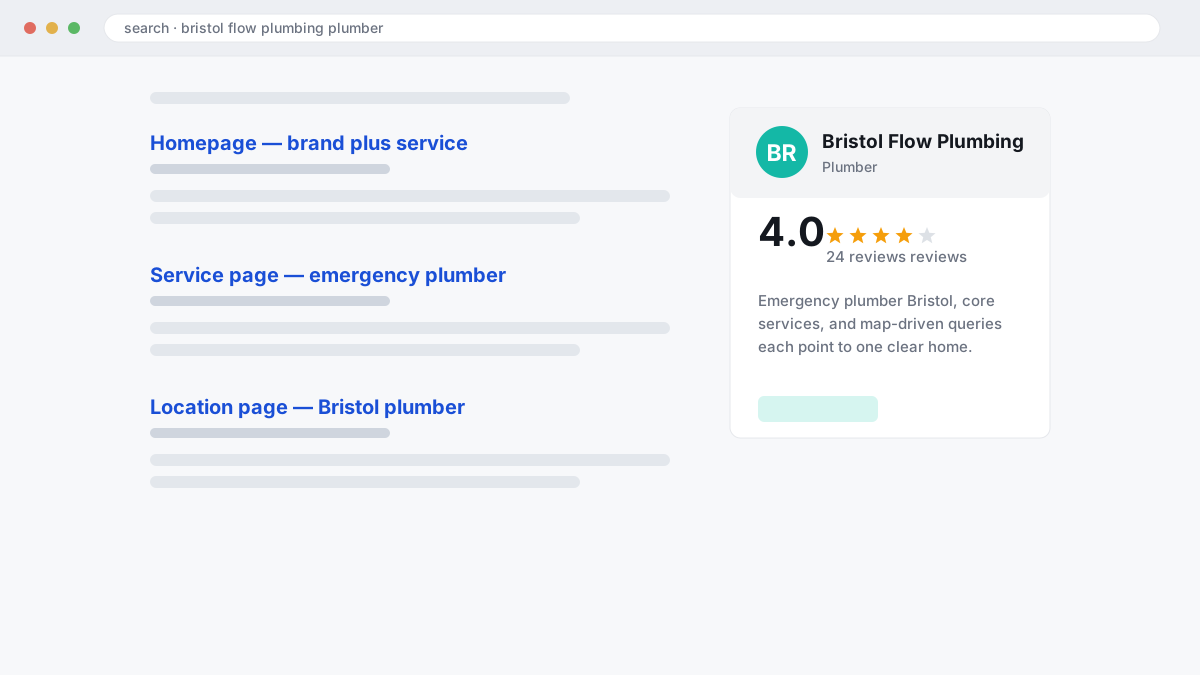
Start with your main clusters and assign a single destination page to each one. A plumber with one town should usually send broad brand-plus-service terms to the homepage, core services to service pages, city-service terms to location pages, and map-driven queries to the Google Business Profile. If two pages both chase “emergency plumber Bristol”, you have a cannibalisation problem, and one of them usually needs to be merged, rewritten or de-optimised.
Intent split matters more than exact-match placement. “Near me”, “open now” and many city-modified service searches often trigger the local pack first, so your profile, reviews and proximity signals do more work there than another paragraph on a page. Broader searches such as “boiler repair cost” or “how long does a roof replacement take” lean more heavily on organic pages, where a service page or guide can win clicks.
Use the phrases your market already gives you. Pull queries from Google Search Console, compare them with Google Business Profile performance data, and lift real wording from reviews and call notes instead of forcing clumsy headings like “best dentist near me London affordable”. Google reads natural variants well enough; awkward exact-match copy usually hurts conversion before it helps rankings.
Review your on-page local signals and schema
An on-page local SEO audit checks whether Google can crawl, index and connect each page to the right place, service and business entity.
Start with the basics before you touch schema. Check indexability in Google Search Console, confirm canonicals point to the live URL, inspect crawl status, and test mobile usability and speed on the pages that should rank. A slow, thin location page with a stray canonical to a parent service page will lose ground long before a missing postcode in schema makes any difference.
Schema helps Google confirm what your page already says. Use LocalBusiness or a more specific subtype where it fits, but make sure the structured data matches the visible name, address, phone number, opening hours and URL exactly. If the page says Suite 4 and the markup says Unit 4, fix it. Mismatches create entity confusion; they do not add relevance.
Internal links should connect contact, service and location pages in a way a real user would follow. Link each location page to its local services, link those services back to the relevant location, and keep the contact page in that path. If you have five locations, each page needs its own contact details, its own structured data and local proof such as area-specific testimonials, photos or project references, rather than one generic Organisation block reused site-wide.
Audit local links and local brand mentions
A local link audit checks whether your site earns authority from places that make sense for your service area, not whether you have piled up the biggest backlink count.
For most single-city and regional firms, relevance beats volume. Five solid mentions from a city chamber, a trade body, a local newspaper, a supplier and a community event page can carry more weight than 50 weak directory links that exist only to drop a URL. That standard is stricter than a generic SEO tool score, but it matches how local visibility usually moves in practice.
Check for links and mentions from your chamber of commerce, trade associations, sponsorship pages, local press, partner businesses, schools, charities and credible neighbourhood sites. If you operate in one metro area, links from that area usually deserve more attention than a random national directory unless the directory is genuinely trusted in your trade.
Look for unlinked brand mentions as well. Search your business name, trading name, phone number and key staff names, then review press references, event pages and supplier listings that mention you without linking. Those are often the lowest-effort wins: a short outreach email to the editor or site owner can turn an existing mention into a live link faster than chasing new placements from scratch.
Measure the trust signals that change conversion, not just ranking
A local SEO audit should score trust signals against lead quality, because clicks and calls often move before map positions do.
Track the metrics that show buying intent: call volume from your Google Business Profile, form conversion rate on location pages, direction requests, branded search lift and the tone of your review responses. A profile with a 4.9 rating, recent review activity and clean owner replies often outconverts a nearby competitor showing similar pack visibility but older reviews, unanswered complaints or obvious copy-paste replies. That gap shows up in enquiries first.
We see this pattern after uneven review growth: rankings may barely shift for a while, but click-through and call intent usually improve before pack position does. Searchers compare stars, recency and how you handle friction. If your latest 10 reviews are fresh and your replies sound like a real operator rather than a template, more people choose you even when Google Maps order stays flat.
Owner responses shape the decision after the click. Google Business Profile lets the review stay live in most cases unless it breaks the Google Maps user-contributed content policy, so the response carries real weight. “Thanks for your feedback” does very little; a calm reply that addresses the issue, gives a next step and signs off with a named manager can recover trust and improve conversion without any ranking jump.
Prioritise fixes by impact, risk and effort
A workable local SEO priority list fixes the issues that suppress enquiries first, then tackles the jobs that may lift visibility later.
Start with high-impact, low-risk work: Google Business Profile accuracy, a review response backlog, broken location pages, duplicate listings and wrong phone or address data. These are the faults that waste demand you already have. If your profile shows the wrong category, an old number or a dead booking URL, more map impressions will not help much.
Put policy-risk work in a separate lane and treat it like compliance, not growth. Google Business Profile rules, the FTC endorsement rules and the UK CMA position on fake reviews all make the same point: fabricated reviews, prohibited incentives and keyword-stuffed profile edits can trigger removals, suspensions or public trust damage. A short ranking lift is a bad trade if the profile gets harder to recover than the gain was worth.
| Fix | Likely impact | Effort |
|---|---|---|
| Correct GBP details and categories | High | Low |
| Clear unanswered review backlog | High for conversion | Low |
| Repair broken location pages or forms | High | Medium |
| Remove duplicate listings and wrong contact data | Medium to high | Medium |
| Build new citations or local links | Medium | Medium to high |
| Risky review or profile manipulation | Unstable | High risk |
If time is tight this week, fix conversion leaks before expansion work. Clean the profile, answer the reviews, repair the landing pages, then decide whether the next month should go to citation cleanup, local links or specialist help such as review removal at $449 per removed link with $0 upfront.
When to handle the audit in-house and when to bring in a specialist
You should handle the audit in-house when the work is basic cleanup, and bring in a specialist when platform policy, repeated failures or reputation damage block progress.
DIY is usually enough for Google Business Profile completion, citation corrections, response templates, location-page rewrites and a cleaner review request process. If your team can update opening hours, services, categories, photos, NAP records and ask for reviews without offering incentives, you can fix a lot before paying anyone. That matters because the FTC rule on fake reviews and testimonials and the UK DMCC Act both raise the risk of sloppy review practices.
Specialist help makes sense when Google keeps rejecting profile edits, suspensions recur, fake or abusive reviews stick, a multi-location rollout creates duplicate or merged listings, or the profile stays flat after the fundamentals are clean. Those are usually policy or workflow problems, not copy tweaks. A weak flag with no evidence trail often goes nowhere, and repeated failed edits can leave you guessing which field is triggering trust issues.
BGR Review sells review growth and negative review removal, not full technical SEO retainers. Our removal model is simple: $0 upfront and $449 per removed review link, paid after success. If reputation is the main blocker, the practical next step is often a review strategy or a removal assessment before you spend months on a broader local SEO rebuild.
Where to go from here
Start your audit where buyers make decisions: your Google Business Profile, your latest reviews, and the location pages that rank or fail to rank for your core local terms. That is where weak profile fields, stale photos, thin service-area pages, rating drops and unanswered complaints cost you calls before any technical fix has time to help.
Some losses are search problems. Others are reputation problems wearing an SEO label. A suppressed profile, fake review cluster, policy-risk review tactic, or unresolved 1-star complaint can drag local performance even if your citations and title tags look fine. The practical move is to separate those two buckets before you spend another month on low-impact clean-up.
Your next step is simple: review the page that matches the bottleneck. If ratings and review volume are the issue, check BGR Review’s compliant review growth service and compare the process against Google’s review policy and the FTC’s endorsements rules. If a fake, abusive or policy-breaking review is blocking conversions, check the negative review removal page; BGR Review handles removals on a pay-after-success basis at $449 per removed review link with $0 upfront. That tells you quickly whether you need SEO fixes, reputation repair, or both.