


Quick answer
Buying Google reviews means paying a provider to help place new reviews on your Google Business Profile, but Google’s fake engagement policy prohibits content that does not reflect a real customer experience. If you are comparing providers, check four things before you pay: price, delivery window, replacement terms, and what happens if Google filters reviews after posting. At BGR Review, Google review packages include a 30-day free replacement guarantee, which matters because dropped reviews are a common complaint. A useful provider should also explain what “verified” means in its own workflow rather than using it as a sales word.
This guide is written from the operator side of the desk. We handle review orders and removal cases daily, and the same sticking points come up every time: weak profile history, duplicate or merged listings, sudden review velocity, and reviews that post cleanly then disappear a few days later.
If you are searching how to buy google reviews, you need the buying workflow in plain English: enquiry, package choice, profile checks, delivery starting in 24-48 hours, and what the 30-day replacement window actually covers. We also sell negative review removal on a pay-after-success model at $449 per removed link with $0 upfront, so we see both sides of the problem: adding reviews safely and dealing with the fallout when low-quality providers get filtered.
What buyers are actually purchasing when they order Google reviews
When you pay for Google reviews, you are usually buying access to reviewer accounts, a posting window, and whatever replacement terms apply if reviews drop within the provider’s stated guarantee.
The product is rarely “reviews” in the simple sense. Most sellers package delivery as 5, 10, 20, or 50-review bundles, then price the job around speed and retention: how quickly posts start, how spread out they appear, and whether replacements are free if Google filters them. At BGR Review, the fixed guarantee on review packages is a 30-day free replacement period, which matters more than vague promises about “permanent” reviews.
Google Business Profile reviews only count if they publish on a live business listing. If your profile is suspended, merged, incorrectly mapped, or missing public review functionality, no package can force valid reviews to show. That basic listing check gets skipped in a lot of sales conversations, and it is the first thing you should verify before paying anyone.
How the buying workflow usually works from order to posting
Buying Google reviews usually follows a simple transaction flow: you place an order, send your Google Business Profile listing URL, approve the review text or brief, then track posting over a staggered delivery window.
BGR Review sells Google review packages, and the first practical check is the listing itself. You submit the public profile link, not your Google Business Profile login, and a legitimate provider should not need ownership access just to arrange posting. If a seller asks for your Gmail password or admin access, stop there. They can work from the live listing URL and your business details.
- You choose a package and confirm the target listing.
- You send the exact Google listing URL so the reviews land on the right profile.
- You approve text, themes or tone if the provider offers pre-approval.
- The reviews post gradually rather than all at once.
- You monitor what sticks, what goes live, and what Google filters out.
Most sellers quote delivery inside 3-14 days because they stagger posting to avoid obvious bursts. That does not mean every review will appear on the same day, or stay live after posting. A common workflow is for the first reviews to start within 24-48 hours, then the rest to land in batches while the profile is monitored for drops, missing posts and duplicate-text problems.
Which provider models exist and how they differ
Google review sellers usually fall into three models: marketplace resellers, ORM agencies, and freelance sellers, and the difference is mainly in how they source reviewers, pace delivery, and handle drops.
| Provider model | How fulfilment usually works | What you should watch for |
|---|---|---|
| Marketplace reseller | Lists a package on a gig platform, then passes the order to a third party or rotating network. | Sourcing is often hidden, delivery promises can be vague, and replacement terms are often thin or missing. |
| ORM agency | Runs the campaign directly, checks your profile first, and explains cadence, review mix, and what happens if reviews drop. | Costs more, but you usually get a clearer posting window and written replacement terms. At BGR Review, review packages include a 30-day free replacement guarantee. |
| Freelance seller | Handles orders personally or through a small private network. | Quality varies hard. Some are careful; some chase speed and trigger Google’s spam checks. |
Agency-managed work usually costs more than gig-platform listings because someone is checking profile history, location signals, cadence, and post-delivery replacements instead of dumping reviews in one burst. Cheap listings tend to sell the number first. Better agencies explain how many reviews, over what window, and what they will replace within 30 days if Google filters them out.
What package terms matter before you pay
The package terms that matter before you pay are the ones that control how the reviews look, where they come from, how fast they post and what happens if Google drops them.
Check four points first: country targeting, review length, star-rating mix and the posting schedule. If your Google Business Profile serves London and every review lands from unrelated countries, the footprint looks wrong straight away. Length matters too. A package made up of near-identical one-line 5-star posts is far easier for Google’s spam systems to distrust than a mixed set of natural comments posted over days or weeks instead of in one burst.
| Term | What to confirm |
|---|---|
| Targeting | Country or local-market fit with your profile |
| Content | Review length, wording variety and star mix |
| Schedule | Drip-fed posting, not all 10 reviews at once |
| Aftercare | Replacement window, edits, replies and refill terms |
Replacement language deserves a hard read. Review packages in this market commonly offer 30, 60 or 90 days, but the headline window means little if the seller excludes refills for reviews that were edited, replied to or filtered after posting. At BGR Review, the review-package term is a 30-day free replacement guarantee. That is clear. A cheap 10-review package often looks cheaper because it strips out edit requests, owner-reply guidance or any refill coverage once the first batch is marked delivered.
Google’s fake engagement rules and the practical risk signals
Google treats purchased, incentivised or deceptive review activity as fake engagement, and that puts any bought review package inside a clear policy risk zone. Google’s spam policies for Search name “fake engagement” directly, and Google Business Profile review guidance requires reviews to reflect a real customer experience rather than a rating arranged to influence visibility. If you are paying for Google reviews, you are relying on content that can be filtered, removed or ignored by Google’s systems.
Risk climbs fast when posting velocity looks manufactured. A batch of reviews landing within 24-72 hours on a profile that usually gets one or two a month is a common trigger for extra scrutiny, especially if the package was sold on a short delivery window. This is where cheap offers cause damage: the provider is trying to complete volume quickly, but Google reads sudden spikes as spam behaviour before a human ever looks at the profile.
Most removals or non-indexed reviews come from obvious footprint problems rather than the star rating itself. Repeated wording, very fresh reviewer accounts, sparse account history, and same-city clusters all create pattern signals; five “Great service, highly recommend” reviews from accounts created recently in the same location can vanish while one detailed review stays live. If a provider cannot explain how they avoid duplicated phrasing, new-account bursts and geographic clustering, you are buying exposure, not certainty.
How review quality affects stick rate and profile trust
Review quality affects two things at once: whether Google leaves the post live and whether your profile looks believable to a real buyer. Under Google Maps user-contributed content rules and its spam detection systems, short generic lines like “Great service” or “Highly recommended” tend to disappear more often than detailed reviews that mention the service, location or buying context in normal customer language. The safer pattern is variation: one review might be two lines, another five, another include a specific staff interaction or product detail.
Mixed review length usually looks less artificial than ten identical one-liners posted in a tight run. A clean profile rarely reads like copy-paste. If every review is 5 stars, 12 words long, posted close together, and none include photos, service detail or any sign of normal account activity, the profile starts to look manufactured even before Google filters anything.
A 5-star burst from weak reviewer profiles is where trust drops fastest. Accounts with no photos, no Local Guide history, no visible contribution trail and very recent creation dates draw more suspicion than older mixed-use accounts. That is why BGR Review checks profile quality before delivery starts and offers a 30-day free replacement guarantee if posted reviews drop within the package terms.
What to ask about reviewer profiles and posting patterns
Reviewer profile quality and posting pace tell you more about fulfilment risk than the package name ever will. Ask a provider whether the accounts they use have real posting history, profile photos and any Local Guide activity on Google Maps. You are checking for lived-in profiles, not empty accounts created to post one line and disappear. If the answer is vague, you are buying guesswork.
Why does timing matter? A staggered drip over 2-6 weeks looks closer to normal customer behaviour than ten reviews landing on the same day. Google Business Profile review moderation looks at engagement signals, account trust and velocity, so compressed bursts draw more scrutiny. At BGR Review, delivery usually starts in 24-48 hours, but the safer question is how the posts are spaced after that.
If your business serves a local market, ask where the reviewers are based. A London plumber suddenly getting reviews from accounts posting mostly in another country can trip manual suspicion even when the wording looks natural. The same check applies in the US and Canada. Ask for a plain answer on reviewer geography, posting cadence and whether accounts already review nearby places before you pay.
Replacement guarantees, drop rates, and refund language
A replacement guarantee tells you what happens if posted Google reviews are later removed, filtered, or simply vanish from your profile after they first appear.
Ask for the exact window in writing. The useful question is not “do you offer protection” but “are replacements like-for-like within 30 or 60 days, and what counts as a drop”. At BGR Review, review packages carry a 30-day free replacement guarantee. That is a fixed term, not an open-ended promise, and it matters because Google can remove reviews after posting if they trip spam checks under the Google Business Profile review policy.
| Term to check | What you need in writing |
|---|---|
| Drop definition | Removed, filtered, unpublished, or vanished after going live |
| Replacement window | 30 days or 60 days, with a clear start date from posting |
| Like-for-like rule | Same quantity and platform, not account credit or a different service |
| Refund language | Whether platform removals after the guarantee period are excluded |
Refund clauses are where weak offers hide. Many providers promise refunds, then exclude any review Google removes after the guarantee window ends, which leaves you with no cover for late drops. Read the service terms line by line before paying, especially the parts on platform action, expired guarantees, and whether replacements are the only remedy.
A practical review-buying checklist for screening providers
A workable screening checklist tells you what to verify before payment: written order terms, a dated delivery schedule, a clear replacement window, and a payment route with dispute protection.
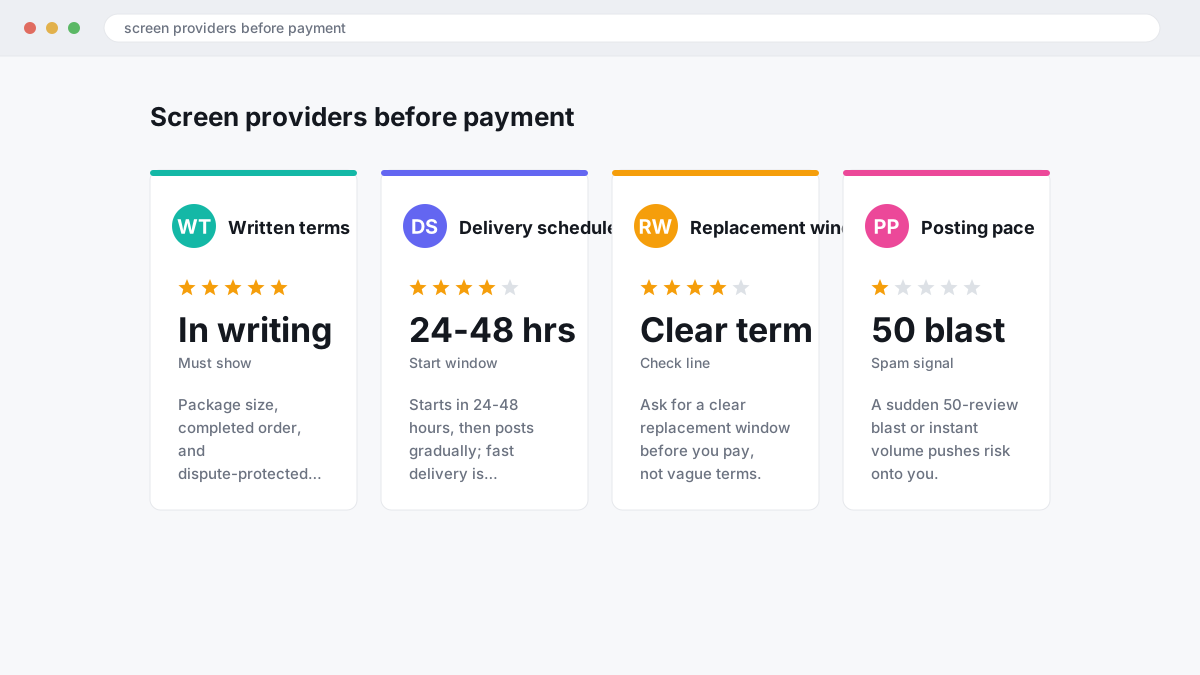
- Ask for the terms in writing before you pay. You need the package size, start window, posting pace, and what counts as a completed order. If a provider cannot show sample terms, treat that as the answer.
- Request the delivery schedule, not a vague promise. “Starts in 24-48 hours” and then posts gradually is a real schedule; “fast delivery” is filler. A sudden 50-review blast is a spam signal, and any seller promising instant volume is asking you to absorb the risk.
- Check the replacement policy line by line. BGR Review’s review packages carry a 30-day free replacement guarantee. If a seller claims 100 percent permanence, skip them. Google Business Profile reviews can drop after posting, and no provider controls Google’s filter.
- Pay with protection. Use a card or an escrow-enabled platform so you can dispute non-delivery or terms that change after payment. Bank transfer and crypto leave you little leverage if the seller disappears.
If the provider also sells removal, separate that quote from the review package. At BGR Review, removals are pay-after-success at $449 per removed review link with $0 upfront, which is a different model from review delivery and should be priced separately.
What happens after posting: monitoring, replies, and profile maintenance
The post-delivery phase is a 30-day monitoring job: you track the live review count, your average rating, and any reviews that vanish so you can use a provider’s replacement terms while they still apply.
Check your Google Business Profile every few days for the first month. Log the review date, star rating, whether the text changed, and whether the review is still public. If a provider offers BGR Review’s 30-day free replacement guarantee, this is the window that matters. A review can post cleanly, sit for a week, then disappear after Google’s spam systems reprocess the listing or the reviewer account loses trust.
Replying to genuine-looking new reviews helps keep the profile active in a normal way. Keep replies short, specific and human. A simple thank-you with a service detail reads better than the same templated line under every post, and it avoids adding another repeated pattern to a listing that already has fresh review activity.
Sudden edits, duplicate wording across different reviewers, or a cluster of removals usually mean the listing is still unstable. Raise that quickly with the provider, send the missing review links or screenshots, and ask whether replacements will be staggered rather than reposted all at once.
When buying reviews backfires on conversion and reputation
Buying Google reviews backfires when the posts look manufactured enough to cut trust before Google’s fake engagement systems or Google Business Profile policy enforcement remove anything. You can replace a dropped review within BGR Review’s 30-day free replacement window, but a thin one-line “Great service” review beside older detailed feedback still makes your profile look staged. That hurts the action you actually want: calls, direction requests, and enquiry clicks.
If you start getting public replies from real customers or competitors accusing you of buying reviews, the damage spreads beyond the profile itself. Those accusations can show up on branded searches, in forum threads, and in screenshots shared with prospects long before any formal takedown happens. Google may leave the disputed reviews live for a period while its systems assess them, so the trust loss can arrive first and the removal later.
A 4.6 average with believable detail usually converts better than a shaky 5.0 built from generic praise. Buyers read for specifics: staff names, delivery issues resolved, product context, and dates that make the review sound lived-in. If the profile looks too clean, people notice.
Where to go from here
Use this checklist before you pay any provider for Google reviews.
- Check the delivery window and whether posting starts in 24-48 hours or only after profile checks.
- Confirm the replacement terms in writing. BGR Review offers a 30-day free replacement guarantee on review packages, which matters because some reviews post and then drop days later.
- Ask what profile checks happen first, especially if your Google Business Profile was recently renamed, merged or suspended.
- Ask what happens when reviews do not stick, and which common filter triggers the provider watches for.
- Read the policy risk plainly. Google can remove fake engagement, and no provider can promise permanent placement.
Your next step is simple: open the buy Google Reviews service page, compare package options, and send your questions before ordering. You should expect clear package details, a profile review before work starts, a stated delivery window, and a straight answer on replacements if reviews drop inside 30 days.
If you want to sense-check your situation first, ask about your profile history, target pace and any recent changes to the listing. Those three details usually decide whether a campaign runs cleanly or runs into Google’s filter.