


Quick answer
Yes. Google reviews affect ranking most clearly in Google Business Profile map results, because Google Business Profile Help states that review count and review score factor into local search ranking. The effect is strongest on local pack visibility, prominence, click-through rate and trust, rather than acting as a direct shortcut to better organic rankings for your website. In practice, the order that usually moves results first is your average score, then your review volume against nearby competitors, then review text that mentions real services, staff, and locations in a natural way.
We wrote this from the operator side, not the generic SEO-blog side. BGR Review has served 15,000+ businesses and logged 12,000+ negative review cases between June 2025 and June 2026, with outcomes tracked as removal success, unresolved, or unknown rather than quietly classing unknowns as failures.
That matters because the real decision is rarely “do google reviews matter?” It is whether you should push for fresh review requests, build a proper evidence pack for a fake-review dispute, or stop wasting time on a weak removal request that only used the in-profile report button — the route roughly 90% of failed self-filed cases had used before coming to us, according to BGR Review’s case records.
Where do Google reviews change visibility first: Maps positions, website SEO, or clicks?
Google reviews usually change click-through and local pack competitiveness before they change classic organic rankings. When your review count, score or recency improves, your Google Business Profile often wins more map-pack attention first, while website SEO gains tend to arrive later through better clicks, stronger branded search demand and higher local trust.
Most guides lump Maps and website SEO together. That fails because Google Business Profile signals and organic rankings run on different mechanisms: reviews sit directly on the profile that competes in local pack rankings, but your category page or service page still depends on its own relevance, links, technical health and on-page content. In BGR Review's dataset of 1,485 businesses observed from February to July 2026, reaching 20-30 reviews over the first three months was associated with improved local visibility for new trades and local service businesses, with other ranking factors active at the same time. That is a Maps signal first, not proof that your website will jump in classic organic results.
The right way to track this is to split the outcomes for 8-12 weeks instead of watching one blended report. Check your Google Business Profile performance for calls, direction requests and website clicks; track local pack rankings by target query and service area; then track organic rankings and landing-page sessions separately in Search Console and analytics. In BGR Review's dataset of trades businesses with complete enquiry-source data, observed February to July 2026, 70-80% of calls and bookings were attributed to a Google Business Profile or Yelp listing rather than a website, which is why click-through rate and map visibility usually move revenue before organic rankings do.
This comparison keeps the signals clean.
| What changes | Where you usually see it first | How to measure it over 8-12 weeks |
|---|---|---|
| Review count, score, recency | Google Business Profile engagement and local pack rankings | GBP performance, map rank tracker, calls and direction requests |
| Better trust from review text and profile quality | Higher click-through rate from the map pack and branded searches | GBP website clicks, Search Console branded queries, form fills |
| Website SEO lift | Organic landing pages, usually later and less directly | Organic positions, non-brand clicks, service-page conversions |
How do Google reviews actually feed local ranking signals?
Google reviews affect local pack visibility by strengthening prominence and relevance inside your Google Business Profile; they do not cancel out proximity. A steady flow of credible reviews, fresh activity and specific review text makes your profile more competitive once your category setup and searcher-location match are already sound.
Most guides stop at correlation: more reviews, higher ranking. That fails because it skips the mechanism. Google’s local systems already weigh relevance, distance and prominence in Google Business Profile results, as Google Business Profile Help explains; reviews feed two of those three. A larger, healthier review profile can increase prominence, while review text that mentions “emergency plumber”, “boiler repair” or a service area such as “Brooklyn” can reinforce relevance by giving Google more context around what you do and where users associate you with doing it.
The right way to read this is narrower and more useful. If two profiles are similarly close to the searcher, use the same primary category, and have comparable business information, the one with stronger review signals usually competes better in the local pack and tends to earn more map-pack click-through rate once shown. In BGR Review’s dataset of 1,485 businesses observed February to July 2026, new trades and local service businesses that reached 20–30 reviews over the first three months were associated with improved local visibility, though other ranking factors were active at the same time.
Proximity still sets a hard ceiling. A dentist with 500 reviews in North London will not reliably outrank a nearer, relevant dentist for a searcher standing in Soho just because the review count is bigger. Reviews help your Google Business Profile win more often within its realistic radius; they do not let you rank everywhere.
Which review signals move the needle fastest when competitors are already close?
When nearby competitors already look similar, fresh genuine reviews and stronger review text usually shift momentum faster than trying to close a huge lifetime review count gap. Your star rating changes click-through rate fastest once your Google Business Profile is already showing in the local pack, but a small score gap rarely reshuffles every map result on its own.
The wrong move is obsessing over a rival with 300 reviews when you already have enough review count to be compared. In BGR Review's dataset of 1,485 businesses observed from February to July 2026, trades profiles often gained local visibility as they reached 20-30 reviews in the first three months; once profiles in the same category were already in a similar band, review recency usually became the faster lever because Google had new trust and activity signals to read. Big lifetime totals help prominence, but stale profiles lose ground to businesses collecting steady month-by-month feedback.
This comparison is the practical order to work in when positions are close and proximity and relevance are already similar.
| Signal | What changes first | What usually works |
|---|---|---|
| Review recency | Maps momentum and local pack competitiveness | Keep new reviews arriving consistently instead of in one burst |
| Review score | Click-through rate and conversions | Lift the average with legitimate new reviews and owner responses |
| Review text and keywords | Service relevance | Let customers mention the actual job naturally, without city-keyword stuffing |
Most guides overstate rating gaps. A 4.8 versus 4.6 can win more clicks and more calls because searchers compare stars before they compare websites, yet if both profiles are equally close to the searcher and both Google Business Profiles are complete, that gap does less for rank than fresh reviews that mention “boiler repair”, “emergency call-out” or another real service in plain language. Stuffed phrases like “best plumber London” read unnatural, help less, and can make the review look less trustworthy to both users and Google's spam systems.
What should you do after a bad Google review if rankings matter?
After a bad Google review, decide fast whether you need a public reply or a removal attempt. A calm owner response protects calls, bookings and form fills quickly, while negative review removal only makes sense when the post breaks Google Business Profile review policy through fake, off-topic, abusive or prohibited content.
The wrong move is to panic-flag everything and say nothing publicly. That fails because disagreement, poor service feedback or a low star rating alone is not a removal ground, and the review stays visible while your click-through rate drops in the local pack. If the review is real and live, reply within 24-72 hours: acknowledge the issue, correct any false point you can prove, and move the conversation offline so your review score takes one hit instead of becoming a trust problem across the whole profile.
The right move is split handling. Use owner responses for genuine complaints, then reserve flagging for policy cases with evidence such as order records, booking history, screenshots, or proof the reviewer was never a customer; across negative review cases with prior self-filed attempts logged by BGR Review from June 2025 to June 2026, roughly 90% had used only the basic report button and 70-80% of those initial requests were rejected. One bad review rarely moves Maps visibility on its own, but a visible run of unanswered negatives can depress clicks before rankings change; if you need help on a policy breach, BGR Review handles removals at $0 upfront and $449 per removed review link.
Can fake, abusive, or off-topic reviews be removed — and what evidence works?
Fake, abusive, or policy-breaching Google reviews can be removed, but the result depends on matching the review to a specific rule and backing that claim with evidence Google can check. The strongest negative review removal requests show that the reviewer could not have been a real customer of the Google Business Profile they targeted.
The wrong approach is treating every bad review as removable because it feels unfair. Google removes reviews that breach its Maps user-contributed content rules, including spam and fake content, harassment, profanity, conflicts of interest, and off-topic posts; it does not remove a harsh opinion from a genuine customer just because the rating hurts. If the review says “slow service” and that person did visit you, your best move is a response and fresh review generation, not a weak policy flag.
The right approach is building an evidence pack around one policy ground. For a fake customer claim, that usually means CRM records, booking logs, invoices, call history, staff rotas, and contact-history gaps for the date the reviewer describes. If someone claims they attended at 3 pm on Tuesday, but your diary was closed, no staff were scheduled, and no phone, webform, payment, or walk-in record exists under the name or facts in the post, that gives Google something testable.
Escalation takes time. In BGR Review’s log of 12,000+ negative review cases recorded June 2025 to June 2026, reviews raised within 28 days of posting and tied to an identifiable policy issue resolved successfully in roughly 90% of cases; for comparable cases raised after 28 days, the observed success rate fell to approximately 25–30%. Across that same case file, roughly 90% of businesses coming to us after a failed attempt had used only the in-platform report button, with no supporting documentation, and 70–80% of those initial requests had been rejected.
Repeat flags rarely improve a weak file. On a Google Business Profile, you usually start by reporting the review, then submit supporting context through the review management route if Google asks for more, and only escalate when you can show the original flag missed a clear spam and fake review policy issue. If you want outside help, BGR Review handles removal on a pay-after-success basis at $449 per removed review link with $0 upfront, but plenty of owners should file the first evidence-backed request themselves.
Can buying Google reviews hurt rankings or even get a profile suspended?
Yes. Buying Google reviews can reduce visibility because Google can filter the reviews, distrust the profile, or suspend the Google Business Profile for policy abuse. The risk widens in the US if a paid or incentivised endorsement is left undisclosed under the FTC's 2024 Rule on the Use of Consumer Reviews and Testimonials.
The wrong move is chasing a fast lift in review count or review score with reviews from people who were never real customers. That collides with Google's spam and fake review policy and its misrepresentation rules, so the apparent boost often fails before it helps: reviews vanish, stop counting, or leave a profile looking manipulated if several land with thin text, weak account history, or the same timing pattern. A higher star average means little if Google stops trusting the signals behind it.
The safer route is earning reviews from genuine customers and keeping the request process clean, documented, and platform-compliant. Legal rules also vary by country and platform, including FTC disclosure rules in the US and UK consumer-protection enforcement on fake reviews, so this is general information rather than legal advice.
Is a managed review service safer or faster than asking customers yourself?
A managed review help service is usually faster at follow-up and reporting, while asking customers yourself gives you tighter control and less compliance risk. The better fit depends on your review volume, your team's spare time, and whether the provider follows Google-safe request practices on your Google Business Profile.
The wrong move is signing a monthly retainer because it promises speed, then letting a provider push every customer through the same script. That often fails on quality: weak context produces thin review text, uneven review recency, and sometimes behaviour that drifts into Google's spam and fake review policy territory if requests look incentivised, filtered, or sent to the wrong people. Fast follow-up helps. Sloppy follow-up creates a bigger problem.
The right move is simpler. If you can ask at the point of delivery, job completion, or checkout, DIY usually gives the safest control over timing, message, and customer context. If your staff miss those moments, a managed service can speed up reminders and reporting, but you should check the request flow, approval steps, and replacement terms before paying for automation.
This comparison is the one worth making before you sign anything.
| Option | Speed and control | Risk and cost check |
|---|---|---|
| Ask customers yourself | Best control over who gets asked, when, and why; slower if staff forget | Lowest policy risk if you ask all genuine customers fairly; staff time is the real cost |
| Managed service | Faster reminders, tracking, and volume handling | Check platform compliance, message templates, and whether pricing is monthly or package-based; at BGR Review, review packages carry a 30-day free replacement guarantee rather than an open-ended retainer promise |
Which review fixes usually deliver ROI first for a local business?
The best ROI usually comes in this order: restore a steady asking process, fix the service issues pulling your rating down, then tighten responses and review text quality. Chasing raw volume first usually burns effort because a weak review score and stale review recency suppress click-through rate before any extra review count pays back.
Most guides push volume-first campaigning. That fails when your Google Business Profile is already leaking clicks in the local pack. In BGR Review's dataset of 1,485 businesses observed from February to July 2026, new trades and local service firms that built toward 20-30 reviews over the first three months were associated with better local visibility, but that lift depended on other ranking factors moving with it. If your last ten reviews expose missed calls, late arrivals or billing disputes, asking harder just amplifies the problem and gives more searchers a reason to pick the listing under you.
This is the order worth following if you want payback fastest.
| Priority | Fix | Why it pays back first |
|---|---|---|
| 1 | Restore request flow after each completed job or visit | No request system means no review pipeline, weak recency and fewer fresh signals for Maps clicks. |
| 2 | Repair the cause of low ratings before scaling asks | A 4.2 profile asked aggressively usually converts worse than a 4.4 profile with cleaner service and fewer complaint themes. |
| 3 | Focus on the location already getting impressions | At a high-visibility branch, even a 0.2-star lift can change click choice faster than broad work across low-traffic locations. |
If you manage several locations, start where impressions are already there and the local pack race is tight. That is where review score and review recency change click-through rate fastest, often before website SEO moves at all. If you want outside help, BGR Review sells managed review services with a 30-day free replacement guarantee, but the cheaper route is often internal: fix the ask trigger in your CRM, train staff on timing, and only then scale volume.
Do reviews matter more when you run multiple locations instead of one?
Yes. Reviews usually matter more in a multi-location setup because each branch needs its own local proof of trust in Google Business Profile. A strong network-wide reputation does not make one weak branch more competitive in local pack rankings near the searcher.
The wrong approach is managing reputation at brand level and celebrating a group average, such as 4.8 stars across all sites. That fails because Google ranks the nearby branch, not your head office scorecard, and the branch with thin review count, stale review recency or a weaker review score will still lose clicks, calls and map-pack visibility to a closer competitor with a healthier local profile. In BGR Review's dataset of 1,485 businesses observed February-July 2026, established practices such as dentists, lawyers, accountants and roofers typically needed 30-50 reviews before profiles performed consistently; one branch hitting that mark does nothing for another branch sitting on eight old reviews.
The workable approach is branch-level targets. Set a separate floor for review count, a minimum acceptable review score, and a recency rule for each location, then build routing, request templates and escalation rules across 10+ profiles so every new review lands on the right branch page, every low-rating alert reaches the local manager fast, and every underperforming location gets attention before branded search demand masks the problem.
What customer review request can you send without sounding pushy or breaking rules?
Send a short, neutral review request within 24 hours of the job finishing: thank the customer, ask for honest feedback, and include one direct Google Business Profile review link. Skip discounts, gifts, “5-star” language, and any filter that asks only happy customers, because Google allows review requests but bars review gating and other deceptive engagement.
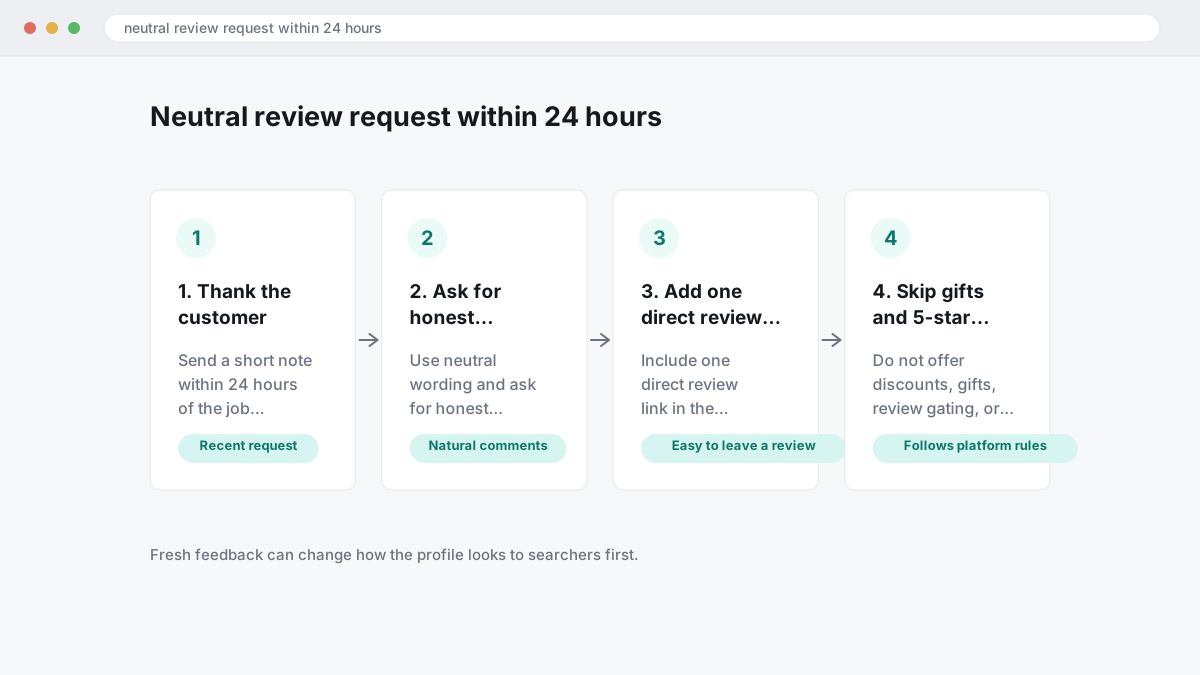
The pushy version fails for two reasons. It breaks platform rules when you screen sentiment first or reward the review, and it usually produces awkward, over-written feedback that helps less than natural, recent comments. Review recency matters because fresh feedback changes how your profile looks to searchers first, and that can lift local pack click-through before any ranking movement shows up.
Use wording like this:
Thanks again for choosing us today. If you have a minute, please leave an honest review here: [direct Google review link]. Your feedback helps other customers find us and helps us improve.
Keep it that plain. One sentence of context, one link, no follow-up pressure. If you use a CRM or job-completion text, trigger it the same day while the service details are still clear in the customer’s mind.
How should you measure whether review work is affecting rank, clicks, or revenue?
Measure review impact by separating ranking metrics from conversion metrics. Track weekly local pack rankings, Google Business Profile actions, and lead outcomes across an 8-12 week window so you can see whether reviews changed visibility, click-through rate, or both.
The wrong approach is watching one vanity metric, usually star rating or a rank tracker screenshot, and calling that proof. That fails because local pack rankings move with proximity, category competition, and profile edits in the same week, while organic rankings often lag or barely move at all; a review push can lift map-pack click-through rate and calls before your website SEO changes. In BGR Review's dataset of trades businesses with complete enquiry-source data, observed February-July 2026, 70-80% of calls and bookings were attributed to a Google Business Profile or Yelp listing, which is why profile actions matter more than website sessions for many local firms.
The right model is simple: log weekly map positions for your priority terms, record Google Business Profile calls, direction requests and website clicks, then note every review gain, review response, category edit, photo update and service-area change in the same sheet. Compare those changes against organic rankings over the same 8-12 weeks, because daily swings hide signal and seasonality; if clicks and calls rise while positions hold, reviews are improving click-through rate and conversions before rank catches up. If you use a managed service, keep that reporting separate from delivery terms such as BGR Review's 30-day free replacement on review packages, so you do not confuse fulfilment with performance.
Where to go from here
Your next move is simple: audit three things on the same sheet — average score, the gap between you and the top local pack profiles on review count, and the quality of the review text on your Google Business Profile. If your rating is acceptable but your review velocity is flat, fix request timing first. If your count is healthy but thin on detail, improve the prompt so customers mention the service, location and outcome. If one or two damaging reviews are suppressing click-through rate, calls and branded search demand, deal with those before you chase volume.
Expect different problems to move at different speeds. Fresh, detailed reviews can improve conversion and map-pack click appeal quickly; organic rankings usually move more slowly. Removal only works when a review breaks Google policy or you can evidence a clear issue. If that is the blocker, the next practical page is review removal support.