


Quick answer
Buying Google reviews is usually unlawful or high-risk in the way most owners mean it: paying for fabricated, brokered or undisclosed reviews. It breaches Google Business Profile’s fake engagement policy, which can trigger review removals, profile restrictions or full suspension. In the US, the FTC’s final rule on fake reviews took effect in 2024, giving regulators a clearer path to act against fake or undisclosed incentivised reviews. The safer route is simple: ask real customers for honest feedback, and disclose any lawful incentive exactly as platform rules require.
We work on Google review disputes, removals and profile recovery every day at BGR Review, alongside verified review campaigns and pay-after-success removals at $449 per removed review link with $0 upfront. The part most guides skip is what happens after a bought campaign lands: sudden review velocity spikes, thin reviewer histories, repeated phrasing, then partial removals that leave your profile looking worse than before.
If you are searching Is buying Google reviews legal, you usually do not need theory. You need the real split between consumer law, Google policy and the cleanup work that starts when an appeal form gets auto-rejected and a suspended profile stops converting.
Quick answer
Buying Google reviews is usually a bad legal bet: it is not automatically criminal on its own, but it often breaches consumer protection rules on deceptive endorsements, and it squarely breaches Google's user-contributed content policy on fake engagement and misrepresentation.
Google can start removing suspicious reviews within days, while regulatory or civil claims can run for years under rules enforced by bodies such as the US FTC and the UK CMA. We sell review services at BGR Review, so the commercial point matters here: a 30-day free replacement guarantee on a review package does nothing to fix the underlying Google policy breach or legal exposure.
Introduction
This page separates three different risks: consumer law, Google Business Profile policy, and Google’s own enforcement against review spam.
The scope is narrow on purpose. It deals with Google Business Profiles and the Google Business Profile review policy, not Amazon, Yelp, app stores or Trustpilot.
In live clean-up work, the sequence is usually the same: the reviews breach platform policy on day one, then legal exposure appears if regulators, competitors or customers can show deception. That distinction matters if you are weighing review packages against removal work billed at $449 per removed link with $0 upfront.
The short legal answer for businesses
Paying for positive Google reviews without clear disclosure can expose your business to deceptive advertising risk, and the legal safe zone is narrow. In the US, the FTC’s Endorsement Guides require disclosure of any material connection between the reviewer and the business, which includes cash, discounts, gifts or free products. If you pay for praise and the review reads like an independent customer opinion, that is the problem.
A lawful edge case exists only where the incentive is disclosed clearly and the platform allows that kind of review collection. Those two conditions have to sit together. If a reviewer says they received a discount or free service, and the platform’s own rules permit incentivised feedback, your legal position is stronger than with undisclosed paid praise. Google’s rules are stricter than that edge case, which is why legal compliance and platform compliance split in practice.
BGR Review sells review growth and review-removal services, so the commercial interest here is obvious, but the legal answer does not change: undisclosed paid reviews are risky. If you are already dealing with harmful review issues, our removal work runs on a pay-after-success model at $0 upfront and $449 per removed review link. That service does not change the underlying advertising law around buying praise.
Why legality and Google policy are not the same thing
Legality and Google policy are separate tests: a review campaign can breach Google’s prohibited and restricted content rules without creating a regulator case, and a campaign can avoid a clear local law breach yet still lose reviews or access to a Google Business Profile.
Google enforces a contract. When you use Google Business Profile, you agree to its review policy and Google decides what stays live on the platform. A court or regulator applies statutes, evidence and consumer harm instead. That is why a paid-review push can vanish from your profile even where nobody files an FTC complaint in the US or raises a CMA issue in the UK under the Digital Markets, Competition and Consumers Act 2024.
| Who acts | What they apply | What usually matters |
|---|---|---|
| Google Business Profile review policy | Spam signals, authenticity, account quality, platform integrity | |
| Courts and regulators | FTC rules, CMA and consumer law, local statutes | Disclosure, deception, proof of payment, consumer harm |
That split matters if you are weighing risk against cost. A package can look cheap beside BGR Review’s removal model of $449 per removed link with $0 upfront, yet the first damage often comes from Google itself: removals, disabled review posting, or profile friction during appeal. Legal exposure usually needs stronger evidence and a claimant or regulator willing to build the case.
What Google actually prohibits in its review policy
Google’s review policy prohibits any review content posted to manipulate a place’s rating, mislead users, or hide a real connection to the business. Google groups this under fake engagement and conflict of interest in its Google Maps user-contributed content policy, the rule set tied to Google Business Profile reviews. The wording matters: enforcement usually points to content integrity problems such as “fake engagement” or “conflict of interest”, even when the business says the intent was “marketing” or “reputation repair”.
Fake engagement covers reviews that are bought, mass-requested from unrelated accounts, posted from accounts that did not have a genuine experience, or coordinated to change star averages. Google also bars reviews from owners, employees, current staff, former staff acting on instruction, and competitors. If you pay for review packages, including services like BGR Review’s verified review campaigns with a 30-day free replacement guarantee, that commercial arrangement does not override Google’s own rulebook. The platform judges whether the review itself is authentic and independent.
Conflict-of-interest wording causes more enforcement trouble than most owners expect. A review can look positive, detailed, and well written, then still fall because the reviewer has a business connection Google considers undisclosed or inappropriate. That is why appeal responses often refer back to policy categories rather than your explanation of intent, and why a profile can lose review count without Google accusing you of “buying reviews” in so many words.
Where businesses face real legal exposure
Businesses face real legal exposure for bought Google reviews when regulators or private plaintiffs treat those reviews as deceptive endorsements, unfair practices, or false advertising rather than as a simple Google Business Profile policy breach.
If you are weighing any paid review service, including BGR Review’s own verified review packages, the legal question starts outside Google. In the US, the FTC’s Fake Reviews and Testimonials Rule took effect on 21 October 2024 and gives the agency a direct route to challenge reviews that misrepresent real consumer experience. Regulators also use Section 5 of the FTC Act, state unfair and deceptive acts and practices laws, and false advertising theories where review content influences purchase decisions.
| Claim type | Who brings it | What they allege |
|---|---|---|
| Deceptive endorsements | FTC or state attorney general | Reviews present paid or fabricated opinion as genuine customer speech |
| Unfair or deceptive practices | State regulator | Review manipulation distorts consumer choice and local search competition |
| False advertising / unfair competition | Competitor or marketplace plaintiff | Star rating and review claims create a misleading commercial advantage |
State claims often make the case more expensive than the federal theory. A single investigation can stack FTC allegations with state consumer protection counts, and some states add per-violation penalties or injunction risk. In the UK, the Digital Markets, Competition and Consumers Act 2024 also squarely targets fake reviews, which matters if your customer base or reviewer pool touches the UK.
Civil exposure is the part most buyers miss. A competitor does not need Google to suspend your profile before claiming unfair competition, lost sales, or reputational harm from manipulated ratings. That is why we tell readers the same thing we tell removal clients paying $449 per removed review link with $0 upfront: platform trouble is one layer, legal discovery is another, and the second one is harder to clean up.
How authorities and plaintiffs build a fake-review case
Authorities and private plaintiffs usually build a fake-review case by proving a pattern, not by arguing over one suspicious Google review. A single post can be defended as a real customer with poor wording; 30 reviews landing in 48 hours, from accounts with thin history and near-identical phrasing, is much harder to explain honestly. That pattern matters more than any one star rating because it points to coordination, which is the core issue under the FTC’s rules on endorsements and testimonials and under UK fake-review enforcement.
The evidence stack is usually mundane. Payment records to a review seller, Upwork or Fiverr messages, WhatsApp or Telegram instructions, shared login details, and bank or card descriptors do more damage than the review text itself. Add timing clusters, repeated language, reviewer accounts created within the same window, and technical links such as matching IP data or device fingerprints from a platform investigation, and the case stops looking like marketing sloppiness. In removal work, BGR Review asks for receipts, chat logs and the exact review URLs before we assess a pay-after-success case at $449 per removed link, because the paper trail often decides whether a defence has any chance.
A badly explained spike is what turns suspicion into a file. If your profile picks up 30 five-star reviews over a weekend after months of flat activity, you need clean source records for each customer, or the other side will fill the gap for you. Plaintiff lawyers and regulators often line up the dates first, then show the payments, then show the messages arranging quantity, wording or timing. That sequence is simple, visual and persuasive.
What actually triggers removals, suspensions and profile damage
Removals, suspensions and profile damage usually start when Google sees an unnatural review pattern: a sudden velocity spike, weak reviewer accounts, and repeated reports under the Google Business Profile review policy.
A normal profile can lose reviews in batches before you see any public suspension notice. That is the part most owners miss. Google often filters first and explains later, so you wake up to 8, 15 or 30 missing reviews while the profile still looks live in Search and Maps. The common triggers are obvious at operator level: several reviews land inside 24-72 hours, many accounts have little or no local contribution history, the wording overlaps too closely, or the reviewers sit in locations with no believable link to your service area.
Repeated policy reports add pressure fast. One competitor report usually does nothing. A cluster of reports tied to the same review set, especially when the reviewer accounts are thin, can push the profile into manual review. In clean-up work that comes to BGR Review after a bought-review run, the damage usually appears in this order: first a batch drop, then review posting slows or stops, then edits to the profile start getting stuck in pending, and only after that does a visible suspension sometimes arrive.
If suspension hits, reinstatement is rarely quick. Google Business Profile support can take weeks to resolve a reinstatement request, and the reply often names a broad policy bucket rather than the exact trigger. That appeal friction is one reason some owners pay for remediation later; BGR Review handles removals on a pay-after-success basis at $449 per removed review link with $0 upfront, but profile reinstatement itself is never something you should treat as guaranteed.
What bought reviews really cost compared with organic review growth
Bought reviews usually look cheaper on day one, but they get expensive fast once you count removals, refund disputes, profile damage and the clean-up work that follows.
| Approach | Typical spend | What the bill becomes |
|---|---|---|
| Bought review packages | $5 to $50 per review, usually higher for aged accounts or target-country profiles | Short-lived lift, then deleted reviews, replacement requests, and in the worst case a suspended Google Business Profile |
| Organic review system | Higher upfront setup and staff time | Slower growth, but fewer disputes, fewer removals, and no later legal clean-up tied to fake endorsements |
The hidden cost is profile equity. One suspension can wipe out years of local ranking momentum, branded search trust and the review count you built before the bought campaign started. That is why clean-up work often costs more than the original package: if you need review removals, BGR Review charges only after success at $449 per removed review link with $0 upfront, and that still does not restore the lost ranking signals overnight.
If you want durable growth, pay for the system, not the shortcut. A proper ask flow, staff training and follow-up sequence cost more upfront, but they avoid the 30-day replacement cycle that comes with purchased review packages and they keep you out of refund arguments with a vendor after Google removes the lot.
The risky grey area of incentivised and solicited reviews
Incentivised and solicited reviews sit in a grey area because asking every real customer for honest feedback is usually acceptable, while rewarding only satisfied customers or filtering out unhappy ones distorts the rating picture.
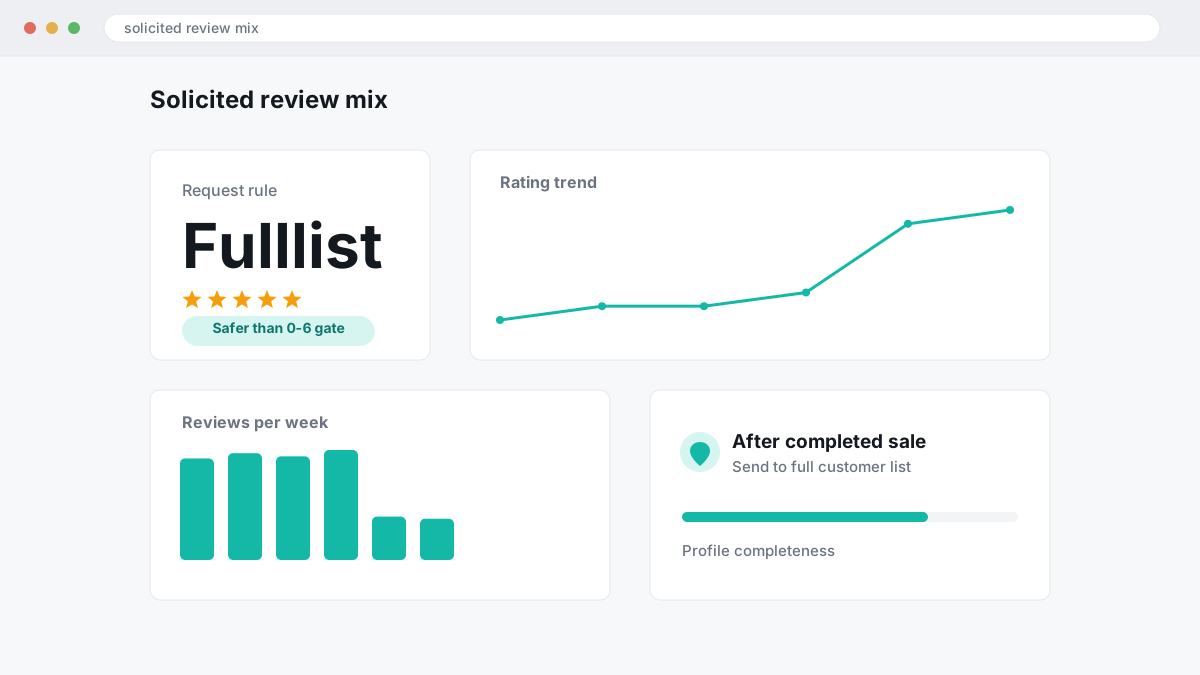
If you send the same review request to your full customer list after a completed sale, you are much safer than if you use an NPS survey, hold back anyone scoring 0-6, and only push 9s and 10s to Google. Google Business Profile guidance tells merchants not to discourage negative reviews or selectively solicit positive ones, and regulators have taken the same view because gating changes what the public sees. The UK’s Digital Markets, Competition and Consumers Act 2024 and the FTC’s rule on fake reviews and testimonials, effective 21 October 2024, both treat manipulated review flows as a consumer-protection issue.
Disclosure does not fix everything. A review that says “I got a discount for this” can still breach platform policy if the reward was tied to leaving a review, a positive tone, or a public post rather than neutral feedback. That is the line we explain to buyers considering BGR Review packages with a 30-day free replacement guarantee: broad, neutral solicitation to real customers is the low-risk route; paid positivity is where policy and legal exposure start to stack up.
What businesses should do if they have already bought reviews
If you have already bought Google reviews, stop every active order now, keep the evidence, and audit the last 90 days of review activity before you touch the profile.
Pause card payments, Telegram or WhatsApp chats, email threads, order dashboards, and any spreadsheet that links reviewer names to delivery dates. Do that before you delete vendor messages. Google Business Profile reinstatement and review appeals move better when you can show what was purchased, when it landed, and which reviews are tied to the campaign, even if that record is awkward to keep.
Start the audit with a 90-day window. Check review dates for unnatural bursts, then read the text for repeated phrasing, generic service language, city-name stuffing, or reviews that mention details no real customer would know. Check the reviewer accounts as well: thin histories, one-photo profiles, reviews across unrelated countries, or a string of same-week posts are the accounts that usually disappear first when Google applies its spam filters.
A workable cleanup plan has three parts: remove what you can, review the policy breach, and rebuild with real customers. Removals can mean asking the vendor to pull posts, flagging reviews that clearly breach Google’s review policy, or using a pay-after-success service where the commercial terms are explicit; BGR Review charges $449 per removed review link with $0 upfront. Then fix your intake process and ask genuine customers for feedback through normal post-purchase or post-service follow-up, not through a review seller.
Our operator view on whether buying Google reviews is ever worth it
Buying Google reviews is rarely worth it because the usual result is a short rating bump followed by removals, replacement requests and a weaker profile than the one you started with.
The lift can look good for a week or a month. Then the attrition starts. Reviews disappear, star averages slip back, and you end up chasing a 30-day replacement guarantee instead of fixing the reason real customers were not reviewing you in the first place.
Vendor footprints are usually more obvious than buyers expect. The names cluster, the posting times stack too neatly, and the language starts to rhyme: short praise, generic service mentions, thin local detail. Once that pattern sits on a profile, appeals get harder because each new review is judged against the rest of the set, not in isolation.
We sell review growth services, so the commercial answer would be easy to spin. The honest one is simpler: if you need bought reviews to convert, your review generation system is the problem. Fix the ask timing, train staff, clean up fulfilment issues, and build a process that keeps producing reviews without constant replacement.
Where to go from here
Skip the bought-review shortcut. Google treats incentivised, misleading and spammy review activity as a policy problem, and regulators such as the FTC in the US and the CMA in the UK treat fake endorsements as a consumer protection issue. The practical risk is simple: you can lose reviews, lose trust, and end up with a harder profile to defend when a real complaint lands.
If your Google Business Profile already shows sudden review spikes, weak reviewer histories, duplicate wording or removals that came in batches, start with an audit. Check review dates, reviewer profiles, text overlap, star-rating clustering and any recent profile edits or suspensions. That gives you a clean-up plan instead of guesswork.
Expect the audit to sort issues into three buckets: reviews you should leave alone, reviews that may be removable under Google’s review policy, and profile patterns that need to stop before they trigger more filtering. At BGR Review, that usually means a manual review of the live profile first, then removal work only where there is a valid route; removals are handled on a pay-after-success basis at $449 per removed review link with $0 upfront.