


Quick answer
Reputation affects revenue because reviews change where you appear, whether people click, and whether they trust you enough to enquire or buy. A drop from 4.7 to 4.2 stars can suppress leads before your sales team speaks to anyone, and the loss compounds when negative reviews sit unanswered. On Google, prospects weigh review count, recency and owner replies alongside star rating, while removal only works when a review clearly breaches Google Business Profile policy or another platform's rules. The practical fix is measurable: respond faster, generate new verified reviews steadily, and challenge policy violations properly.
This page is written from live ORM work, not theory. We handle review generation and removals across Google, Trustpilot, Yelp, Clutch and TripAdvisor, and the pattern is consistent: weak flags usually die in the first pass, while a precise policy citation and the right evidence field can decide the case.
BGR Review has served 15,000+ businesses, with review packages backed by a 30-day free replacement guarantee and removals priced at $449 per removed review link with $0 upfront. That matters here because revenue risk from reputation becomes clearer when you have seen what happens on day 3 after a bad review lands, and what still sits unresolved three weeks later.
Quick answer
Reputation affects revenue because it changes who clicks, who contacts you, who buys, who comes back, who refers you, and how much you can charge without pushback. In live review recovery work at BGR Review, a 0.5-star drop is often enough to dent leads and booked revenue inside 30 days, especially on Google Business Profile where star rating shows before the click. Average rating matters, but it never works alone; review volume, recent review flow, and whether you respond to complaints all shape the money outcome.
Introduction
Reputation affects revenue when it changes clicks, calls, bookings, and closed sales across the places people check before they buy. This guide tracks that path on Google, Yelp, Trustpilot, and marketplace review environments, using practical signals you can measure rather than vague sentiment scores.
BGR Review sells review growth and negative review removal, so the commercial angle is clear. The useful part for you is the operator detail: flagging rarely fixes a weak case, response timing changes fallout, and removal usually works only when a review clearly breaches a named platform policy such as the Google Business Profile review policy.
How reputation turns attention into revenue
Reputation turns attention into revenue by deciding whether you get the first click, call, or tap before your price, location, or offer is even compared. On Google Business Profile, your star rating and review count sit in the local pack before a buyer reaches your site, menu, or booking page. That is why clients who come to BGR Review for review growth or pay-after-success removal at $449 per removed link usually start with a traffic problem that looks like a sales problem.
Trust signals lift conversion at every step because each step asks for a small risk decision. A searcher chooses your listing, then your site, then your form, then your quote, then your invoice. If the profile looks weak at the top of the funnel, fewer people reach the bottom. If the profile looks stable, recent, and answered, more do. That is also why our review packages start delivering in 24-48 hours rather than in one spike: steady proof converts better than a sudden burst that looks artificial.
The money shows up in four places you can measure: lead volume, close rate, repeat purchases, and refunds. A damaged profile usually cuts enquiry volume first, then forces your sales team to defend trust on calls, then hurts return business, and finally increases refund pressure because buyers arrived half-convinced. The 30-day free replacement guarantee on our review packages exists for the same reason: revenue follows credibility, and credibility has to hold after the first sale.
Which reputation signals customers actually use
Customers judge reputation by combining four signals at once: your star rating, total review count, review recency, and whether the complaints repeat the same issue. A 4.2 average beside a competitor at 4.7 can knock you off the shortlist in one scan, especially on Google Business Profile where the rating sits next to your name before a visitor even clicks. Review count changes the read as well. A 4.7 from 18 reviews looks less settled than a 4.7 from 280, and a six-month gap since the last review often reads like a stale profile rather than a stable one.
Higher-ticket buyers read deeper. For legal, dental, B2B and home services, they often care more about the wording inside the reviews and your owner responses than the headline score, because they are checking for competence, delays, billing disputes, and how you handle friction in public. Google Business Profile lets owners reply publicly, and that response can steady a weak review if it is prompt and specific. Thin one-line praise helps less here; detailed reviews with dates, staff names, and a clear service outcome usually carry more weight before someone picks up the phone.
How rating shifts change clicks, calls, and booked sales
A rating shift changes demand by altering how often searchers click your profile, tap call, and complete a booking before your rankings change at all.
A small drop can cut action volume fast on Google Business Profile. If your average slips from 4.6 to 4.2, fewer people choose your map listing over the one beside it, so profile views and direct calls usually fall before you see a clear position change in local pack results. That is why BGR Review treats the first 24-48 hours after a review hit as a conversion problem first and a visibility problem second.
A 1-star crisis usually damages branded search conversion even faster. Searchers who type your company name already had intent; then they see a fresh 1-star review, a lower average, or a review snippet that looks unresolved, and they bounce without calling. On the removal side, BGR Review charges $0 upfront and $449 per removed review link because removal only helps revenue if the review clearly breaches platform policy and the damaging content is still visible on the branded query.
High-consideration categories take the bigger hit. Dental clinics, law firms, cosmetic practices, SaaS vendors, and B2B agencies lose more from a rating slide because the buyer weighs risk, compares profiles, and often checks more than one platform before booking. A coffee shop can survive a rough week more easily; a clinic that falls near 4.0 may lose booked consultations long before it loses traffic.
Why review volume and review velocity change revenue faster
Review volume changes revenue because people trust fresh proof more than stale proof, and review velocity changes revenue because a steady flow of new feedback makes your business look active right now.
Twenty reviews posted in the last 60 to 90 days usually do more for conversion than twenty reviews from two years ago. A buyer checking your Google Business Profile or Trustpilot page is trying to answer a current question: are people still having a good experience this month. Old five-star reviews still help, but they stop carrying the same weight once the date stamps look neglected.
Steady monthly volume works better than bursts. If new reviews arrive every month, your profile signals live operations, ongoing service quality, and a customer base that still engages after purchase; that lifts trust faster than a dormant profile with a high lifetime total. This is why BGR Review paces review delivery into a drip rather than a single drop, even though fulfilment can start in 24-48 hours.
One-day spikes create the opposite problem. Yelp's recommendation software and Google's spam systems both look for unnatural patterns, and buyers do too when they see fifteen near-identical reviews land on a Tuesday afternoon. The faster route can cost you visibility, filtered reviews, or a trust hit that wipes out the gain.
How negative reviews hurt revenue differently by business type
Negative reviews cut revenue on different timelines: restaurants lose walk-in traffic within days, medical and legal practices carry trust damage for longer, and SaaS or ecommerce can often contain the hit if the reply is fast and specific.
| Business type | Main revenue risk | Why the impact differs |
|---|---|---|
| Restaurants | Immediate drop in walk-ins and same-day bookings | Google Business Profile and Yelp surface recent hygiene, waiting-time, and staff-conduct complaints where mobile searchers make fast decisions. A visible food safety comment can hurt tonight's covers, not next quarter's pipeline. |
| Medical and legal | Longer trust drag on higher-value enquiries | Patients and clients read more deeply because the stakes are higher. Reviews mentioning misdiagnosis, confidentiality, billing disputes, or poor advice tend to stay in consideration longer, even when the average rating remains passable. |
| SaaS and ecommerce | Containable conversion loss | Buyers often tolerate an isolated complaint on Trustpilot or Google if support replies with dates, refund steps, or resolution terms. Strong response handling matters more here than a single low-star post. |
If you sell review support or removal, the triage should match the category. For a restaurant, you usually act first on Google and Yelp because that is where local intent converts fastest. For a clinic, law firm, SaaS brand, or store, response drafting may recover more revenue than a weak removal attempt, because BGR Review's pay-after-success removal model only applies when a review clearly breaches platform policy at $449 per removed link and $0 upfront.
When negative reviews do not reduce revenue as much
Negative reviews usually hurt less when they are outnumbered by recent positive feedback, answered quickly, and attached to a brand people were already searching for by name.
A profile with a few critical reviews can look more believable than a perfect 5.0, especially once you have enough recent, verified feedback for buyers to judge the pattern instead of one complaint. That is why some Google and Trustpilot profiles keep converting after a bad post lands: the issue reads as isolated, not systemic. If the review does not clearly breach the Google Business Profile review policy, flagging it is often a dead end, so your fastest revenue defence is the public reply.
Detailed owner responses can recover hesitant buyers within 24 to 72 hours if you address the facts, offer a fix, and avoid canned language. Strong brand demand also cushions short-term loss. A restaurant with heavy branded search, a clinic with repeat patients, or a trades firm winning from referrals can absorb public complaints for a while, even before BGR Review steps in with pay-after-success removal at $449 per link where policy grounds exist.
How response handling affects conversion and customer recovery
A well-handled review response protects conversion by showing future buyers that you deal in facts, next steps and timing, while a pasted apology usually confirms the complaint.
Fast matters because the response sits under the review where the next buyer is deciding whether to call, book or leave. Google Business Profile publicly allows owner responses, so your recovery attempt is visible on the listing itself, not buried in a support thread. In our clean-up workflow, the strongest replies usually go up within 24-48 hours: brief acknowledgment, the exact issue raised, what you have checked, and when the customer can expect an update.
Generic lines such as “We’re sorry you had a bad experience, please contact us” waste the only public space you control. A better reply names the service date or order stage if you can do so safely, states the action taken, and gives a real timeline like “we will review this by 5pm tomorrow” or “our manager has emailed you today”. That gives a hesitant buyer something concrete to trust.
Keep privacy tight. Google’s business response guidance and common sense both point the same way: never post account numbers, health details, payment data, or anything that exposes the customer. If the review clearly breaches platform policy, removal is a separate track; our service charges $449 per removed review link with $0 upfront, but a response still matters while the case is pending because flagging alone often leaves the review live.
How platforms change the revenue impact
The revenue effect of reviews changes by platform because each site sits at a different point in the buying journey, from local discovery on Google to renewal risk on Trustpilot, G2, and app stores.
| Platform | Where it hits revenue | What a rating drop usually changes first |
|---|---|---|
| Google Business Profile | Local search, Maps, calls, direction requests | Visibility in map packs, click-through, phone leads |
| Yelp | Restaurants, salons, trades, home services | High-intent comparison traffic and booked enquiries |
| Trustpilot, G2, app stores | SaaS, ecommerce, subscriptions | Signup conversion, checkout confidence, churn |
Google usually moves revenue fastest for local firms because a rating shift changes what people do inside Maps: call, visit the site, or tap directions. A weak Google profile can lose money before your homepage even loads. That is why BGR Review gets more urgent requests around Google and Yelp than Clutch or TripAdvisor when lead flow drops in a single week.
Yelp carries more weight in categories where buyers compare three options and book fast, especially food and home services. Trustpilot and G2 matter later in the funnel. They influence whether a buyer starts a trial, trusts a checkout page, or renews a subscription. If you sell software or online services, one-star swings on those platforms often show up as lower conversion and higher cancellation pressure, even when branded search traffic holds steady.
A practical model to estimate revenue at risk from reputation damage
A workable revenue-risk model starts with four inputs for the next 30 days: profile impressions, click-through rate, conversion rate, and average order value.
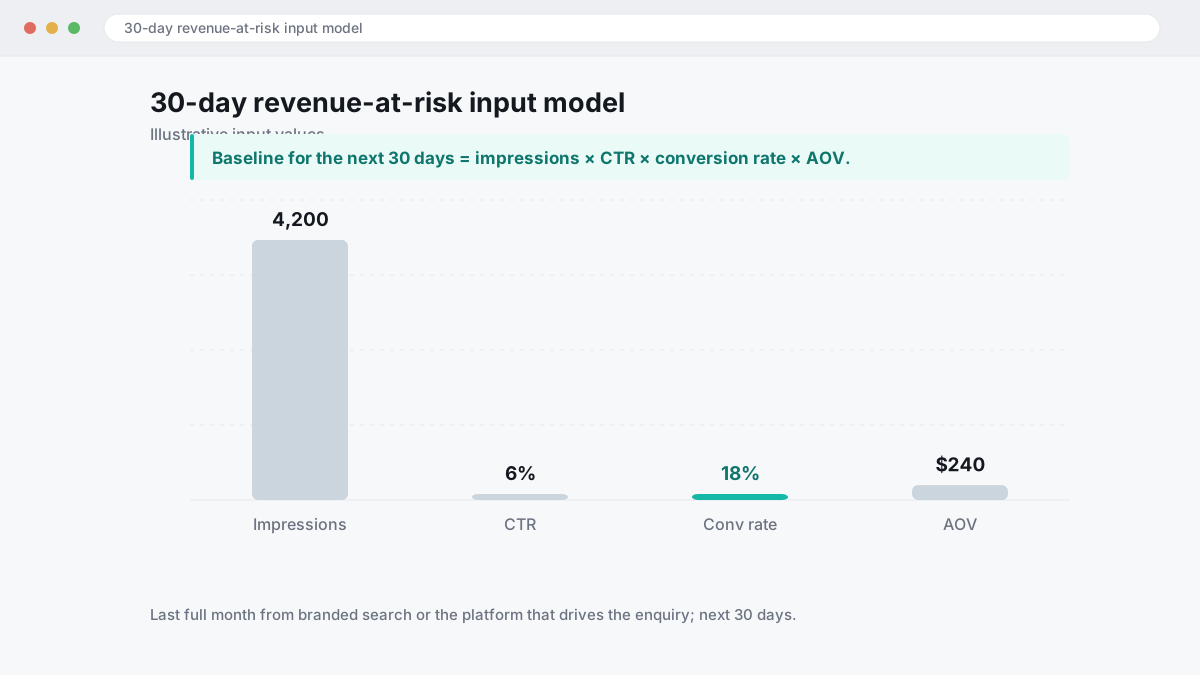
Use your last full month from Google Business Profile, branded search, or the platform that drives the enquiry, then calculate a baseline: impressions x CTR x conversion rate x AOV. If your business closes leads by phone, swap conversion rate for lead-to-sale rate. Keep the window to 30 days because review damage usually hits before any clean-up work, and because a removal case at BGR Review only makes commercial sense when the lost value is clearly higher than our pay-after-success fee of $449 per removed review link with $0 upfront.
| Scenario | Apply this change for 30 days | What to measure |
|---|---|---|
| 0.2-star drop | Reduce CTR by 5% and conversion rate by 3% | Lost clicks, lost leads, lost booked sales |
| 0.5-star drop | Reduce CTR by 12% and conversion rate by 8% | Same as above, plus cancelled enquiries |
| Response delay | Hold rating flat, reduce conversion rate by 4% if no public reply within 72 hours | Lead loss from trust friction rather than visibility loss |
If 20,000 monthly impressions produce a 6% CTR, a 10% lead-to-sale rate, and a £300 average order value, your baseline is £36,000 for 30 days. A 0.5-star scenario takes that to roughly £29,030 before any repeat-purchase effect. That gap tells you whether the cheaper move is a fast response and review generation campaign with BGR Review’s 30-day free replacement guarantee, or a formal removal attempt where the review clearly breaches platform policy.
What actually happens when you flag, dispute, or suppress harmful reviews
Flagging, disputing, or trying to suppress a harmful review only works when the review breaches a platform rule, because platforms remove for policy violations rather than simple unfairness or a bad tone.
Google Business Profile is the clearest example. If a review attacks you but stays inside Google Business Profile prohibited and restricted content, the first flag often goes nowhere, and an escalation through support can still take a few days or several weeks. The weak cases fail for a simple reason: “this is false” is not enough on its own. Google wants something it can map to policy, such as off-topic content, impersonation, conflict of interest, harassment, or a reviewer with no real customer link.
Evidence quality decides the case more than the length of the complaint. The useful pack is usually small: screenshots of the live review and profile, order records or booking logs, message history, timestamps, staff rota notes, and one sentence that matches the exact policy language. If the review is legitimate but commercially damaging, removal usually fails and the practical route is response control, fresh review acquisition, and suppression through volume. At BGR Review, removals run on a pay-after-success model at $449 per removed review link, with $0 upfront, because many disputed reviews simply do not qualify.
The operator playbook for protecting revenue after a review hit
The operator playbook is simple: classify the review hit correctly on day one, fix the underlying cause before you ask for fresh feedback, and track recovery every 7 days against revenue signals rather than star rating alone.
| Review type | First move | Revenue protection move |
|---|---|---|
| Fake or impersonation | Document screenshots, order records, and profile mismatch | Use the platform route only if it clearly breaches the Google Business Profile review policy or equivalent |
| Policy-violating | File a precise dispute | If removal is viable, BGR Review handles this on a $0 upfront, $449 per removed link basis |
| Service failure | Reply fast and fix the job, refund, delay, or handoff issue | Do not launch review generation yet |
| Reputational pile-on | Stabilise response handling and profile messaging | Restart review acquisition only after operations are clean |
If your fulfilment, support, or staff handover is still broken, fresh review activity just spreads the problem faster. Review packages that start in 24-48 hours work best after you close the operational gap; if you buy volume into a live service issue, you usually amplify refunds and low-star follow-ups.
Measure recovery weekly. Check lead count, close rate, refunds or cancellations, and branded search clicks from your main profile. If those four numbers improve while the rating moves slowly, recovery is real; if the stars recover but refunds stay high, the revenue problem is still operational.
Where to go from here
Revenue moves when your rating, review volume and response handling change buyer behaviour at the point of search, comparison and checkout. A profile sitting at 4.1 with thin recent feedback usually loses more money than the dashboard shows, because the drop happens in clicks, calls and booked enquiries before anyone reaches your site. In live clean-up work, the pattern is usually clear within days: weak flags get rejected, policy-breaching reviews can come off, and unanswered criticism keeps ranking while you wait.
Your next step is simple. If your profile is quiet, go to BGR Review’s review generation service page and check the package that fits your platform, noting the 30-day free replacement guarantee and delivery starting in 24-48 hours. If one or two damaging reviews are doing the real harm, use the negative review removal page instead; BGR Review handles removals on a pay-after-success basis at $449 per removed review link with $0 upfront. Expect a practical review of what is fixable, what is not, and which route is cheaper before you spend anything.