


Quick answer
Online reputation management in Las Vegas usually comes down to three tasks: getting more genuine reviews, removing reviews that break platform rules, and correcting how your business appears on Google and other review sites. For most local companies, Google Business Profile and Yelp affect calls first, while Trustpilot, Clutch and TripAdvisor matter in certain sectors. BGR Review runs verified review campaigns across those platforms and handles negative review removal on a pay-after-success basis at $449 per removed review link with $0 upfront, plus a 30-day free replacement guarantee on review packages.
We handle this work every day, so this page sticks to the parts most sites skip: what Google will actually review under its prohibited and restricted content policy, why Yelp flags rarely move without a clean evidence trail, and when chasing removal burns time you should spend on review acquisition instead. The difference usually shows up in the first triage pass, where we sort each review by platform, policy match, account history and whether the proof is strong enough to survive escalation.
If you are looking for online reputation management Las Vegas help, start with the platform that is costing you leads now. BGR Review has served 15,000+ businesses, works from New York, London and Thornhill, and applies the same practical workflow we use on live review disputes and verified review campaigns rather than generic ORM advice.
What online reputation management in Las Vegas actually includes
Online reputation management in Las Vegas means managing the places people actually check before they call you: reviews, review disputes, public replies, ongoing monitoring, and branded search results that sit above your website. In practice, that usually splits into two tracks at BGR Review: verified review growth on platforms such as Google, Trustpilot, Yelp, Clutch and TripAdvisor, plus review-link removal work charged only after success at $449 per removed link with $0 upfront.
Las Vegas buyers rarely look at one platform alone. Google Business Profile drives map-pack clicks, Yelp still matters for restaurants, salons and home services, Facebook affects local trust, TripAdvisor matters on the Strip and around tourism, and BBB often appears when someone searches your business name plus “complaints”. If you only monitor Google, you miss the pages that shape first impressions before a call or booking.
Review acquisition and review removal are separate jobs. Removal tries to get policy-breaking content taken down under the platform’s own rules, while acquisition adds fresh verified reviews to dilute old damage and improve click-through and map-pack trust; BGR Review backs review packages with a 30-day free replacement guarantee. Most owners need both, because a bad review that stays live and a weak review profile create two different problems.
Which Las Vegas businesses need platform-specific ORM most
Las Vegas businesses need platform-specific reputation work most when a single review platform drives booked revenue, because Google, Yelp, TripAdvisor and Trustpilot rank, filter and remove reviews under different rules.
Hotels, restaurants, law firms, med spas and contractors sit in that group. Hotels and restaurants get hit on Google, Yelp and TripAdvisor at the same time, with tourist traffic creating a steady flow of one-off reviews from people who never come back to update or soften the rating. Law firms, med spas and contractors live on high-intent local searches where a buyer often compares only a few profiles before calling, so a visible shift from 4.6 to 4.3 stars can change who gets the lead. That is why BGR Review splits the work by platform: verified review growth where policy allows it, and removal attempts only where a review appears to breach the Google Business Profile review policy, Yelp content rules or another named platform standard.
| Category | Main platforms | Why ratings move fast |
|---|---|---|
| Hotels, restaurants | Google, Yelp, TripAdvisor | High tourist volume and frequent one-off reviews |
| Law firms, med spas, contractors | Google, Yelp, Trustpilot | High-intent comparison searches with few profiles in view |
How Google review removal works for Las Vegas businesses
Google removes reviews that breach its Google Business Profile review policy, not reviews you think are unfair, rude or bad for bookings. A 1-star post that says your service was slow usually stays live; a post that contains spam, impersonation, harassment, conflicts of interest or content unrelated to a real customer experience can qualify for removal under Google's Maps user-contributed content rules. That distinction matters before you spend money, because the cheapest route is often to flag the review yourself first inside your Business Profile.
Google's first decision can land within a few days, but a rejected flag does not mean the review was checked in depth. The normal route is: flag in GBP, wait for the initial moderation result, then use Google's reconsideration or support escalation path if you have a clear policy ground and evidence such as screenshots, order records or proof the reviewer was never a customer. Reviews fail at this stage when owners argue "false" or "damaging" without tying the complaint to a named policy category.
| Ground | Usually worth flagging? | Typical timing |
|---|---|---|
| Spam or promotional links | Yes | Often days |
| Impersonation or fake identity | Yes, if you can evidence it | Days to several weeks |
| Harassment, slurs, threats | Yes | Often days |
| Low rating with genuine opinion | Usually no | Stays live |
That only makes sense where the review matches a real policy breach. If it does not, the better move is response work and new verified review acquisition rather than chasing a removal Google is unlikely to grant.
How Yelp review disputes differ from Google
Yelp disputes differ from Google because Yelp filters a large share of review activity with its recommendation software, but once a review is published you cannot delete it from the business dashboard and Yelp usually removes it only for a clear Guideline breach.
Google Business Profile gives you a direct “Report review” route and a tighter policy framework around spam, off-topic content and prohibited content in Google Business Profile Help. Yelp works differently. A review can sit live, stay visible, and still survive multiple owner complaints unless you can point to something specific in Yelp’s Content Guidelines, such as a conflict of interest, hate speech, threats, or content copied from somewhere else. “This is unfair” rarely moves a Yelp moderator. Evidence does.
The practical limit matters in Las Vegas hospitality, medical and home-service listings. If a posted Yelp review does not breach a named rule, removal usually stalls and the cheaper route is to stop chasing deletion and work on review balance elsewhere.
Yelp is also stricter than Google on solicitation. Google allows you to ask for reviews if you do not gate, selectively invite, or incentivise in ways that breach platform rules or the FTC’s endorsement rules; Yelp actively tells businesses not to ask for reviews and warns against review stands, kiosks and scripted solicitation. That makes aggressive Yelp growth campaigns riskier, especially if they create reviews that get filtered before they ever help your profile.
What can be removed legally and what usually cannot
A review can usually be removed on legal or policy grounds only when it alleges false facts, hides a paid endorsement, or breaks a named platform rule; ordinary negative opinion usually stays live.
| Usually removable or challengeable | Usually stays live |
|---|---|
| “This clinic billed me twice” when you can show no transaction existed | “I thought the staff were rude” |
| Undisclosed paid praise that breaches the FTC endorsement guides and platform policies | Low-star feedback with no policy breach |
| Impersonation, conflicts of interest, or non-customer reviews under Google Business Profile review policy | Harsh but genuine customer criticism |
Defamation turns on false statements of fact, not hurt feelings. “The valet stole my watch” is a factual accusation and may justify a legal review if you have booking records, CCTV timing, staff logs, or payment data showing the claim is false; “I would never stay here again” is opinion and platforms rarely remove it for that reason alone. On Google and Yelp, a badly written complaint can still remain if it describes a real experience.
Paid reviews create a separate problem. The FTC’s rule on fake reviews and testimonials took effect in 2024, and undisclosed compensation can also breach Google, Yelp, and Trustpilot rules.
A practical review removal workflow from first flag to escalation
A review removal workflow starts with evidence capture, moves to the platform’s closest policy-based report route, and only then goes to escalation with a structured evidence pack if the first flag stalls.
-
Capture the review before you touch anything. Save full-page screenshots, the review URL, the reviewer profile link if visible, the date and time, and the business profile URL where it appears. Match that against your own records: booking logs, CRM notes, invoices, call records, CCTV timing where lawful, or a simple “no customer found” check if the reviewer never existed.
-
File the report under the closest category the platform actually offers, not the category you wish existed. On Google, that usually means choosing the relevant reason under the Google Business Profile review policy rather than writing a long complaint in free text; Yelp and Trustpilot use different flagging menus and often force a narrower policy choice. Most first-round failures happen here because the report says “unfair” instead of tying the review to impersonation, conflict of interest, harassment, or another named rule.
-
Escalate if no action follows the initial review window. That means sending an evidence pack with the review link, profile link, timeline, screenshots, customer-record check, and a short policy map showing which rule the content appears to break. If removal still goes nowhere, stop sinking time into repeat flags and switch to damage control or review acquisition; for removal work we keep the commercial side simple at BGR Review with $0 upfront and $449 only after a review link is removed.
What an evidence pack needs to improve removal odds
An evidence pack improves removal odds when it ties one review link to verifiable business records and presents the proof in a format a platform reviewer can check quickly.
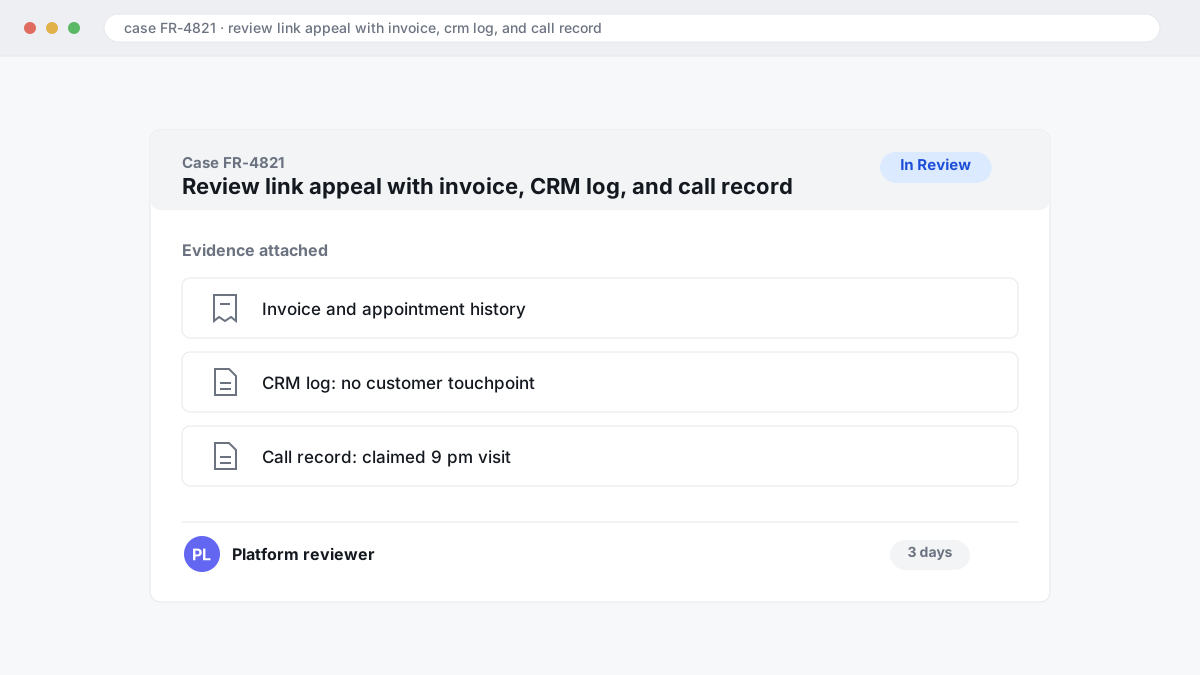
Useful evidence starts with your own records: invoices, CRM logs, call records and appointment histories for the name, date and service claimed in the review. If the reviewer says they visited at 9 pm but your booking system shows you close at 6 pm, that timeline conflict matters. The same applies when the review names a staff member who does not work at that location, or when your records show no customer touchpoint at all for that name, phone number or email.
Google Business Profile review appeals move faster when the file is clean. Put everything into one PDF, add the review URL on page 1, then number the exhibits: Exhibit 1 invoice log, Exhibit 2 CRM extract, Exhibit 3 call history, Exhibit 4 appointment ledger. Duplicate wording across multiple reviews can support a fake-review claim too, especially if the same phrasing appears on several profiles. One organised PDF makes follow-up easier if the first flag is rejected and you need to escalate or reply to support with the same record set.
How review acquisition works without risking platform penalties
Compliant review acquisition means asking real customers for honest feedback on the right platform, on the same terms for everyone, without filtering out unhappy buyers or coaching the rating.
The safest setup is simple: send the request to every completed job, sale or stay, and keep the wording neutral. Do not review-gate by asking only “happy” customers to post publicly while routing unhappy ones elsewhere. The FTC’s 2024 rule on fake reviews and testimonials treats suppressed or distorted review collection as a risk area, and Google’s review policies allow asking for reviews but ban spam, fake engagement and misrepresentation. If you use BGR Review for verified review growth, the compliant part is the process, not a script that tries to force 5 stars.
| Platform | What to do | What to avoid |
|---|---|---|
| Ask all customers by SMS or email after service | Selective asks, incentives, bulk blasts | |
| Yelp | Point customers to your profile only if they ask where to leave feedback | Actively soliciting reviews, which Yelp discourages |
Timing matters more than most Las Vegas owners think. SMS and email requests sent within 24 to 72 hours of the visit or completed job usually perform best because the interaction is still fresh and the customer can recall staff names, dates and details. Wait two weeks and response quality drops. Push too fast, before the service is complete, and you invite complaints instead of useful public proof.
Response strategy for negative reviews that stay live
A damage-limiting review response on Google or Yelp does three things: acknowledges the issue, avoids blame, and moves the specifics into a private channel. Your reply sits under the review in public, so it is written for the next customer reading your profile, not for the reviewer alone. On both Google Business Profile and Yelp, that public exchange affects whether a searcher clicks through or keeps scrolling.
Speed matters more than perfect wording. Posting within 24 to 72 hours signals that you are paying attention, which is usually better than waiting a week to draft something defensive. Keep it short: thank them, recognise the concern, invite them to contact a named email or phone line, and do not argue facts point by point in public unless there is a clear safety or legal issue.
If a flagged review stays live after the normal dispute route, this is where we stop chasing rewrites of the same complaint and switch to response plus review acquisition. That call saves time. A calm public reply paired with fresh verified reviews usually does more for a Las Vegas profile than a second or third rejected Google or Yelp flag.
How ORM affects local SEO visibility in Las Vegas
Online reputation management changes local SEO in Las Vegas by improving the review signals Google uses for prominence and by pushing stronger brand assets above complaint pages in search results. Google Business Profile Help says local ranking depends on relevance, distance and prominence, and reviews sit inside that prominence bucket through rating, recency and volume. A profile that picked up fresh verified reviews in the last 30 days usually looks stronger in the map pack than one sitting on stale feedback from six months ago. BGR Review’s review packages include a 30-day free replacement guarantee, which matters because broken velocity creates a profile that looks inactive fast.
Las Vegas makes freshness easy to spot. Your prospect often compares three map-pack listings side by side on mobile, and the one with recent Google reviews, a balanced rating mix and owner replies usually wins the click before your website even loads. A flat 5.0 with thin volume can look less believable than a high 4-point-something profile with steady, current feedback. That is why review acquisition and removal serve different SEO jobs: one improves prominence signals, the other clears policy-violating reviews that depress click-through.
Brand search results shift as well. If your Google Business Profile, Trustpilot page or other strong profiles gain traction, they can outrank old complaint threads for your business name and capture leads that would have leaked.
How to compare Las Vegas ORM providers before signing
A good Las Vegas ORM provider should tell you exactly which platforms they handle, what they will try on each one, what they charge, and when you pay.
| What to ask | Good answer | Weak answer |
|---|---|---|
| Platform scope | Names Google, Yelp, TripAdvisor and BBB, with a separate process for each platform's policy and flagging route | Says “all major sites” and stays vague |
| Removal terms | Fixed price per removed link | Large setup fee before any review is assessed |
| Reporting | Monthly reporting with live status, next action and stop/go decision | No written reporting cadence |
Ask for sample timelines before you sign. Google and TripAdvisor can move in days or stall for weeks, while Yelp disputes often end with no action if the review does not break a named rule. A serious provider should define escalation criteria, such as when a first-party flag fails, when evidence is thin, and when they stop chasing removal and shift budget to verified review growth.
Pin down who writes responses. Some firms “advise” and leave your staff to post under pressure; others draft, route for approval and track what was published in the monthly report. If review acquisition is included, ask how replacements work too: BGR Review offers a 30-day free replacement guarantee on review packages.
What review request template can your team use today without sounding scripted or risky?
Use a short, neutral message soon after the job is finished: thank the customer, name the Las Vegas location, and include one direct review link. The safe version asks every eligible customer for honest feedback, not only the people your staff expect to leave five stars.
Selective happy-customer asks fail for two reasons. They create rating-gate risk under the FTC endorsement guides if you screen for sentiment before sending, and they produce erratic review velocity that looks staged when a quiet profile suddenly gets a burst after a manager hand-picks names. A steady, neutral invitation sent by SMS within 24 hours of service completion works better because the visit is still fresh, the link is easy to tap, and your Google Business Profile collects reviews in a pattern that matches normal customer flow.
Use this exact template and change only the bracketed fields:
Hi [First Name], thanks for choosing [Business Name] at our [Las Vegas / Henderson / Summerlin] location today. If you have a minute, please leave an honest review here: [direct Google review link]. We appreciate your feedback.
Keep it to one link, one ask, and no offer of gifts, discounts, or “only if you were happy” wording. If your team cannot keep that cadence consistent, BGR Review can set up compliant review collection support alongside its review packages, which carry a 30-day free replacement guarantee.
Where to go from here
Start with a platform-by-platform audit of every review profile you control in Las Vegas: Google Business Profile, Yelp, Trustpilot, Clutch, TripAdvisor, and any trade directory that ranks for your brand name. Sort each review into three buckets. First, reviews that may qualify for removal under a named policy such as Google Business Profile prohibited content or Trustpilot’s flagging rules. Second, reviews that need a reply because the platform is unlikely to remove them. Third, profiles where the faster fix is steady verified review growth, because removal will stall or the review is harsh but policy-compliant.
That audit usually gives you a clearer plan within days. You will know which links are worth evidence packs and escalation, which complaints need a tight public response, and where fresh verified reviews will shift trust fastest in Maps, search results, and comparison pages. If you want the next step, send the profile links first. The links decide the route.