


Quick answer
A former employee Yelp review can be removed, but Yelp usually acts only when you prove the post breaks its content rules rather than showing the reviewer treated you unfairly. The strongest reports connect the review to employment records, the staff exit date, and Yelp’s first-hand consumer experience standard, because ex-staff often write from an insider dispute instead of a customer visit. What rarely helps is an angry owner response, HR background, or broad claims of revenge. If BGR Review removes the review for you, the model is $0 upfront and $449 per removed review link after success.
This page is written for owners and practice managers dealing with a former employee Yelp review that slipped past normal flagging. The practical difference is the evidence pack: Yelp tends to ignore emotion and focus on whether the reviewer had a genuine customer transaction, whether the timeline matches your records, and whether the account shows insider knowledge without a real consumer visit.
At BGR Review, we handle review disputes across Google, Trustpilot, Yelp, Clutch and TripAdvisor, and Yelp cases often turn on small details inside the report rather than the public reply. A weak flag says the review is false; a usable one lines up the roster, termination date, shift logs and customer-record mismatch, then escalates only if the policy angle is clear.
What Yelp actually bans in a former employee review
Yelp usually removes a former employee review only when the text breaks a named rule, not because the writer used to work for you. The relevant buckets are Yelp’s Relevance standard, its Conflicts of Interest rule, harassment or hate content, and privacy breaches such as posting a staff member’s phone number, medical detail, or home address. A review centred on pay disputes, rostering, dismissal, management conduct, or office politics often fails the consumer-experience test because Yelp is built for first-hand customer experiences, not HR grievances. That policy match matters more than your certainty that the ex-staffer wrote it.
Employment status on its own is usually weak removal grounds. Yelp often leaves a revenge post live if it still reads like a customer account and avoids obvious abuse, even when you know the author’s termination date and role. The stronger argument is relevance or conflict: the reviewer had an employment relationship with the business and used Yelp to air an internal dispute rather than describe a genuine customer transaction. If your own flagging has already failed, that is usually the point where outside help becomes a cost question; BGR Review handles removals on a pay-after-success basis at $449 per removed review link, with $0 upfront.
Why Yelp often leaves revenge reviews live
Yelp often leaves revenge reviews live because it enforces its Content Guidelines, not your employment decision. A report built around “this person was fired” usually fails unless you tie it to a named breach such as threats, hate speech, privacy exposure, impersonation, or a false statement of fact that can be checked against records. Yelp does not remove a post for sounding bitter, sarcastic, or vindictive on tone alone. If the review stays inside policy, the anger is usually irrelevant.
Most owners expect a hostile ex-staff post to come down fast. Yelp usually looks at something narrower: did the writer describe a first-hand interaction they were involved in, and did they avoid prohibited content while doing it. That is why a former employee can write, “the manager screamed at staff during my shift and payroll was a mess,” and Yelp may still leave it up, even after you flag it. A stronger report points to the exact line that crosses policy. “Revenge review” by itself rarely moves moderation.
The first-hand experience test Yelp applies
Yelp usually treats a former employee review as potentially valid if it reads like a direct, personal account of what happened at the business location, rather than a complaint about the employment relationship itself.
That is the first-hand experience test in practice. Yelp’s Content Guidelines focus on consumer-relevant content, so an ex-staffer can still look “relevant” if they describe things they personally saw during a shift, a meeting on site, or day-to-day operations at the address on the Yelp page. A post saying, “I watched patients wait an hour and saw the front desk turn people away,” fits that frame far more easily than, “They underpaid me and gave me a written warning.”
Most owners get stuck here. They assume “former employee” alone should be enough for removal. Yelp often disagrees because staff can have first-hand knowledge of service conditions, cleanliness, booking practice, or how customers were treated in the premises.
Content centred on payroll, discipline, rota disputes, termination, or HR complaints usually looks less useful to Yelp’s audience and gives you a cleaner policy argument. Content centred on what the reviewer claims to have observed on site is harder. That is why a revenge post can stay live even when you know the motive behind it.
The evidence pack that gives a report its best chance
A Yelp report has its best chance when you send a short exhibit pack that ties the review’s story to verifiable employment records from the same dates. Yelp moderators do not need a long grievance history. They need a clean timeline.
- Exhibit 1: termination or resignation record with the effective date, plus the job title and location.
- Exhibit 2: rota, schedule, or shift log covering the day or week named in the review.
- Exhibit 3: site-access evidence from the same window, such as keycard logs, alarm disarm records, or clock-in data.
- Exhibit 4: manager or team roster showing whether the named manager actually supervised that location at that time.
- Exhibit 5: customer-record mismatch, where the review claims a visit, booking, or transaction that your records cannot match to any real customer entry.
The key move is to match employment dates against the review’s claimed event. If the review says, “Your front desk manager Sarah shouted at me on the Tuesday night shift,” show that the reviewer left before that Tuesday, Sarah did not manage that site on that date, or the reviewer had no access to the premises after termination. Keep each exhibit labelled by date range and source. If internal flagging fails and you want outside help, this is the pack BGR Review uses first because anything looser usually leaves Yelp room to keep the review live.
Proof that helps and proof Yelp usually ignores
Proof that moves a Yelp report forward is evidence tied to a specific date, person and policy line, while opinion about the ex-employee’s character usually goes nowhere.
| Usually helps | Yelp often ignores |
|---|---|
| Staff roster showing the reviewer worked there on the date claimed, or had already left before it | Statements that the reviewer was “difficult”, “dishonest” or “out to get us” |
| Shift logs, clock-in records, booking records or customer files that show no matching visit | Termination reasons, disciplinary history or internal HR complaints with no link to the review text |
| CCTV references with exact timestamp ranges, so Yelp can compare the claimed incident to a real window | Broad claims that Yelp is biased against owners or always sides with reviewers |
| Screenshots mapped to a named Yelp rule such as conflict of interest, harassment, or inaccurate claim of first-hand experience | A notarised statement that repeats your position without any dated business records behind it |
A notarised declaration looks serious, but Yelp’s moderation flow usually gives more weight to ordinary records created at the time: rota exports, POS timestamps, camera logs, or appointment history.
How to match the review to the right Yelp policy
The strongest Yelp removal report uses one policy theory, backed by dated facts, instead of throwing five accusations into one flag.
Start with the policy that best fits the review’s core defect. If the writer was an employee who reviewed your business as if they were a customer, the cleaner argument is usually Yelp’s Conflict of Interest rule or its ban on content that does not reflect a genuine consumer experience. Anchor that with dates: hire date, termination date, last shift, and the review date. If the post went live two days after dismissal and names internal staff issues, payroll, rota disputes, or management conduct rather than a customer transaction, keep the report centred on employee motive and lack of customer standing.
Conflict-of-interest arguments get stronger when the text pushes revenge or a rival interest. A review that says “avoid this clinic, go to the place across the road instead” gives Yelp a cleaner policy hook than a vague “my old boss is awful.” Stick to one main theory, then add one supporting point. Mixed reports often get brushed aside.
Privacy, harassment, and hate-speech claims need exact quotes. ” Quote the line, identify the target, and attach the screenshot. If your first flag fails, outside help should still build the same way: one policy, one timeline, one evidence set.
A practical former employee Yelp removal workflow
A workable former employee Yelp removal workflow starts with preserving the review exactly as it appeared, then sending one policy-matched report, then escalating once with a tighter second submission if Yelp rejects the first flag.
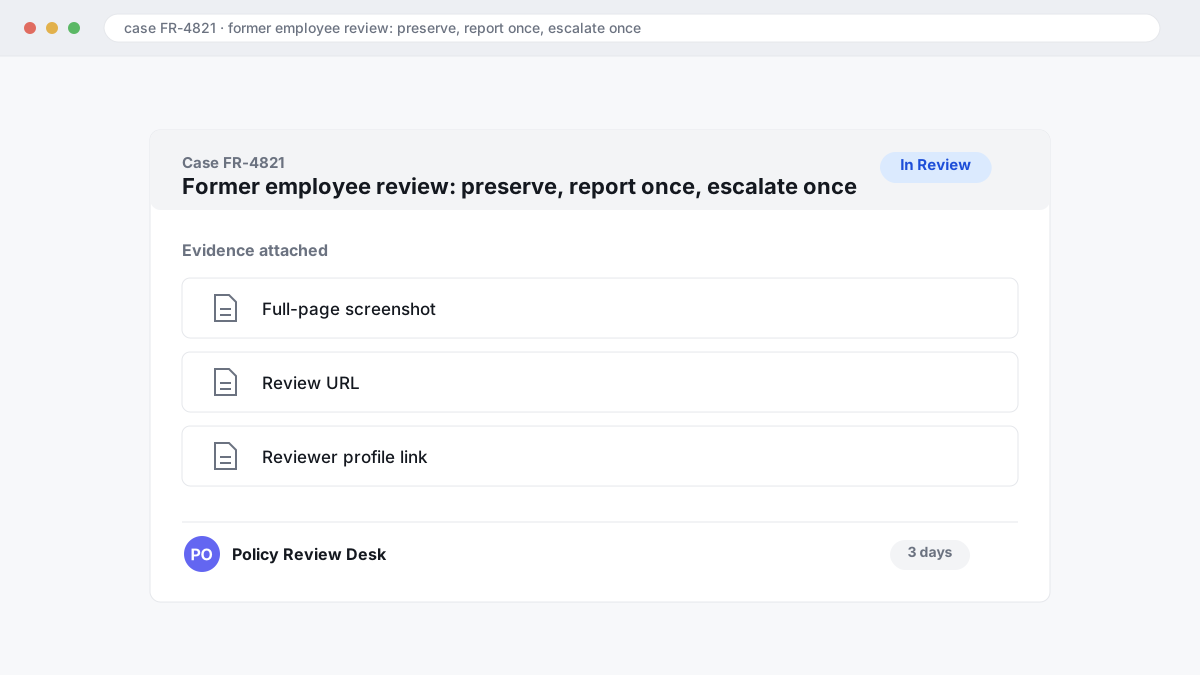
Document the review before anyone replies to it or the text changes. Save full-page screenshots, the review URL, the date and time you captured it, the reviewer’s Yelp profile link, and any profile details that connect the account to the former staff member. Keep the star rating in the screenshot.
Submit one clean report first. Yelp’s reporting flow gives you limited room, so use it for one policy theory only, matched to the review text itself. If your ground is that the writer was a former employee with no customer transaction, say that directly and attach the evidence pack already prepared. Do not send three versions of the same complaint in the first 24 hours. Repeated flags can muddy the record, create inconsistent wording, and make the account look reactive rather than precise.
If Yelp rejects the first report, narrow the second one. Strip out emotion, drop weak evidence, and frame the review under the exact Yelp policy issue supported by your documents, such as lack of first-hand consumer experience or false factual claims tied to employment timing. This is the point where broad statements like “disgruntled ex-staff” usually fail. A tighter submission built around dates, roster placement, and customer-record mismatch gives Yelp less room to treat the post as ordinary opinion.
What to write in the flagging form and owner response
Your Yelp flag should read like a policy report, not an argument: state the issue, name the Yelp content rule it appears to breach, point to the evidence you hold, and ask Yelp to remove the review.
Keep the form tight. A workable structure is four lines: reviewer appears to be a former employee; review lacks a qualifying first-hand consumer experience or contains a conflict-driven account; attached records show employment dates and no matching customer transaction; please review for removal under Yelp’s content guidelines. Long backstories usually weaken the report because the key field is the policy match, not your full employment dispute file.
Your public owner response needs a different job. Do not post, “This was a dismissed staff member” while Yelp is reviewing, because you risk turning a removable policy issue into a public workplace fight. Keep it factual, calm, and under about 100 words: “We take feedback seriously and could not match this review to a customer visit in our records. We have asked Yelp to review it under their policies. If this relates to a genuine service issue, please contact the practice directly so we can check the details.”
When legal issues change the strategy
Legal issues change the strategy when a former employee review moves from a Yelp policy dispute into a false-statement or disclosure problem, and the rules vary by country and platform, so this is general information rather than legal advice.
If the post makes a factual accusation you can prove false, such as theft, insurance fraud, patient harm, or criminal conduct, that can raise defamation issues under U.S. state law. Opinion is usually treated differently. “Worst boss I ever had” rarely helps you legally; “they billed patients for treatments never given on 14 March” is a different category because it asserts a checkable fact. In those cases, preserve the review URL, screenshots, account details, timestamps, and the records that contradict the claim before you file anything else.
Disclosure rules can matter too. S. UK and EU businesses also need to think about misleading-practice rules, including the UK DMCC Act framework and EU consumer-protection rules.
What actually happens after Yelp receives the report
After Yelp receives your report, the usual path is a brief review window followed by one of three outcomes: no action, removal, or a separate change in Yelp’s recommendation filter.
Some flags get reviewed within a few days. Others sit much longer with no explanation from Yelp at all. That delay does not mean the review is being escalated. In practice, silence usually means your report did not give Yelp a clean policy match under its Content Guidelines, especially on the point that the writer lacked a genuine consumer experience.
The result can look confusing. Yelp might remove the review. Yelp might leave it live with no message beyond the original report acknowledgement. Yelp might also change whether the review is recommended, which affects visibility without confirming a policy violation. Those are separate systems.
If nothing changes after a reasonable wait, assume Yelp did not find the evidence decisive.
When outside removal help is worth considering
Outside removal help is worth considering after your first Yelp report fails and you still have date-linked evidence that ties the reviewer to employment rather than a customer visit. That usually means a termination date, rota or shift log, and a customer-record mismatch that lines up against the review date. If you have none of that, paying anyone to “try again” is usually wasted effort. Yelp’s moderation team still wants a policy reason, not a story about workplace drama.
Useful providers build a policy-led evidence pack around Yelp’s content rules and first-hand experience standard, then draft the report so each attachment proves one point. The value is triage, wording, and escalation strategy after an initial rejection, not special access to Yelp. Be wary of guaranteed-removal promises. Yelp does not offer third parties a private back door, and any honest provider should say that plainly.
That model makes more sense than a large advance fee if your internal flagging already failed once and you want a tighter second submission. For a review that is harsh but still based on genuine first-hand employment experience, outside help will often tell you to stop chasing removal and focus on a measured owner response instead.
Where to go from here
Yelp removes the reviews you can evidence against policy, and it leaves up plenty of reviews that look vindictive but are still hard to disprove. That is the part most owners miss. Your strongest route is a file built around verifiable facts: employment dates, rota or shift logs, customer-record mismatches, and any detail showing the reviewer did not have the first-hand consumer experience Yelp expects.
If your own flags have already failed, move to a review-by-review assessment instead of sending the same report again. Check each review link on its own merits, match it to the most relevant Yelp policy issue, and strip out any argument about motive unless you can prove it. In practice, weak flags usually fail because they say “former employee” without attaching records Yelp can test.
You should expect a yes-or-no view on each review, not a blanket promise that every ex-staff post will come down.