The 'Trustpilot vs Google reviews' question gets asked wrong. Owners frame it as picking a winner, when the two platforms answer completely different questions. Google reviews decide whether a searcher clicks your listing in the first place. Trustpilot reviews decide whether they finish the checkout after they click. Ranking them head-to-head is like ranking a front door against a checkout counter.
Budgets are finite and staff time is real. This is the honest 2026 breakdown of where each platform pays off, where each one is oversold, and how to sequence them so you are not paying for both before you have the fundamentals of either.
The head-to-head at a glance
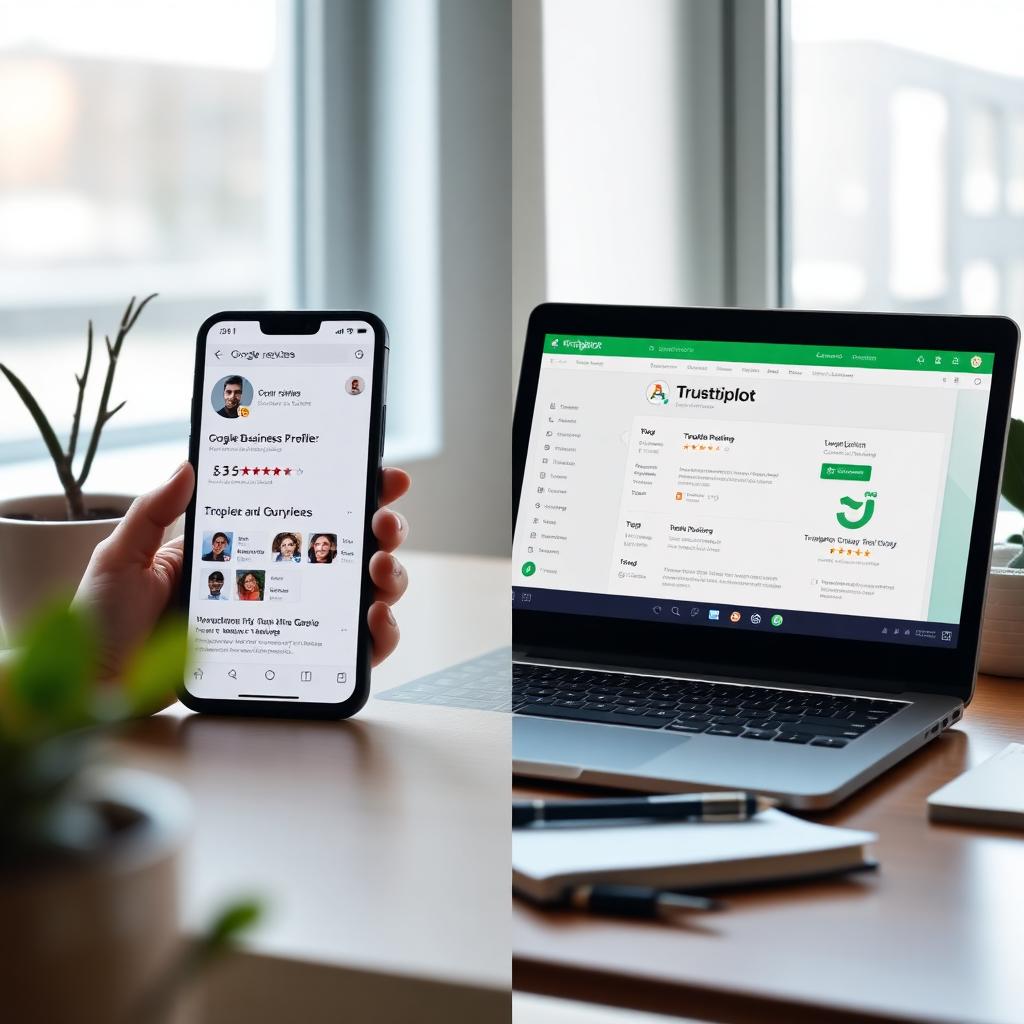
- **Reach** — Google Business Profile appears on ~93% of local commercial searches (Google's own 2025 local search data). Trustpilot appears when a searcher deliberately looks for a company name plus 'reviews' or 'is X legit' — high intent, lower volume.
- **Cost** — Google Business Profile is free forever. Trustpilot is free up to ~100 invitations/month, then $259-$1,499+/month for paid Business tiers.
- **SEO value** — Google reviews feed the local pack and map results directly. Trustpilot reviews power Google Seller Ratings in Ads and can appear as star ratings in organic search via Google's approved review integration.
- **Buyer trust ceiling** — Google reviews are trusted for local services but have a documented fake-review problem in some categories. Trustpilot reviews carry higher trust for online-only purchases where the buyer never meets the seller.
- **Removal control** — Google's removal criteria are strict but consistent. Trustpilot's appeals process is faster but more evidence-heavy. See our Trustpilot removal guide and Google removal guide.
- **Legal exposure** — both platforms are covered by FTC 16 CFR Part 465, the UK DMCC Act 2024, and the EU Omnibus Directive. Buying fake reviews on either carries identical penalties.
Where Google reviews win outright
For any business with a physical address or a local service area, Google reviews are not optional. They drive the three metrics that decide whether a searcher ever sees the business:
- **Local pack ranking.** Google's three-pack uses review count, average rating, and review recency as direct ranking signals. Businesses with 50+ reviews rated 4.5+ dominate their local pack; businesses with under 10 reviews rarely appear.
- **Click-through rate.** BrightLocal's 2026 consumer survey shows 87% of consumers read Google reviews before contacting a local business — up from 77% in 2022. A profile without visible star ratings loses roughly 30-50% of potential clicks.
- **Free organic traffic.** Every review adds unique keyword-rich content that Google indexes and can surface for long-tail local queries.
- **Zero cost.** Google Business Profile is fully free. No paid tier, no invitation cap, no per-review fee.
- **AI Overview citation.** Google's AI Overviews and AI Mode results in 2026 pull review snippets directly from Business Profiles for local queries, which Trustpilot does not currently feed at the same volume.
Where Trustpilot wins outright
For e-commerce brands, SaaS companies, and any business whose buyers are physically remote from the seller, Trustpilot pulls its weight in ways Google reviews structurally cannot:
- **Post-click conversion.** Baymard Institute's checkout-abandonment research consistently ranks visible third-party review widgets among the top five trust-restoring elements on a checkout page. Trustpilot's TrustBox widgets typically lift add-to-cart conversion 6-14%.
- **Google Seller Ratings in Ads.** Trustpilot is one of the few Google-approved review sources that populates the star rating shown under paid Google Ads. Google's own case studies attribute an average ~10% CTR lift when Seller Ratings are enabled.
- **Enterprise procurement trust.** For B2B SaaS deals over $10K/year, procurement teams routinely check Trustpilot, G2, and Capterra before shortlisting. A missing Trustpilot profile is a red flag in a way a missing Google Business Profile is not.
- **Cross-border credibility.** Trustpilot originated in Denmark and carries disproportionate trust weight in UK, EU, and Nordic markets. For US brands selling into Europe, a strong Trustpilot profile is often more persuasive than a strong Google profile.
- **Structured product reviews.** Trustpilot's Product Reviews add-on captures SKU-level reviews that feed Google Shopping and can appear in organic Shopping results.
The cost-per-outcome comparison
Cost per review is the wrong metric — the right one is cost per new customer attributable to reviews. Using industry benchmarks from Trustpilot's 2026 state-of-reviews data, BrightLocal's local consumer survey, and Google's own local-search research:
- **Google reviews:** $0 platform cost. Staff time to invite and respond runs $3-$6 per verified review. Attributable customer acquisition cost via local search is roughly $8-$25 per new customer for well-optimized profiles.
- **Trustpilot Free plan:** $0 platform cost. Same staff time, but attributable acquisition is post-click conversion lift rather than discovery — most useful once you have consistent paid or organic traffic.
- **Trustpilot Standard ($259/mo):** blended cost per verified review ~$4-$5, but the math shifts because Seller Ratings in Google Ads pay for the plan on ad-CTR lift alone once you spend >$3,000/month on Google Ads.
- **Trustpilot Premium ($1,299/mo):** only justifiable at 500+ orders/month or as part of an enterprise trust stack. Below that volume, the fixed cost swamps the incremental lift.
The correct sequencing for most businesses
- **Fix Google Business Profile first.** Verify the profile, add photos, respond to every review inside 48 hours, and drive verified customers to leave reviews via a short URL. Free, and it moves the needle on discovery immediately.
- **Reach 50+ Google reviews at 4.5+ stars** before adding a second platform. Below this baseline, splitting attention hurts both platforms.
- **Add Trustpilot Free plan** once monthly order volume exceeds 40-50 fulfillments. Use the free BCC/AFS channel to invite 100% of eligible customers after fulfillment. See our safe review growth playbook.
- **Upgrade to Trustpilot Standard** only when you consistently exceed the 100 invitations/month cap for two months running, or when you spend >$3,000/month on Google Ads and want Seller Ratings.
- **Consider Trustpilot Plus/Premium** only if you sell SKU-level products (Product Reviews add-on) or are targeting UK/EU enterprise buyers who benchmark on Trustpilot.
The mistakes that make both platforms underperform
- **Review-gating** — only inviting happy customers. Violates both Google's and Trustpilot's guidelines and, under FTC Rule 16 CFR Part 465, is illegal in the US as of October 2024. See our is buying Trustpilot reviews illegal breakdown.
- **Buying reviews on either platform** — same $53,088 FTC fine, same 10% UK DMCC turnover penalty, same 4% EU Omnibus penalty. Trustpilot additionally adds a public consumer-warning banner that typically cuts conversion 20-40%.
- **Ignoring negative reviews** — response rate is now weighted above star rating in BrightLocal's 2026 purchase-decision survey on both platforms.
- **Copy-pasted responses** — Google's algorithm and Trustpilot's moderation both flag templated responses as low-quality, and consumers see through them instantly.
- **Running both platforms without integration** — invitation triggers should be centralized in the order-management system, not duplicated in two separate marketing tools.
Frequently asked
Q.Which is more important, Trustpilot or Google reviews?
Google reviews are more important for local discovery and free organic traffic — they directly influence local pack ranking and map results. Trustpilot is more important for post-click conversion, Google Ads Seller Ratings (~10% CTR lift), and enterprise or cross-border buyer trust. For most businesses the correct answer is Google first, Trustpilot second — not either/or.
Q.Do Trustpilot reviews help Google rankings?
Indirectly, yes. Trustpilot reviews power Google Seller Ratings shown under Google Ads (average ~10% CTR lift per Google's own case studies) and can appear as star-rating rich snippets in organic search via approved schema integration. They do not directly rank Google Business Profiles.
Q.Is Trustpilot worth the cost for a small business?
The Free plan (up to ~100 invitations/month) is worth it for any business with online orders. Paid tiers starting at $259/month are only worth it once monthly order volume consistently exceeds the free cap or you are spending $3,000+/month on Google Ads and want Seller Ratings.
Q.Can I get Google Seller Ratings without Trustpilot?
Yes. Google accepts Seller Ratings from a rotating list of approved review partners including Trustpilot, Reseller Ratings, PowerReviews, and others. Google's own free Customer Reviews program also feeds Seller Ratings for merchants that ship physical products in supported countries.
Q.Are Google reviews more trusted than Trustpilot reviews?
For local physical services, yes — BrightLocal's 2026 survey puts Google review trust at 79% versus Trustpilot at 62% in the US. For UK, EU, and Nordic online-only purchases the numbers invert, with Trustpilot trust higher than Google in those markets.
Q.Should I ask the same customer to review on both platforms?
Yes, but sequence the ask. Send the Trustpilot invitation via the automated post-fulfillment channel first, then follow up 5-7 days later with a Google review ask via SMS or a short URL on the receipt. Asking for both simultaneously typically halves conversion on both.
The honest 2026 bottom line: if you run a local physical business and only have budget for one platform, pick Google every time. If you run an e-commerce brand, a SaaS company, or a cross-border business, you need both — but sequence Google first and layer Trustpilot on top once your order volume justifies the invitation infrastructure. Skipping the sequencing is how businesses end up paying $1,299/month for a Trustpilot Premium plan while their Google Business Profile still has 12 reviews and no owner responses.