

Quick answer
Local SEO is the work that gets you into Google’s local pack, Google Maps and location-based organic results. The fixes that move visibility first are usually practical, not theoretical: correct your Google Business Profile, clean up duplicate Google listings, tighten NAP consistency, build a review request and response process, then improve local landing pages and local backlinks. Google Business Profile Help states local ranking is driven by relevance, distance and prominence, so the fastest gains usually come from removing profile errors and review friction before you spend on broader SEO work.
This page is written from live reputation and listing work, not from SEO software prompts. At BGR Review, we handle verified review campaigns on Google, Trustpilot, Yelp, Clutch and TripAdvisor, and we run review removal cases on a pay-after-success model at $449 per removed review link with $0 upfront, so we see exactly where visibility losses start and where conversion losses start first.
A bad review usually hurts click-through rate and calls before rank shifts: the first step is preserving the live URL, screenshots, account details and policy match, because a bare flag with no evidence is where most removals die. Across 12,000+ negative review cases logged June 2025 to June 2026, we recorded outcomes as success, unresolved or unknown, never padded as failures when the final state could not be confirmed.
What should you fix first when local visibility is flat or slipping?
Fix your Google Business Profile, your review flow, and the local landing page attached to the target query before anything else. Those three assets usually change local pack click-through, calls and booking intent faster than broad citation cleanup or another round of generic content.
The wrong sequence is easy to spot: bulk directory submissions, weak blog posts, then a pile of thin city pages. That work often fails because it does nothing for the listing a searcher actually sees first in Maps, and it rarely improves the page Google pairs with the profile for local relevance. In BGR Review's dataset of trades businesses with complete enquiry-source data, observed February to July 2026, 70-80% of calls and bookings were attributed to a Google Business Profile or Yelp listing rather than a website, so fixing the profile and its connected page usually beats citation busywork on ROI.
The right sequence is tighter. Correct the Google Business Profile categories, service areas, hours, photos and primary business details; build steady customer reviews on the profile that matters most; then bring the matching local landing page into line with the service, place and intent behind the query. In BGR Review's dataset of new trades and local service businesses observed February to July 2026, reaching 20-30 reviews over the first three months was associated with improved local visibility, though other ranking factors were active at the same time.
Profile edits and review gains often show up in call volume within 2-8 weeks, especially when the listing already has some history and the landing page is indexable, specific and linked from the profile. Citation cleanup still matters, but it is usually a stabiliser after the main assets are accurate. Random city-page expansion is where a lot of budget goes to die.
| Task | Usual local impact | Fix first? |
|---|---|---|
| Google Business Profile accuracy | Direct effect on local pack visibility, clicks and calls | Yes |
| Customer reviews on the main listing | Improves trust, click-through and sometimes pack competitiveness | Yes |
| Aligned local landing pages | Improves relevance between query, profile and page | Yes |
| Bulk directories and weak blog posts | Usually slow or negligible | No |
How do local results work differently from regular SEO when the same keyword triggers maps?
Local SEO adds map-pack eligibility, proximity and profile signals to normal SEO work. If your keyword triggers the local pack, Google weighs Google Business Profile data, relevance, distance and prominence alongside your site, so strong organic pages alone do not guarantee map visibility.
Most guides treat a high organic ranking as the main goal. That fails on maps because proximity changes the result set in a way national organic rankings do not: a weaker site that is closer, better matched to the query and getting stronger behavioural signals can win the pack, take the call, and get the directions request before your better article earns a click. In BGR Review's dataset of 1,485 businesses observed February-July 2026, trades businesses with complete enquiry-source data attributed 70-80% of calls and bookings to a Google Business Profile or Yelp listing rather than a standalone website.
This is the practical split you should use when deciding what to fix first.
| Area | Local SEO | Broader SEO |
|---|---|---|
| Primary assets | Google Business Profile, reviews, categories, service areas, local landing pages | Site architecture, content depth, internal links, broader backlink profile |
| Main KPIs | Local pack visibility, calls, directions, form fills, map-pack click-through rate | Organic sessions, non-brand rankings, page-level click-through rate |
| Typical timeline | Faster movement after profile and review fixes; BGR review packages start delivery in 24-48 hours, but ranking lift still depends on category and location | Usually slower because page edits, crawling and link equity take longer to compound |
| Win condition | Eligibility plus trust: relevant profile, close searcher distance, enough prominence to earn the click and call | Best answer on the page with stronger authority and content match |
How do you set up local SEO in the right order without wasting the first 90 days?
A workable local SEO sequence is Google Business Profile first, your primary local page second, consistency third, reviews fourth and authority fifth. That order cuts false negatives, because a weak profile or mismatched landing page can hide gains from local citations, local backlinks and review growth.
Random checklist hopping wastes the first 90 days. You add citations before the Google Business Profile is verified, chase links before the service page matches the primary category, then wonder why the local pack does not move and calls still come through branded search instead of Maps. In weeks 1-2, verify the profile, set the right primary and secondary categories, rewrite the main local page so its title, H1, service copy and location intent line up with the profile, then record a baseline for map-pack position, calls, direction requests and form fills by location.
If your visibility is flat after that, weeks 3-6 are for cleanup, not more content. Remove duplicate Google listings, fix core local citations so your name, address and phone stay consistent, add schema markup to the location or service page, and strengthen internal links from top-level service pages into that location URL. This is where regular SEO and local SEO split: when the same query triggers maps, Google weighs relevance, distance and prominence through the profile and its connected page, not through backlinks alone.
Weeks 7-12 are where momentum starts to show. Build a review request flow tied to job completion, earn a small number of relevant local backlinks from chambers, suppliers or local press, and track calls by branch so you can see whether visibility is turning into conversions. In BGR Review’s dataset of 1,485 businesses observed from February-July 2026, new trades and local service businesses typically saw first reviews around two weeks after launch, and reaching 20-30 reviews over the first three months was associated with stronger local visibility while other ranking factors were active too.
Why does Google show one nearby business in the pack and bury another?
Local pack placement usually comes from a balance of relevance, distance and prominence. You cannot control distance, so the levers that usually move are Google Business Profile category accuracy, service-page alignment with the query, review strength and brand signals Google can verify.
The wrong approach is chasing one factor as if Google uses a single score. Adding citations, stuffing the business name with keywords or collecting reviews on a weak profile fails because Google still has to match the search intent: “emergency plumber” needs the right primary category, the right service on the site, and a nearby option before prominence can help. A Google Business Profile set to the wrong primary category often loses to a less-reviewed competitor whose category and landing page match the search more cleanly.
Prominence usually compounds more slowly. Brand mentions, local backlinks, review recency and review text help Google trust that your business is known in that market, and they tend to lift map-pack click-through rate before they lift position. In BGR Review’s dataset of 1,485 businesses observed from February to July 2026, trades businesses with complete enquiry-source data attributed 70–80% of calls and bookings to a Google Business Profile or Yelp listing, which is why buried pack visibility hurts conversions fast even before your website traffic changes.
How complete does your Google Business Profile need to be before other work starts paying off?
Your Google Business Profile needs to be accurate enough for Google to match your business with confidence: the right primary category, the right service model, correct hours, and a landing page that fits the listing. If those basics are wrong or thin, later review, citation, and link work usually lifts less than you expect.
Most guides push profile completeness as a box-ticking exercise. The failure point is profile bloat. Adding every possible secondary category, stuffing services you do not actually offer, or setting broad service areas across whole counties weakens relevance and hurts click-through rate from the local pack because the listing promises too much and the page behind it does not support it. The tighter approach works better: choose the single best primary category, add only secondary categories you can prove on-site, keep hours current, and use attributes that help a searcher decide whether to call or book.
If you are one of the service-area businesses that serves customers at their location, hide the address unless customers are genuinely served there. Google Business Profile guidance is clear on this point, and a visible address on a home, mailbox, or unstaffed unit creates a mismatch that can trigger edits, suspensions, or low-trust clicks.
Duplicate Google listings create a different mess. They split reviews, send branded search demand to two CIDs, and make support threads harder because one profile may be scoped to the wrong city or service model. Before you spend on review growth or local landing pages, clean duplicates and fix the profile scope first.
When do reviews change local performance, and when are they mostly a conversion signal?
Reviews move local performance in two ways: they can strengthen prominence in Google Business Profile and they can raise click confidence when searchers compare similar options in the local pack. They do far less when your category is wrong, your service page does not match the query, or a closer competitor has stronger relevance and distance.
The wrong approach is treating customer reviews as a magic ranking lever and pushing volume alone. That fails because Google still weighs relevance, distance and profile-page match first, so a 4.8 profile for “general contractor” can lose to a nearer roofer whose profile, landing page and review text clearly match “roof repair near me”. The right approach is to improve review text, recency and response handling after the profile basics are right, because those signals support prominence and improve behavioural signals such as click-through, calls and direction requests.
In BGR Review’s dataset of 1,485 businesses observed from February to July 2026, new trades and local service businesses that reached 20–30 reviews over the first three months were associated with improved local visibility, with other ranking factors active at the same time. That matters most when two listings are otherwise close on relevance and distance; before rank moves, better reviews often lift conversions first.
This is the practical split between ranking support and click impact.
| Review issue | Ranking support | Click impact | Operational action |
|---|---|---|---|
| Low volume | Weak prominence signal | Thin social proof | Request reviews after completed jobs, not in bulk |
| Old reviews only | Less freshness support | Lower trust on comparison | Build steady monthly review flow |
| Generic review text | Less query relevance support | Fewer clicks from searchers scanning details | Ask for service-specific wording naturally |
| Unanswered negative reviews | Little direct ranking effect | Conversions drop fast | Reply promptly, then assess removal options |
How do you remove false reviews and report map spam without making the problem worse?
Remove a false review by tying it to a published platform rule, then sending evidence Google can verify fast. For spam and fake listings, including duplicate Google listings and keyword-stuffed profiles, report the exact violation first and escalate through Google's redressal route only after you have the proof in order.
The wrong approach is emotional reporting: "this review is unfair", "that competitor is stealing leads", "please take it down". Google rarely acts on that because disagreement is not a removal ground under the Google Business Profile review policy, and a weak spam report can leave a fake listing live while your own local pack click-through rate keeps slipping. In BGR Review's case file of negative review cases with prior self-filed attempts, logged June 2025 to June 2026, roughly 90% of businesses that came to us after a failed try had used only the basic in-platform report button with no supporting documents, and 70-80% of those initial requests had been rejected.
The right approach is a policy-grounded evidence pack. For review removal, that usually means checking whether the reviewer appears in your CRM, invoices, booking calendar or payment records, then lining that up with screenshots, the review date, the review link, and the profile URL. For spam and fake listings, add storefront or service-area details, duplicate Google listings, category misuse, name stuffing, and any mismatched phone numbers or addresses visible on the listing.
Keep the pack tight so support can verify it quickly:
- review or listing URL and your profile URL
- screenshots showing the violation in place
- transaction check or proof no customer record exists
- dates, timestamps and any prior support reference numbers
Google's Business Redressal Complaint Form and spam reports can move in a few days, or sit for several weeks. If the review states a harsh opinion, removal may fail; if it states false facts, impersonates a customer, or sits on a fake or duplicate listing, the case is stronger. That delay matters because unresolved review issues usually hit conversions first - calls, bookings and form fills soften before rankings move.
How can NAP errors and duplicate listings quietly suppress local rankings?
Mismatched business names, phone numbers, landing-page URLs and stray duplicate Google listings suppress local visibility by splitting one real business into several weak entities, which blunts map-pack relevance signals before your reviews, links or new pages can do much.
Most guides push more local citations first. That fails when your core NAP consistency is broken, because Google Business Profile, Yelp, Apple Maps and old directory records may point to different phones, different suite formats or an outdated homepage, so Google keeps re-evaluating which record is the “real” one. You end up feeding the same confusion into more directories.
Fix the entity first. Merge or remove duplicate Google listings before broad citation work, then repair the core sources that actually get reused by other platforms: your Google Business Profile, main website footer and contact page, major directories, and any old tracking-number listings still live. If you bring BGR Review a review-growth campaign while this is messy, we stop and clean the listing inputs first, because a 30-day free replacement guarantee on reviews does not solve a broken business identity.
Cleaner consistency usually beats a bigger citation count. One accurate business name, one primary phone, one canonical URL and one live profile produce better branded search demand, stronger click-through from the local pack and fewer ranking swings than spraying fifty low-value directory submissions onto bad data.
What should a location page include to rank locally instead of cannibalising your main site?
A location page ranks when it targets one place and one service intent clearly, shows that you really operate there, and lines up with your Google Business Profile. Thin duplicate city pages usually split relevance and can pull clicks away from your main service pages without helping the local pack.
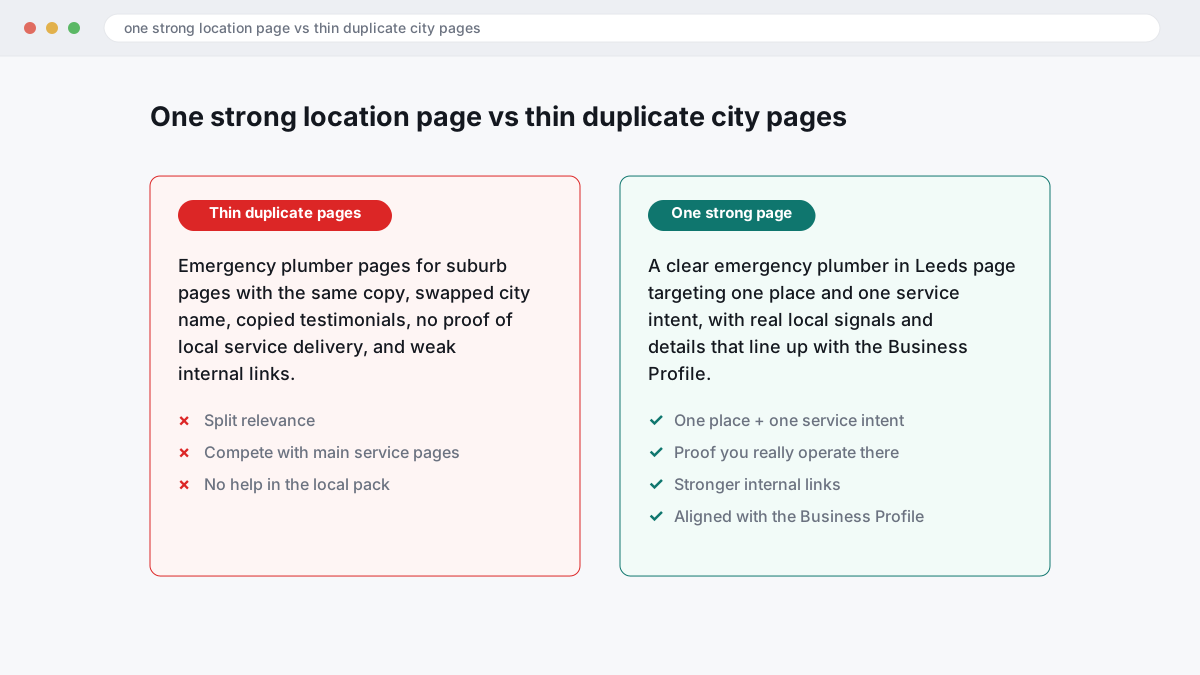
Scaled templates fail because Google can read the pattern: same copy, swapped city name, copied testimonials, no proof of local service delivery, and weak internal links. That leaves your local landing pages competing with each other and with the main site. One strong “emergency plumber in Leeds” page usually beats ten thin suburb pages if the page carries real local signals and the profile, category and on-page intent all match. In BGR Review’s dataset of 1,485 businesses observed February–July 2026, trades businesses attributed 70–80% of calls and bookings to a Google Business Profile or Yelp listing rather than a website, which is why the page should support the listing and conversions, not exist as spun SEO filler.
The page itself should include embedded NAP consistency details, opening hours, a clear service area if you are a service-area business, unique proof such as local project photos or area-specific FAQs, and internal links back to the main service page and contact page. Add LocalBusiness schema markup where it fits the business model, but keep it consistent with the visible address and hours; schema markup does not rescue a page that says one thing while the profile says another. If you cannot add evidence for a suburb page, do not publish it yet.
How do you run local SEO across multiple locations without creating duplicate chaos?
Multi-location local SEO works when governance is centralised and local proof stays local. Standardise your core business data across every branch, then keep each Google Business Profile, review stream, photo set and local landing page tied to the real staffed location it represents.
The wrong approach is central control of every field on every branch profile, plus cloned city pages pushed live from one template. That fails because Google reads the profiles as interchangeable: categories drift, hours go stale, local landing pages repeat the same copy, and NAP consistency breaks as one team edits phone numbers in three systems but misses the fourth. The first fix is ownership. Put one person or one small ops function in charge of naming, primary and secondary categories, opening hours, holiday updates, and review-response rules across all locations.
The right approach is central standards with local proof. Use one master data source to push identical core NAP fields everywhere your branches appear, then let each location add evidence Google can verify: its own staff photos, branch-specific services, local FAQs, and reviews answered by someone who knows that site. That keeps the data clean without turning every profile into a duplicate.
Separate profiles and pages by real staffed locations only. Service-area businesses can define service areas inside Google Business Profile, but they still need one profile per legitimate base rather than doorway-style area pages for every suburb with no team there. If review governance breaks and a false branch review sticks, the conversion damage usually lands before rankings move; if you need removal help, BGR Review handles it on a pay-after-success basis at $449 per removed link with $0 upfront.
What usually causes a Google Business Profile drop, and what should you check first?
Most Google Business Profile drops come from edits, duplicate Google listings, suspensions, landing-page changes, review loss, or a closer competitor gaining ground in the local pack, not from some hidden penalty. Start with the profile change history and duplicate status before you spend money on fresh citations, new content, or a site rebuild.
Algorithm panic wastes time because it treats every fall in calls as a ranking event. The better method is date matching: line up profile edits, category changes, review removals, website changes, rank tracking, and call trends on the same timeline. If calls fell on Tuesday and someone changed the primary category on Monday, broke the appointment URL, or merged the wrong listing, you have a cause to test. Recovery often starts by reversing the bad edit within 24-72 hours, then waiting for Google Business Profile data to refresh before changing anything else.
Check five things first: suspension status, primary and secondary categories, duplicate listings, landing-page changes, and missing reviews. A duplicate can split behavioural signals such as clicks, calls, direction requests and branded search, which weakens one profile even if both stay live. If reviews vanished or a false review landed, fix that separately; in BGR Review's dataset of 12,000+ negative review cases logged June 2025 to June 2026, cases raised within 28 days and backed by a clear policy issue resolved successfully in roughly 90% of cases, while comparable cases raised later dropped to approximately 25-30%. If none of those dates line up, then look at competitor movement in the map pack rather than guessing at a penalty.
What should your local SEO checklist include each month so work actually gets finished?
A usable local SEO checklist gives every recurring task an owner, a cadence and proof. If you cannot verify it each month, whether that is Google Business Profile accuracy, customer reviews, page updates or duplicate checks, the job usually gets skipped or repeated badly.
Long wish lists fail because nobody owns them and nothing ties the work back to map-pack movement, click-through rate or conversions.
Use one operating table per location and require evidence, not verbal updates.
| Task | Owner | Cadence | Evidence required |
|---|---|---|---|
| Check Google Business Profile name, category, hours, services, photos and duplicate listings | Location manager | Monthly | Timestamped screenshots and edit log |
| Review flow: request recent customers, reply to new customer reviews, flag policy breaches | Front desk or CRM owner | Weekly review, monthly audit | Request list, reply links, flagging notes |
| Update local landing page offers, FAQs, service areas, schema markup and internal links | Marketing manager | Monthly | Published URL changes and crawl check |
| Audit local citations, NAP consistency and key local backlinks | SEO lead | Monthly | Directory corrections and live link list |
| Check nearest competitors for category changes, new reviews, spam listings and offer shifts | SEO lead | Monthly | Comparison sheet with actions assigned |
Where to go from here
Start with a local visibility audit. Check your Google Business Profile for wrong categories, old phone numbers, hidden duplicate Google listings, weak service-area settings and missing attributes. Then review your location pages, local citations, NAP consistency, internal links and the review profile itself: rating trend, recency, response quality and whether one false review is dragging click-through rate, calls or form fills before rankings move.
You should come out of that audit with a short fix list in order: profile errors first, duplicate risk second, review issues third, then page and citation clean-up. That order matters because the local pack reacts faster to profile accuracy and review trust than to another round of generic blog content. If the blocker is false or policy-breaching feedback, gather screenshots, dates, order records and any proof the reviewer was never a customer before you file anything.
Expect a practical yes, no or not-yet answer, not a vague promise.