

Quick answer
To get into the Google local pack, fix the three local ranking signals Google names: relevance, distance and prominence. You control that by completing your Google Business Profile properly, choosing the right primary and secondary categories, keeping your NAP details consistent across citations, building location-specific landing pages, and generating a steady flow of genuine recent reviews. Reviews strengthen prominence and often lift map-pack click-through before they lift position, but they do not beat poor proximity. If a damaging review is false or breaks Google Business Profile review policy, removal is a separate job; at BGR Review, that runs at $449 per removed review link with $0 upfront.
This page comes from the same operator workflow we use when a profile has decent on-page SEO but still loses calls because review recency has stalled, ratings are mixed, or the category setup is off by one level. In Google review disputes, the in-platform report button usually fails because it carries little evidence; the cases that move are the ones built around a clear policy breach, dated screenshots, and a review URL that can be checked against the profile CID.
We connect ranking advice with reputation work because that is how local visibility behaves in practice. BGR Review has served 15,000+ businesses, and in our case file of 12,000+ negative review cases logged June 2025 to June 2026, we tracked outcomes as removal success, unresolved or unknown rather than dressing unknowns up as wins.
How do you break into the local pack when you need wins in the right order?
Break into the local pack by fixing the signals Google can trust first: the right primary category, a verified Google Business Profile, duplicate cleanup, review growth, location-page relevance, then citation and engagement gaps. Most owners lose a month polishing low-impact fields while a category error or duplicate listing keeps relevance and prominence weak.
The wrong approach is filling every photo slot, writing long service descriptions and posting updates before you check whether the profile is eligible to compete. A complete but miscategorised Google Business Profile often loses to a thinner listing with the correct primary category, because Google can match that competitor to the query more confidently. Verification comes next. If the profile is unverified, suspended, or split across duplicate listings, Google gets mixed trust signals and your prominence never compounds properly from reviews, clicks and branded searches.
Use the order that moves rankings, calls and map-pack click-through fastest. Start with primary category and secondary categories, confirm verification, remove or merge duplicates, then push review recency and review response rate, then tighten the matching local landing page, then fix NAP consistency across the core citations you actually control, then work on behavioural signals such as calls, direction requests and website visits. If you want help with the review step, say that plainly: BGR Review sells managed review packages with a 30-day free replacement guarantee, and that part only helps after the category and trust layer is clean.
A common recovery workflow looks like this: strong on-page SEO, weak review recency, mixed ratings and sloppy category setup. Fix the category setup first, because that changes relevance immediately; then clean duplicates, because duplicated authority splits engagement; then improve review flow, because fresh ratings lift click-through before they lift position; then align the location page and citations. Track movement weekly for 8-12 weeks. Day-to-day swings after a Google update tell you very little, and they push people into the wrong fixes.
Why can a fully completed profile still miss the local pack?
A fully filled-out Google Business Profile can still miss the local pack because completeness only makes you eligible to compete. Google still sorts the top three by category accuracy, distance, review strength, duplicate conflicts, landing-page support and nearby spam before it shows your listing.
The wrong move is to keep adding posts, photos and service lines once every field is filled. That fails because a complete profile does not fix weak primary categories, a hidden address problem, a duplicate listing splitting trust signals, or a closer competitor with a cleaner setup. In BGR Review's dataset of 1,485 businesses observed from February to July 2026, improved local visibility lined up with review build-up and other active ranking factors at the same time, which is the point: completeness alone was never the deciding lift.
If your Maps impressions stay flat for 30 days after the profile is complete, check suppression causes before you add more content. Start with duplicate or merged listings, then confirm the primary category matches the money-making service, then verify the address or service-area setup has not weakened distance relevance, then look at nearby spammy competitors and Google's own spam fighting lag in your category. The right approach is diagnostic, not decorative. A clean Google Business Profile with the right category and no duplicate conflict gives Google a clearer trust signal, and that is what usually moves map-pack visibility first.
Which Google Business Profile settings actually decide whether Google trusts your listing?
Google trusts listings that map cleanly to a real business: the right primary category, completed Google Business Profile verification, accurate hours, filled service details and a policy-compliant setup. A polished profile with the wrong category or a weak address signal will often lose local pack exposure to a plainer listing that gives Google a clearer trust match.
The common mistake is category sprawl. Owners add five or six secondary categories to chase reach, then wonder why relevance stays weak for the money term that actually drives calls and form fills. Your primary category does most of the work, so set it to the service that produces your main revenue, then use secondary categories only where the service is genuinely delivered and supported by the page content on your site. This is one of the first checks we run before recommending any paid review campaign, because review velocity cannot rescue a category setup that tells Google the wrong thing.
Trust also depends on legitimacy signals that are easy to verify and easy to break: verification status, current opening hours, populated services, and attributes that match reality. If your hours say open and users hit a closed phone line, behavioural signals turn against you fast. If you are a service-area business, verify properly under Google Business Profile rules and hide the address only if you do not serve customers there; hiding it does not remove proximity limits in the map pack, and it does not give you reach across a whole city. We tell DIY readers to fix these settings before paying for managed help, because this part costs time, not our $449 pay-after-success removal model or any review package.
How much do relevance, distance and prominence each matter before you chase anything else?
Relevance, distance and prominence work together, but they do not deserve equal effort. Fix relevance first, treat distance as your ceiling, and build prominence after the profile and page basics are correct.
The wrong approach is treating all three as equal and chasing reviews, citations and posts before you know whether Google can match your listing to the query. Relevance is your category and service match: primary category, secondary categories, service list and the matching terms on your local landing page. Distance is simple proximity to the searcher. Prominence is the trust layer on top: review strength, brand mentions, links, citations and the general authority signals that help a listing win more map-pack clicks and later more calls or form fills.
A bad category setup caps you fast. If your on-page SEO says “emergency plumber” but your Google Business Profile leans generic or misses the right service terms, Google may rank a nearer competitor with cleaner relevance even if your rating is stronger. In the profile repair sequences we run for clients from New York, London and Thornhill, category and service edits can affect local finder visibility within days, while prominence work usually needs 4-12 weeks before the local pack and branded search demand move in a durable way.
This is the practical order.
| Factor | What it controls | What to do first |
|---|---|---|
| Relevance | Whether Google sees you as a fit for the query | Fix categories, services and page alignment first |
| Distance | How far your listing can realistically compete | Accept the limit; do not expect content to beat geography everywhere |
| Prominence | How strongly you compete inside that radius | Build reviews, responses and citations after relevance is clean |
You cannot fully outrank distance, especially for service-area searches centred far from your address. Stronger prominence can widen your competitive radius, though. A listing with better review recency, stronger response rate and cleaner authority signals often wins more click-through from the local pack at similar distance, and those extra clicks can turn into more bookings and more branded searches a few weeks later.
What improves local pack rankings fastest when you cannot change your address?
If you cannot move closer to the searcher, the quickest local pack gains usually come from fixing category signals, cleaning up duplicate listings, and generating fresh reviews from real customer flow. Those changes affect trust and click appeal sooner than buying batches of directory citations.
Buying citations first is the wrong order for most single-location profiles. Extra directory submissions rarely solve a mismatched primary category, a stray duplicate that splits reviews, or a dead review velocity pattern that makes the listing look stale; by contrast, in BGR Review's dataset of 1,485 businesses observed from February to July 2026, new trades and local service businesses that reached 20-30 reviews over the first three months were associated with better local visibility, with other ranking factors active at the same time. Fix the category setup first, then merge or remove duplicate confusion, then ask for reviews on a steady cadence you can maintain.
Review recency and review response rate usually move faster because they change what searchers see before they change pure position. A stronger snippet, newer photos and replies that address real jobs can lift behavioural signals such as map-pack clicks, calls and direction requests within weeks, while low-value citation work often sits in the background with little visible effect. If your profile already ranks in the local finder but misses the pack, this is usually where the faster ROI sits.
How do reviews help—or hurt—your local pack visibility in practice?
Reviews help your local pack visibility when they arrive at a believable pace from real customers, mention the service you actually provide, and make your listing more clickable in the map pack. They hurt when review velocity looks manufactured, sentiment turns mixed, or fake and incentive-tainted patterns trigger filtering and trust problems.
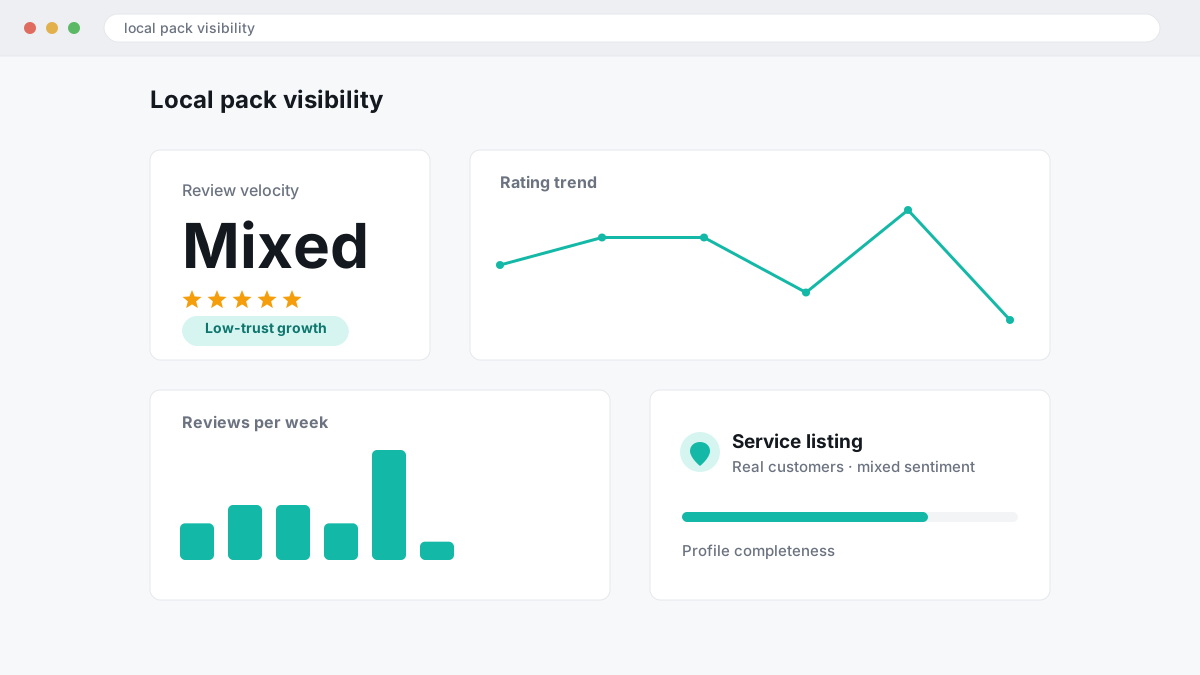
Most guides say any review growth helps. What actually happens is that low-trust growth can weaken prominence instead of building it. A burst of short, generic five-star posts from new accounts often gets filtered or ignored by Google’s systems, and if the wording suggests paid or undisclosed incentivised endorsements you also step into FTC endorsement risk in the US and consumer-protection risk under the UK’s DMCC Act rules; this is general information, not legal advice.
The safer route is steady review acquisition tied to real jobs, timed close to completion, with service terms that match your category. In BGR Review’s dataset of 1,485 businesses observed from February to July 2026, new trades and local service firms typically saw first reviews around two weeks after launch, and reaching 20–30 reviews in the first three months was associated with better local visibility while other ranking factors were still in play. That kind of review velocity strengthens prominence and usually improves pack click-through because searchers can see both recency and relevance before they call.
Owner replies matter, but they work on conversions more than rank recovery. A strong review response rate shows you are active, answers objections in public, and can lift calls, bookings and form fills after the click, yet replies will not rescue a listing with thin review volume, a 3-star average, or months of inactivity. If reviews are missing because Google filtered them, adding more replies does nothing; you need cleaner acquisition, real customer proof, and a profile that is still trusted.
When should you fix citations and NAP consistency instead of building more content?
Fix citations before you build more content when your business identity is sending mixed signals: old addresses after a move, stale phone numbers from call-tracking swaps, rebrand leftovers, or duplicate directory records can stop Google from reconciling one location across the map pack, directories and your local landing pages.
The wrong move is adding directory after directory while your core NAP consistency is broken. That fails because new local citations just spread the conflict wider, and Google updates and volatility tend to expose that mess rather than hide it. A profile can look complete in Google Business Profile and still lose click-through rate and local pack visibility if Apple Maps, Bing Places, Yelp, Facebook, chamber listings and data aggregators disagree on the same business identity.
The better move is a tight cleanup first. Audit the top 15-25 citation sources that actually rank for your brand and category, match the name, address and primary phone to the version on your site, then remove or merge duplicates before chasing long-tail submissions. That works because citations help Google connect one entity across directories, maps and your local landing pages.
Why do local landing pages still decide pack visibility even when the profile looks strong?
Local landing pages still decide map-pack visibility because they give Google a service-and-place match your Google Business Profile cannot fully prove on its own, especially when the profile looks complete but the website gives weak location relevance and poor behavioural signals.
The wrong approach is cloning ten city pages and swapping only the place name. Google can crawl that pattern in minutes, and users bounce fast because the page says the same thing everywhere. That hurts relevance and weakens behavioural signals such as short visits, low engagement and poor click-through from branded search or the local pack.
The page that works is one real page per location. Give each page its own service mix, local proof, staff or project details, area-specific FAQs, embedded map or address cues where appropriate, and internal links from your main Services or Locations navigation so Google treats it as part of the core site rather than an orphan URL. A complete profile may win clicks, but the landing page helps those clicks turn into calls, bookings and form fills, which is the behavioural feedback loop generic guides usually skip.
How is the local pack different from the local finder when you track progress?
The local pack is the three-result snapshot on the main search results page, while the local finder is the expanded map results view with more listings and filters. A business often shows in the finder before it holds a stable pack position, so you need separate expectations and separate tracking for each surface.
The wrong approach is treating Maps visibility as one metric. That fails because the pack is tighter, more query-sensitive and more affected by distance in stricter moments such as “near me” searches, while the finder gives Google more room to show additional relevant listings outside the top three. You can sit in the finder for a target term, collect calls and branded search demand, and still miss the pack because a closer competitor or a stronger review profile edges you out.
The right approach is to track pack share and finder positions separately by keyword, location and device. That works because optimisation wins surface differently: review recency, response rate and category clean-up often move finder visibility first, then pack placement follows if relevance and distance allow it. During Google updates and volatility, this split matters even more.
What changes when you need local pack visibility across multiple locations?
Multi-location pack visibility comes from branch-level signals, not a corporate template: each location needs its own primary category choice, its own local landing page, its own NAP consistency across citations, and its own proof of activity if you want calls and bookings from more than one pin.
The wrong move is copying one branch that ranks well and pasting its description, phone number, category stack and service area settings across every profile. That creates duplicate confusion. Google can struggle to separate branches when several listings share one call-tracking number, reuse near-identical wording, or claim overlapping service-area business coverage from addresses that are close together, and the weaker branch usually drops out of the local pack first.
The better move is localising each branch’s signals and proof. Give every office a distinct primary category where the service mix actually differs, build local landing pages with branch-specific staff, jobs, photos and directions, and clean citations so the name, address and phone match that location exactly. Then audit at location level every 30-60 days, because one corporate checklist misses the branch that lost reviews, changed hours or drifted into the wrong category. If you outsource the review side, BGR Review’s packages carry a 30-day free replacement guarantee, which matters more when one location falls behind the rest.
How do you handle spammy competitors and duplicate listings without wasting weeks?
Handle local spam by pinning down the exact policy breach first, then filing it through the right Google route with evidence attached. Keyword-stuffed names, fake addresses and duplicate Google Business Profile listings can distort local pack visibility, but vague reports usually stall.
The wasted-weeks version is easy to spot: you report a rival because the listing "looks wrong", then Google updates and volatility shuffle the map results, the competitor edits the profile, and your proof disappears. Common offenders are names stuffed with city and service terms, practitioner listings that should have been merged or removed, and branch pages created for addresses where no staffed location exists. Screenshot the business name, address, category, map pin, website URL and any duplicate listing URLs before anything changes, then use Google's Business Redressal Complaint Form for clear policy breaches rather than the basic suggest-an-edit flow.
Evidence beats outrage. In BGR Review's dataset of negative review cases with prior self-filed attempts, logged June 2025 to June 2026, roughly 90% of businesses that came to us after failing had used only the basic in-platform report button, and 70-80% of those initial requests had been rejected. That is why spam fighting works best when you match the proof to a named violation inside Google Business Profile rules: false business name, ineligible address, or duplicate entity. Escalate only when you can verify the breach. Weak reports rarely beat obvious spam signals, and they do nothing for your click-through rate or conversions while the bad listing stays live.
What should your local pack audit checklist include before you expect rankings to move?
A local pack audit should check profile trust, category accuracy, duplicate suppression, review strength, landing-page support, citation accuracy and engagement signals together. If one layer is weak, rankings often stall even when your Google Business Profile looks complete.
Most guides audit only the profile. That fails because Google judges the listing against the page behind it, the citations that repeat your business details elsewhere, and the behavioural signals that show whether searchers actually click, call and keep engaging. Start with category fit, verification status, duplicate listings, review recency and rating mix, the linked local landing page, and NAP consistency across your core citations. Then benchmark those same points against the top three pack competitors inside your real service radius, not a city-wide search from your office.
| Check | What to compare | How to score |
|---|---|---|
| GBP setup | Primary/secondary categories, verification, duplicates, service area | Impact, effort, confidence |
| Reviews | Volume, recency, response rate, rating spread versus top 3 | Impact, effort, confidence |
| Landing page | Location relevance, services, internal links, conversion path | Impact, effort, confidence |
| Citations | NAP consistency on major directories and industry sites | Impact, effort, confidence |
| Engagement | Clicks, calls, direction requests, branded search demand | Impact, effort, confidence |
Fix the high-impact, low-effort items first, then recheck at 14 days and again at 45. The first check catches verification, duplicate suppression and citation edits landing; the second shows whether better reviews, stronger click-through and improved landing-page relevance are feeding through into the map pack and the local finder.
Where to go from here
Your next move is a local pack audit, done in the order that changes outcomes fastest: Google Business Profile setup, primary and secondary categories, review recency and rating mix, NAP consistency across key citations, local landing pages, and any recovery issues such as false reviews, duplicate listings or a weak review response rate. That gives you a ranked fix list instead of another generic checklist. You should come out of it knowing what is blocking map-pack visibility, what can lift click-through rate first, and which jobs belong with your web team versus your front-desk or ops team.
If false reviews are part of the drag, move straight from diagnosis into removal and replacement planning. In practice, that means separating policy-removal candidates from reviews you will need to answer, then rebuilding review velocity with compliant requests after real jobs or purchases so calls, bookings and branded search demand can recover.