


Quick answer
Local SEO is the work that gets your business into Google Search and the local pack for nearby, high-intent searches. In 2026, the biggest ranking levers still come from a properly built Google Business Profile, the correct primary category, strong location pages, clean NAP consistency, and a steady flow of policy-safe Google reviews. Google Business Profile rules prohibit review gating, and the FTC requires disclosure for incentivised endorsements in the US. The safest gains usually come from fixing relevance, cleaning up spam listings or false reviews, and improving review volume and owner responses together.
This page is written from live reputation and profile work, not from a generic SEO checklist. We sell review generation and negative review removal, so we see the point where visibility, click-through rate and conversions start moving for real: after the profile is accurate, the review request timing is clean, and the replies stop looking auto-written.
On false Google reviews, the basic flag almost never carries enough context on its own; the stronger submissions usually include the review URL, order or booking evidence, a named policy issue from Google Business Profile Help, and a short chronology that matches the account record. Our removal model is pay after success at $449 per removed review link with $0 upfront, which forces a hard decision on what is actually worth escalating and what you should fix yourself first.
Why do reviews deserve a bigger slice of your local SEO budget in 2026?
Reviews deserve more budget because they move two outcomes at once: where you appear and whether people trust you enough to call or book. A steady flow of compliant Google reviews, quick owner responses and false-review cleanup can strengthen prominence signals while raising click-through from the local pack and improving booking confidence.
Most local SEO guides still treat Google reviews as a minor ranking factor, so the budget goes to location-page edits and a quarterly backlink push. That fails because on-page changes often take longer to alter behaviour, while fresh reviews change what a searcher sees today: recency, rating trend, reply quality and whether the business looks active. In BGR Review’s dataset of 1,485 businesses observed from February to July 2026, trades and local service firms typically saw first reviews around two weeks after launch, and reaching 20-30 reviews over the first three months was associated with stronger local visibility, with other ranking factors active at the same time.
The better approach is weekly review operations: request timing after the job, owner replies within a working rhythm, and review policy compliance so the flow sticks instead of getting filtered. That works because reviews influence behavioural signals as well as prominence. More people click a profile that looks current, more of those clicks turn into calls and bookings, and the leads are usually better qualified because the buyer has already read service detail in the review text and your response.
If you buy help here, be clear about the job. BGR Review sells verified review packages with a 30-day free replacement guarantee and fake-review removal at $0 upfront, then $449 per removed review link after success; the value is operational speed, not magic rankings. Cheap volume that ignores Google’s review policy can damage branded trust, trigger filtering and leave you paying twice: once for bad acquisition, then again for cleanup.
What should you fix first when you want local SEO gains without wasting six months?
Fix your local SEO in this order: get your Google Business Profile accurate, align the primary category, close review gaps, strengthen location pages, clean up citations, then work on local links. That sequence usually lifts relevance, prominence and conversions faster than spreading effort across everything at once.
Most guides send you chasing backlinks first. That fails because a weak profile and thin pages cap the upside: Google can see the link, but your listing still looks mismatched for the query, your map-pack click-through rate stays soft, and the visits you do win convert poorly. Start with the fields you control inside Google Business Profile — name, address, phone, service area, opening hours, services, and the primary category that best matches the job you actually want.
If your primary category is off, your profile can rank for the wrong terms or miss the right ones. A roofer filed as “general contractor” or a cosmetic dentist filed too broadly makes relevance weaker before proximity even enters the picture. Then check the review gap. In BGR Review’s dataset of 1,485 businesses observed from February to July 2026, trades businesses that shared complete enquiry-source data attributed 70–80% of calls and bookings to a Google Business Profile or Yelp listing, which is why review generation moves before schema markup or citation expansion.
Weak location pages are the third blocker. If each page says the same thing apart from a town name, your branded search demand may rise while organic local landing traffic stalls because the page gives Google little evidence about that place, that service, or that team. Run fixes in 30-day sprints: week one profile cleanup, week two review request timing and response handling, week three location-page rewrites, week four citation cleanup. Compare local pack visibility weekly for your core terms before you spend a pound or dollar on authority work.
How is local SEO different from traditional SEO when budget and expectations are on the line?
Local SEO runs on local pack eligibility, proximity, reviews and Google Business Profile completeness; traditional SEO leans harder on content breadth and domain authority. Most local firms need both, but the first gains usually come from profile, page and reputation fixes rather than a large editorial calendar.
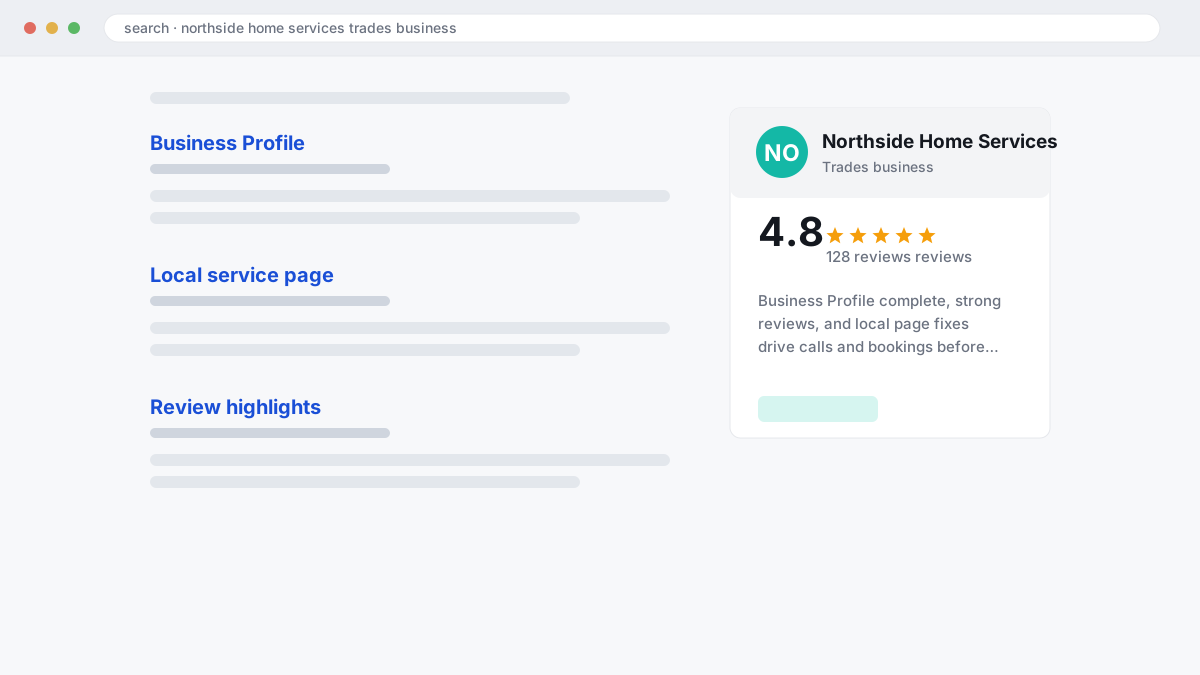
The wrong budget move is to treat local search as regular SEO with a city name added to title tags. That fails because your best traffic may never reach a blog post in the first place. In BGR Review's dataset of trades businesses with complete enquiry-source data, observed from February to July 2026, 70-80% of calls and bookings were attributed to a Google Business Profile or Yelp listing rather than a website. If you run one location, the right starting point is usually your profile, your service pages and your review flow, because the local pack rewards relevance, completeness and distance from the searcher before a big content programme can prove its value.
Traditional SEO still matters, especially once you want non-local terms, broader category pages and stronger link authority. But if your immediate goal is calls, bookings or form fills from nearby intent, spend the early budget where the action happens: correct profile data, stronger categories, better owner responses and compliant review generation. That is also where managed help can beat DIY faster.
Which local SEO tasks usually change results first, and which ones take longer to pay back?
The first gains usually come from fixing your Google Business Profile, tightening categories and building review momentum on the profile and your location pages. Citation cleanup and local backlinks still help, but they usually compound over months, while profile accuracy and reputation work can lift click-through and calls within a few weeks of Google's reprocessing.
The wrong approach is to treat every local SEO task as equal and start with the slowest jobs first: directory sweeps, broad citation edits and link outreach. That fails because a profile with the wrong primary category, weak photos, patchy services or stale opening hours can already rank close enough to show, yet lose the click when the local pack is judged on trust and behavioural signals. A cleaner profile, fresher reviews and owner replies often change conversions before position moves, because the searcher decides in the map pack before they ever reach your site.
The right order is faster profile fixes first, then review generation and replies, then the slower authority layer. BGR Review's review packages start delivery in 24-48 hours and carry a 30-day free replacement guarantee, which fits the part of the job that can influence perception quickly; local backlinks and deeper citation cleanup still matter, but they pay back later and work best once the profile is already converting the traffic it earns.
Why are you still missing the local pack after doing the obvious basics?
If your profile still misses the local pack after the basic clean-up, the gap usually sits in primary category relevance, review strength, duplicate-listing confusion, thin location-page support, or a plain proximity disadvantage. Diagnose against the three strongest competitors within 3 miles of you, not a citywide average or a generic Local SEO checklist.
The wrong diagnosis is “Google ignored our website”. That sends you into title tags, schema markup and blog posts while the map result is being decided by a nearby rival with a tighter primary category, more recent Google reviews and a cleaner Google Business Profile. In BGR Review’s dataset of 1,485 businesses observed from February to July 2026, review build-up tracked earlier visibility gains fastest in local service categories, while website-led work usually lagged behind profile signals.
The better diagnosis is simpler: a nearby competitor beat you on relevance, prominence or proximity. Relevance means their category stack matches the query better; prominence means their reviews, responses and local citations look stronger; proximity means they are physically closer, and no amount of on-page work fully cancels that. If you are three miles farther away than the top result, you need a stronger conversion profile to win the click even when you do not win position one.
Check for duplicate listings before you touch anything else. A duplicate or an old practitioner profile can split reviews, confuse category signals and suppress map exposure, and spam listings in the same 3-mile radius can crowd the pack until they are reported. On review disputes, BGR Review logs outcomes as success, unresolved or unknown across 12,000+ negative review cases from June 2025 to June 2026, which matters here because weak or false reviews often depress click-through rate and calls before they visibly change rankings.
How do you turn a flatlined profile into a practical local pack recovery plan?
A recovery plan starts with Google Business Profile integrity checks, then moves to review momentum, page relevance and spam suppression. If your local pack rankings rose and then flattened, test one fix at a time for 14 to 28 days before you stack anything else.
The panic move is to change the primary category, rewrite the business name, edit services, build citations and ask for twenty reviews in the same week. That fails because you lose the ability to tell whether the stall came from a bad category choice, a duplicate listing, a quietly rejected edit, or a simple ranking-radius limit where proximity beats everything outside your core service area. Check the profile first: confirm the primary category still matches the query you want, look for edits stuck in review or reverted inside your Google Business Profile dashboard, search Maps for duplicate listings tied to the same address or phone, and compare rankings from postcodes near your location before assuming you have a site problem.
If the profile is clean, rebuild prominence in a controlled order. Start compliant review requests after the job closes or the booking completes, then strengthen the location page with clearer service-area copy, and only then add missing local citations and a handful of local backlinks that actually confirm place and trade. In BGR Review's dataset of 1,485 businesses observed February to July 2026, new trades and local service firms that reached 20 to 30 reviews in the first three months were associated with stronger local visibility, although other ranking factors were active at the same time.
If a fake competitor or lead-gen shell is taking pack space, gather evidence before you escalate: screenshots, address mismatch, category mismatch, a virtual office trail, duplicate phone use, or a site that routes every city page to one call centre. Then file Google's Business Redressal Complaint Form against the spam listings. Use standard flagging for obvious duplicates; use a removal route when the false listing is damaging enquiries, because a weak one-click report often goes nowhere. Across 12,000+ negative review cases logged by BGR Review from June 2025 to June 2026, roughly 90% of businesses who came to us after failing had used only the basic in-platform report button, with no supporting documentation.
Can reviews hurt local SEO when the wrong ones stay up or the right ones are collected badly?
Yes. Reviews can hurt local SEO when fake negatives cut clicks, when your collection method breaks platform rules, or when a sudden burst gets filtered. The safer route is review policy compliance, quick public replies, and documented removal attempts for clearly invalid reviews.
Most guides treat any review growth as good growth. That fails when the growth comes from incentives, review gating, or staff asking only happy customers for Google reviews, because Google Business Profile rules ban review discouragement and deceptive engagement, and the US FTC and UK consumer-protection rules also care about undisclosed endorsements and fake review practices. The ranking hit is often indirect first: your star profile looks less trustworthy, click-through from the local pack drops, and weaker behavioural signals follow because fewer searchers call, book or request directions after seeing the listing.
If a fake one-star attack stays live, position may hold for a while and conversions can still fall. A public reply helps because it shows you noticed the issue, but fraud cases move faster when you attach evidence: order records showing no match, screenshots of threats or duplicate text, and proof the reviewer targets multiple competitors. Across 12,000+ negative review cases logged by BGR Review between June 2025 and June 2026, reviews raised within 28 days and backed by an identifiable policy issue resolved successfully in roughly 90% of cases; comparable cases raised later fell to approximately 25–30%.
The right approach is steady, policy-safe review generation after a real job or visit, with no cash, gifts or filtered funnels, plus immediate escalation on obviously false content. Rules vary by country and platform, so treat this as general information rather than legal advice.
What does a policy-safe review system look like when you need more volume without getting filtered?
A policy-safe review system asks every eligible customer in the same way, uses neutral wording and keeps an audit trail you can show later. The safest setups send review requests within 24 hours of the job, avoid incentives or satisfaction gating, and collect fake-review evidence before any Google reviews flag or escalation.
The wrong setup is selective asking with a reward attached: staff message happy customers, hold back the awkward ones, then offer a discount or gift for posting. That breaks review policy compliance on Google and can poison your local pack performance because filtered reviews stop helping click-through rate or conversions even when they were posted by real buyers. If you use a managed service, this is the line to hold your provider to as well; at BGR Review, review packages carry a 30-day free replacement guarantee, but the safer long-term gain still comes from neutral request timing and clean platform rules, not aggressive scripts.
The stronger system is dull on purpose. Trigger one request from your CRM or booking tool for every completed job within 24 hours, use the same plain wording for everyone, and let the customer choose whether to leave feedback. If a fake review lands, freeze the record first: check the invoice or booking log, confirm staff had no matching interaction, save screenshots of the review, profile, date and edits, then note any link to spam listings or copied wording.
How should multi-location businesses split effort between profiles, pages and citations?
Multi-location local SEO works when each branch has its own Google Business Profile, its own location page, and matching business details everywhere those details appear. Central shortcuts save admin time, but duplicated content and merged signals usually blur ranking relevance for individual branches.
The common shortcut is one master page for every branch, with the city name swapped in and the same phone number reused across the group. That fails because Google has to reconcile weak on-site signals with conflicting local citations, and the branch ends up looking half-real: one page says Suite 204, a directory says Unit 204, another uses the head-office line, and the Google Business Profile shows something else. You then get ranking drift, duplicate directory clusters and lower click-through from the local pack because searchers cannot tell which office is theirs.
The better model is one verifiable entity per location. Give each branch a unique landing page with its own address, opening hours, embedded map, local proof, and a direct phone line where possible; then keep NAP consistency tight across the main directories and data aggregators. If two branches genuinely share a call centre number, make the page and profile do more of the separation work with distinct staff, service-area details and branch-specific reviews — that is usually where managed review generation helps more than another citation sweep, and BGR Review keeps review packages under a 30-day free replacement guarantee.
Which assets on your site still help local rankings after the profile is already decent?
Once your Google Business Profile is in good shape, the site assets that still move local rankings are unique location pages, accurate LocalBusiness schema markup and clear internal links from service pages. They strengthen relevance when the local pack is crowded with competitors that already have similar review counts, ratings and profile completeness.
The weak setup is a homepage plus a contact page with one address block. That rarely gives Google enough city-level context for competitive terms, and it gives the visitor little reason to convert after the click. A proper set of location pages works better because each page can tie one place to the services you actually sell there, visible proof such as job photos or testimonials from that area, nearby landmarks, parking or service-radius detail, and internal links back to the matching service pages.
Schema markup only helps when it matches what the page shows. Your LocalBusiness schema should mirror visible NAP consistency, opening hours and primary service details, or you create conflicting signals instead of cleaner relevance. For BGR Review clients using managed Google review campaigns, these pages also improve map-pack conversions because the user lands on a page that confirms the same name, phone and offer they just saw in the profile.
What should a local SEO checklist include if you want something a manager can actually run this month?
A usable local SEO checklist is a monthly run sheet, not a 100-item wish list. Put Google Business Profile accuracy first, page and citation fixes second, review and outreach work third, then check movement against the local pack each week.
The bad checklist treats every task as equal, so your manager spends Tuesday tweaking wording in location pages while a wrong primary category, old hours or a duplicate profile keeps suppressing calls. The better version works by dependency: fix the profile first, then clean NAP consistency across top local citations, then push the actions that change click-through rate and conversions. In BGR Review's dataset of 1,485 businesses observed February-July 2026, trades firms that gained early review volume typically saw first reviews around two weeks after launch, which is why review asks belong in weeks 3-4, not month three.
Use this order for a month-one checklist.
- Week 1: audit every Google Business Profile field: name, address, phone, hours, primary category, secondary categories, services, booking link and duplicate listings.
- Week 2: check your top local citations for NAP mismatches, then fix thin or missing location pages so each service area has a real page to support relevance.
- Weeks 3-4: start compliant review asks, begin local outreach for nearby links and mentions, and run weekly ranking checks against the same map-pack competitors rather than random citywide searches.
When does DIY local SEO stop making sense and managed help start paying for itself?
DIY local SEO works while one person can keep your Google Business Profile, review requests, location pages and reporting moving every week. Managed help starts paying for itself when rankings stall, spam listings keep outranking you, or extra locations turn simple updates into month-long coordination work.
The wrong assumption is that agency support is for big brands. That fails because the real handoff point is complexity, not size: one plumber with one verified profile and clean ownership can usually handle updates, responses and a small local citations audit in-house, but a three-location firm with duplicates, mismatched addresses and review issues often burns more time fixing dependencies than winning new calls.
Specialist support earns its keep when the work has to be coordinated. If duplicate cleanup, citation correction, review generation and page edits happen separately, your local pack recovery drags. If they move together, the profile, the supporting pages and the trust signals reinforce each other.
Where to go from here
Start with the fixes that change both your map-pack position and what happens after the click: correct every field in your Google Business Profile, tighten your primary category, fix NAP consistency, strengthen the location page that supports that profile, and clear obvious spam listings that crowd the same query. Then check your review layer properly. Thin review volume, weak recency, unanswered complaints and false Google reviews depress click-through rate before they show up as a rankings problem, and they drag conversions down even when proximity still keeps you visible.
Your next step is simple: run a 30-day local audit on one location, not your whole estate. Track profile edits, new reviews, owner responses, location-page changes, branded search demand, calls, bookings and form fills from the local pack. If rankings have stalled, a review strategy or a removal assessment usually tells you why faster than another citation sweep.