
Quick answer
For a car dealership, reputation management means controlling how reviews are requested, answered and disputed across Google Business Profile, DealerRater and the other platforms buyers check before they call, submit a finance form or visit your forecourt. The quickest wins usually come from cutting response time, separating sales complaints from service complaints, and challenging reviews that break a platform's published rules. Google removes reviews that violate its content policies, such as spam, impersonation or false factual claims with evidence behind them; it does not remove a review because it is negative. Where removal is justified, BGR Review handles it on a pay-after-success basis at $449 per removed review link with $0 upfront.
BGR Review has handled review growth and removal work since 2019 across Google, Trustpilot, Yelp, Clutch and TripAdvisor, serving 15,000+ businesses and 1,240+ verified clients from offices in New York, London and Thornhill. We see the practical failure points generic guides skip: a one-star service complaint posted on the sales profile, a Google flag rejected because the dealer only used the in-platform report button, or a Yelp recommendation filter burying legitimate first-time reviewers.
That matters because the real work starts after the first rejection. Our team builds evidence packs, matches the issue to the platform's actual appeal route, and where removal qualifies we charge only after success, with no upfront fee and a fixed $449 per removed review link.
Why do car dealership reviews break differently from other local businesses?
Car dealership reputation problems break on operational lines, not generic local SEO lines. Sales and service reviews come from different journeys, dealer groups need branch-level routing within 24 hours, and false-review disputes usually stand or fall on whether your evidence ties the reviewer to a real transaction or shows none existed.
Generic advice says ask for more reviews. That fails in a dealership because sales vs service reviews belong to different managers, different timelines and different failure points: a finance complaint, a delayed handover and a missed workshop update should not land in the same inbox or get the same owner response template. If your multi-location governance is weak, a one-star service review sits unanswered while the sales team assumes the aftersales manager is handling it, response time slips, and your Google Business Profile loses trust signals that affect map pack click-through and conversions before rank moves.
False-review handling breaks the same way. Screenshots rarely carry a removal request on Google Business Profile, DealerRater or Trustpilot; the usable evidence pack usually comes from your DMS, CRM, repair-order history and call logs, with timestamps, adviser names and proof that no matching lead, sale or booking exists. Across 12,000+ negative review cases logged by BGR Review from June 2025 to June 2026, roughly 90% of businesses that came to us after a failed attempt had used only the in-platform report button with no supporting documentation, and 70–80% of those initial requests had been rejected.
Where should a dealership start if trust is slipping this month?
Start with a 30-day triage, not a bigger review push. Check review count, recent negatives, unanswered posts and platform spread, then fix the single highest-visibility trust leak first; for most dealerships, that means Google Business Profile and DealerRater before Yelp or Trustpilot.
The wrong move is trying to improve everything at once: more review requests, new response templates, paid traffic, maybe a homepage refresh. That fails because shoppers usually see the same trust leak first in the map pack or branded search results — a fresh one-star Google post, a weak DealerRater trend, or a lopsided star-rating distribution where recent negatives sit on top of older praise. You fix the leak that gets seen first.
Audit the four profiles before you change request volume. On Google Business Profile and DealerRater, check the last 30 days for unanswered complaints, rating drops, and whether the latest reviews are about sales, service, or financing; on Yelp and Trustpilot, check for the same pattern but treat them as secondary unless they rank for your dealership name. Across 12,000+ negative review cases logged by BGR Review from June 2025 to June 2026, reviews raised within 28 days and tied to a clear policy issue resolved successfully in roughly 90% of cases; beyond 28 days, observed success fell to approximately 25–30%.
Give the work to three people. One owner monitors intake and tags every new review by platform and department, one person writes and posts responses, and one handles removals and escalations with the evidence pack if a post contains false factual claims.
How many reviews does a dealership need before shoppers stop hesitating?
A dealership needs enough recent, credible reviews to look competitive against nearby rivals, not to hit an arbitrary national total. Count, recency and star-rating distribution work together, so 200 old reviews can lose shopper confidence to 80 recent, detailed ones from the same market.
The wrong approach is chasing a vanity review number and ignoring what shoppers see on page one. If your local pack listing shows a lopsided 1- to 3-star mix, or your last meaningful review landed six months ago, the total count does little for click-through rate or calls. A high-volume archive cannot hide fresh complaints about handover delays, finance pressure or service follow-up.
The right target is set against local rivals with similar inventory, distance and profile completeness. If the three strongest nearby dealers all show steady review velocity every month, you need visible recent proof at a similar pace, not a one-off burst. In BGR Review's dataset of 1,485 businesses observed February to July 2026, established local-service profiles usually needed 30-50 reviews before performance stabilised; dealerships often need a higher practical benchmark because shoppers compare multiple sellers before they book a test drive or submit a finance form.
Use this as a payoff rule: fix recency first, then the star mix, then volume. Ten detailed reviews from the last 30-60 days usually move conversions faster than another 50 buried in a five-year archive, because shoppers trust what looks current enough to reflect how your sales desk and service lane operate now.
How fast should reviews grow before the pattern looks unnatural?
Review growth should follow real dealership activity. A busy service lane can sustain faster review velocity than a quieter showroom, but a sharp jump without matching deliveries, repair orders or promo traffic looks manufactured to both shoppers and platform filters.
Most guides tell you to ask for more reviews everywhere, all the time. That fails at a car dealership because sales vs service reviews move on different rhythms: end-of-month handovers, tyre season, recall work and tax-season service demand can produce a legitimate burst, while the same spike in a dead month looks wrong on Google Business Profile and weakens trust before it helps map-pack click-through or calls. The safer approach is to tie requests to completed handovers, closed service tickets and live promotions, then let the pace rise and fall with actual customer flow.
If you run more than one rooftop, check volume weekly by location. Multi-location governance breaks when one branch lands a heavy review push and head office reports it as healthy group growth, even though the other stores stayed flat and the star-rating distribution is drifting. Keep separate targets for each rooftop, split by department, so one service-heavy branch does not distort branded search demand, conversion reporting or the local pack picture for the whole dealer group.
Which platform rules matter most when a dealership manages reviews daily?
Dealerships need a platform-specific playbook rather than one review script pushed everywhere. Google Business Profile drives Maps trust and most branded local clicks, DealerRater shapes automotive credibility, Trustpilot needs controlled invitation methods, and Yelp can hide genuine feedback if the pattern trips its recommendation software.
The wrong approach is sending the same review request, the same owner response, and the same escalation logic to every platform. That fails because each site exposes different signals: Google Business Profile affects the map pack and branded search click-through rate, DealerRater separates the store from individual salesperson profiles, Trustpilot watches invitation methods and verification flow, and Yelp restricts active solicitation while its Yelp recommendation filter can suppress reviews without saying the reviewer broke a rule.
This comparison matters more than a generic review checklist.
| Platform | What matters daily | What usually goes wrong |
|---|---|---|
| Google Business Profile | Fast owner responses, location accuracy, steady review intake, clear handling of sales vs service complaints | One slow reply to a financing complaint can drag conversions from Maps even if ranking holds |
| DealerRater | Dealership rating plus named salesperson pages, detailed automotive complaint context, follow-up on deal-stage disputes | Stores answer the dealership page and ignore the salesperson page shoppers actually read |
| Trustpilot | Controlled invitations and consistent routing after sale or service completion | Selective asks create bias and trigger credibility issues |
| Yelp | Let reviews arise naturally and avoid bursts that look manufactured | Staff ask every happy buyer at handover, then genuine reviews get filtered |
The right approach is to route each review source by its own visibility mechanics. Use Google for daily response time and local pack click-through, use DealerRater for salesperson accountability and automotive detail, use Trustpilot only with controlled invitation rules, and treat Yelp as a low-pressure channel where natural review velocity matters more than volume.
How should staff respond when the complaint is about sales, service, or financing?
Dealership review replies should change by department. Sales complaints need clear expectations and a named escalation path, service complaints need a status update and one person owning the remedy, and financing disputes need privacy-safe wording that moves the conversation offline without looking slippery.
The wrong approach is the same apology pasted under every review. It fails because sales vs service reviews signal different risks to the next shopper in the map pack: a sales complaint usually raises trust and disclosure issues, while a service complaint raises timing, workmanship and handoff problems. If your response time slips past 24 hours on an active thread, other users often join in before your side is visible, which drags down click-through rate and conversions from people comparing nearby dealers.
The right approach is department-specific owner response templates with one public purpose: show control without exposing account details. For sales, say who will review the deal notes and when the customer will hear back. For service, confirm the job is being checked, give a realistic callback window, and name the service manager or adviser who owns it. For financing, never post APR terms, lender names, credit outcomes, repair history or personal data in a public reply on Google Business Profile, DealerRater or Trustpilot.
Use copy like this. Sales: “We’re reviewing the sales process you described and our sales manager will contact you today.” Service: “We’re checking the repair timeline and our service manager will update you by 3pm tomorrow.” Financing: “We want to resolve this, but we can’t discuss finance details in public. Please reply with your best contact number so our finance manager can call you today.” That works because the reader sees ownership, response time and restraint, which protects branded search demand better than a vague apology ever does.
Can a dealership remove false reviews, or only reply to them?
Dealerships can get some false reviews removed, but only where the post breaks a platform rule or states a fact you can disprove. A bad opinion usually stays; a fake customer claim, impersonation, or review tied to an undisclosed incentive may qualify for removal.
The wrong approach is treating every one-star review as removable because it feels unfair. Google Business Profile, Yelp, Trustpilot and DealerRater do not remove posts for being harsh, commercially damaging, or written by an unhappy buyer after a real deal or service visit. They act on policy breaches: false factual claims you can contradict, impersonation, conflict of interest, spam, or incentive-led reviews that were not disclosed in line with the FTC's endorsement rules in the US. If a reviewer says, “worst finance manager in town”, that is opinion. If they say, “you sold me a car on Sunday at 11pm” and your site was closed, no deal was logged, and the timestamp makes the visit impossible, that moves into something you can evidence.
Most failed removal attempts stop at the in-platform report button. In BGR Review's case file of negative review cases with prior self-filed attempts logged June 2025 to June 2026, roughly 90% arrived with no supporting documentation, and 70–80% of those initial requests had been rejected. The right approach is narrower and more boring: match the allegation to the named policy, attach the contradiction, and keep reply and removal strategy separate.
Legal rules change by country and platform. In the US, undisclosed incentives can breach FTC rules; a review that states false facts may also raise defamation issues; in the UK and EU, fake or misleading review practices can trigger consumer-protection problems. That is general information, not legal advice.
What evidence actually gets a false dealership review taken seriously?
A dealership review gets taken seriously when each disputed sentence is tied to a record you can verify. A usable evidence pack links the review text to DMS checks, CRM history, call logs, and a short timeline showing why the reviewer could not be the buyer or service customer they claim to be.
The weak approach is a screenshot plus a complaint that the review is “fake”. It fails because the platform moderator sees an allegation, not proof. In BGR Review’s case file of 12,000+ negative review cases logged June 2025 to June 2026, roughly 90% of businesses that came to us after a failed attempt had used only the basic in-platform report button with no supporting documentation, and 70–80% of those initial requests had been rejected. That rejection did not prove the review was legitimate; it usually meant the submission did not map the false factual claims to records.
This is the standard that usually moves a case from a shrug to a real appeal route.
| Disputed claim in review | Record to attach |
|---|---|
| “I visited on 14 June” | DMS appointment log or service diary for that date and name |
| “Your salesperson Mark lied to me” | Staff rota, CRM notes, and named user activity for that shift |
| “You sold me this VIN” | Deal jacket, invoice, stock record, or proof that vehicle was never in inventory |
| “I called three times from this number” | Inbound call logs showing no contact or a different caller history |
Capture the review screenshot, the profile URL, and every case ID before anyone edits the text, merges the profile, or deletes internal notes. If the first flag is refused, those frozen records let you escalate with a clean evidence pack instead of arguing from memory. That matters on Google Business Profile and similar systems because the second submission often gets read against the first one, and inconsistency kills credibility fast.
What should a dealer group do when one location drags down the whole brand?
Dealer groups need governance rather than passive monitoring. Let each rooftop own the first reply, while corporate controls response templates, disputed-review evidence packs, and legal escalation rules so one weak location does not turn into a brand-wide trust problem.
Corporate owning every reply is the wrong model. It slows response time, flattens genuine local context, and leaves sales, service and finance complaints sitting long enough to hurt map-pack click-through and branded search for the whole group. The better setup is multi-location governance with local managers answering routine reviews, while head office keeps admin access for Google Business Profile, Trustpilot or DealerRater disputes, false factual claims, and any case that may need formal removal work or legal review.
Route every review within one working day by three tags: rooftop, department, and severity. A one-star service-delay complaint goes to the service manager; a finance accusation or impersonation claim goes straight to corporate because the evidence pack, policy match and appeal route need one owner. That split works because local teams can solve real customer issues fast, while risk cases stay consistent and documented.
Use one weekly scoreboard across the group so weak branches show up before they damage conversions.
| Weekly check | What to compare | Why it matters |
|---|---|---|
| Response time | Same-day vs delayed replies by location | Slow branches lose trust before rankings move |
| Star-rating distribution | Share of 1-2 star, 3 star, and 4-5 star reviews | A 4.4 built on polarised reviews converts worse than a steadier profile |
| Unresolved backlog | Open complaints older than 7 days | Backlogs depress enquiry quality and spread into group-level reputation |
What do you do after the first removal request gets rejected?
After a rejection, stop sending the same weak report. Reclassify the issue, rebuild the evidence pack around one policy breach, use the platform’s appeal route with the original case ID, and protect trust in the meantime with a calm public reply.
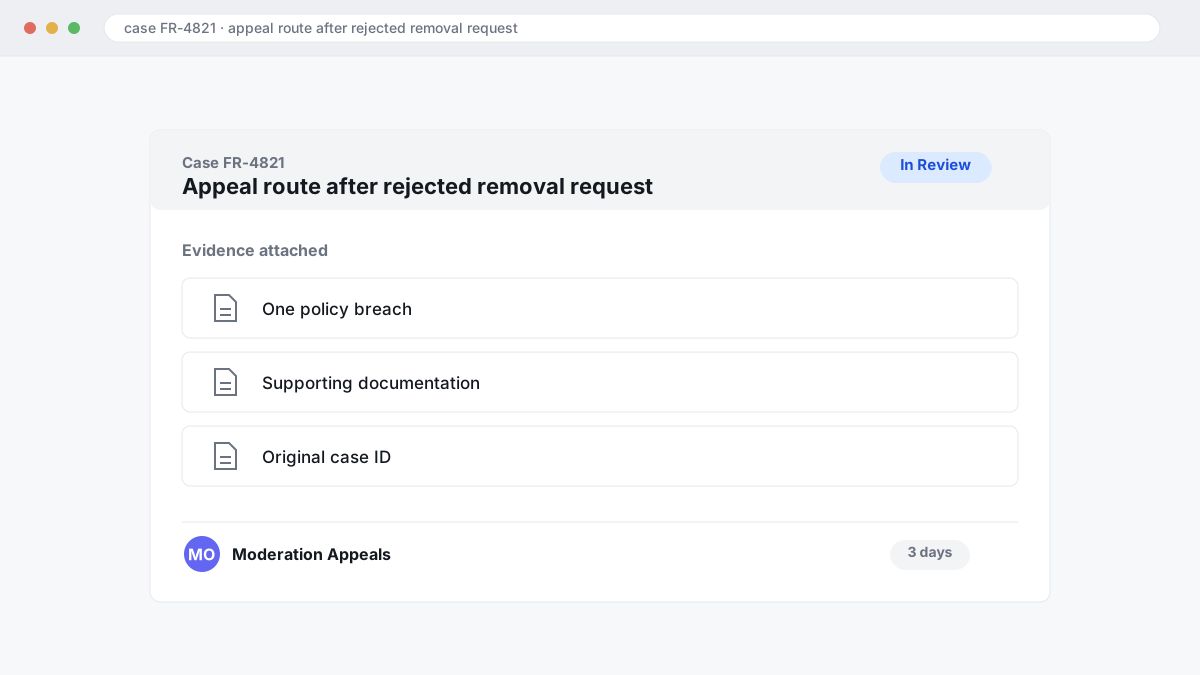
The usual mistake is repeated flagging under broad labels like “spam” or “off topic”. That fails because Google Business Profile and DealerRater both want a clear policy match, not your frustration. In BGR Review’s dataset of negative review cases with prior self-filed attempts, logged June 2025 to June 2026, roughly 90% had used only the basic in-platform report button with no supporting documentation, and 70–80% of those initial requests had been rejected. A rejection does not prove the review is genuine. It usually means weak categorisation, missing evidence, or no stated violation theory.
The better move is narrower. If the review alleges a repair date that never happened, lead with false factual claims and attach the RO, booking log, CCTV still, and customer lookup result in one evidence pack. On Google Business Profile, include the review URL, profile ID, the first case ID, and a short chronology in support. On DealerRater, the appeal route is usually stronger when you show no transaction record and point to the exact sentence that is false, instead of arguing about tone.
If the platform still refuses, post an owner response that sticks to verifiable facts, avoids naming the customer, and invites offline contact. That protects map-pack click-through and conversions better than a defensive argument. Keep documenting new signals as well: copy changes, account behaviour, duplicate wording, or fresh contradictions.
When is in-house review management enough, and when does a dealership need outside help?
In-house review management works when one owner or manager can check every profile daily, reply the same day, and build a defensible dispute file when a review contains false factual claims. Outside help earns its keep when review volume, multi-location governance, or repeated disputes across Google Business Profile, DealerRater, Trustpilot or Yelp push past what your team can document and escalate properly.
The cheap answer is to keep everything inside the dealership. That fails when response time slips, one rooftop answers differently from another, and the first rejected flag is treated as the final decision instead of the start of an appeal route. In BGR Review's dataset of 12,000+ negative review cases logged June 2025 to June 2026, reviews raised within 28 days of posting and backed by an identifiable policy issue resolved successfully in roughly 90% of cases; comparable cases raised later fell to approximately 25-30%.
This is the practical trade-off:
| Factor | In-house | Outside help |
|---|---|---|
| Monthly cost | Hidden in payroll, training and manager time | Fixed price per removed link |
| Response SLA | Strong if one person owns daily monitoring | Stronger when coverage spans multiple rooftops and weekends |
| Training burden | Your team must learn policy wording, evidence standards and routing | Policy expertise and reporting are already built into the process |
| Disputed-review process | Basic flagging often stops at first rejection | Evidence pack, policy match and escalation path are handled with consistency |
If one person can own the queue, in-house is enough. If your dealer group needs fast replies, shared standards and a real escalation process across rooftops, outside support usually protects map-pack click-through, branded search demand and conversions better than a cheaper but slow internal setup.
What should a dealership do in the next 30 days to rebuild trust fastest?
Over the next 30 days, repair unanswered negatives, standardise how each branch replies and disputes, and review results every week. The fastest trust recovery usually comes from shorter response time, tighter routing and better handling of false-review cases, not from pushing another review ask before your basics are fixed.
Launching a fresh campaign first is the wrong move. It lifts review velocity for a week, but shoppers still see stale one-star complaints, uneven owner response templates and no clear split between sales and service issues, which hurts map-pack click-through, calls and form fills. In BGR Review's log of 12,000+ negative review cases from June 2025 to June 2026, reviews raised within 28 days and backed by a clear policy issue resolved successfully in roughly 90% of cases; beyond 28 days, observed success fell to approximately 25–30%.
Use this 30-day cadence across every branch.
| Window | What to do | What to track |
|---|---|---|
| Week 1 | Audit Google Business Profile, DealerRater, Yelp and Trustpilot, assign one owner per platform, and clear unanswered negatives from the last 30 days. | Open complaints by branch and current response time. |
| Week 2 | Set branch-safe owner response templates, routing rules for sales vs service reviews, and an evidence-pack checklist for disputed posts. | Template use, escalation accuracy, disputed reviews filed inside 28 days. |
| Weeks 3–4 | Review branch performance weekly and fix bottlenecks fast. | Review velocity, median reply time, recovered star-rating distribution, calls and bookings by location. |
Where to go from here
Start with your routing. If sales complaints, service complaints and finance complaints still land in one shared inbox, your response time slips, owner response templates get reused in the wrong context, and trust drops in the map pack before rankings move. Put one person on sales reviews, one on aftersales, and one on multi-location governance. Then fix review collection: trigger requests from your CRM at handover for sales and at job completion for service, watch review velocity by branch, and aim for a believable star-rating distribution rather than a sudden spike that looks manufactured.
Challenge policy breaches last, and do it properly. Reviews alleging false factual claims, reviews from non-customers, and posts tied to undisclosed incentives need an evidence pack, not a single click on the report button. Across 12,000+ negative review cases logged by BGR Review from June 2025 to June 2026, cases raised within 28 days and backed by a clear policy issue resolved successfully in roughly 90% of cases; beyond 28 days, observed success fell to approximately 25–30%.
Your next step is simple: audit the last 30 reviews by location, tag each one as sales or service, and pull out any that may breach platform rules. Expect a faster triage, a cleaner appeal route, and clearer odds before you spend anything.