
Quick answer
Local SEO still drives calls, visits and bookings in 2026 because buyers usually check Google before they choose a nearby provider. The numbers that matter first are inside your Google Business Profile: review quality, review recency, category accuracy, service areas, opening hours and reply activity. BrightLocal’s 2023 Local Consumer Review Survey reported that 98% of consumers read online reviews for local businesses. The useful reading of that data is practical: stronger profile trust improves map pack click-through rate first, then calls and form fills, and it tells you what to fix before you spend on citations or new landing pages.
This page is written from live reputation and profile work, where the order of fixes changes the result. A weak profile with stale reviews, mismatched NAP details and one fake-review dispute usually needs the dispute documented first, then profile corrections, then review recency rebuilt; if you do that backwards, Google Business Profile trust signals stay messy and the pack often stays flat even after new reviews land.
BGR Review sells review growth and negative review removal, so the commercial angle is out in the open. We use named-source data, our own research methodology, and the operational details that decide outcomes in practice, including a fixed $449 pay-after-success fee per removed review link with $0 upfront and a 30-day free replacement guarantee on review packages.
Which local SEO numbers deserve attention first in 2026?
The numbers worth watching first are the ones tied to visibility and action: Google Business Profile completeness, fresh reviews, map-pack click-through rate, calls, website clicks, and direction requests. Put your next 90 days into signals you can change inside the profile and on your core local pages, not into broad traffic totals that rarely explain why leads moved.
Most generic local SEO guides still push vanity traffic charts. That fails because AI Overviews and the local pack strip away a lot of low-intent browsing before it ever reaches your site, so a traffic rise can sit next to flat enquiries. The better read is simpler: did your Google Business Profile earn more conversion actions, did map-pack CTR improve, and did the landing page matched to that service and location answer the query well enough to turn a click into a call or booking.
The 90-day order is usually profile health first, reviews second, pages third, citations fourth, links last. Profile health means the right primary category, complete services, working hours, photos, and clean reporting for calls, website clicks, and direction requests inside Google Business Profile; if the category is wrong, your relevance drops before links can rescue it. Reviews come next because recency changes trust at the moment of choice, then local landing pages because weak service-area or city-page relevance wastes the visibility you already have.
Links still matter, but they are rarely the first fix for a local profile that has thin review recency, a weak category setup, or a page mismatch. In BGR Review's dataset of 1,485 businesses observed from February to July 2026, trades businesses with complete enquiry-source data attributed 70–80% of calls and bookings to a Google Business Profile or Yelp listing rather than a standalone website. That is why we tell clients who contact our New York, London, or Thornhill teams to sort profile health and review flow before chasing top-line sessions.
How does local SEO actually turn a nearby search into a call or visit?
Local SEO works when Google can trust three things about you at once: your business is relevant to the query, close enough to the searcher, and credible enough to show in local results. When those signals line up, your Google Business Profile, map pack rankings and local landing pages turn a nearby search into conversion actions such as calls, direction requests and bookings. If you only watch rank, you miss the point; at BGR Review we check click-to-call, direction taps and booked leads before recommending a review campaign or a $449 pay-after-success removal case.
Most generic guides stop at visibility. That fails because ranking on its own does not tell you whether mobile local searches are producing anything useful. The better approach is to connect Search and Maps exposure to the action path: impression, profile click, landing-page visit, then call or visit. In BGR Review’s dataset of trades businesses with complete enquiry-source data, observed from February to July 2026 within a wider sample of 1,485 businesses, 70–80% of calls and bookings were attributed to a Google Business Profile or Yelp listing rather than a website. That is why a fast-loading location page and a complete GBP usually work better together than either one alone.
Why do generic ranking-factor lists miss what operators need right now?
Generic ranking-factor roundups miss the job because they list signals in isolation, lean on stale surveys, and skip the order that actually protects calls, bookings, and map pack rankings when your Google Business Profile starts slipping.
The wrong approach is to read a long list of factors and treat each one as equal. That fails because published percentages rarely tell you what to fix first when online reviews slow down, your profile health weakens, and leads drop in the same week. In BGR Review’s dataset of 1,485 businesses observed from February to July 2026, trades businesses with complete enquiry-source data attributed 70–80% of calls and bookings to a Google Business Profile or Yelp listing, which is why review recency and profile integrity usually deserve attention before a broad site audit.
The useful approach is action-led: tie each stat to revenue risk. If fake reviews or spam hit, the basic in-platform report button often goes nowhere on its own; across 12,000+ negative review cases logged June 2025 to June 2026, BGR Review recorded outcomes as success, unresolved or unknown, because a rejected flag never proved the review was legitimate. That works better for local decisions because you can link the percentage to a fix, the fix to map pack click-through, and the click-through to leads.
How much of local visibility still comes down to your Google Business Profile?
Google Business Profile still sits at the centre of local SEO because it drives Maps visibility, branded search impressions and the conversion actions that matter most: calls, directions and bookings. In BGR Review’s dataset of trades businesses with complete enquiry-source data, observed from February to July 2026, 70–80% of calls and bookings were attributed to a Google Business Profile or Yelp listing rather than a website.
Most guides push profile completion as a numbers game. That fails when the extra fields are wrong. Your primary category shapes relevance far more than stuffing in every secondary category you can find, because Google uses that category choice to decide which searches your profile can plausibly match in the local pack. We see the same practical issue during clean-up work before review campaigns start in 24–48 hours: a locksmith filed as “general contractor” can have every field filled and still lose click-through rate because the profile looks off before a searcher even reads the reviews.
The right move is accuracy first, then completeness. If your hours are missing, your services are generic, or your attributes contradict what your site and local citations say, you create trust friction and weaker branded search follow-through. Duplicate or outdated listings make that worse. They break NAP consistency, split reviews across versions of the same business and send mixed signals to searchers who see one phone number in Google Business Profile and another in directory citations. Before you spend on anything fancy, fix ownership, merge duplicates, correct the primary category and make sure the fields that affect clicks are current.
Why can two businesses in the same city see completely different map-pack rankings?
Two businesses a few streets apart can rank very differently in map pack results because Google recalculates visibility around the searcher’s location, the exact wording of the query, and each profile’s local prominence. Proximity often decides who can appear consistently in that part of the city.
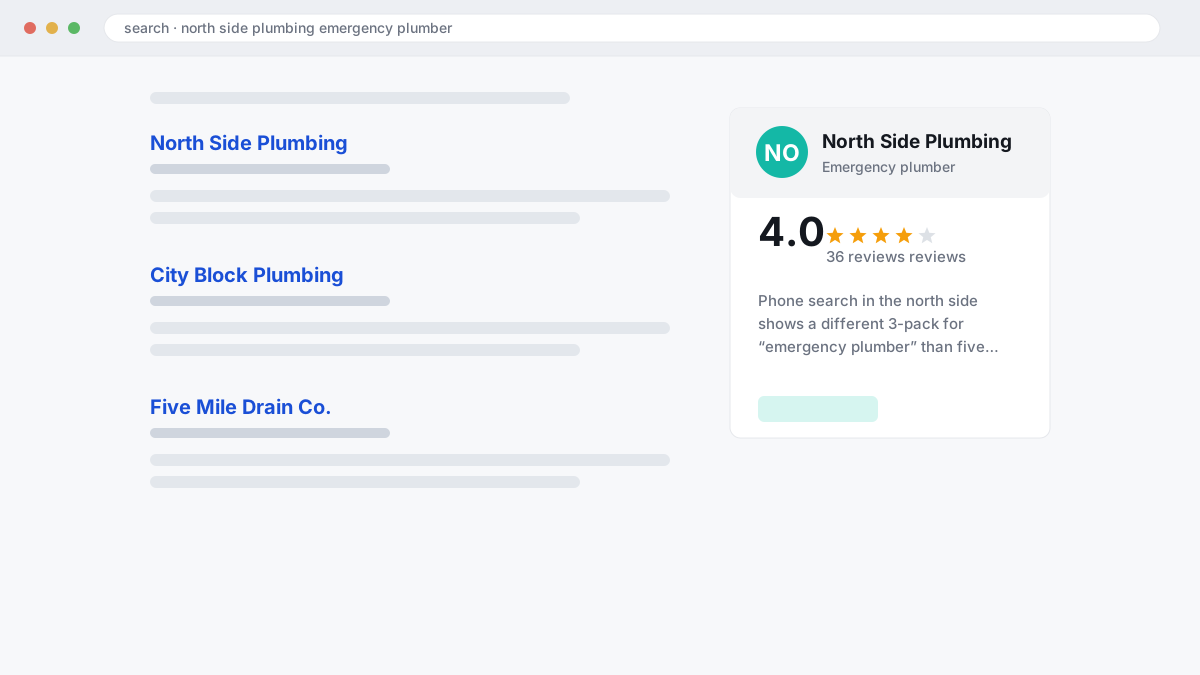
The wrong approach is checking one desktop search from your office and assuming you “rank citywide”. That fails because mobile local searches shift with the device location: “emergency plumber” from a phone in the north side can produce a different 3-pack from “plumber near me” searched five miles away, even inside the same postcode area. The right approach is to judge visibility by neighbourhood, query type, and direction of travel, then compare like for like on the Google Business Profile you are actually trying to grow.
Service area businesses hit this problem harder. A profile can win close to its real operating footprint, then fade sharply outside it even if the service area setting names the whole city, because that field does not override proximity. Prominence can offset distance sometimes — stronger review recency, better category fit, and more branded searches help — but there is a limit.
Do reviews influence only trust, or can they change local visibility too?
Reviews change two things at once: how often people click and whether Google sees your profile as more prominent locally. Strong ratings and fresh review activity lift click-through rate directly, while review volume, review text and review recency feed prominence signals more indirectly inside Google Business Profile.
Most guides treat online reviews as conversion-only social proof. That fails because the map pack is a click market before it is a website visit: if your listing shows a 4.8 average, recent comments from this month and steady volume, you usually win more taps than a profile with the same position but stale reviews from six months ago, and those extra clicks often turn into calls, direction requests and branded searches later. Google Business Profile Help also states that prominence uses factors including review count and review score, so reviews sit inside ranking evidence as well as trust evidence.
The better approach is to manage reviews for both behaviour and visibility. A 4.8 profile with fresh reviews usually outperforms stale social proof because recent activity answers the searcher’s first question — “can I trust this place now?” — and gives Google newer prominence evidence tied to the business entity, especially when the review text mentions the service and location naturally. That does not override proximity; a closer competitor can still rank higher. It does explain why two similar listings with comparable categories and profile completeness can see different map-pack click-through and different local visibility even before the website enters the picture.
Can fake reviews and local spam drag rankings down even before they hurt reputation?
Yes. Fake reviews can weaken local performance before a prospect reads a single comment. Spam creates policy risk inside your Google Business Profile, distorts the online reviews pattern that supports click-through rate and prominence, and can bring manual scrutiny long before the reputational damage fully lands.
Most guides treat “more reviews” as a simple win. That fails when those reviews come from conflicted accounts, undisclosed paid endorsements, review gating, or copied consumer claims. Google’s Google Business Profile review rules prohibit spam and fake content, conflicts of interest, and deceptive engagement, so a short burst of low-trust activity can lead to removals, missing reviews, or a profile that stops compounding trust signals in the map pack. You do not need a public scandal for the damage to start.
The approach that holds up is slower and less exciting: collect compliant online reviews from real customers, keep review recency natural, and fix obvious spam fast with evidence rather than bulk reporting. In BGR Review’s dataset of 12,000+ negative review cases logged June 2025 to June 2026, roughly 90% of businesses that came to us after a failed attempt had used only the basic in-platform report button, and 70–80% of those initial requests had been rejected. That matters because once a bad pattern sits on the profile, your click-through rate can soften even if your average rating still looks acceptable.
Platform rules and laws vary by country, so treat this as general information, not legal advice. In the US, the FTC’s Endorsement Guides and its 2024 rule on fake reviews target undisclosed paid endorsements and fabricated consumer claims; Google separately enforces its own platform policy inside the business profile. If you buy review volume, buy the compliance risk with it too.
How does local SEO compare with traditional SEO when budgets are tight?
Local SEO and traditional SEO solve different jobs. Local work chases map pack rankings, Google Business Profile strength, reviews and location relevance so you win nearby conversion actions, while broader organic SEO usually needs deeper content and stronger link authority before it moves.
Most tight-budget campaigns fail because they chase broad organic traffic first. A local plumber, dentist or roofer does not need another thin blog post targeting national keywords if the profile is missing review recency, the local landing pages are weak, and the phone number is inconsistent across citations; those gaps suppress calls long before they suppress sessions. In BGR Review's own dataset, among trades businesses with complete enquiry-source data observed from February to July 2026, 70–80% of calls and bookings were attributed to a Google Business Profile or Yelp listing rather than a website.
This comparison is what usually matters when you have to choose where the next pound or dollar goes.
| Approach | Main target | Budget reality when funds are tight |
|---|---|---|
| Local SEO | Map pack visibility, nearby searches, calls, directions, form fills | Best first move for service businesses if your GBP, reviews, citations and local landing pages are underbuilt; meaningful movement can show in 30 to 90 days |
| Traditional SEO | Broader organic sessions across larger topic sets | Usually slower because you are competing on content depth, internal linking and external authority, not just proximity and profile quality |
The right split is simple. Fix the local layer first if your revenue depends on nearby demand, then expand into broader organic once the profile converts and branded search starts rising; otherwise you pay for traffic that sits above weaker trust signals and converts worse.
Is local SEO still worth the spend once you measure calls, bookings, and directions?
Local SEO earns its budget when you measure conversion actions rather than rank screenshots: calls, bookings, form fills and direction requests. The fastest payoff usually comes from fixing your Google Business Profile, improving review recency, and tightening the few local pages that already attract high-intent searches.
The wrong approach is to spread the same monthly spend across citations, blog content, link outreach and another reporting tool, then judge success from map-pack position alone. That fails because ranking reports do not show whether your profile generated a phone call or whether direction requests rose after you fixed opening hours, categories and duplicate-listing confusion. A healthier Google Business Profile with fresh, believable reviews often lifts click-through rate before it lifts position, and those extra clicks convert better because the searcher has already seen your rating, review replies and service details inside the pack.
If you want a clean ROI read, start with the actions that lead to revenue and work backwards. Track GBP calls, booking clicks, website forms and direction requests first; then check whether review recency improved in the same period as profile completeness and local landing-page updates. That sequence usually beats equal spend everywhere. Spend follows the blockage, not a fixed channel split.
What changes when you manage local SEO across ten, fifty, or hundreds of locations?
Once you move from one branch to ten, fifty or hundreds, local SEO stops being page-by-page optimisation and turns into governance: controlled Google Business Profile ownership, fixed category rules, duplicate suppression, and local landing pages built with branch-specific proof rather than city-name swaps.
The wrong approach is to clone one page template across every town, change the place name, and assume scale will carry you. It fails because Google sees thin local landing pages, users see no local proof, and uneven online reviews start to distort click-through rate between branches. One office with recent, detailed reviews pulls calls and branded search; another with stale feedback and a weaker Google Business Profile loses trust even if the service is the same. For review programmes, BGR Review runs verified review delivery with a 30-day free replacement guarantee, because branch-level recency usually matters more than headline volume.
The right approach is a governed system: one owner structure for every Google Business Profile, approved primary and secondary categories by branch type, a duplicate-check process before edits go live, and local landing pages that carry genuine branch evidence such as staff, service area, photos, and location-specific FAQs. That works because multi-location SEO wins through consistency at the system level and relevance at the branch level.
What should you check first if your Google Business Profile suddenly drops?
Start with the basic failure points: suspension notices, primary category edits, duplicate listings, ownership changes, and recent review or business-info edits. A sudden Google Business Profile drop usually starts with an operational change before it points to a wider algorithm shift.
The wrong move is to assume Google hit your whole local SEO setup and then start rewriting pages or building citations. That fails because map pack rankings can fall from one profile-level change: a category swap, a merged duplicate, an old manager removing your access, or a hidden suspension that leaves the listing visible in one place and weakened in another. Check Search, Google Maps, and GBP Performance side by side, then mark the first day impressions, calls, direction requests, or clicks dropped.
Match that drop window against three things: missing reviews, spam and fake reviews, and any edits to hours, address, phone, or service areas. In BGR Review's log of 12,000+ negative review cases from June 2025 to June 2026, reviews raised within 28 days of posting and backed by a clear policy issue resolved successfully in roughly 90% of cases, while comparable cases raised later fell to approximately 25-30%. That is why recent spam attacks matter twice: they can hurt click-through rate immediately and, if left alone, become harder to remove.
Look at ownership last. If the profile owner changed, your fixes may never publish, and your visibility loss will look algorithmic when it is really access-related.
What belongs on a practical local SEO checklist after you finish the stats?
A practical local SEO checklist should cover four areas: Google Business Profile accuracy, review health, local landing-page relevance, and citation consistency. Tie each one to conversion actions such as calls, form leads, and direction requests so you fix what moves revenue first.
Most managers export one audit, file it away, and call that tracking. That fails because map-pack visibility shifts before a quarterly report catches it: a wrong opening hour in Google Business Profile, a weak service page, drifting NAP consistency across local citations, or a run of stale reviews can all cut click-through rate while rankings look broadly similar.
Use this eight-week operating list rather than a one-off export.
- Audit your Google Business Profile for core accuracy: primary category, hours, phone, website URL, services, and photos.
- Check your top local landing pages for one city-plus-service intent each, then confirm the page still matches the query and location.
- Review weekly trends: new reviews, review recency, rating changes, and unanswered feedback.
- Check NAP consistency on your main local citations, especially any directory that still ranks for your brand name.
- Search one radius term, one service term, and one branded query every week on mobile.
- Record conversion actions for eight weeks: calls, direction requests, form leads, and review changes.
Where to go from here
The numbers that move local visibility are usually the plain ones: whether your Google Business Profile is complete, whether your latest reviews are recent enough to reassure a searcher, whether the rating profile looks credible, and whether your profile turns views into calls, bookings and form fills. Position in the map pack matters, but click-through rate and conversion actions tell you whether that visibility is worth anything. A profile with stale reviews, missing categories, weak replies or citation mismatches often loses trust before it loses rank.
Start with a 30-day check: review recency, unanswered reviews, NAP consistency, duplicate listings, broken local landing pages and call tracking inside your GBP data. Fix those first. Expect a cleaner profile, clearer trust signals and a better chance of turning map-pack impressions into leads.