


Quick answer
Google has not announced a single public “2026 review filter update”, but the google review filter is catching more reviews before they ever go live, especially ones that look coordinated, duplicated, incentivised or tied to low-trust accounts, devices or networks. Your first job is diagnosis: work out whether the review is delayed, hidden by automated suppression, removed under Google Business Profile review policy, or never published at all. If a review was removed for a policy issue and you need help, BGR Review charges $449 per removed review link with $0 upfront, payable after success.
We handle both review growth and review removals across Google, Trustpilot, Yelp, Clutch and TripAdvisor, so this page comes from the queue where these failures actually show up. The practical difference is simple: a delayed Google review often leaves no public trace for days, while a policy removal usually needs an evidence pack with the review URL, profile link, screenshots, posting date and the exact policy ground rather than a vague spam complaint.
BGR Review has served 15,000+ businesses and 1,240+ verified clients, with teams in New York, London and Thornhill. We also sell review packages with a 30-day free replacement guarantee, so we see both sides of the problem: reviews that should publish cleanly, and reviews that disappear because the request method, account history or network pattern tripped trust checks.
Why are some Google reviews hidden, delayed, removed or never published at all?
A missing Google review usually falls into one of four states, and calling all of them “filtered” wastes time. The real buckets are delayed publication, hidden suppression, policy-based removal under the Google Business Profile review policy, or a review that never publishes at all; each one leaves different evidence and needs a different next step.
Most generic guides shove every missing review into one bucket. That fails because Google can surface reviews on different timelines across Search and Maps, so a delay can look like suppression for the first 24-72 hours, while a true non-publication leaves no public trace at all. If you sell local services, that distinction matters fast: in BGR Review’s dataset of 1,485 businesses observed February-July 2026, trades firms attributed 70-80% of calls and bookings to a Google Business Profile or Yelp listing when complete enquiry-source data was available, so a lost review can hit map-pack click-through and conversions before you have time to guess.
Use this four-state check before you contact Google Business Profile support or pay anyone for help.
| State | What you can usually see | Best next action in the first 24-72 hours |
|---|---|---|
| Delayed | Reviewer sees it posted; you may not see it everywhere yet in Search or Maps | Collect screenshot, review text, star rating and timestamp; wait briefly, then recheck both surfaces |
| Hidden | Reviewer may still see it; the public cannot | Preserve proof and compare reviewer view with public view before escalating |
| Removed | Review was live, then disappeared after moderation or a policy report | Match the text against Google’s prohibited content rules before asking support to review it |
| Never published | No public appearance at all after posting attempt | Check for posting errors, duplicate attempts and missing confirmation from the reviewer |
Screenshots and timestamps decide whether support can do anything. If the reviewer can capture the submission screen, the profile name, the date, and whether the post ever appeared in Maps or Search, Google Business Profile support has something to inspect; if you turn up a week later with only “the customer swears they posted”, recovery usually stalls. That is also why BGR Review tells clients to document review loss before buying review packages with a 30-day free replacement guarantee or using removal work at $449 per removed link with $0 upfront.
How does Google’s review filter actually decide what looks risky in 2026?
Google’s review filter scores authenticity patterns rather than star ratings on their own. Suppression risk rises when several reviews share wording, land in a tight time cluster, come from thin reviewer account history, or show matching device and location signals that suggest coordination.
Most guides blame the one review that vanished. That approach fails because Google usually reacts to the surrounding pattern, not because a single 5-star or 1-star post was “bad”. If ten customers post within an hour after the same staff ask method, use near-identical wording, or leave reviews from the same Wi-Fi at your reception desk, review velocity and spam detection signals can make the whole batch look manufactured, which drags down trust before it hurts map-pack click-through.
The better diagnosis is to check the cluster first: posting window, repeated phrases, account age, and whether several reviewers used the same device or network path. That works because Google’s 2026 handling lines up more closely with account-level and environment-level trust signals, so a long-standing Google account posting from its usual area looks safer than a fresh account reviewing three businesses on the same day from one IP. We see this distinction matter when owners contact BGR Review before escalating to Google Business Profile support; the reviews with the weakest recovery prospects usually combine thin account history with obvious network overlap.
This also explains why a clean star-rating distribution does not protect you. A profile can hold a natural mix of 4-star and 5-star feedback, help conversions and branded search demand, and still lose visibility if the acquisition pattern looks staged. If you need reviews now, spreading requests across genuine customer touchpoints beats any batch push, even when you are trying to lift local pack performance quickly.
Which signals most often trip the filter even when the customer is real?
Real customers still get caught by Google’s filter when the way you collect reviews creates a spam-like footprint. The usual triggers are shared devices or networks, a short posting burst, and review text that reads like it came from the same staff prompt.
The wrong approach is treating “real customer” as enough. It fails because Google evaluates spam detection signals around the review as well as the person behind it: device and network patterns, posting timing, geographic consistency, and reviewer account history. Five genuine customers leaving reviews on an in-store tablet or the same guest Wi-Fi can look like one operator manufacturing volume, especially if a QR campaign pushes them to post before they leave the counter.
The same problem shows up in staff ask methods. If your team uses one script — “Please mention fast service and ask for John” — you create wording overlap, repeated star-rating patterns, and unnatural review velocity. That is why BGR Review tells clients before any Google review package with our 30-day free replacement guarantee goes live to avoid kiosk-style collection, avoid same-minute posting bursts, and vary the ask by touchpoint rather than feeding every customer the same line.
The safer approach is simple: send the request after the visit, let the customer use their own device and connection, and keep the prompt short enough that they write in their own words. That works because an older Google account with normal contribution history, posting from its usual network, leaves a trail that looks human instead of coordinated.
When is a disappearing review just a delay instead of a filter problem?
A delayed review is a timing issue, not a final suppression decision. If the customer posted recently, the text has no obvious Google Business Profile policy trigger, and the review appears differently across Search, Maps or devices, treat it as a publication timing problem first.
The wrong move is to assume a missing review means the Google review filter has already buried it for good. That fails because review delay vs non-publication is not the same event: Google can hold a review in profile moderation or indexing, then surface it hours later or after a few days, especially when Search and Maps have not refreshed at the same pace. A customer may see the review while logged in, you may not see it in Maps, and a third device may show an old review count.
The better move is to wait briefly, then check the same review in three states: the reviewer’s logged-in view, your public Business Profile in Search, and your public profile in Maps. If the timing is still recent and there is no sign of incentivised language, review gating, copied text or location mismatch, escalation usually creates noise rather than a fix. In BGR Review’s support workflow, we usually tell clients to hold screenshots, submission time and the reviewer’s profile link first, then escalate only if the review stays non-public after that short lag window.
How can you tell a filtered review from a policy removal in one check?
Filtered reviews usually disappear because Google's automated trust checks suppress them, while removed reviews come down under a policy ground. That split matters because the evidence, the Google Business Profile support route, and the chance of getting the review restored are different.
The wrong check is to treat every missing review as a filter issue and wait. That fails when Google has actually enforced its Google review policies for prohibited content, a conflict of interest, fake engagement, or off-topic material, because those are policy-based removals and support will look for a rule match, not just proof that the customer was real. If the review vanished with no visible policy notice in your dashboard, you are usually dealing with automation-based suppression instead.
| Check point | Filtered review | Policy removal | Best support path |
|---|---|---|---|
| Visibility to the business | Usually never appears publicly and often leaves no policy message | Often tied to a stated policy reason or a clear rules issue | Ask Google Business Profile support to confirm publication status first |
| Likely cause | Automation flags trust risk from posting context | Content falls under prohibited content, fake engagement, conflict, or off-topic rules | Reference the exact Google review policy section |
| Reversibility | Sometimes recoverable if the post was legitimate and supporting evidence is strong | Usually stays down if the policy match is valid | Appeal only with evidence the policy was misapplied |
A practical clue from our removal intake: across 12,000+ negative review cases logged June 2025 to June 2026, most rejected self-filed requests reached us after the business had used only the basic report button, with no supporting documentation. That is why a vague "my customer posted this" message rarely works for either path.
How do review velocity and timing change what Google trusts?
Google judges review velocity by context, not by a fixed daily limit. Twenty reviews in one weekend can look normal for a busy restaurant or multi-location retailer, but the same burst on a solo legal practice looks far less credible, especially if publication timing, wording and ratings all jump together.
The wrong approach is to treat any fast growth as bad. That fails because Google weighs the business model around the burst: a reopening, a one-day event, a seasonal rush, or a post-visit request flow can produce real campaign bursts. In BGR Review's dataset of 1,485 businesses observed February to July 2026, new trades and local service firms typically saw first reviews around two weeks after launch and reached roughly 20–30 reviews over the first three months, which tells you pacing already differs by category and buyer cycle.
The better approach is to ask whether the timing makes sense for how you actually serve people. If a restaurant runs a weekend promotion, a short spike may fit normal footfall; if a solicitor who closes a few matters each month suddenly gets 20 five-star posts between Friday night and Sunday morning, the star-rating distribution and publication timing create a stronger spam signal. That risk grows when every review is glowing and recent. Balanced, steady growth usually protects map-pack click-through and conversions better than a sharp rating spike that Google may suppress before it helps branded search demand.
How much can filtered reviews hurt leads, clicks and local trust right now?
Losing visible reviews can cut lead flow before your local pack position moves because buyers notice weaker recency, lower review count and thinner social proof first. The fastest fix is usually to recover legitimate recent reviews where you can, then rebuild a steady compliant flow so your profile looks active again.
The wrong approach is to watch rankings only. That fails because click confidence drops earlier: your star-rating distribution looks thinner, your newest proof disappears, and the profile beside you in the map pack shows fresh praise from last week while yours stalls for a month. In BGR Review’s dataset of 1,485 businesses observed February to July 2026, trades firms with complete enquiry-source data often got most calls and bookings from a Google Business Profile or Yelp listing rather than a website, so weaker trust signals can hit conversions before you see a clear ranking loss.
The right approach is triage in order. First, restore recent legitimate reviews if they were filtered or wrongly removed; recent proof usually lifts click-through rate faster than chasing older missing posts. Next, restart compliant asks through the same staff ask methods that produced natural recency before. Then check competitor review gaps weekly, because if rivals also slowed down, your branded search demand and lead quality may hold better than the raw review count suggests.
How do you recover legitimate Google reviews without making suppression worse?
Recovering a legitimate Google review starts with diagnosis, not repeated flagging. Confirm whether the review is delayed, hidden, removed under policy, or never published, then send one clean Google Business Profile support request with evidence that the customer, visit and timing are real.
Start with a state check before you touch support. If the customer can still see the review from their own account but you cannot, you may be dealing with a delay or non-publication rather than a policy removal. If the text has vanished for both sides, or Google shows a policy message, treat it as removed. The mistake is opening appeals, forum posts and chat requests at the same time. That fragments the record, resets context, and makes your timeline look less reliable to Google Business Profile support.
Build one evidence pack first. Include the reviewer name as shown in Google, the posting date and time, screenshots from the reviewer side and the public profile side, the order or booking record, and location context that proves geographic consistency between the visit and the business. If the customer visited a London branch but posted while travelling in Manchester, say that plainly. Staff ask methods matter here as well. A review request sent after job completion from your CRM is easier to explain than a burst of same-day requests from a shared office device or network.
Send one support case per issue and wait for the outcome in that thread before you repeat anything. The wrong approach is five short tickets saying “real customer, please restore”. The better approach is one evidence-led appeal with a dated sequence, attachments, and a clear statement that the review appears legitimate under the Google Business Profile review policy. If support refuses and you still have gaps, tighten the file before you re-open it. At BGR Review, that is the same discipline we use before any platform dispute: one timeline, one route, one complete record.
What should an evidence pack include before you contact Google Business Profile support?
A usable evidence pack does one job: it shows Google Business Profile support that the review came from a real customer and does not obviously breach the Google Business Profile review policy. The core file set is simple: the review text as posted, the submission date, screenshots, transaction proof, customer details the reviewer can confirm, and a short timeline of what happened.
The weak approach is a complaint that says “this review disappeared” with no proof behind it. That fails because support cannot verify whether the issue is delay, non-publication, later removal, or a reviewer-side problem, and a vague ticket often gets a generic reply. The support-ready case file is tighter: invoice or booking record, CRM note, date of service, and store-visit or service-area evidence that matches the reviewer’s location. Geographic consistency matters here. If the job was in your service area or the customer visited the listed address, show that link clearly.
Include your profile URL, the case ID, the support channel you used, and the next follow-up date in one running log. Duplicate tickets usually slow resolution because Google Business Profile support splits the history across threads. At BGR Review, we also tell clients to add one line explaining why policy removal seems unlikely, because support handles a missing legitimate review differently from a fake-review complaint.
Can repeated filtering put your profile at broader risk?
One filtered review does not usually mean Google has put a formal penalty on your profile. Repeated suspicious collection patterns can create ongoing suppression and much harder support outcomes, especially around incentivised reviews, review gating, staff self-reviews, and coordinated posting from the same device or network.
The wrong read is to treat every missing post as a one-off filter miss and keep pushing the same ask method. That fails because Google Business Profile review policy issues can stack into broader distrust without any visible account warning, so your future review velocity, star-rating distribution and map pack click-through can soften even while the profile stays live. A customer who gets offered a discount for a five-star review, or only happy customers being sent the link, creates a bigger compliance problem than one hidden review.
The better move is to separate suppression from policy-based removals and fix the collection method first: one neutral ask, sent to all eligible customers, with no reward, no screening form, and no staff-generated reviews from your premises Wi-Fi.
Rules also change by country and platform. In the US, the FTC’s 2024 rule targets fake or bought consumer reviews and undisclosed testimonials; in the UK and EU, fake reviews and misleading commercial practices face separate consumer-protection rules, including the UK’s DMCC Act framework. Defamation can matter when a review states false facts about a real event, but that is legal territory, not a filter fix, and this is general information rather than legal advice.
What review request wording gets more compliant Google reviews with less filter risk?
The safest Google review request is neutral, short, and sent to your customer’s own phone or inbox. Ask for honest feedback, include the direct Google review link, avoid any reward or discount language, and never screen people first or hint that only positive reviews should post.
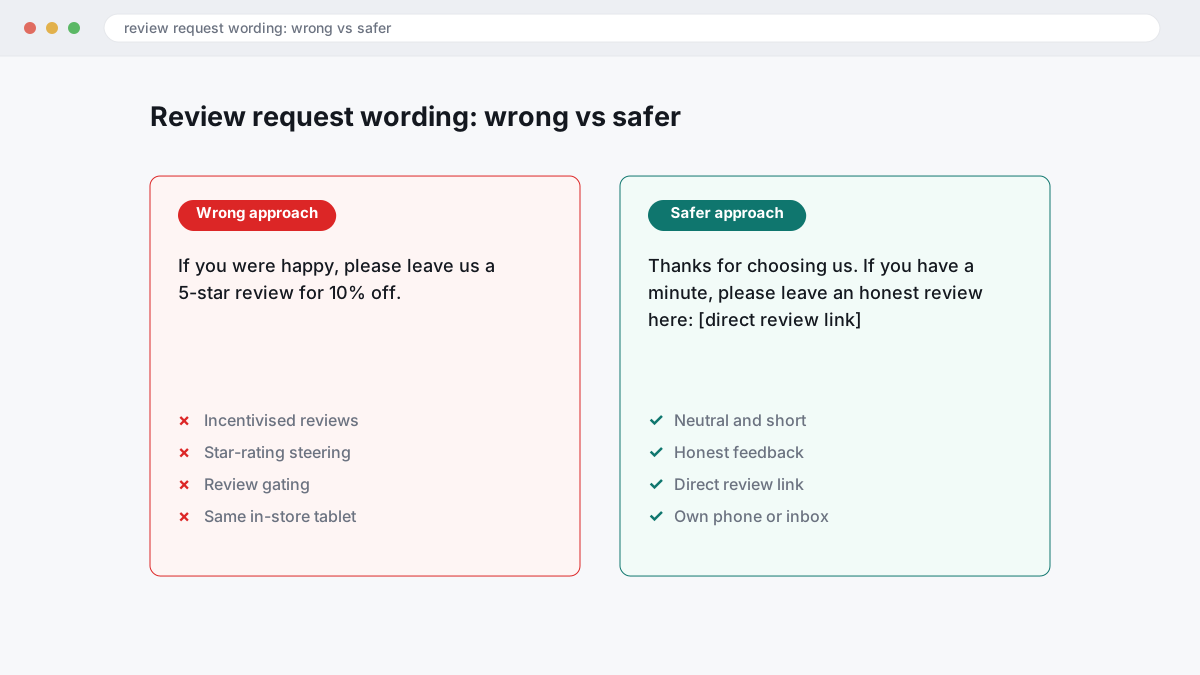
The wrong approach is “If you were happy, please leave us a 5-star review for 10% off.” That mixes incentivised reviews, star-rating steering, and review gating, which conflicts with Google’s review policy and leaves a messy footprint if the customer posts from the same in-store tablet as ten others. The safer approach is plain: “Thanks for choosing us. If you have a minute, please leave an honest review here: [direct link]. Your feedback helps other customers.” That works because the wording is neutral, the customer uses their own account, and your staff ask methods stay consistent across every job instead of pushing only your happiest buyers.
This comparison is the one to use in your request flow.
| Method | Filter risk | Why |
|---|---|---|
| SMS or email with direct link | Lower | Cleaner audit trail, individual device and network patterns, easier to show Google if a review never publishes |
| Shared counter tablet | Higher | Multiple reviews from one device or IP can look coordinated even when customers are real |
If you buy review support from BGR Review, fix the ask before you worry about delivery speed. Our 30-day free replacement guarantee on review packages does not override platform rules, and it will not rescue reviews collected with gating, discounts, or scripted 5-star prompts.
What should you do in the next 7 days if reviews are missing now?
Classify every missing review first, then fix collection risks before you open support cases. Over the next 7 days, document each loss, stop high-risk ask methods, relaunch compliant outreach by SMS or email, and escalate only evidence-backed cases that involve legitimate customer reviews.
The wrong move is chasing every vanished review as a filter failure. That fails because review delay vs non-publication is the first split you need to make: on day 1-2, log each review as delayed, hidden, removed or never published, and save screenshots from both Google Search and Maps with the business name, date and visible rating count. If you contact Google Business Profile support without that record, you usually get a generic reply and no useful investigation trail.
Day 3-5 is for fixing the collection method. Move staff ask methods away from front-desk tablets, office Wi-Fi and rushed in-store prompts, and send review requests from your CRM or phone after the job by individual SMS or email so the customer posts on their own device and network; that lowers the chance that geographic consistency, device overlap or odd review velocity trips spam checks. In BGR Review's case file of 12,000+ negative review cases logged June 2025-June 2026, roughly 90% of businesses that came to us after a failed attempt had used only the basic in-platform report button with no supporting documentation.
Day 6-7 is where selective escalation works. Send documented cases to Google Business Profile support only when you can tie the reviewer to a real transaction and show what changed between Search, Maps and the profile count, then watch whether new reviews publish normally over the next few days. If fresh reviews start landing cleanly, your map pack click-through and conversions usually recover faster than if you keep disputing old missing reviews while the collection process stays broken.
Where to go from here
Start with a 7-day audit. Pull the missing-review dates, the review links if you have them, the reviewer names, your request method, and any pattern around device, network or location. Then sort each case into one of four buckets: delayed, hidden by spam signals, policy-removed, or never published. That classification tells you what to do next. A delay often clears on its own. A suppression pattern means changing how staff ask, spacing review request timing, and stopping risky prompts such as shared-office follow-ups or gated feedback flows. A policy removal needs evidence, not another report-button click.
The result you should expect is clarity first. You may recover some reviews, but you should also expect some losses to stay lost if the reviewer account history, review velocity or geographic consistency looks wrong to Google. In our work at BGR Review, the cases with the best recovery odds are the ones documented early and tied to a specific policy issue; if the evidence is thin, the right move is usually process repair so your map-pack click-through, conversions and branded search demand stop slipping further.