
Quick answer
Zero-Click Search means the searcher gets the answer on Google and never reaches your site. SparkToro and Datos reported that 58.5% of Google searches in the US ended without a click in 2024, so your job is to win visibility inside AI Overviews, featured snippets, People Also Ask, the local pack and your brand SERP. Start with the assets Google can quote or display directly: tighter answer formatting, clearer entity signals, complete Google Business Profile fields, and recent verified reviews where local intent drives calls or bookings.
Most guides stop at traffic loss. Our team handles the assets that still produce demand when clicks flatten: Google Business Profile build-out, verified review coverage across Google, Trustpilot, Yelp, Clutch and TripAdvisor, plus negative review removal at $0 upfront and $449 only after success.
That work shows the pattern generic SEO write-ups miss. A basic in-platform report button usually fails because it carries no evidence pack, while a structured submission with policy-grounded screenshots, profile context and timing often changes the outcome; across 12,000+ negative review cases logged June 2025 to June 2026, we tracked removals, unresolved cases and unknowns separately rather than inflating results.
Why does zero-click search still matter when the click never comes?
Zero-click search still matters because Google can shape the decision before your site loads. If your business owns the answer, the local pack result or the knowledge panel, you can win trust, calls and branded search demand even while website sessions and click-through rate from classic blue links soften.
Most guides stop at traffic loss. That fails because high-intent queries often end on the results page itself: AI Overviews answer the question, the brand SERP shows reviews and business details, and a knowledge panel can settle credibility in seconds. In BGR Review's own dataset of 1,485 businesses observed from February to July 2026, trades businesses that shared complete enquiry-source data attributed 70-80% of calls and bookings to a Google Business Profile or Yelp listing rather than a website. That is demand capture, not a reporting glitch.
The priority changes with it. You still watch click-through rate, but you judge it next to assisted conversions such as calls, direction requests, bookings and the lift in branded searches after your reviews, profile completeness and answer-ready content improve together. That is also where commercial intent becomes clearer: if someone sees your rating, opens your panel, then searches your brand by name, the click came later. If you need help with the review side of that visibility, BGR Review sells verified review packages with a 30-day free replacement guarantee and handles negative review removals on a pay-after-success model at $449 per removed link, $0 upfront.
Which zero-click surfaces deserve attention first when clicks start dropping?
Prioritise the zero-click assets already taking attention on your highest-value searches. For most local and service brands, the local pack, Google Business Profile, review signals and branded SERP assets move faster than a full site rewrite when clicks start flattening.
The wrong move is treating every page as equal and sending your team into broad content refreshes. That fails because Google is already telling you where attention sits: check the top 20 non-brand queries bringing impressions in Search Console, then inspect the live results page and mark which surfaces already appear above or beside organic listings. If a map result, knowledge panel or AI Overview is absorbing the first screen, rewriting five blog posts will rarely lift click-through rate or calls as quickly as fixing the asset already winning impression share.
Local businesses should usually go straight to the local pack. In BGR Review's dataset of 1,485 businesses observed from February to July 2026, trades businesses that shared complete enquiry-source data attributed 70-80% of calls and bookings to a Google Business Profile or Yelp listing rather than a website, so your GBP categories, services, photos, opening hours and review recency come before blog rewrites. A stale profile with thin reviews suppresses trust before the click even happens.
Brands with existing demand need a different order. Start with the brand SERP: tighten title consistency, sameAs schema markup, review visibility, and the sources Google uses to build knowledge panels, because branded searches often rise after reputation work even when non-brand clicks stay flat. If AI Overviews keep citing your category, structure answer-ready pages for citation, but fix the branded result first; that is where conversions, form fills and reputation checks usually happen.
| Business type | Fix first | Why it moves faster |
|---|---|---|
| Local service business | Local pack, Google Business Profile, reviews | These surfaces drive calls directly and shape map-pack click-through before a site visit |
| Brand with search demand | Brand SERP, knowledge panels, review visibility | People check brand trust here before they call, book or submit a form |
How do you optimise for zero-click search without rewriting your whole site?
Optimise for zero-click search by matching each query to the SERP feature it already triggers, then editing the asset most likely to appear there. Start with answer formatting, schema markup, owned brand assets and local profiles before you publish another page.
More content volume is the wrong first move. It fails because Google is already answering many searches with a featured snippet, People Also Ask, a knowledge panel or the local pack, so a new article often adds crawl load without improving click-through rate, calls or branded search demand. The better move is asset-to-SERP matching: map query intent into four buckets before you edit anything — answerable queries for direct answers, navigational queries for your brand SERP and knowledge panel, local queries for Google Business Profile, and comparison queries for side-by-side pages that can earn snippet or AI Overview citations.
Use this order when you triage pages and profiles in the first 30 days.
| Query intent | Best asset | First edit |
|---|---|---|
| Answerable | Core service page | 40-60 word answer-first opening, short list, clear subheads |
| Navigational | Homepage and owned profiles | Consistent brand facts, same-phone citations, Organisation schema markup |
| Local | Google Business Profile | Primary category, services, photos, review recency, Q&A |
| Comparison | Comparison page | Compact table, pros/limits, pricing model where publishable |
Rewrite priority pages for extraction, not elegance. Lead with the answer, keep lists short, and use comparison tables where the reader is weighing options; that structure gives Google cleaner units to quote than long introductions do. Then strengthen supporting assets inside 30 days: complete your Google Business Profile, add valid schema markup, tighten FAQs to one question per block, and improve review coverage on the platforms your buyers already check.
If you serve local demand, do the profile work early. In BGR Review's dataset of 1,485 businesses observed from February to July 2026, trades businesses with complete enquiry-source data attributed 70-80% of calls and bookings to a Google Business Profile or Yelp listing rather than a website, which is why review signals and profile completeness usually move conversions before site traffic does. That will not rescue weak relevance or a poor offer, but it does capture demand that zero-click search is already sending your way.
How is zero-click search different from featured snippets in practice?
Zero-click search is the broader user behaviour where the search results page answers the question before a visit happens. A featured snippet is one format inside that behaviour, usually a short paragraph, list or table pulled near position zero from a single page.
The wrong approach is to treat the two terms as interchangeable and optimise only for snippet extraction. That fails because the SERP layout now mixes several answer surfaces on the same query, and a searcher may stop at an AI Overview, a knowledge panel or the local pack before your featured snippet even comes into play. Google Search Central describes featured snippets as extracts from web pages, while AI Overviews synthesise information from multiple sources, so the writing and asset choices that win each surface are different.
The practical move is to separate “one feature” from “the full no-click outcome” in your workflow. At BGR Review, when a client asks why click-through rate has stalled, we split the fix into page-level answer formatting for snippet eligibility and brand-level work across reviews, Google Business Profile and the wider brand SERP, because those assets still drive calls and branded search demand when the click never lands on the site. One tactic can win a box. A broader zero-click strategy captures demand across the whole results page.
How do AI Overviews choose what to quote and when should you target them?
AI Overviews usually quote pages that answer a clear question and give Google enough context to merge several sources into one response. Pages that lead with a direct answer, define the entities in plain language, and support the point with structured comparisons are easier for overview systems to use for answer extraction.
Most guides tell you to target every keyword that matters to revenue. That fails with AI Overviews because query intent decides whether Google wants a synthesised answer at all. A term like “buy Google reviews” is heavily commercial and often stays ad- and landing-page-led, while “how do Google reviews affect local pack visibility” gives Google synthesis value across policy, reviews, and ranking signals. On BGR Review service and editorial pages, the pages that hold up best after overview rollout are the ones built around named entities such as Google Business Profile, Trustpilot, Yelp and FTC endorsement rules, with the answer in the first lines instead of buried under sales copy.
This is the practical split to use before you start rewriting pages.
| Query pattern | Usually poor for AI Overviews | Usually worth targeting |
|---|---|---|
| High-intent commercial | “buy reviews”, “review removal service” | Only if paired with policy or process questions |
| Informational with comparison | Thin opinion pages | Definitions, steps, trade-offs, platform comparisons |
| Entity-led questions | Pages with vague wording | Pages naming the platform, policy, asset and outcome |
Watch impressions and query shifts after rollout, especially on informational terms in Google Search Console. In BGR Review’s own work, the common pattern is simple: impressions rise, clicks flatten, and branded search demand or calls lift later when your Google Business Profile, review signals and answer-ready page structure improve together. If you sell review support, be direct about the commercial interest as well; BGR Review sells verified review packages with a 30-day free replacement guarantee, but overview-friendly content still needs to teach first and pitch second.
How can People Also Ask and answer formatting win more SERP real estate?
People Also Ask appears more often when each question has its own self-contained answer block. A direct answer of 40 to 60 words, followed by short steps or bullets, gives Google cleaner answer formatting to extract than a long paragraph that wanders through background first.
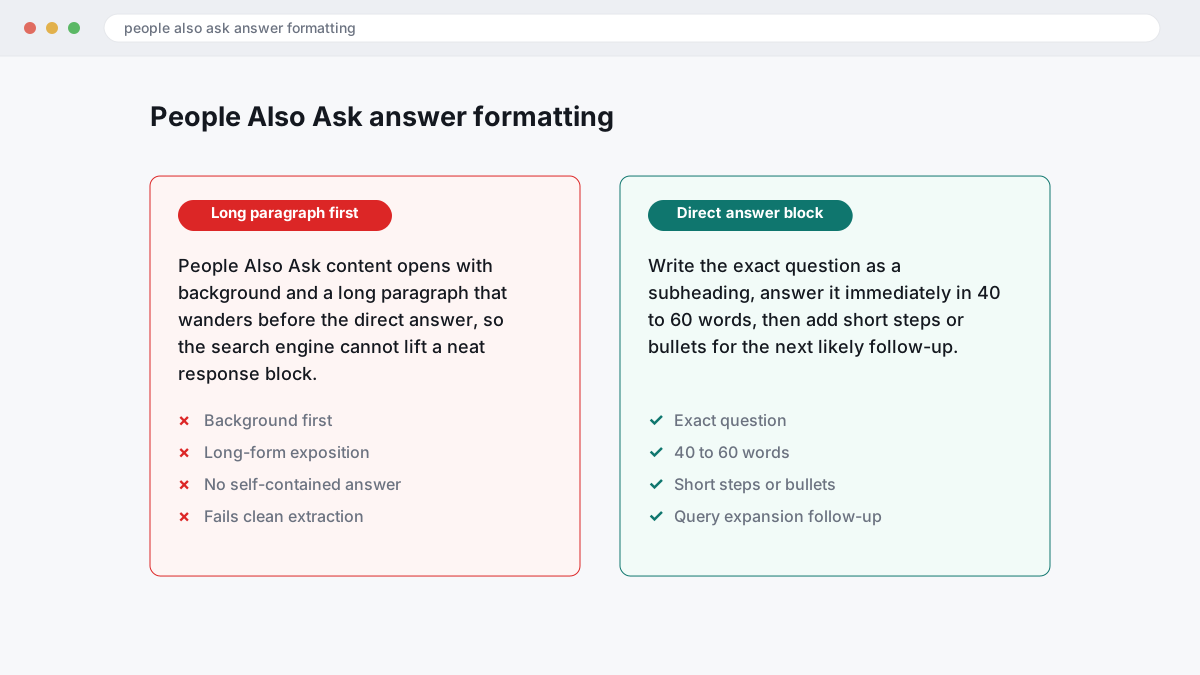
Long-form exposition usually fails here because Google cannot lift a neat response from a wall of copy. The better approach is to write one core question, answer it immediately, then support it with a small list that matches the next likely follow-up created by query expansion.
Use this structure when you build the block:
- Write the exact question as a subheading or on-page prompt.
- Answer it in one paragraph that makes sense with no surrounding context.
- Add 2 to 4 bullets only if they clarify steps, comparisons or exceptions.
- Place related questions nearby so Google can connect the cluster without padding the page.
That cluster matters for branded search and review-led pages as well. If your page covers Google Business Profile reviews, for example, pair “How do Google reviews affect local trust?” with “Can review replies improve click-through rate?” and “What should you fix first on a weak brand SERP?” The result is more extractable SERP real estate, even when the click never lands on your site.
How should local businesses adapt when zero-click search happens in the map results?
Local businesses should treat zero-click search as a Google Business Profile problem before a website problem. In map-heavy results, the local pack often turns the “visit” into a call, a direction request, a booking tap or a message, so profile completeness, category accuracy, review recency and owner activity usually move conversions faster than another blog click.
Website-first local SEO is the wrong priority when clicks are already leaking from map results. It fails because a well-written service page cannot fix a weak Google Business Profile with the wrong primary category, missing services, old opening hours or thin photos; the searcher compares profiles before they compare sites. In BGR Review’s dataset of 1,485 businesses observed from February to July 2026, trades businesses that shared complete enquiry-source data attributed 70–80% of calls and bookings to a Google Business Profile or Yelp listing rather than a website, which is exactly why local demand capture starts in the profile.
Profile-first local demand capture works because the searcher can decide inside the SERP. Your first checks are simple: complete every field in Google Business Profile, tighten category selection, keep your NAP and service wording consistent with the local landing page, and keep review signals fresh enough that the listing does not look abandoned. A 4.8-star profile with recent reviews often out-converts a better-ranked stale listing, because click-through rate in the local pack depends on trust at a glance, and trust rises when the last five reviews are current and the owner has replied in plain English.
Freshness matters more than most local guides admit. If you want more calls, ask for reviews close to job completion, publish updated photos, and correct category drift after any service change; if you want more website clicks, then tune the landing page to match the profile instead of treating it as a separate asset. That order usually lifts map-pack actions first, then branded search demand later.
Is zero-click search bad for SEO ROI or just changing what you should measure?
Zero-click search does not automatically damage SEO ROI. It shifts value away from raw sessions and last-click attribution toward impression share, assisted conversions, branded demand and lead quality, so your reporting has to widen with it.
The wrong read is simple: click-through rate drops, therefore SEO failed. That fails because low-value informational clicks usually disappear first, especially when Google answers the query in AI Overviews, People Also Ask or the local pack, while your visibility still grows and your brand SERP gets seen more often. In BGR Review's dataset of trades businesses with complete enquiry-source data, observed from February to July 2026, 70–80% of calls and bookings were attributed to a Google Business Profile or Yelp listing rather than a standalone website.
The better read is slower and more commercial. If impressions rise, your review profile improves, and branded searches lift a few weeks later, zero-click visibility is often feeding demand before the click happens. That is why we tell decision-makers to judge ROI over 8 to 12 weeks, comparing visibility gained, lead quality and content cost against what actually moved: calls, map actions, form fills and branded search volume.
If you are deciding where to spend next, keep the expensive rewrite on hold until the basics are measured properly. A tighter answer format, stronger review signals and a cleaner brand SERP usually cost less than a full site rebuild, and they often capture more high-intent demand before click-through rate recovers.
What can go wrong when brands optimise too aggressively for zero-click visibility?
The main risk in zero-click optimisation is giving away enough information to cut qualified clicks while losing control of the message. Errors also spread faster when schema markup, reviews or third-party profiles push the wrong data into search features such as knowledge panels and branded results.
Most guides treat extra visibility as an automatic win. That fails when you answer a high-intent query so completely that the searcher never reaches the page that explains price, service area, exclusions or proof, which is where calls and form fills usually sort themselves into qualified leads. The safer approach is to answer the core question, then hold back the decision detail for the page that needs conversion context: eligibility, turnaround, evidence, location coverage, or policy terms.
Weak citations create a second problem. Outdated facts, stale review counts, or mismatched schema markup can feed bad data into knowledge panels, drag down brand authority, and keep repeating across SERP features long after you edit the page. Compliance still applies. In the US, the FTC’s Guides Concerning the Use of Endorsements and Testimonials in Advertising require clear disclosure of material connections; in the UK and EU, consumer-protection rules on misleading commercial practices and fake reviews apply alongside platform rules. This is general information, not legal advice, and the exact line depends on country and platform.
What should a zero-click optimisation checklist include before you publish anything new?
A usable zero-click checklist starts before you publish: confirm the query intent, inspect the live SERP features, pick the answer format Google is already rewarding, then update the off-page assets Google uses to answer people directly. If the result shows a featured snippet, People Also Ask box, local pack or knowledge panel, your page structure and your Google Business Profile need to support that surface before the page goes live.
Publish first and optimise later usually fails because the page gets indexed with the wrong shape. A query that triggers comparisons may need a compact table; a how-to query often needs a clean list; a local service query may send attention to your Google Business Profile, review signals and brand SERP before your page wins a click. Schema markup helps only when it matches visible content and Google's structured data guidelines. Marking up FAQs you do not show on-page, or forcing review schema onto the wrong asset, creates noise and can waste the publish window.
Use this pre-publish order:
- Check query intent on the live SERP, not in a keyword tool alone.
- Note which surfaces appear: AI Overviews, snippets, PAA, local pack, brand panel.
- Choose the page format to match: paragraph, list or table.
- Add schema markup only where the visible content supports it.
- Audit branded assets monthly: business name consistency, top citations, GBP categories, services, photos, opening hours and reply coverage.
- Check review freshness monthly. If you are running a review package, BGR Review's 30-day free replacement window matters only if the underlying profile stays active and current.
How do you measure zero-click performance when clicks no longer tell the whole story?
Measure zero-click performance by pairing visibility metrics with outcome metrics: impressions, click-through rate, branded-query growth, assisted conversions, and local profile actions. A 28-day before-and-after window usually tells you more than daily swings on feature-heavy result pages, especially when AI Overviews, the local pack and knowledge panels keep reshuffling attention.
Last-click traffic reporting is the wrong lens here. It fails because impression share can rise while organic sessions stay flat, and the commercial gain shows up elsewhere: more branded searches, more call clicks, more map actions, or a higher assisted-conversion rate in your analytics path report. For local brands, pull Google Business Profile data into the same monthly view as Search Console and analytics, then track calls, direction requests, website taps, branded queries and assisted form fills together rather than judging the month by sessions alone.
The cleaner comparison is pre-change versus post-change over at least 28 days, using the same pages, same locations and the same query intent group. In BGR Review's dataset of trades businesses with complete enquiry-source data, observed February to July 2026, 70-80% of calls and bookings were attributed to a Google Business Profile or Yelp listing rather than a website, which is why zero-click reporting for local brands has to count profile actions as conversions, not side metrics. If you sell review growth or review cleanup, keep those campaign dates on the report too; the effect often lands first in branded demand and profile actions before click-through rate catches up.
How do you track AI Overview visibility, calls, and assisted conversions after clicks disappear?
Track zero-click performance by pairing Search Console impressions with AI Overview presence, branded search demand, and Google Business Profile actions. When clicks drop, assisted conversions, calls, and direction requests usually tell you whether search visibility is still producing revenue.
The wrong move is to treat sessions as the only KPI. That fails because AI Overviews, the local pack, and other zero-click results often cut click-through rate while keeping your impression share high; in BGR Review’s own dataset of trades businesses with complete enquiry-source data, observed from February to July 2026 within a wider sample of 1,485 businesses, 70–80% of calls and bookings were attributed to a Google Business Profile or Yelp listing rather than a website. If you only watch traffic, you will mark a healthy search channel as a loss.
Use a simple weekly log until tooling catches up. For each priority query, record whether an AI Overview appears, whether your brand is cited or paraphrased, your Search Console impressions and clicks, your Google Business Profile calls and direction requests, and whether branded query volume rose in the same week. That gives you one sheet showing visibility, action, and brand lift together instead of splitting the story across four dashboards.
Review assisted conversions over 8 to 12 weeks, not one reporting day. A user can see you in an AI Overview on Monday, search your name on Thursday, call from your Google Business Profile the next week, and fill a form later; if branded search demand rises while direct clicks soften, the search channel is still doing its job.
Where to go from here
Treat the search result as the asset you manage. Your page still matters, but in zero-click search the local pack, Google Business Profile, review snippets, knowledge panel and AI-generated answers often shape the decision before your site gets a visit.
If your clicks have flattened, start with a simple audit this week: search your brand name, your main service, and your main service plus location; then check what appears first, which reviews are visible, whether your phone number and opening details match, and whether the result answers the obvious pre-sale questions. Weak local trust signals usually show up fast. So does thin brand SERP coverage.
The next practical move is to improve the assets Google already shows: tighten your Google Business Profile, add recent verified reviews, reply properly, and restructure key pages with answer-ready headings and schema where it fits. Expect better click-through from the map pack, more calls from profile views, and a lift in branded searches before website traffic fully follows.