
Quick answer
Yelp has not published a full technical 2026 algorithm document, so the useful question is what changed in review visibility, recommendation and local ranking behaviour. For most profiles, the biggest shift still comes from Yelp’s recommendation software: some reviews stay prominent, others move to the “not recommended” section, and that can change your visible rating without any public warning. Yelp’s policy also still bars direct review solicitation, which raises filtering and trust risk. If performance drops, first check recommended-to-filtered movement, then profile edits, categories and completeness before changing anything else.
We handle review acquisition, disputed review removals and profile-level reputation issues across Google, Trustpilot, Clutch and Yelp, so this is written from live workflow rather than rumour roundups. The first thing we check after a visibility drop is whether reviews actually disappeared from the recommended feed or whether ranking fell while the review set stayed intact; those are different problems and the wrong fix wastes time.
That distinction matters because most failed DIY escalations start with the basic in-platform report button and no evidence. In BGR Review’s log of 12,000+ negative review cases recorded June 2025 to June 2026, outcomes were tracked as removal success, unresolved or unknown, and unconfirmed cases were never counted as failures.
Why did Yelp visibility shift even when your star rating barely moved?
Yelp does not treat ranking, review recommendation software, and the public star display as one system. Your page can hold the same average rating while recommended reviews drop into not recommended reviews, category placement slips, and trust falls because fewer visible reviews now support the profile.
The wrong read is simple: the star score still says 4.5, so nothing meaningful changed. That fails because the displayed average can stay stable even after Yelp reorders which reviews it trusts enough to show prominently, and that changes both your star rating distribution on page one and how persuasive the profile looks in search results. A business with the same headline rating but fewer recent recommended reviews often loses click-through from Yelp category pages first, then sees weaker conversions from calls, bookings, or form fills because the proof under the rating looks thinner.
If you are seeing a drop, check movement before you check sentiment. Count how many reviews shifted from recommended to filtered, then compare any profile edits such as business categories, hours, or service-area details, then separate a ranking loss from a review loss before you contact support or start asking for replacements. That order matters. In BGR Review’s own workflow, the first seven days after a visibility change usually tell you whether the hit came from review visibility or from broader local search visibility changes, and the fix is different in each case. Same rating can hide a real traffic loss.
How does Yelp rank reviews now after the 2026 update?
Yelp now appears to rank review visibility with a blend of reviewer trust, review usefulness, recency of reviews, and overall profile quality rather than publish date alone. A new review can go live the same day and still sit below an older one if the reviewer account history looks thin, the text says little, or the profile around it gives Yelp less confidence.
Most guides still treat Yelp like a normal newest-first feed. That fails because Yelp’s review recommendation software weighs whether a review looks useful and credible, not just fresh. A five-star post that says “Great service” from a first-time account with no photo, no friends, and no other activity can rank below a three-month-old review that explains the job, names the staff member, and has engagement on the profile. In the first triage step BGR Review uses after a visibility drop, we separate ranking loss from review loss before any outreach, because a review that is still recommended can simply have been pushed down by stronger, older content.
The right approach is to improve the signals around the review page, not chase the latest praise. Reviewer account history matters, text detail matters, and business owner responses matter because they add context that can lift click-through rate and conversions even before any local search visibility recovers. A short, defensive owner reply usually does nothing; a specific response that addresses the service, timing, or fix gives the review more informational value. If the issue turns out to be a policy breach rather than ordering, BGR Review handles removals on a pay-after-success basis at $0 upfront and $449 per removed review link.
Which signals now decide whether a review gets recommended or sidelined?
A Yelp review usually stays recommended when the reviewer shows credible activity over time: a fuller account, broader reviewing behaviour, and a profile that does not look newly created for one business. Short, isolated, or solicitation-linked posts are more likely to fall into Yelp’s not recommended reviews area.
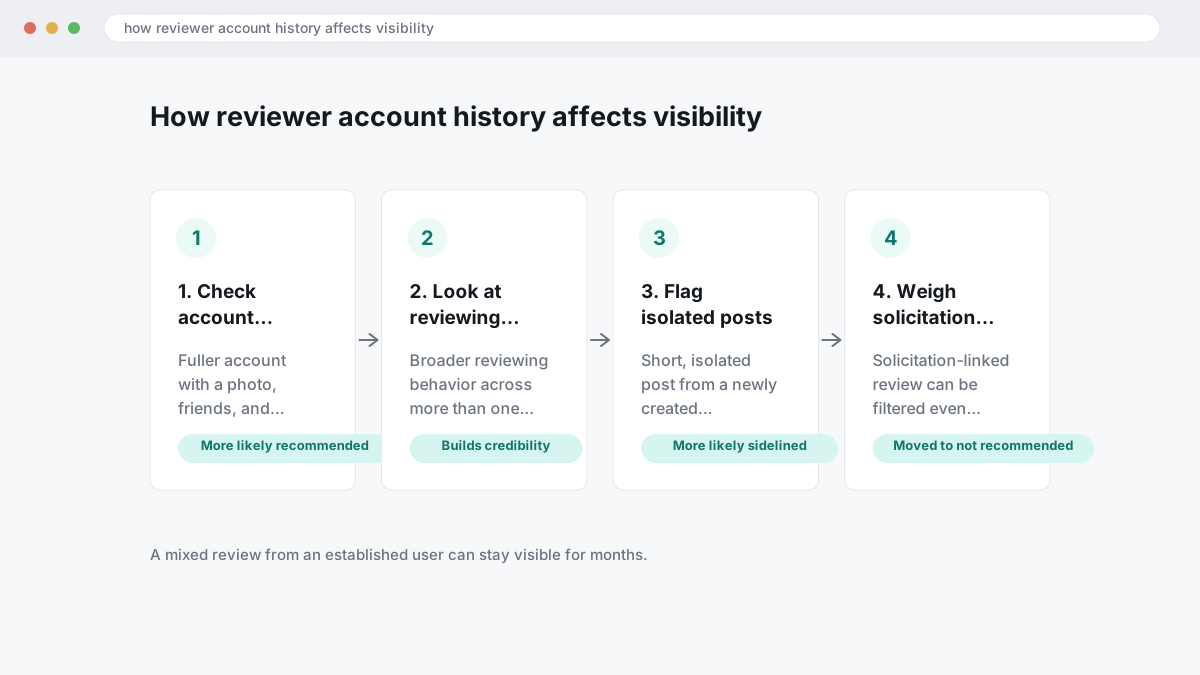
Most owners blame the business profile first. That misses how Yelp’s review recommendation software works. Reviewer account history often carries more weight than your latest profile edit, so a five-star review from a one-review account with no photo, no friends, and no other activity can get sidelined while a mixed review from an established user stays visible for months. That is why the idea that only fake reviews get filtered fails; plenty of legitimate low-trust reviews disappear too.
The safer diagnosis starts with the reviewer, not the star count. Check whether the hidden reviews came from sparse profiles, whether several arrived in a tight praise cluster, and whether those accounts look disconnected from normal Yelp use. Then check profile completeness on your side, because an incomplete business page can weaken trust signals around the edges, but it usually does not explain a sudden batch of filtered praise on its own.
Use the same order we use before any outreach: count recommended-to-filtered movement first, then review recent profile edits, then separate ranking loss from review loss. If three visible reviews moved into not recommended reviews and your star rating barely changed, you have a visibility problem, not necessarily a reputation problem. Acting too fast with more requests can make it worse, especially if those new reviews come from fresh accounts that reinforce the same low-trust pattern.
Can asking for Yelp reviews now do more harm than good?
Yes. On Yelp, direct review asks can create more downside than upside because filtered reviews, weaker trust signals and, in worse cases, a visible consumer alert can outweigh any short-term lift in review count. The risk climbs when your staff ask selectively, send scripted requests, or offer any incentive.
Most guides treat review growth as a volume problem. That fails on Yelp because the review solicitation policy cuts against direct asking, and Yelp’s recommendation software can treat the resulting reviews as low-trust even when the text is positive. A burst of new ratings from thin reviewer accounts can leave your public star average almost unchanged while your visible review mix gets worse, your map-pack click-through rate softens, and conversions from the profile drop because fewer reviews stay recommended.
The higher-risk version is the paid or incentivised ask. Discounts, freebies, credits, staff prompts at the till, or messages sent only to happy customers push you from filtering risk into policy risk, and Yelp can escalate beyond hidden reviews to a consumer alert on the business page. If you need brand-awareness prompts, keep them broad: link Yelp in your footer or post-purchase materials alongside Google and other platforms, avoid directing only satisfied customers there, and do not tie the request to any reward.
That slower approach protects visibility better. In BGR Review’s dataset of 1,485 businesses observed February to July 2026, trades businesses with complete enquiry-source data attributed 70–80% of calls and bookings to a Google Business Profile or Yelp listing, which is why protecting trust on the listing matters more than forcing extra review volume for a week.
What should you fix first if Yelp traffic or lead flow dropped after the change?
Start with the signals that restore trust and local search visibility fastest: your recommended review count, your category position, your profile completeness, and any unanswered negative reviews. Fixing listing gaps usually brings clicks and leads back sooner than chasing every filtered review one by one.
The wrong move is to fight every hidden review first. That fails because a visibility drop often comes from three things moving at once: recommended reviews sliding into the filtered area, weaker placement inside your Yelp category, and profile completeness slipping after an edit, missing hours, thin service details, or stale photos. In BGR Review's dataset of trades businesses with complete enquiry-source data, observed February to July 2026, 70-80% of calls and bookings came from a Google Business Profile or Yelp listing, so even small listing gaps can hit conversions before your star average visibly changes.
Check these items together before you contact support or pay for any recovery work.
| Check first | Why it matters | Fastest payoff |
|---|---|---|
| Recommended vs filtered review count | Shows whether the drop is review visibility or broader ranking loss | Diagnosis, not immediate recovery |
| Category position | A fall here cuts discovery even if your rating barely moved | Higher click-through if rank returns |
| Hours, service details, fresh photos | Improves profile completeness and buyer confidence quickly | Often the fastest route back to calls and form fills |
| Business owner responses on recent negatives | Can lift conversion after the click | Commonly visible within 14 days, but it does not change recommendation status |
The right approach is blunt prioritisation. Fix the profile first, because complete hours, specific services, and current job photos help click-through rate and conversions now; then triage business owner responses on the newest negatives; only after that should you decide whether review recovery or removal is worth the effort. If the issue is a policy-breaking review, BGR Review's removal model is $0 upfront and $449 per removed link after success, but profile repair is often the cheaper first win.
What should you do when Yelp filtered good reviews you wanted to keep visible?
When Yelp filters legitimate reviews, start with diagnosis rather than a dispute. Check reviewer account history, posting timing, wording overlap, and any solicitation exposure before you touch support, because most good reviews that land in Yelp’s not recommended reviews were discounted by trust signals first.
The wrong move is to treat every hidden review as a platform error or a competitor hit and fire off appeals on day one. That usually fails because Yelp’s recommendation software is judging the reviewer as much as the text: thin profiles, first-time reviewers, clustered posting dates, and near-duplicate wording all weaken visibility even when the review sounds genuine. The first triage step we use is simple: count how many reviews moved from visible to filtered, then inspect each reviewer account history before blaming the profile.
The right move is to audit the review source. Open each reviewer profile and check whether the account has a real history of local activity, friends, profile detail, and reviews across more than one business category; a five-star review from a near-empty account carries less weight than one from a reviewer with normal local behaviour. Also check whether you edited your business profile, changed categories, or triggered a burst of new reviews just before the drop, because those timing patterns often separate review loss from a broader local pack or map-pack ranking issue that is affecting click-through rate and conversions.
Do not ask the same reviewer to repost identical text from the same account. That gives Yelp another similarity signal to work with and can keep the review buried. Track visible-to-filtered movement weekly for 8 weeks after any profile change or review-request campaign, then use appeal and support routes only if you can point to a clear mismatch, not just a hidden review you wish were public.
How should you reply on Yelp after a ranking drop without sounding defensive?
Post a brief reply that acknowledges the complaint, adds one factual clarification, and moves the fix offline. Keep it under about 90 words, reply within 48 hours when a new negative mentions a service failure, and do not drag Yelp filtering, recommendation software, or policy arguments into the public thread.
The wrong move is to defend yourself line by line. That fails because readers scan business owner responses for tone, not for a courtroom transcript, and a sharp rebuttal can hurt conversion trust even when your star rating distribution barely changed. Public replies help calls, bookings and form fills more than they help recommendation placement. If the review may breach policy, separate the jobs: post a calm reply for prospects, then decide whether to pursue a removal route privately.
The better pattern is simple: acknowledge the experience, clarify one verifiable point, offer offline help. For example: “We’re sorry this visit felt unresolved. Our record shows your appointment was moved after a parts delay, and we’d like to put that right. Please email the manager so we can review it directly.” That reassures the next reader, protects click-through from the map pack, and avoids giving fresh oxygen to a review you may later challenge.
How is Yelp now different from Google reviews for ranking, filtering, and ROI?
Yelp and Google reward different inputs. Google usually responds well to compliant review generation and fresher review recency, while Yelp is stricter on its review solicitation policy, leans harder on reviewer-trust filtering, and separates visible recommendations from the full review count more aggressively.
Most guides treat both platforms as the same review feed and then wonder why a campaign that lifts Google does nothing on Yelp. That approach fails because Google and Yelp score different behaviours: Google tends to reward steady, policy-compliant review requests with stronger local search visibility, while Yelp’s review recommendation software puts far more weight on reviewer account history, activity and trust signals before a review influences what the public sees.
The budget question is easier to judge side by side.
| Area | Yelp | |
|---|---|---|
| Review generation | Compliant asks usually help review recency and volume | Direct asking carries more risk under Yelp’s solicitation stance |
| Filtering | Spam controls matter, but legitimate reviews often stay visible faster | Recommendation software can sideline good reviews if reviewer history looks weak |
| Replies | Owner replies can improve trust signals, click-through rate and map-pack performance indirectly | Replies mainly affect conversions after the click, not ranking strength |
| Paid placement | Ads and organic are closely tied inside Google’s local ecosystem | Yelp ads separation is clearer, so ad spend does less to fix organic review visibility |
The right approach is to treat Google as your active review engine and Yelp as a higher-friction trust platform.
Which Yelp businesses felt the update most: restaurants or local services?
Restaurants felt the 2026 Yelp update faster, while local services felt it deeper: food and drink profiles react quickly to changes in review recency, but plumbers, roofers and dentists depend more on reviewer history, detailed narratives and slower-moving trust signals.
One Yelp strategy for every category fails because the signal mix changes by business type. A restaurant can lose local search visibility after a short slowdown in fresh recommended reviews, even if its star rating barely changes, because diners scan the newest comments first and click through on momentum. In BGR Review's dataset of 1,485 businesses observed February to July 2026, trades businesses with complete enquiry-source data attributed 70-80% of calls and bookings to a Google Business Profile or Yelp listing, which is why small Yelp visibility losses in competitive local services categories can cut conversions before branded search demand catches up.
The comparison is clearer side by side.
| Business category | What moved most after the update | What works now |
|---|---|---|
| Restaurants | Recency of reviews and recommended-review velocity | Keep a steady flow of genuine recent feedback and reply cleanly to visible complaints |
| Local services | Trust depth, reviewer account history and specific job-detail narratives | Prioritise credible reviewers, fuller profiles and service-specific detail over raw volume |
Competitive business categories magnify the effect. If three nearby roofers have similar profile completeness and similar stars, one or two good reviews slipping into Yelp's not recommended area can move map-pack clicks, calls and form fills more than the same loss would for a single-location cafe with heavy foot traffic.
When should you appeal, flag, or simply wait for Yelp support to do nothing?
Use Yelp support only when you can tie the issue to a policy breach or a clear factual error. Yelp is far less likely to override its review recommendation software than to act on impersonation, non-customer claims, conflicts of interest, or prohibited content when you attach proof.
Most guides push every hidden or filtered review into an appeal. That fails because support routes and recommendation decisions are separate: a review can look fair to you, keep your star rating steady, and still stay in not recommended with no manual reversal. Escalate when you can show something concrete such as a transaction record that disproves the visit, an identity mismatch between the reviewer name and your customer file, or screenshots of a policy breach; save waiting for cases where visibility dipped but no rule appears to have been broken.
One evidence pack works better than scattered messages. Put the review URL, posting date, the exact reviewer claim, your matching records, and any prior contact with the reviewer or Yelp support into one file so the moderator sees the timeline fast. Across 12,000+ negative review cases logged by BGR Review from June 2025 to June 2026, roughly 90% of businesses who came to us after a failed attempt had used only the basic in-platform report button with no supporting documentation, and 70–80% of those initial requests had been rejected.
If a review triggers or sits alongside a consumer alert, treat it as a higher-risk case. Yelp will not remove an alert because you dislike the wording, and support will usually want evidence tied to solicitation, deceptive conduct, or another named policy issue before it reviews the account state; if that evidence does not exist, paying for escalation makes little sense.
Where do policy and legal lines get crossed when reviews, alerts, or suppression are involved?
Policy trouble starts when you treat a Yelp visibility drop as permission to push for reviews, threaten the reviewer, or buy undisclosed endorsements; legal remedies need a specific policy breach or false factual statement, and the rules change by platform and country, so this is general information rather than legal advice.
The wrong approach is common: your star rating holds, leads fall, Yelp suppresses reviews, and you assume the platform owes you reinstatement or damages. That usually fails because Yelp's review solicitation policy restricts asking for reviews in ways many owners still treat as normal marketing, and a consumer alert can follow conduct Yelp reads as deceptive rather than unlucky. If you buy review help, disclose what is paid and what is earned; BGR Review sells review packages with a 30-day free replacement guarantee, and that commercial line needs to stay inside each platform's rules rather than around them.
The right approach is narrower and more effective: use appeal and support routes only when you can point to a named policy issue, or when a review states a false fact that may raise defamation questions. In the US, the FTC's endorsement guides and its 2024 rule on fake reviews target undisclosed paid endorsements and deceptive review practices; in the UK and EU, consumer-protection rules on misleading commercial practices also apply. If the issue is a false statement, preserve screenshots, timestamps and transaction records first. Frustration alone is not a claim.
What should your next 30 days on Yelp look like after this update?
Run a 30-day Yelp reset around visibility diagnostics, profile completeness, consistent business owner responses, and strict solicitation-risk control. If recommended reviews keep moving into the filtered area or a consumer alert risk appears, stop guessing and switch to a documented support and reputation-repair workflow.
Week 1 starts with a baseline, not a fix. Count how many reviews are currently recommended versus filtered, note your category rank for your main service terms, check reply coverage on recent negatives and neutrals, and log every profile gap before you touch anything. The wrong approach is changing one field, waiting three days, and blaming the update; that fails because review loss, ranking loss, and profile weakness often move separately. First separate them.
Week 2 is for controlled edits: correct hours, replace weak photos, add missing attributes, tighten service descriptions, and remove category clutter that muddies local search visibility. Keep a dated changelog. If leads improve after profile edits while review counts stay flat, you are looking at a relevance problem, not a recommendation-software problem.
Weeks 3 and 4 are for monitoring movement, not forcing new reviews. Track recommended-to-filtered shifts, new reply coverage, and whether calls, bookings, or form fills from Yelp are getting better or worse in quality.
Where to go from here
Start with a three-part check on your Yelp profile: count any movement from recommended to filtered, note any recent profile edits to categories, address or business details, and then separate a ranking drop from a review-visibility drop. Those are different problems. If you treat them as one, you usually waste time asking customers for new reviews when the real issue sits in Yelp’s recommendation software or a policy trigger tied to solicitation.
If a harmful review is live, or a legitimate review has vanished, pause any wider reputation campaign until you have a case review. The useful output is simple: a list of review URLs, likely policy issues, the right support or appeal route, and a call on whether outreach will help or make the profile riskier.
Your next action is to collect screenshots, review links and the dates of any profile changes, then get the profile assessed before you spend on ads, discounts or review requests.