

Quick answer
TikTok Shop sellers should treat the 2026 reviews update as a reputation-control problem with direct sales impact. Reviews are tied to the order journey, so late delivery signals, refund and return reasons, weak product detail page accuracy, and undisclosed paid creator endorsements can all drag down your average shop rating and conversion rate. In the US, undisclosed paid reviews or endorsements can also raise FTC endorsement compliance issues. The practical move is to check rating movement weekly, save the order ID, tracking scan, buyer messages and listing screenshots, then report the review through Seller Center before the evidence goes stale.
We handle review disputes and policy-based removal work every week, and the pattern is usually the same: sellers hit the in-platform report button, attach nothing, get rejected, and assume the review must stay. Across 12,000+ negative review cases logged by BGR Review from June 2025 to June 2026, cases raised within 28 days and backed by an identifiable policy issue resolved successfully in roughly 90% of cases, while comparable cases raised later fell to approximately 25–30%.
This page deals with the part generic setup guides miss: what actually happens after a review is flagged, which evidence fields decide the outcome, and where seller-side mistakes start hurting visibility, click-through rate and conversions before you notice the revenue drop.
Why are sellers getting stuck after the 2026 TikTok Shop reviews update?
TikTok Shop sellers are getting stuck because the 2026 update tightened review enforcement and raised the bar for disputes, while most pages still teach onboarding. The seller problem starts later: which product detail page reviews actually breach policy enforcement, what proof TikTok can verify, and which actions lift your average shop rating first.
Most ranking guides tell you how to open a storefront, add products and connect fulfilment. That advice fails the moment a rating drop hits, because sales pressure shows up after reviews turn public, not during setup. A weaker average shop rating can drag click-through on your listing before it shows up anywhere else, and the wrong first move is usually a blind report with no evidence. Across 12,000+ negative review cases logged by BGR Review from June 2025 to June 2026, roughly 90% of businesses who came to us after a failed attempt had used only the basic in-platform report button, and 70–80% of those first requests had been rejected.
The right approach is seller-side triage: check whether the review points to a policy issue, save order-linked proof, then work in recovery order based on what moves demand fastest. Start with the reviews depressing conversion on product pages, then the issues pulling down your shop-level score, then the reporting path itself. That is also where our paid work starts if you need it later: review removals run on a pay-after-success model at $449 per removed link with $0 upfront, because filing weak reports early usually makes the second pass harder.
How do TikTok Shop reviews move from a delivered order to a public rating?
TikTok Shop reviews usually start with a completed, fulfilled order: the buyer receives the item, then leaves a product rating and written feedback that can show on the product page and the shop profile. That order connection supports verification because the review is tied to a transaction, but it does not make every published comment immune from challenge if the content is false or irrelevant.
Most generic guides treat TikTok Shop like an open review platform, where anyone can post a public opinion at any time. That is the wrong starting point. On an order-linked review system, the buyer rating flow begins after delivery or order completion, so the first seller check is always the order record itself: dispatch date, delivery scan, refund status, return reason and any message history that explains what the buyer was actually rating.
That structure works better than open posting because verification starts with a fulfilled order rather than a loose account comment, which gives sellers something concrete to match against the review. It still has limits. A verified purchase can produce a review that mixes a real order with the wrong product claim, a shipping complaint caused by a carrier delay, or service criticism that ignores a partial refund already issued. At BGR Review, that is why we tell sellers to save the order timeline before they hit the in-platform report button; once a dispute starts, your strongest evidence is usually the sequence of fulfilment events, not the star rating itself.
Why can a small batch of bad TikTok Shop reviews hurt sales faster than sellers expect?
A small run of weak TikTok Shop reviews can cut sales before a buyer reads your product detail page, because the average shop rating and recent feedback sit upstream of the purchase decision and change trust in a single scroll.
Most sellers answer a sudden drop by buying more traffic. That usually fails. If your average shop rating has slipped and the newest comments mention the same refund and return reasons, extra ad spend only sends more people into the same trust problem, so click-through from discovery to product view softens and conversions usually weaken before you see a clear traffic collapse.
The faster fix is operational. Read the return codes and support tickets first, then line them up against the wording in the new reviews. If the complaints cluster around missing parts, sizing mismatch or damaged packaging, the review issue is telling you where fulfilment or listing accuracy broke. If the product itself is fine but late delivery signals keep appearing, buyers still score the order badly because they judge the whole transaction, not just the item.
Speed matters here. In BGR Review's case file of 12,000+ negative review cases logged June 2025 to June 2026, reviews raised within 28 days of posting and supported by an identifiable policy issue resolved successfully in roughly 90% of cases; for comparable cases raised beyond 28 days, the observed success rate fell to approximately 25–30%. That is why rating repair and fulfilment correction usually recover revenue faster than chasing more impressions.
Which TikTok Shop reviews are realistic dispute targets and which ones usually stay live?
The strongest dispute targets are reviews with a clear policy problem: the wrong order attached, a false factual claim, irrelevant content, or another breach you can evidence. A blunt opinion on fit, quality or value usually stays live unless you can tie it to a rule violation under TikTok Shop policy enforcement.
Sellers get stuck when they treat a bad review and a policy-breaching review as the same thing. “Cheap”, “not worth the money” or “didn’t suit me” is painful, but it reads as opinion. “I never received this order” when delivery tracking shows completion, or a review posted against the wrong SKU or wrong seller account, is different because order-linked reviews can be checked against platform records. False or irrelevant reviews have a cleaner path because you can prove the mismatch instead of arguing about taste.
The first mistake is filing the in-platform report before you save the order ID, fulfilment record, tracking scan, product variant and any refund or return reason. That fails often. In BGR Review’s case file of 12,000+ negative review cases logged June 2025 to June 2026, roughly 90% of businesses who came to us after a failed attempt had used only the basic report button with no supporting documentation, and 70–80% of those first requests had been rejected. Save the mismatch evidence first, then report. If the review is only harsh but tied to a real transaction, your better fix is reply handling and rating recovery, not a removal request at $449 per removed link.
What should you save before reporting a TikTok Shop review?
Save the order ID, product SKU, delivery proof, tracking events, any relevant buyer messages, and screenshots of the review exactly as published before you report it. A clean appeal evidence pack lets TikTok verify mismatch, timing and policy breach much faster than a general complaint that says the review is “fake” or “unfair”.
Sellers get stuck when they send a feeling instead of a file. A short complaint with no order ID trail, no SKU match and no delivery proof gives moderation very little to check, so the report often dies at the first pass. In BGR Review’s case log of 12,000+ negative review cases recorded June 2025 to June 2026, roughly 90% of businesses who came to us after a failed attempt had used only the basic in-platform report button with minimal supporting evidence, and 70–80% of those first requests had been rejected.
Build one file for one review. Put the order ID, product SKU, delivery timestamp, carrier tracking screenshot and the review screenshot in the same PDF or zipped folder so the timeline is obvious without extra explanation. Add chat logs only when they prove a mismatch, an admission that the buyer never received this specific item, or another clear policy breach; long message threads about general frustration usually dilute the point.
Name everything so the case history stays readable on resubmission: Case-18427_Order-55691_SKU-BLACK-M_ReviewScreenshot, Case-18427_Tracking, Case-18427_ChatLogs.
How do Seller Center moderation tools and appeals actually work once a case is opened?
Once a TikTok Shop review case is opened, Seller Center puts the report, appeal status and case ID into one moderation path, and your job shifts from single-click flagging to a dated evidence trail that survives a first rejection.
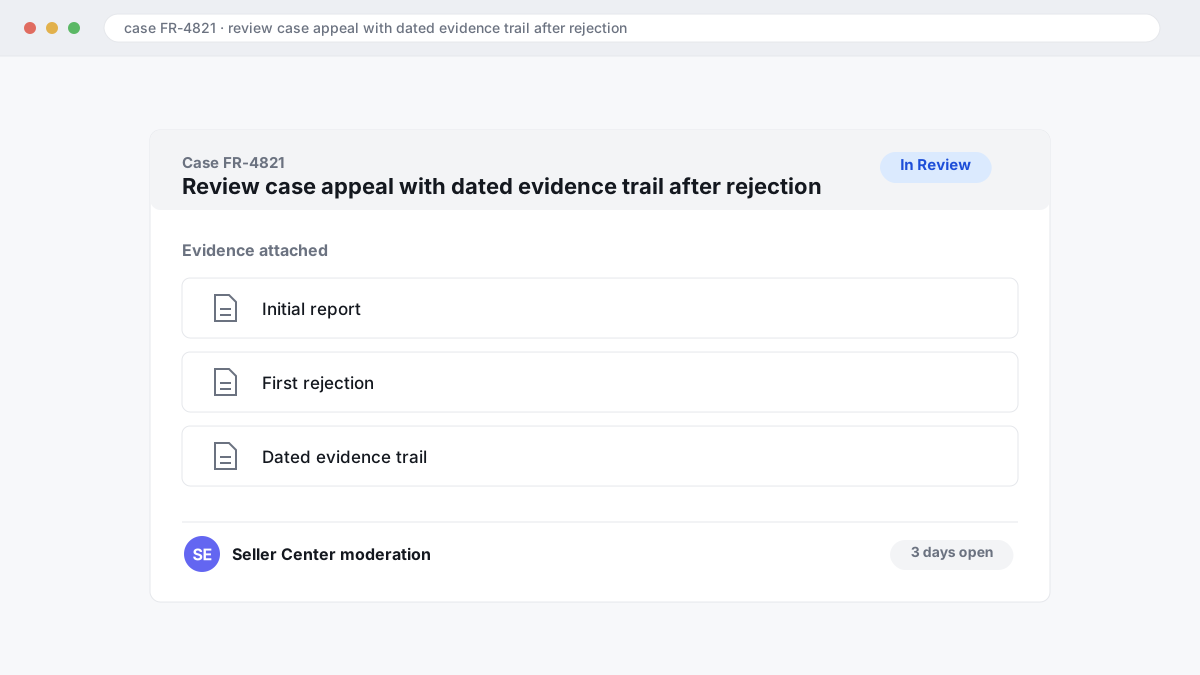
The wrong approach is to hit the basic report button once, wait, and assume the decision was final. That fails because the reporting path records very little context unless you add it through the case flow, so an appeal often lands with the same thin file that triggered the rejection. In BGR Review’s dataset of negative review cases with prior self-filed attempts, logged June 2025 to June 2026, roughly 90% of businesses came in after using only the in-platform report button, and 70–80% of those initial requests had been rejected.
The right approach is tracked case management inside Seller Center moderation tools. Save the case ID the moment it appears, log the submission date, note the reason code you selected, and set a follow-up deadline in your own sheet or CRM so the appeal does not drift. A first rejection does not always mean your evidence was wrong; it often means the review was framed as “bad feedback” instead of a policy issue, or the supporting files did not tie the review to the order record, refund history or delivery timeline.
If you treat appeals as a continuation of the same case rather than a fresh complaint, you keep the moderation path coherent and make later escalation easier. That matters when a weak public rating is already cutting product-page conversion and dragging down click-through from repeat buyers who recognise your shop name.
What should you do if TikTok Shop rejects your report the first time?
If TikTok Shop rejects your first review report, do not send the same story again through Seller Center moderation tools. Match the rejection note to one cleaner policy ground, add the missing order or delivery proof, and escalate only after your evidence now answers the exact moderation objection.
The wrong move is repeating the original report with three weak arguments at once: “fake buyer”, “competitor”, “abusive”, then attaching screenshots that prove none of them. That usually fails because moderation decisions turn on one missing proof point, not on volume. In BGR Review’s dataset of negative review cases with prior self-filed attempts, logged June 2025 to June 2026, roughly 90% had used only the basic in-platform report button with no supporting documentation, and 70–80% of those initial requests had been rejected. A rejection did not prove the review was valid.
The better move is to rebuild the appeal evidence pack around one verifiable breach. If the reviewer never had a matching order, submit the order ID range, buyer mismatch and fulfilment record. If the complaint centres on shipping, check your late delivery signals first. A review saying “arrived late” will usually stay live if tracking, dispatch scans or refund and return reasons support that delay. Fix fulfilment before escalating again, because a second appeal about “irrelevant content” goes nowhere when your own logs show a genuine delivery failure.
When do creator campaigns and incentivised reviews turn into a policy problem?
Incentivised reviews on TikTok Shop become a policy risk when payment, free products or discounts are tied to an endorsement without clear disclosure, or when you shape the outcome by asking for positive wording or a five-star score. Creator endorsements sit under both platform rules and market-specific disclosure rules such as the US FTC endorsement guides, so a campaign can look fine in your brief and still create a moderation problem later.
The wrong approach is offering a rebate, sample or affiliate boost only if the creator or buyer leaves favourable feedback. That fails because it turns encouragement into steering, and undisclosed paid reviews are exactly the kind of signal marketplaces and regulators scrutinise. The safer approach is simpler: ask for honest feedback from verified buyers, separate the incentive from the rating outcome, and require visible disclosure anywhere a creator promotes the product.
If you are seeing a sudden jump in review velocity after campaigns, check disclosure consistency before you file disputes. A burst of near-identical praise after a creator push can trigger scrutiny even when the orders are real, especially if some posts say “ad” or “gifted” and others say nothing. Rules vary by country and platform: the FTC endorsement guides in the US, UK consumer rules enforced by the CMA under the DMCC Act, and TikTok’s own commerce policies do not use identical wording. This is general information, not legal advice. The practical fix is to keep the creator brief, gift terms, order records and disclosure screenshots in one folder before the first post goes live; if a review package later needs balancing with genuine verified feedback, BGR Review’s review plans carry a 30-day free replacement guarantee.
How does TikTok Shop compare with Amazon when reviews go wrong?
TikTok Shop and Amazon both remove reviews that breach platform rules, but seller risk lands differently. TikTok ties review damage to social campaigns, creator content and fast swings in average shop rating, while Amazon leans on a longer-developed abuse system with broader account-history checks and more stable policy enforcement.
The useful comparison is this:
| Issue | TikTok Shop | Amazon |
|---|---|---|
| Review source | More tightly tied to order-linked reviews and product-detail-page activity around live social traffic | Usually tied to verified purchase signals plus a longer reviewer history across the marketplace |
| What goes wrong | Creator endorsements, discount pushes and sudden review velocity can blur into undisclosed paid influence or irrelevant feedback | Abuse tends to trigger mature filters for manipulation, repeat reviewer patterns and incentive issues |
| Appeal route | Seller Center reports often need order records, chat logs, return or refund reasons and proof the review is unrelated or false | Appeals usually lean harder on transaction history, buyer-seller messaging and established policy categories |
Most sellers use the wrong transfer tactic: they assume an Amazon-style report button and a short note will carry the case. That fails on TikTok Shop because a review can be anchored to a real order yet still be dispute-worthy for false factual claims, irrelevant creator spillover or clear policy breach. The stronger move is to build the evidence before the first report: order ID, fulfilment timestamps, delivery scans, refund status, creator brief, disclosure wording and screenshots showing where the review stops matching the transaction.
What should a TikTok Shop review appeal template actually include?
A strong TikTok Shop appeal starts with your case ID, order ID, and the exact review URL or screenshot, then states one review-policy breach in the first line and attaches matching proof so policy enforcement has a clear ground to assess.
Sellers get stuck when they write like a complaint email: “this review is unfair”, “please remove it”, “we work hard”. That fails because the reviewer on the other side is checking rule grounds, not judging effort. In BGR Review’s removal work, the first draft that moves fastest is the one built as an appeal evidence pack, not an emotional defence.
Use this structure in the text box:
- Case ID: [insert case ID]. Order ID: [insert order ID]. Review URL or screenshot attached.
- Policy issue: “This review appears to breach TikTok Shop rules on [false or irrelevant content / undisclosed paid review / non-order-linked review].”
- Proof: attach delivery record, buyer-seller messages, refund timeline, creator brief, or endorsement disclosure evidence that matches that single breach.
- Request: ask for review under that specific rule ground, not a general fairness review.
How do you improve your TikTok Shop rating without creating new compliance risk?
Improve your TikTok Shop rating by fixing fulfilment and product-friction issues before you ask for more feedback. The safest gains come from cutting delivery complaints, tightening listing accuracy, and then increasing legitimate post-purchase review volume with no reward tied to a positive outcome.
The wrong move is pushing harder for reviews while the same refund and return reasons keep repeating. That usually lifts review velocity after campaigns for a week, then your average shop rating stalls because fresh buyers hit the same late delivery signals, damaged packaging, sizing confusion or missing-item complaints. Fix dispatch cut-off times, courier handoff delays, stock sync errors and weak product detail copy first; those changes improve conversion more reliably than any surge of new prompts because the next orders generate cleaner feedback.
If you want a simple control window, track three things every week for 30 days: average shop rating, review recency and the top complaint themes. In BGR Review's log of 12,000+ negative review cases recorded June 2025 to June 2026, reviews raised within 28 days and backed by a clear policy issue resolved successfully in roughly 90% of cases, while comparable cases raised later fell to approximately 25-30%, so you need to catch operational faults early.
Use post-purchase prompts carefully. Ask every buyer for an honest review after delivery, never after a refund dispute is still open, and never attach coupons, cashback, gifts or creator perks to positive feedback because undisclosed paid reviews create a new policy problem instead of fixing the old one. If you need outside help with review volume, keep the same compliance line; BGR Review's review packages include a 30-day free replacement guarantee, and that guarantee does not change platform rules.
What should you optimise next once TikTok Shop reviews start improving?
Once your reviews start improving, the next lift usually comes from fixing the listing itself rather than sending more traffic to it. Compare rating movement, return reasons and conversion rate on your top SKUs for the next 30 days, then update the product detail page for the items already getting the most visits.
The wrong move is celebrating a better star average and pushing harder on ads, creator traffic or affiliate traffic straight away. That fails when the product detail page still has weak images, vague delivery promises or FAQ copy that leaves refund and return disputes unresolved until after purchase; you pay for extra clicks, but conversion rate stays flat and seller performance metrics can still slide if returns and complaints keep coming. A cleaner rating helps click-through and can lift branded search demand, but it will not rescue a listing that creates doubt once the buyer lands.
The better move is narrower. Start with your top-selling SKUs, rewrite delivery windows in plain language, replace any image set that hides size, colour or what's in the box, and add FAQ copy that answers the exact complaints showing up in reviews and return reasons. If you are using BGR Review to improve verified review flow, use the 30-day free replacement window on review packages to keep review velocity steady while you test those edits. Track the next 30 days inside TikTok Shop Seller Center: rating trend, return reasons, conversion rate and any change in seller performance metrics. That is where better reviews turn into stronger listing conversion, and later into broader marketplace gains.
Where to go from here
Start by splitting the problem into two files: fulfilment failure and review integrity. If the review matches a real late delivery, damaged item, refund delay or return dispute, fix the operational issue first and reply with dates, tracking and refund status. If the review looks false, irrelevant, order-unlinked or tied to an undisclosed paid endorsement, build the evidence pack before you report it: order ID, dispatch scan, delivery events, chat logs, refund timeline, product page screenshots and any creator brief that shows what was or was not disclosed.
That next step gives you a cleaner dispute. You should expect at least one rejection if the first report only uses the in-platform flag, because the weak point is usually missing proof rather than the platform deciding the review is valid. In BGR Review's case file of 12,000+ negative review cases logged June 2025 to June 2026, reviews raised within 28 days and backed by an identifiable policy issue resolved successfully in roughly 90% of cases; beyond 28 days, the observed success rate fell to approximately 25–30%.
If suspect reviews are already pulling down trust, conversions or repeat purchase rate, a review-removal assessment is the practical next move before you escalate.