


Quick answer
Perplexity is an AI answer engine that runs real-time web search, summarises what it finds, and attaches citation links inside the answer so you can inspect the source trail. For a business user, the main shift is discovery: your brand, reviews, press mentions and third-party listings can be pulled into an answer without the standard Google click path. Perplexity Pro has been priced at $20 per month, and recent updates have pushed deeper research, model choice and shareable outputs such as Pages. It is useful for sourced research and monitoring, but you still need to verify each cited claim before you act on it.
We wrote this from the operator side, not the fan side. At BGR Review, our team tracks how brands surface across Google Business Profile, Trustpilot, Yelp and publisher pages because a wrong citation can hurt map-pack click-through rate, calls and branded search demand before you notice the traffic drop in analytics.
The practical check is simple but most teams skip it: open the cited page, confirm the date, then compare the answer against the source language itself. In our own negative-review workflow, 70–80% of businesses that came to us after a failed self-filed attempt had only used the in-platform report button with no supporting documentation, which is the same mistake teams make when they trust an AI citation headline without checking the underlying page.
Why are business teams paying attention to Perplexity now, not just testing another AI app?
Perplexity matters because it turns search into cited answers rather than a page of ranked links. That changes brand visibility, click-through patterns and trust because users judge the answer and its citations together, not your position in a classic Google results page.
The wrong way to look at it is as another AI app your team can test for curiosity, then park beside ChatGPT. That fails because an answer engine changes discovery before a click happens: your brand can appear inside the response, disappear behind another publisher's citation, or get reduced to a single sourced line that shapes whether a user searches your name later, fills a form, or never leaves the platform at all. For a business already paying attention to review and reputation signals, the shift is practical, not theoretical; the same company that might pay BGR Review $449 only after a review link is removed often also needs to know why a third-party source is being cited above its own site.
The better approach is to treat Perplexity as a visibility channel built on source selection. That works because citations decide who gets surfaced, what claim gets repeated, and whether the traffic you do receive is higher intent than a broad informational click from Google's ten blue links. If your brand is misquoted or absent, the issue usually sits with source credibility, page structure or third-party mentions, not with ranking alone.
What changed in Perplexity recently that affects research, publishing and search competition?
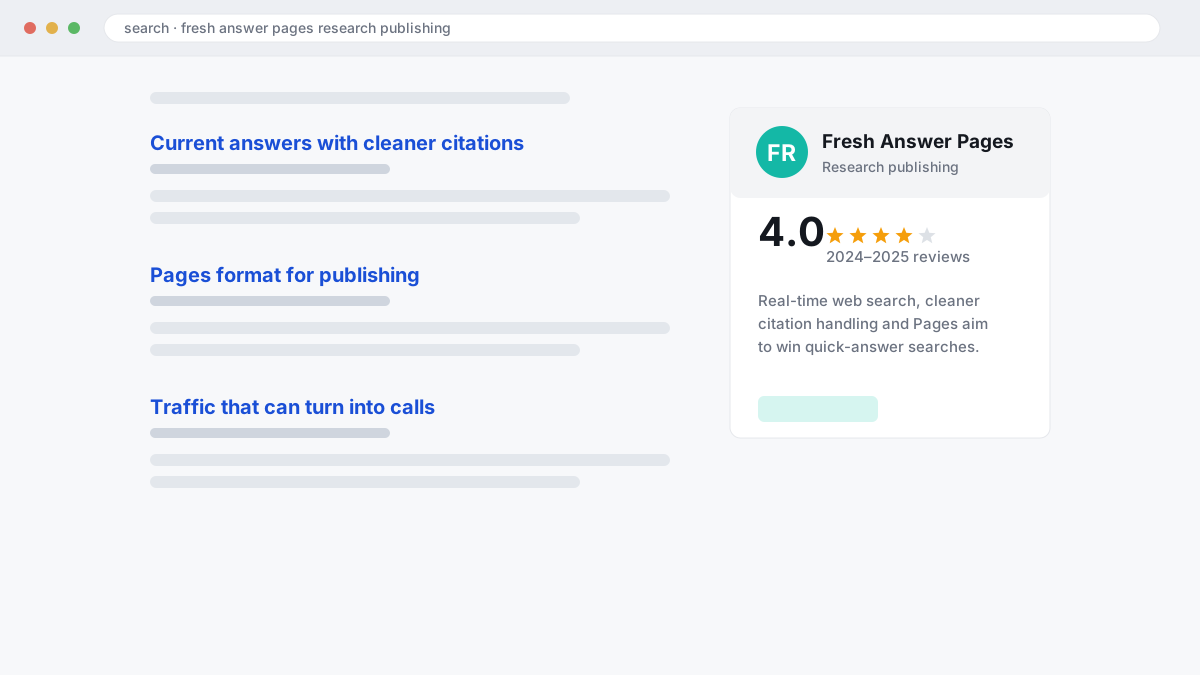
Perplexity’s recent changes affect real research workflows, not the colour of the interface. Its stronger real-time web search, cleaner citation handling and Pages publishing format make it more useful for teams that need current answers, while Google AI Overviews raised the bar across 2024 and 2025 for any answer engine trying to win quick-answer searches.
Most release-note coverage stops at features. That fails because your problem is not “does Perplexity have a new tool”, but whether a fresh answer pulls better sources than Google AI Overviews, whether it protects branded search demand, and whether the traffic it sends has any chance of turning into calls, bookings or form fills. That matters fast when your reputation already lives across Google, Trustpilot, Yelp, Clutch or TripAdvisor, which are the review platforms BGR Review works on every day.
The useful shift is Pages. Instead of passing around chat exports that lose context, your team can turn a researched thread into a shareable summary with the source trail still attached, then check whether the same publishers and citations are shaping both Perplexity and Google AI Overviews for your brand terms. That works because you can audit the claims before they spread; if a false review accusation or bad citation gets copied into public search surfaces, clean-up still happens one link at a time under BGR Review’s pay-after-success removal model at $449 per removed review link, with $0 upfront.
Which recent Perplexity updates actually change what users see and trust?
The updates that change trust are the ones that alter citations, follow-up behaviour, mobile discovery and commercial inserts, because those are the moments when a buyer decides whether to click your site, trust a third-party source or stop at the answer.
Most coverage chases funding headlines. That fails because valuation news does nothing to your visibility. The useful timeline is product-side: in 2024 Perplexity kept pushing answer-first search with stronger source cards and deeper follow-up threads; later releases expanded shopping-style results and mobile use, which moved the tool closer to buyer research on the go rather than desktop-only comparison.
Two changes matter more than the headline features. First, Perplexity Pro pricing, commonly positioned around $20 per month in the US, widened serious daily use among marketers and founders who now run repeated branded searches instead of one-off curiosity prompts. Second, monetisation moved from theory to limited tests: the publisher programme and ads gave some answers sponsored or partner-shaped surfaces, but those are not the same as a full organic ranking signal and should be treated as tests, not universal behaviour.
If you are auditing brand trust, separate official launches from limited rollouts. A citation UI change or mobile search update can shift click-through, branded search demand and conversions quickly; an ad test only matters when your name appears in a query where Perplexity is already citing review platforms, news coverage or stale directory pages you have not fixed.
Why do source links matter more than the answer text for brand visibility?
In Perplexity, the source links usually matter more than the summary because they decide whose version of your brand gets carried into the answer. If a review platform, forum thread or news piece is cited before your site, that source frames trust before any click, call or form fill.
The wrong approach is chasing rank for your own homepage and treating the answer text as the prize. That fails because Perplexity credits the cited page, not the brand with the best title tag, and buyers often open the source links to verify a claim, compare reviews or check a complaint. The better approach is to audit every branded query, separate owned pages from third-party mentions, and fix the source most likely to be cited again.
This is where source quality changes traffic and conversions. A clean service page can help, but a strong publisher citation or trusted review-source mention often wins more referral clicks because it looks independently verified, especially as Perplexity expands its publisher programme and ads inventory around commercial queries.
The source type changes what the buyer sees next.
| Source type | What Perplexity credit looks like | Brand visibility outcome |
|---|---|---|
| Direct site | Official facts, pricing, policies | Best for control; weaker if third-party trust signals are missing |
| Publisher article | Independent reporting or comparison | Higher perceived reliability; can lift click-through and branded search demand |
| Forum | User anecdotes and complaint threads | High risk of one-sided framing; can depress conversions fast |
| Review source | Star ratings, review excerpts, platform trust signals | Strong effect on lead confidence, local discovery and map-pack click behaviour |
Where can Perplexity pull reviews and third-party brand claims from?
Perplexity can pull brand claims from review-platform citations such as Google reviews, Trustpilot, Reddit threads, and publisher roundups, and those third-party sources often shape trust faster than your homepage copy because the answer engine shows them as evidence.
The wrong approach is to polish your About page and assume branded prompts will repeat it. That fails because Perplexity leans on source links, and for reputation-led queries those links often come from places you do not control. In BGR Review’s live workflow, we run a branded prompt, open every citation, split owned pages from third-party mentions, then fix the source most likely to be repeated across future answers; if a weak Trustpilot page or a Reddit complaint thread keeps appearing, changing your site copy does very little.
This source map is the useful starting point for brand reputation monitoring.
| Query type | Sources Perplexity is likely to cite | What to fix first |
|---|---|---|
| “Is [brand] legit?” | Trustpilot, Reddit, publisher reviews | Low-rated review profiles and repeated complaint threads |
| “[brand] reviews” | Google reviews, Trustpilot, roundups | Review recency, response quality, missing verified proof |
| Local business discovery prompts | Google profile data, directory mentions, map alternatives, location pages | Inconsistent location details and weak city-specific mentions |
The right approach is to track which source class dominates by query type, then improve that source before it spreads into more answer threads. For local business discovery, location-specific mentions and review-platform citations can affect map-pack clicks, calls and form fills before a user reaches your site, which is why BGR Review treats Google, Trustpilot and removal work as one visibility job rather than three separate tasks.
Perplexity vs ChatGPT vs Google: which wins for research, discovery, and branded searches?
Perplexity usually works best for source-backed research, ChatGPT Search for conversational help, and Google for navigation and transaction-heavy queries. Your best answer engine depends on whether you need cited synthesis, a guided thread, or direct SERP actions such as maps, calls and site links.
Most comparison guides try to pick one winner. That fails because buyer intent shifts by query. A branded search for your company name, opening hours or nearest branch usually favours Google AI Overviews and the standard results page, because Google still owns the map pack, local business discovery flow and click paths into calls, directions and reviews. A query like “compare three SEO agencies and cite sources” often feels cleaner in Perplexity, because the answer, source links and follow-up threads stay in one view instead of splitting research across tabs.
This is the practical decision frame we use before recommending where to fix visibility problems first.
| Tool | Where it wins | Where it weakens | Click behaviour |
|---|---|---|---|
| Perplexity | Cited research, fast synthesis, source checking | Transactional discovery, local pack intent, direct brand navigation | Clicks skew to cited publisher pages, review platforms and brand pages when the source link looks trustworthy |
| ChatGPT Search | Conversational exploration, drafting, follow-up clarification | Source discipline can feel less explicit than Perplexity on some queries | Users often stay in the thread longer before clicking, which can delay branded search and form-fill traffic |
| Google AI Overviews | Navigation, product intent, local queries, branded searches | Messier research flow when you need to inspect several citations deeply | Strongest path to map-pack clicks, calls, bookings and high-intent conversions |
If you want one rule, use Perplexity to audit what claims and review-platform citations an answer engine may repeat, then use Google to judge whether those claims damage map-pack click-through rate and conversions.
Does Perplexity create real lead visibility or just another analytics blind spot?
Perplexity can create real lead visibility, but the payoff usually appears as citations, branded recall and shortlist inclusion over 30-90 days rather than as a clean last-click conversion in your analytics.
The wrong approach is to judge it like paid search and ask whether Perplexity sent the final session before a call or form fill. That fails because the answer engine often influences the buyer earlier: they read the summary, inspect the citations and source links, then return later through branded search, direct traffic or a Google query for your company name. The right approach is to treat it as assisted discovery, especially in categories where buyers compare providers before speaking to sales, such as agencies, software, clinics and higher-ticket services.
The lead impact is lower for urgent local intent. In BGR Review's dataset of trades businesses with complete enquiry-source data, observed February-July 2026, 70-80% of calls and bookings were attributed to a Google Business Profile or Yelp listing, not a research-heavy journey through answer engines. That boundary matters. Perplexity tends to matter more where review-platform citations, editorial mentions and category comparisons shape trust before contact.
Track three things for 30-90 days: whether your brand appears in cited sources, whether branded-search demand lifts after those mentions, and whether assisted conversions rise in your CRM even when last-click stays elsewhere. That is also where brand reputation monitoring earns its keep. If Perplexity keeps citing the same weak third-party page, fix that source first; BGR Review sells review growth and negative review removal, and that work often improves the pages AI systems choose to quote before your site ever gets the click.
How accurate and safe is Perplexity when your brand is named?
Perplexity is often accurate when its citations and source links point to strong, current sources, but your brand still faces hallucination risk when the source set is thin, stale or contradictory. The test is simple: ignore how fluent the answer sounds and check whether each brand claim is supported by the links underneath it.
Most teams stop at the polished summary. That fails because a smooth answer can still pull a wrong address, an old pricing claim, or a recycled accusation from a low-quality forum thread and compress it into one confident sentence. The safer approach is brand reputation monitoring at source level: run the branded query, open every cited link, separate owned pages from third-party mentions, and fix the source most likely to be repeated in future answers.
Hallucination risk rises fastest when a brand has little fresh coverage, conflicting review-platform citations, or outdated press and directory pages. That is where Perplexity can blend a verified company page with a years-old article or forum post and present both as if they carry the same weight. Generic guides explain the tool; they rarely show how one stale claim can shape trust before a buyer clicks, cut click-through rate from a branded search, and push calls or form fills to a competitor with cleaner citations.
Rules also vary by country and platform, so treat legal fixes carefully. In the US, the FTC’s endorsement guides and fake-review rules matter if a source contains undisclosed paid endorsements; a false statement of fact may raise defamation issues; and in the UK or EU, misleading commercial-practice rules can apply to deceptive claims and reviews. This is general information, not legal advice. If a statement is wrong but not removable, the practical route is usually to publish a stronger corrected source and make sure future answer engines have something better to cite.
What does Perplexity Pro change for teams, pricing, and everyday use?
Perplexity Pro changes business use by turning a free answer engine into a quicker research workflow: as listed on Perplexity’s official pricing page at the time of writing, Pro is US$20 monthly or US$200 yearly, and the gain is speed, continuity and fewer dead ends in follow-up work.
The wrong approach is paying because you expect smarter answers on every prompt. That usually disappoints. The better reason to pay is that Pro makes query follow-up threads more usable for branded checks, competitor comparisons and source chasing, which matters when your team is checking Google, Trustpilot, Yelp, Clutch or TripAdvisor mentions before a buyer sees them.
For day-to-day use, the difference is easiest to judge by workflow.
| Use case | Free plan | Pro plan |
|---|---|---|
| Solo research | Fine for occasional branded searches and quick source checks | Better if you run repeated comparisons and longer follow-up threads |
| Team usage | Works, but handoffs break when one person has to restart the search path | Stronger for shared workflows where speed affects calls, form fills and branded search demand |
| Monitoring | Good for ad hoc checks | More useful when you need frequent brand, review-platform and citation reviews tied to lead visibility |
Which prompt template catches brand mentions, reviews, and risky claims fastest?
A repeatable Perplexity monitoring prompt catches brand mentions, review-platform citations, and risky claims faster than ad hoc searching because it forces the answer engine to run real-time web search against the same checks every week and makes changes easy to compare by date.
Random prompting fails because each query pulls a slightly different source mix, so you miss contradictions, lose track of follow-up threads, and cannot tell whether a bad claim is spreading or was a one-off citation.
Copy this prompt, then run four variants every week for your brand, product, executive, main location, and any live crisis term.
Search the latest web results about [BRAND]. Use real-time web search and list: 1) the newest mentions in the last 7 days, 2) all cited review sources and review-platform citations such as Google, Trustpilot, Yelp, Clutch or TripAdvisor, 3) any contradictory claims about ratings, ownership, pricing, locations, service quality, complaints or legal issues, 4) which sources are owned by the brand and which are third-party, and 5) which source is most likely to be repeated in future AI answers. Then repeat for [PRODUCT], [EXECUTIVE NAME], [LOCATION], and [CRISIS TERM]. Include source links and note changes from the previous saved report dated [YYYY-MM-DD].
This works for brand reputation monitoring because the output is comparable week to week, and comparable outputs are what let you act: update an outdated profile, answer a review on the platform being cited, or fix a publisher page before branded search demand, click-through rate, and conversions take the hit.
How should you track mentions after a Perplexity answer appears?
Save the exact prompt, the answer text, every cited URL, and the date in one sheet, then tag each mention by risk level and source type. The point is a repeatable response workflow, not endless checking, so you can decide whether to correct a source, publish a rebuttal, respond publicly, or escalate.
One-off spot checks fail because Perplexity rarely stops at one answer. A branded prompt often turns into query follow-up threads, and each follow-up can reuse the same weak source, pull in fresh review-platform citations, or surface an old forum claim that never ranked well in Google. If you only screenshot the first answer, your brand reputation monitoring misses the source most likely to be repeated.
Use one sheet with four fixed columns first: prompt, answer excerpt, cited URLs, and check date. Then add action and owner. If the citation is on your site, correct the page. If a third-party article is wrong, ask for a correction and publish your own rebuttal on a page Perplexity can crawl. If the claim sits in a public review reply, respond publicly. If a review-platform citation appears to breach platform policy, escalate it.
Check high-risk branded queries weekly and lower-risk ones monthly. High risk means “brand + scam”, “brand + reviews”, “brand + complaints”, and local discovery prompts where a map-pack click, call, booking, or form fill can be diverted before your site gets the visit. That cadence works because it ties each mention to an owner, a deadline, and a visible fix.
Where to go from here
Run five branded searches in Perplexity today: your company name, company name + reviews, company name + complaints, best alternative to your company, and company name + location. Open every citation and sort them into three buckets: pages you control, review-platform listings, and third-party articles or forum threads. Fix the source that repeats across more than one answer engine first, because the same weak Trustpilot profile, stale Google Business Profile, or thin “about” page often shows up again in Google AI Overviews and ChatGPT Search.
Expect a cleanup job, not an instant reset. Perplexity can pick up real-time web search signals quickly, but corrected claims still depend on the source page being updated, recrawled, and judged reliable enough to cite again. In practice, you are trying to improve click-through rate, map-pack trust, and lead quality before branded search demand is shaped by someone else’s summary.