


Quick answer
Reputation management in 2026 means running the parts of trust that change enquiries: earning verified reviews, replying to complaints, fixing weak branded search results, and removing content that breaks platform rules such as the Google Business Profile prohibited and restricted content policy. The statistics that matter are operational ones: review recency, review volume, star-rating spread, owner response time, local pack visibility and whether a disputed review has a real policy path to removal. At BGR Review, the fastest gains usually come from closing review gaps first, then improving response coverage, then escalating fake or policy-breaking reviews on the platforms driving calls and bookings.
This page is built from live platform work, not recycled percentages. We handle review acquisition and disputed-review removals across Google, Trustpilot, Yelp, Clutch and TripAdvisor, and the mechanics differ by platform: a weak Google flag often fails because the report has no evidence attached, while a Trustpilot dispute can turn on whether the account history and invitation trail support the challenge.
That difference matters if you are buying a provider. We sell both review growth and removals, so the useful benchmark is the one you can act on: what improves click-through rate and conversions first, what lifts map-pack visibility, and where a removal request stalls before it ever reaches a human reviewer. Our removal model is pay after success at $449 per removed review link with $0 upfront, which keeps the claims tied to outcomes rather than promises.
Which reputation management statistics are reliable enough to act on in 2026?
Reliable reputation management statistics name the source, date, sample and platform context, then point to a business action. If a claim gives you no methodology, no year, or no platform scope, treat it as marketing copy rather than a benchmark.
The wrong approach is to act on an orphaned percentage like “most buyers trust online reviews as much as personal recommendations” and use it to raise budget across every channel. That fails because it tells you nothing about where the behaviour happened, whether it came from Google Business Profile, Trustpilot or Yelp, and whether it reflects 2026 buying paths shaped by AI search summaries, review snippets and branded search results. A usable benchmark is narrower: in BGR Review’s dataset of 1,485 businesses observed from February to July 2026, trades businesses with complete enquiry-source data attributed 70–80% of calls and bookings to a Google Business Profile or Yelp listing rather than a website, which changes platform priority, owner response workflow and where you spend first.
Dates matter as much as percentages. A 2019 or 2021 study on review behaviour can still describe human trust in broad terms, but it is weak for decisions on sentiment trends, recency targets or what a buyer sees before they click because the search page now compresses more reputation signals into fewer impressions. Benchmarks from 2024 to 2026 are more useful for practical choices such as whether you need faster review request timing, whether weak branded search results need suppression work, or whether your review response rate is hurting conversions before ranking even moves.
The right test is simple: if the number does not change a budget, workflow, platform choice or escalation route, ignore it. If it does, keep it and verify the source before you hire anyone, whether that is for review generation with BGR Review’s 30-day free replacement guarantee or fake review removal on a pay-after-success model at $449 per removed link with $0 upfront.
Which metrics move demand first when buyers compare brands online?
Track four numbers first: star rating, review recency, review volume, and what appears in your branded search results. Those four usually decide whether a buyer clicks, trusts you, and contacts you before they read your site in any depth.
The wrong approach is watching everything your dashboard can export: follower growth, sentiment clouds, impressions, share of voice, response templates, and average response length. That fails because buyers do not compare brands with a spreadsheet. They scan a star rating distribution, check whether the latest reviews are recent, notice whether you have enough review volume to look established, and then judge the branded search results sitting under your name on Google, where Trustpilot pages, Yelp listings, press mentions, Reddit threads, or complaint pages can appear before your contact page does.
The right approach is simpler. Track the average rating and the spread behind it, because a clean 4.8 with a natural mix of 4-star and 5-star reviews usually earns more trust than a profile that looks unnaturally perfect; track review recency, because six strong reviews from last week beat six from last year for first-click confidence; track review volume, because tiny totals make every negative review carry more weight; and track branded search results, because they shape click-through rate before any form fill or call happens.
Google Business Profile deserves a separate line in your dashboard because it can turn search into enquiries in the same session. In BGR Review's dataset of 1,485 businesses observed from February to July 2026, trades businesses that shared complete enquiry-source data attributed 70-80% of calls and bookings to a Google Business Profile or Yelp listing rather than a website. If you serve a local market, map-pack clicks often arrive before branded search demand catches up.
How does reputation management actually work once you move past the buzzword?
Reputation management works when you turn public signals into a repeatable operating loop: monitor mentions, diagnose the cause, respond in public, ask for fresh proof, and improve what your branded search results show. The point is demand protection and recovery, so the work has to connect review sentiment, response handling, and search visibility rather than sit in one person's inbox.
Most guides reduce this to one-off review replies. That fails because a single polite answer does nothing if the same complaint keeps appearing on Google Business Profile, Trustpilot, and Yelp, your review response rate is patchy, and owner response time slips until replies land too late to shape click-through rate or conversions. Weekly review routing works better: one owner or manager checks every platform on the same day, tags each review by theme, sends operational issues to the right team, and logs what needs a public reply, a service fix, or a fresh review request.
A 30-day cycle usually exposes the parts you can actually fix. You see recurring sentiment trends, delayed owner responses, weak star-rating distribution, and branded-search gaps such as an unmanaged profile outranking your site or old complaint pages sitting high in the SERP. In BGR Review’s operating model, that monthly readout is where reputation work stops being optics and starts feeding map-pack visibility, calls, bookings, and form fills.
What improves reputation ROI fastest when time and budget are limited?
The fastest return usually comes from dealing with high-visibility negative reviews, cutting owner response time, and adding fresh legitimate reviews on the profile your buyer already checks. New brand content and extra tools can wait if your core trust signals on Google Business Profile, Trustpilot or Yelp still look weak.
The wrong approach is a long tactic list: redesign the site, post on three social channels, rewrite brand pages, then reply to reviews whenever someone has time. That fails because buyers usually see your star rating, your last few reviews and your branded search results before they read your new content, so weak recency and slow replies depress click-through rate and conversions first. In BGR Review's log of 12,000+ negative review cases recorded June 2025 to June 2026, reviews raised within 28 days of posting and backed by a clear policy issue resolved successfully in roughly 90% of cases, while comparable cases raised later fell to approximately 25–30%.
The better order is simpler. Reply to recent negatives fast, resolve the service issue offline where you can, then ask that customer for an updated or new review on the platform that already drives enquiries. Recent reviews compound faster than old volume because they change what the next buyer sees today, and they help local pack click-through sooner than a library of older testimonials buried on your site.
Fix branded search results next if page one is thin, outdated or dominated by complaint pages and empty profiles. A clean branded search result set with an active Google Business Profile, a maintained Trustpilot or Yelp page, and current review recency usually does more for trust than low-value social posting, because it meets the buyer at the moment they compare names, prices and credibility.
When does an agency beat software, and when is software enough?
Software covers the job when you need a reliable system for asking for reviews, routing them to the right person, and replying on time. An agency earns its keep when the problem shifts to Google Business Profile disputes, Trustpilot flags, Yelp recommendation issues, branded-search cleanup, or policy decisions your team cannot handle consistently across locations.
The wrong approach is buying a dashboard to solve a judgement problem. A tool can trigger review requests after a job closes, push replies into one inbox, and standardise owner response time for a process-driven team, but it will not build an evidence pack for a fake-review dispute or decide whether a hostile post belongs in legal, platform policy, or simple customer recovery. Across 12,000+ negative review cases logged by BGR Review from June 2025 to June 2026, roughly 90% of businesses that came to us after a failed attempt had used only the basic in-platform report button, and 70-80% of those first requests had been rejected.
This is the practical split.
| Need | Software is usually enough | Agency is usually better |
|---|---|---|
| Review generation | Automated request timing, templates, reporting for one repeatable workflow | Only if response writing or escalation is already breaking internally |
| Platform disputes | Rarely; dashboards do not argue policy well | Google Business Profile, Trustpilot and Yelp disputes need evidence, policy matching and follow-up |
| Search-result cleanup | Limited to alerts and monitoring | Branded search results, review-site rankings and governance need hands-on decisions |
Managed service costs usually land above software seat pricing because you are buying labour, escalation and governance, not just reporting.
How should multi-location brands manage reviews without losing local trust?
Multi-location review operations work best when head office controls the rules and each branch owns the conversation on its own listing. Your centre team should set escalation paths, response templates, policy checks and reporting, while local staff answer with the service details, timings and names that make a reply credible.
The wrong model is full centralisation: one team replying to every branch from a shared script. It fails because review response rate stays visible while the substance feels generic, and generic replies weaken local trust before they help conversions or branded search demand. A Google Business Profile for Manchester and a Yelp page for Bristol need location-specific ownership, correct hours, the right primary category and staff who can fix the complaint locally; if those basics drift, multi-location consistency breaks and local pack visibility usually slips with it.
The workable model is controlled local ownership. Head office should approve tone, legal language, refund thresholds and escalation triggers, but branches should answer on their own profiles within a set window and route disputes by service line, manager and urgency before a 50-location estate turns backlog into the norm. If you use outside help, keep review generation and fake review removal mapped to the exact branch URL from day one; BGR Review's review packages include a 30-day free replacement guarantee, and that only helps when each location is correctly routed instead of pooled into the wrong profile.
How much do Google, Trustpilot, and Yelp change the numbers you should care about?
The same review metric behaves differently on each platform. Google Business Profile usually drives local discovery first, Trustpilot carries more weight in branded-search comparison for SaaS and national service brands, and Yelp shapes service trust where buyers already expect to compare nearby providers.
A single blended benchmark is the wrong approach because it hides buyer intent. In BGR Review's dataset of trades businesses with complete enquiry-source data, observed from February to July 2026, 70-80% of calls and bookings were attributed to a Google Business Profile or Yelp listing rather than a website, which is why review volume, review recency and owner response time matter differently on Google than they do on Trustpilot. Google changes local pack visibility, map clicks and call actions directly; Trustpilot more often changes click-through rate on branded search results; Yelp can still influence conversions even when its recommendation software hides a review from the main count.
Use platform-specific benchmarks tied to the action you need next.
| Platform | What it moves first | Benchmark to watch |
|---|---|---|
| Google Business Profile | Local pack visibility, map clicks, calls | Review recency, star rating distribution, response rate, category-level review volume |
| Trustpilot | Branded search click-through and brand validation | Recent verified reviews, profile completeness, response quality, sentiment trends on brand terms |
| Yelp | Service comparison and booking confidence | Recommended-review ratio, photo depth, reply quality, consistency with Google ratings |
Platform policy differences decide what counts as a win. Google Business Profile gives you the strongest local demand signal, Trustpilot often earns a visible slot on branded search pages for research-heavy buyers, and Yelp's filter means a hidden review may still be read by cautious shoppers, so a removal or reply strategy there needs more care than a simple star-count check.
Is reputation management legal, and where do providers cross the line?
Reputation management is lawful when you ask real customers for honest feedback, reply in public, fix service problems, and correct inaccurate search results. It crosses the line when a provider posts fake reviews, conceals paid endorsements, impersonates customers, or publishes false factual claims.
The wrong approach is manufacturing sentiment. That fails twice: it breaches platform policy differences on Google Business Profile, Trustpilot and Yelp, and it can breach advertising law when payment or incentives are hidden. In the US, the FTC's rule on fake reviews and testimonials, finalised in 2024, targets undisclosed endorsements and review suppression; in the UK and EU, consumer-protection rules take a similar view on misleading commercial practices, though the legal tests and enforcement route differ by country.
The right approach is simpler. Ask every genuine customer, disclose any incentive where the platform allows it, and publish the full spread of feedback rather than filtering for five-star sentiment. That works because authentic review generation survives platform checks, gives you defensible review recency, and avoids the cleanup cost of fake review removal later.
False factual reviews sit in a different bucket from harsh opinions. “Staff were rude” is usually opinion; “this clinic billed me twice” can raise defamation or consumer-law issues if it is untrue and you can prove it. Platform removal still depends on the site's own rules first, so legal risk and takedown success are related but not identical. This is general information, not legal advice.
What does a real negative-review removal workflow look like from first flag to outcome?
Negative review removal works when the post breaches a named platform rule or states false facts you can prove. Start by matching the review to a valid policy ground, build a short evidence pack, then track the appeal route instead of flagging publicly and hoping the platform works it out.
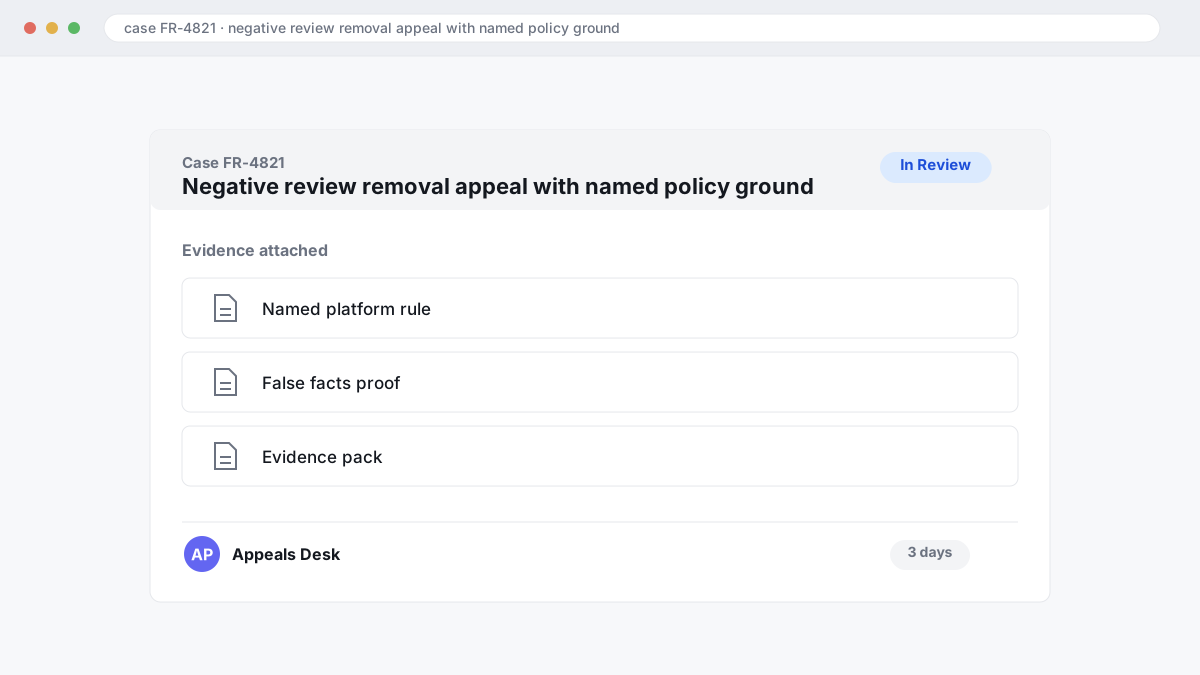
The wrong approach is filing a report because the review feels unfair. That usually fails because platforms assess policy breaches, not frustration. In BGR Review's log of 12,000+ negative review cases from June 2025 to June 2026, roughly 90% of businesses that came to us after a failed attempt had used only the basic in-platform report button with no supporting documentation, and 70-80% of those initial requests had been rejected. The right approach is fake review removal by rule: identify the breach first, then attach timestamps, booking records, screenshots, account-name mismatches, message history, and any proof that the reviewer was never a customer.
A live workflow is usually simple on paper. You pull the review URL, capture the posting date, compare the claim against your CRM or booking system, match it to the relevant Google Business Profile policy, Yelp content guideline, or Trustpilot flagging reason, and submit one concise pack. Cases stall when the evidence proves the review is harsh but genuine, or when the reviewer identity cannot be disproved.
These platform policy differences change both the route and the expectation.
| Platform | Best first route | What usually decides it | Practical expectation |
|---|---|---|---|
| Google Business Profile | Report the review, then escalate through GBP support if policy fit is clear | Documented breach of Google's review policy, especially impersonation, off-topic content, or provably false factual claims | Turnaround varies; if you raise it within 28 days and the policy issue is identifiable, outcomes are materially better in BGR Review's records |
| Yelp | Use Yelp's reporting flow and keep the submission tightly tied to a content rule | Whether Yelp sees a guideline breach, not whether the review hurt conversions or local pack click-through rate | Reviewer contact is limited; many disputes end with no removal if the post reflects a real transaction |
| Trustpilot | Flag through the business account under the relevant reason and respond to any verification step | Identity, invitation record, and whether the review can be tied to a genuine service experience | Trustpilot may ask for more detail before acting, so weak evidence packs slow the case |
If the platform refuses and the review remains live, your next search move is operational rather than legal theatre: publish a calm owner reply, fix review recency with fresh legitimate feedback, and stop one disputed post from shaping branded search results, map-pack click-through rate, and form-fill conversions.
Which benchmarks matter most inside Google Business Profile for local visibility?
Inside Google Business Profile, the benchmarks worth watching are review recency, review volume, star distribution and reply activity. They do not override proximity or relevance, but they often decide which similar listings win the click from the local pack.
The wrong approach is treating reviews as a ranking switch. That fails because Google Business Profile still weighs distance to the searcher and category relevance, so a weaker nearby listing can outrank a stronger distant one. The right approach is to use review volume and review recency as prominence signals that help when two profiles are otherwise close on relevance, then judge success by local pack visibility, click-through rate and calls rather than rank alone.
Fresh reviews do two jobs at once: they keep the profile current, and they give buyers something recent to compare in the map pack. In BGR Review's dataset of 1,485 businesses observed from February to July 2026, new trades and local service profiles that reached 20-30 reviews in the first three months were associated with improved local visibility, with other ranking factors active at the same time. A stale profile with a strong lifetime average often loses the click to a slightly lower-rated competitor whose last five reviews landed this month.
Owner replies matter more for trust than for guaranteed ranking movement. Buyers read them during map comparisons, especially when the star rating distribution includes a few negatives, and a clear response can rescue conversions even if position does not move. If you have limited time, answer recent critical reviews first and keep the tone factual; that lifts confidence faster than chasing vanity volume.
What should a reputation audit checklist include before you hire anyone?
A useful reputation audit checks your branded search results, your main review profiles, reply speed, recurring complaint themes and who actually controls each listing.
Generic templates fail because they count stars and screenshots, then stop. That gives you a document, not a decision. The right checklist looks at the last 90 days and asks harder questions: which complaints are still unanswered, where review response rate has slipped, whether sentiment trends point to one operational fault, and whether one branch has fresh reviews while another has gone quiet and lost multi-location consistency in the map pack.
Use this scoring grid before you buy software, a review package with BGR Review's 30-day free replacement guarantee, or a removal service.
| Audit item | What to check in the last 90 days | Score |
|---|---|---|
| Branded search results | Page one for your brand name: review sites, press, complaints, old profiles, duplicate listings | High visibility if it ranks top 5; high conversion risk if a negative result sits above your site |
| Review platforms | Google Business Profile, Trustpilot, Yelp and any category site that already appears for your brand | High effort if ownership is unclear or profiles are unclaimed |
| Replies and complaints | Response backlog, owner response time, unanswered 1-3 star reviews, repeated service themes | High conversion risk if complaints stay public without a reply |
| Location spread | Review recency gaps, rating gaps and inconsistent responses across branches | High visibility if weak locations drag down local pack clicks |
That version works because it tells you what to fix first. A stale profile with no recent reviews usually hurts click-through rate before it hurts rankings, while unresolved negative themes in branded search results can cut calls, bookings and form fills immediately. Hire the provider who can explain the fix path for each scored item, not the one who hands you a prettier spreadsheet.
What should you fix in the next 30 days if your benchmarks look weak?
Start by controlling your profiles, generating recent reviews from real completed customers, and replying quickly to visible negatives. In the first 30 days, that usually shifts trust signals faster than a broad brand campaign and shows whether you need software, agency support, or both.
The wrong move is pouring budget into awareness while your Google Business Profile, Trustpilot or Yelp page still shows ownership gaps, stale review recency and a slow owner response time. That fails because buyers who search your brand name see the trust deficit in branded search results before any campaign message lands, and the leak hits click-through, calls and form fills first.
Use this 30-day order instead.
| Timing | What to fix | Why it moves first |
|---|---|---|
| Week 1 | Claim every live profile, fix ownership, lock NAP details, and note each platform's policy limits before you touch reviews. | You cannot improve response coverage or escalate fake review removal properly if access sits with an ex-staff member or old agency. |
| Weeks 2-3 | Clear the reply backlog, prioritise recent negatives, then request fresh reviews from completed customers through your normal job-close or delivery-close workflow. | Reply visibility and review recency change buyer confidence faster than a homepage redesign. |
| Week 4 | Compare branded search results, review trends and location gaps against your day-one baseline. | You see which locations still suppress clicks and whether the problem is volume, recency or unresolved negatives. |
For removal work, speed matters. In BGR Review's dataset of 12,000+ negative review cases logged June 2025 to June 2026, reviews raised within 28 days of posting and backed by an identifiable policy issue resolved successfully in roughly 90% of cases, while comparable cases raised later fell to approximately 25-30%; that is our observed outcome profile, not a platform rule.
Where to go from here
Use these numbers to set order, not to fill a slide. If your profile has a review volume gap, weak recency, or a lopsided star rating distribution, fix the collection process first: trigger requests at job completion, tighten owner response time, and check whether Google Business Profile, Trustpilot or Yelp is the profile that actually drives your calls, bookings or form fills. If branded search results already surface a policy-breaking negative, treat that as a removal problem before you spend more on traffic.
Your next step is a platform-specific audit. Check review count, review recency, response rate, local pack visibility, and any reviews that may breach platform rules. Then separate three buckets: reviews you should answer, reviews you should outnumber with fresh legitimate feedback, and reviews worth escalating for fake review removal. The audit usually shows where conversions are leaking.
If the issue is review growth instead, the useful benchmark is consistency: a steady flow beats short bursts every time.