


Quick answer
Reputation law covers the rules that govern false factual claims, deceptive reviews, endorsements, privacy breaches and disputes over online content about your business. Your first decision is whether the content breaks the law, a platform policy, or both. In the US, Section 230 often shields platforms from liability for user posts, while the FTC Endorsement Guides target undisclosed paid endorsements and fake testimonials. In practice, the fastest route is usually evidence-first reporting under policies such as Google Maps user-contributed content rules, then legal escalation if a review alleges false facts, uses impersonation, or invents a transaction.
This guide is written from live removal work, where the result usually turns on the evidence pack rather than the anger level in the complaint. The details that move a case are mundane but decisive: a screenshot that shows the review URL and timestamp, proof the reviewer never appeared in your CRM or booking log, and a policy match stated in the first submission instead of buried in a follow-up.
Across 12,000+ negative review cases logged by BGR Review from June 2025 to June 2026, outcomes were recorded as removal success, unresolved or unknown, and unknown was never padded into failure. That is the practical side of reputation law: choosing the cheapest route that can work first, knowing when a solicitor helps, and knowing when a legal letter slows the platform process.
Where does reputation law stop and platform policy take over?
Reputation law decides whether a review is unlawful. Platform policy decides whether the review can come down faster without court action, so your first practical test is whether your evidence fits a site rule better than a legal claim.
Most guides start with courtroom theory and jump straight to defamation, jurisdiction and legal letters. That fails early because courts judge legality across countries and states, while review platforms apply their own private rules in their own review platform terms. A review can stay live in a legal sense yet still breach the Google Maps user-contributed content policy for spam, off-topic content, impersonation or conflicts of interest, which gives you a cheaper route than paying a lawyer before you have matched the facts to a platform rule.
Use the policy route first when the breach is platform-verifiable: the reviewer never existed in your records, the account is tied to a competitor, the post contains copied text across listings, or the review describes a visit at a time your location was closed. Those points are easier for Google, Trustpilot or Yelp to assess inside their own enforcement systems than a court is to assess through a cross-border reputational claim. In BGR Review's case file of 12,000+ negative review cases logged June 2025 to June 2026, reviews raised within 28 days of posting and backed by an identifiable policy issue resolved successfully in roughly 90% of cases; for comparable cases raised beyond 28 days, the observed success rate fell to approximately 25–30%.
If your budget has to stay below legal action, start with evidence capture and a policy-matched removal request. Save court escalation for situations where policy fails, the harm is serious, and jurisdiction actually gives you a realistic path to an order rather than a long bill. BGR Review handles removals on a pay-after-success basis at $449 per removed review link with $0 upfront, which only makes sense after the cheaper in-platform route has been tested properly.
Which reputation problem should you fix first if leads are already leaking?
Fix the trust signals people see on a branded search before they call or fill in a form: low stars, fresh negative reviews, and complaints with no reply. Those leaks cut brand search click-through and lead volume faster than slower legal steps or a broad clean-up.
The wrong move is chasing the loudest complaint first because it feels urgent. That often fails on ROI. A single false one-star review hurts far more when your profile has 12 reviews than when it has 212, because the average drops harder and the review sits near the top of the page people check before they click; in BGR Review's dataset of 1,485 businesses observed from February to July 2026, trades businesses with complete enquiry-source data attributed 70-80% of calls and bookings to a Google Business Profile or Yelp listing, which means visible trust leaks on listing pages directly affect conversions.
Check these four signals before you choose the first intervention.
| Signal | Why it leaks leads first | Best first move |
|---|---|---|
| Average rating | Changes click behaviour on branded searches and the map pack | Remove policy-violating reviews or add legitimate recent reviews |
| Review count | Low volume makes each one-star review hit harder | Stabilise volume before deeper brand work |
| Recency | Fresh negatives get read first | Reply fast and file removal where a rule trigger exists |
| Reply rate | Silence makes the complaint look true | Post a factual reply while the appeal runs |
The right move is fixing the most visible trust leak first. If the review is false and platform-removable, negative review removal services can be the fastest route because they target the page already depressing branded clicks; BGR Review runs that model at $0 upfront and $449 per removed review link after success, but if the review is harsh and still compliant, a clean reply and fresh verified review volume usually does more for click-through than a legal letter that sits unanswered.
When does a bad review cross from opinion into actionable falsehood?
A bad review becomes much stronger to challenge when it makes a false claim you can check, rather than a harsh view you dislike. “Terrible service” usually sits on the opinion side of the line; “this clinic forged my consent form” or “they billed me twice” makes a factual allegation that can support online defamation arguments and a platform report.
The wrong approach is calling every one-star review defamatory. That fails because defamation vs opinion turns on whether the statement can be proved true or false, and courts usually protect value judgments such as “rude staff”, “overpriced”, or “would never return”. The right approach is to isolate the sentence that alleges a fact, then test it against records: invoice history, booking logs, call recordings, staff rotas, signed forms, payment processor data.
For a defamation claim, you usually need four pieces: a false statement presented as fact, publication to a third party, fault by the reviewer, and measurable harm such as lost enquiries, damaged branded search click-through, or weaker conversion from your profile page. The exact test varies by country and platform, so this is general information rather than legal advice. In BGR Review’s log of 12,000+ negative review cases recorded from June 2025 to June 2026, reviews raised within 28 days and tied to an identifiable policy issue resolved successfully in roughly 90% of cases; beyond 28 days, the observed success rate fell to approximately 25–30%, which is one reason false factual accusations should be documented fast.
How does online reputation law actually work once a false review appears?
The practical sequence is evidence first, policy match second, escalation third, and legal action last. Most failed removal attempts start with an angry explanation of why the review feels unfair, then skip the only part a platform can act on: proof that the post breaches a named rule.
Start with evidence preservation before the reviewer edits, deletes, or adds details. Save the review URL, the business profile URL, timestamps, screenshots of the full review and profile context, and any transaction record showing whether the reviewer was ever a customer; if you suspect impersonation and fake reviewer identity, preserve the account name, profile photo, claimed visit date, and any mismatch against your booking, CRM, invoice, or call log. On Google, that evidence needs to map to the Google Maps user-contributed content policy, such as spam, fake engagement, off-topic content, or misrepresentation, because “this is damaging” is not a policy category.
The wrong approach is emotional argument. It fails because platform reviewers and automated systems look for a rule breach, not a fairness debate. The right approach is a tight submission: one sentence naming the policy, one sentence attaching the proof, and one sentence explaining the contradiction. In BGR Review’s case file of negative review cases with prior self-filed attempts, logged June 2025 to June 2026, roughly 90% of businesses came to us after using only the basic in-platform report button with no supporting documents, and 70–80% of those initial requests had been rejected.
If Google rejects the first flag, the next step is usually stronger evidence or a different route, not the same report filed again. That can mean a fuller appeal pack, an impersonation record tied to your customer ledger, or, where local law supports it, counsel seeking a court order or takedown order; rules vary by country and platform, so this is general information, not legal advice.
Which platform rules give you the best removal shot on Google, Yelp, or Trustpilot?
Google, Yelp and Trustpilot do not remove reviews on the same grounds. Your best removal chance comes from matching the review to each platform’s exact trigger inside its review platform terms, such as conflict of interest, impersonation or false customer status, before you file the report.
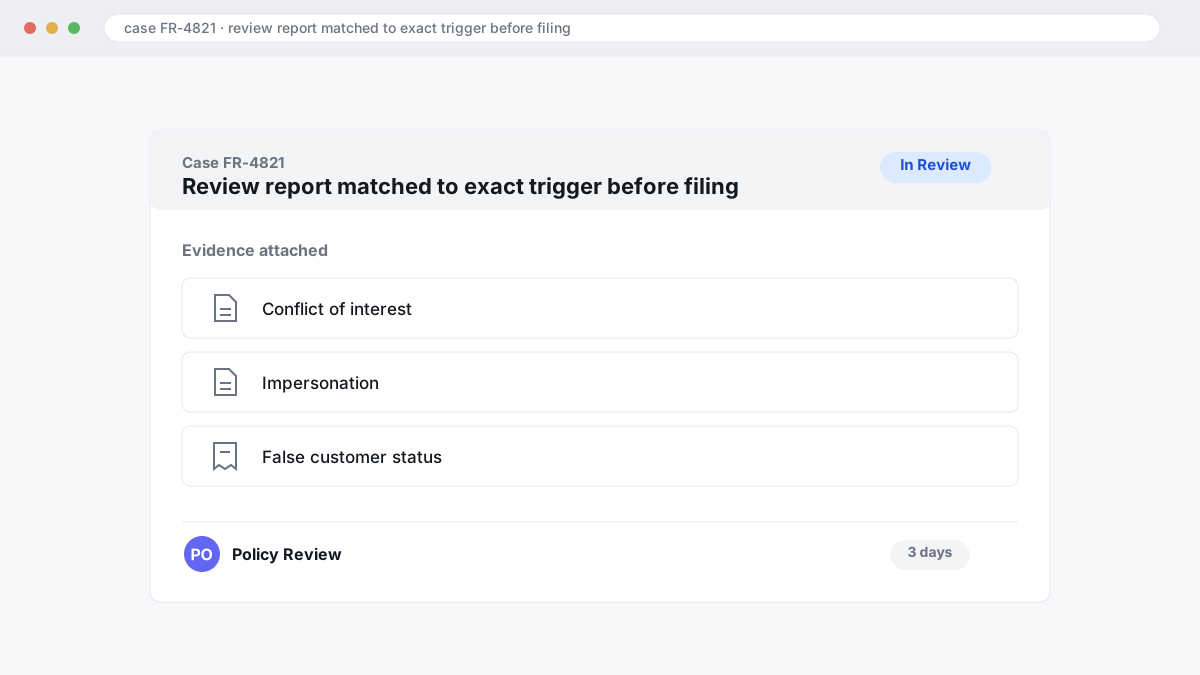
The wrong approach is one generic complaint sent everywhere: “this review is fake, please delete it.” That fails because each platform tests a different rule set. In BGR Review’s dataset of negative review cases with prior self-filed attempts, logged June 2025 to June 2026, roughly 90% had used only the basic in-platform report button with no supporting documentation, and 70–80% of those initial requests had been rejected. A rejection did not prove the review was genuine. It usually meant the report never matched a removable trigger.
If you are reporting on Google, start with the Google Maps user-contributed content policy, because Google responds best to specific policy breaches: spam, prohibited conflicts of interest, impersonation, and clear misrepresentation by someone who was never a customer. Yelp weighs firsthand consumer experience heavily, so “I disagree” goes nowhere, while reviewer-business relationships or deceptive review behaviour can move the case. Trustpilot gives you more room to challenge harmful content, suspicious patterns and non-genuine experiences, but it expects a cleaner evidence trail.
This is the comparison that usually decides whether your report has any chance.
| Platform | Best trigger | Evidence that helps | Usual escalation path |
|---|---|---|---|
| Spam, conflict of interest, impersonation, non-customer misrepresentation under Google Maps user-contributed content policy | Order lookup failure, staff roster, booking logs, screenshots of copied text, profile links showing competitor ties | In-platform report, then Business Profile support appeal with a policy-matched evidence pack | |
| Yelp | Conflict, non-firsthand account, deceptive review activity | No transaction record, proof reviewer is staff/competitor, timeline mismatch, message history | Report review, then support ticket tied to the exact content rule |
| Trustpilot | Non-genuine experience, harmful or misleading content, suspicious behaviour | Customer database check, invoice gap, identity mismatch, documented request for reference details | Flag through business account, then compliance review if the first flag is refused |
Why do some clearly false reviews survive even when you have proof?
False reviews can stay live because platforms have broad immunity and moderation discretion, especially under Section 230 in the US. Your records may support a claim against the reviewer for online defamation, yet still fail to force a platform takedown unless the post also fits a clear policy breach or you obtain a court order.
The wrong approach is to assume proof of falsity equals removal power. That fails because Section 230 generally shields the platform from liability for user reviews, so Google, Yelp, or Trustpilot can decline to adjudicate a messy factual dispute between you and the reviewer even when your invoices, call logs, CRM notes, or job sheets point your way.
The right approach is to separate two questions. First, can you show a platform-rule violation that a moderator can verify quickly, such as impersonation, a fake reviewer identity, or content copied from another listing. Second, if the review is a pure factual lie that damages you, can your lawyer pursue the reviewer directly for defamation and, where the court grants one, use injunctions and takedown orders to press for removal.
That distinction matters in practice. A platform may treat “they never finished the job” as a borderline dispute and leave it up without a court order, while the same statement can still expose the reviewer to legal risk if it is false, published as fact, and caused loss. Rules vary by country and platform, and this is general information rather than legal advice.
Which evidence pack makes a cease-and-desist letter or platform appeal credible?
A credible evidence pack combines the review text with timestamps, the full URL, the reviewer name, and business records that confirm or disprove any real transaction. Your aim is verification, not indignation, so a moderator or solicitor can test the claim in minutes.
A complaint narrative fails because it asks the platform to trust your account of events. A verifiable file works because it lets Google, Yelp, Trustpilot, or the sender of a cease and desist letter check the same facts independently. In BGR Review's log of negative review cases with prior self-filed attempts, covering June 2025 to June 2026, roughly 90% had used only the basic in-platform report button and no supporting documents, and 70-80% of those initial requests were rejected.
Build the file in this order:
- Screenshot the live review with the date visible, copy the full review URL, record the reviewer name exactly as shown, and save an archived copy for evidence preservation before the text changes or disappears.
- Attach booking logs, invoices, call records, or CRM entries showing no customer match for that name, date, or claimed job.
- If you suspect impersonation or a fake reviewer identity, add the profile URL, profile screenshot, and any mismatch between the claimed visit and your records.
- Finish with a one-page chronology: review posted, preservation request sent, platform report filed, and any contact from the reviewer or counsel.
That pack gives a cease and desist letter substance. Without it, you have a complaint.
What should a first cease-and-desist for a false review actually say?
A usable first cease-and-desist identifies the exact words complained of, explains why they are false, points to the evidence that contradicts them, and asks for a defined action by a clear deadline. Keep it restrained so the same document can later support an online defamation complaint, a platform appeal, or a solicitor-led filing if you need to escalate.
The wrong first move is the shouting letter: fraud accusations, damages claims, criminal threats, and deadlines measured in hours. That usually fails because the reviewer ignores it, a platform moderator treats it as noise, and your later position looks inflated if you cannot actually issue proceedings in that jurisdiction. A narrow demand works better. State that the review says, for example, "we were a paying customer on 12 June 2026", then attach the booking log, invoice record, CRM extract, or access log showing no matching transaction, and request removal or correction within 5 business days.
Keep the structure simple:
- Identify the URL, profile name, posting date, and quoted statement.
- Explain the falsity in one short paragraph.
- List the preserved evidence already held.
- Request deletion, correction, and non-republication by the deadline.
- Reserve rights without making threats you will not execute.
Preserve screenshots, source links, and timestamps before sending anything. This is general information, not legal advice, and the legal effect of cease and desist letters varies by country and platform terms.
What can you do if Google rejects your removal request?
If Google rejects your request, do not send the same complaint again. Rebuild it around a named trigger in the Google Maps user-contributed content policy, attach the missing proof, then choose between escalation, a legal route, or a calm public reply.
The usual failure point is simple: you argued harm to your reputation, while Google reviews against policy. “This is unfair” rarely moves a case. “This reviewer never transacted with us, here is the booking log, staff rota, CCTV window, and order history for the date claimed” gives Google something it can test against fake engagement, impersonation, harassment, or conflict-of-interest rules. Across 12,000+ negative review cases logged by BGR Review from June 2025 to June 2026, roughly 90% of businesses who came to us after a failed attempt had used only the basic in-platform report button, and 70–80% of those initial requests had been rejected.
Repeating a rejected flag with the same screenshots usually fails because the evidentiary basis has not changed. The better move is evidence preservation first, then a tighter pack: the review URL, profile link, dated screenshots, customer database search, call records, invoices, refund history, and any proof the named event could not have happened. If Google still refuses, add context through the Google Business Profile support path or product forum, where chronology and document clarity matter more than anger.
If your no-customer proof is thin, or the account may belong to a real but untraceable buyer, push damage control while you escalate. Post a measured public response that denies specific false facts, invites offline contact, and protects branded search click-through and map pack trust while the case is live.
Should you hire a lawyer or a reputation management company first?
Hire a lawyer first when you need legal compulsion, damages, or cross-border advice. Hire a reputation management company first when the likely win turns on platform policy, evidence packaging, and repeated appeals rather than a lawsuit.
Most businesses make the wrong first move here: they send a solicitor's letter at a platform problem. That often fails because Google, Yelp and Trustpilot usually act on their own review platform terms and user-content policies before they care about your threat of litigation, and Section 230 in the US also limits when platforms are liable for user posts. A lawyer earns their fee when the review alleges false facts that could support online defamation, when you need injunctions and takedown orders against the reviewer, or when jurisdiction is messy because the reviewer, business and platform sit in different countries. This is general information, not legal advice, and the answer changes by country and platform.
This table works best if your aim is simple: remove the review, stop the drop in map-pack clicks, and protect conversions without spending on the wrong route first.
| Route | Cost and speed | Leverage | Likely outcome path |
|---|---|---|---|
| Lawyer | Usually higher cost; speed depends on court timetable and country | Cease-and-desist letters, damages claims, injunctions, takedown orders | Best for defamation, impersonation with real harm, cross-border disputes, high-value loss |
| Negative review removal services | Fixed price per removed link | Policy matching, evidence packaging, appeal drafting, failed-flag recovery | Best for fake reviewer identity, conflict-of-interest reviews, off-topic spam, duplicate content, policy-led removals |
The right sequence is usually cheaper. If the review can fall under Google Maps user-contributed content policy, Yelp's content rules or Trustpilot's flagging standards, start with policy-driven removal support and a clean evidence pack. If that route stalls and the review is causing serious branded-search damage, lost calls or a wider smear across borders, bring in counsel for legal compulsion; otherwise a legal letter can slow the case by pushing a platform issue into a court-shaped argument the platform will ignore.
Is paying for reviews illegal, or just against platform rules?
Paying for reviews can create legal risk as well as a policy problem. Hidden incentives can breach the FTC Endorsement Guides in the US and similar UK or EU consumer-protection rules, while disclosed feedback requests are a different category from undisclosed paid endorsements built to mislead.
The wrong approach is simple: you pay cash, discounts or gifts for a positive review and leave the material connection hidden. That fails twice. It can mislead readers under the FTC’s endorsement framework, and it can breach review platform terms on Google, Yelp, Trustpilot and other sites that restrict compensated, biased or inauthentic review activity. The lower-risk approach is to ask every real customer for feedback after a genuine transaction, disclose any incentive clearly where local law requires it, and never condition payment on a positive rating. That works because the legal issue is the deceptive impression, not the act of asking for feedback itself.
If you are comparing law against platform enforcement, use this split first.
| Scenario | Legal risk | Platform risk |
|---|---|---|
| Undisclosed paid 5-star review | Possible FTC, UK or EU misleading-practice exposure, depending on jurisdiction | High risk of removal or account penalties under review platform terms |
| Neutral review request sent to real customers | Usually lower risk if the request is honest and the relationship is real | Usually allowed if it follows the platform’s solicitation rules |
Jurisdiction decides the legal route. US rules centre on material connections and deceptive consumer impressions; UK and EU enforcement also targets misleading commercial practices, and the exact standard varies by country.
How lowest-risk next step if you need action this week actually works
If you need action this week, capture the review, sort it by platform policy and possible legal claim, then run one primary route. An evidence-led report usually outperforms three scattered reactions: flagging, threatening letters, and a rushed reply posted without a plan.
Within 24 hours, do evidence preservation properly: save full-page screenshots, the review URL, profile ID, username, dates, account details, and any booking or CRM records that test whether the reviewer was real. Then classify the issue. Google Maps user-contributed content policy, Yelp terms, and Trustpilot reporting rules decide the first removal route; defamation, impersonation, and jurisdiction decide whether counsel may later matter. Generic guides treat reputation law as courtroom theory. Your first job is cheaper and narrower: match facts to the exact platform trigger before you spend on letters.
Within 3 business days, submit one evidence-led report and draft a public response that avoids admissions, states the reviewer cannot be matched to your records if true, and invites offline contact. In BGR Review's dataset of negative review cases with prior self-filed attempts, logged June 2025 to June 2026, roughly 90% of businesses came to us after using only the in-platform report button, and 70-80% of those initial requests had been rejected. That is why one disciplined route works better than three uncoordinated reactions.
Escalate to counsel only when the review is causing measurable damages, you can identify the reviewer with confidence, or you need an injunction or takedown order that a platform will recognise. A legal letter can help when identity certainty is strong. It slows cases when the platform only wants a clean policy submission.
Where to go from here
Classify the review before you do anything else: policy breach, legal claim, or both. A fake identity, impersonation, conflict of interest or incentive issue usually belongs in the platform route first, matched to the exact rule such as Google Maps user-contributed content policy or a review platform’s terms. A false factual allegation that damages your business can raise online defamation issues, but jurisdiction, Section 230 and local court standards decide whether a letter, injunction or takedown order has real force. This is general information, not legal advice.
If the review is already hurting calls, bookings or form fills, stop guessing and build a file today: screenshots, profile URL, review link, dates, customer records, reply status and the policy clause or legal basis you will rely on. Then file once, properly. Expect an initial rejection if you only use the basic report button; across 12,000+ negative review cases logged by BGR Review from June 2025 to June 2026, most failed self-filed attempts came with little or no supporting evidence.
Your next step is simple: classify the issue, preserve the evidence, and choose the lowest-cost route that can work first.