

Quick answer
Local SEO keyword research means picking the service, problem and location phrases that can win both the map pack and local organic clicks. Start with your Google Business Profile categories, core services, review wording, and city, borough or service-area modifiers. Then rank terms by intent, page fit and commercial value, not search volume alone. Google’s local pack usually shows 3 businesses, so priority matters. Put your highest-conversion services first, map each keyword to one page or GBP section, and stop the same intent from competing across multiple location pages.
This page comes from the same practical work BGR Review does for local companies buying verified reviews on Google, Trustpilot, Yelp, Clutch and TripAdvisor, plus negative review removal at $0 upfront and $449 per removed review link after success. In that work, the useful keyword clues rarely come from a tool first; they come from the exact phrases customers repeat in reviews, the service terms Google Business Profile actually accepts, and the page titles that start cannibalising each other when a city page and a service page chase the same booking intent.
Across BGR Review’s operations for 15,000+ businesses and 1,240+ verified clients, the pattern is clear: generic guides stop at volume, while the terms that lift calls, form fills and branded search demand usually sit in review language, category alignment and cleaner page targeting. That is the gap this local seo guide fixes.
Which local keywords should you act on first when volume is low but lead value is high?
Start with local terms that show buying intent, match a real destination page, and use wording your customers already use in reviews. For most firms, the first 10 to 15 targets should be high-intent phrases, not every city-service variation your tool exports.
Most guides sort by volume first. That fails when the query lands on the wrong page or attracts researchers instead of buyers. A term like “roof maintenance tips london” can show more searches than “emergency roofer soho”, yet the second phrase usually drives calls because the search intent modifiers are urgent, local and transactional. In BGR Review’s dataset of 1,485 businesses observed from February to July 2026, trades firms with complete enquiry-source data attributed 70–80% of calls and bookings to a Google Business Profile or Yelp listing rather than a website, which is why low-volume emergency terms often carry more commercial payoff than broader research traffic.
Score each keyword against four tests: intent, page fit, review themes and sales value. If you cannot name the exact service page or local landing page that should rank, the term is not a priority yet. Review keywords matter here: when customers repeatedly write “same-day locksmith”, “boiler repair”, or “weekend dentist” in Google or Trustpilot reviews collected through BGR Review campaigns, that language gives you conversion-led phrasing for titles, headings and internal links.
Use this simple model to rank your first 15 targets before you write or optimise anything.
| Factor | Score 1 | Score 5 |
|---|---|---|
| Intent | Research query | Book / call now query |
| Page fit | No clear page | Exact service page exists |
| Review themes | Customers never use it | Phrase appears naturally in reviews |
| Sales value | Low-margin job | High-margin or repeat service |
Add the four numbers. A 20-search term can beat a 200-search term if it scores 16 to 20 and points to a page that can convert now. Keep anything scoring 12 or below out of your first batch, even if the keyword tool makes it look tempting.
How do you do local keyword research step by step without getting stuck in tool exports?
Build your local keyword list in this order: services, modifiers, locations, manual SERP checks, then final page assignment. Checking Google before you cluster stops you from grouping phrases that look similar in a tool export but trigger different intent.
Export-first research wastes time because tools flatten local intent into one spreadsheet. “Emergency plumber”, “emergency plumber near me” and “24 hour plumber Brooklyn” can show a map pack, service pages and directory results in different mixes, so volume alone will push you towards the wrong page type and weaker conversions. We see this early when a review package starts delivering in 24-48 hours and fresh review wording suddenly matches service area keywords the original keyword sheet never included.
Use one sheet and force the first pass to stay simple:
- List your core services in one column: drain cleaning, boiler repair, roof leak repair.
- Add search intent modifiers beside each one: emergency, same day, affordable, open now, best, certified.
- Add locations last: city, district, postcode, borough, and realistic service area keywords you actually cover.
Then search the best combinations manually for 10 to 15 terms, not 200. Check whether Google shows a map pack, local landing pages, homepages, or mixed organic pages, and note where near me queries behave like city terms versus where they trigger broader radius results from the Google Business Profile.
Finish by clustering inside 60 minutes. Give each page one primary keyword, 2 to 4 secondary variations, and a small support set pulled from review language, GBP services, and missed competitor phrasing; if a term needs a different page type, split it now instead of forcing it into one URL.
How can Google Business Profile categories reveal keyword opportunities your tool misses?
Google Business Profile categories often show local demand that keyword tools underreport. If a competitor ranks in the map pack with a category or service label you do not use, that gap usually points to missed search terms and missing service pages.
The wrong approach is exporting keyword ideas, sorting by volume and assuming your page title can force relevance. That fails because Google Business Profile uses business categories as a stronger local relevance signal for pack visibility than a meta title alone, especially on service-area searches where several listings offer similar websites. If your primary category says one thing and your homepage says another, the category usually wins the diagnostic.
The better approach is to compare your primary and secondary categories against the top local profiles, then check which services they expose inside GBP. Secondary categories often uncover adjacent demand your tool misses, such as emergency callout work, same-day repair, or a specialist treatment that deserves its own service page instead of a throwaway paragraph.
Check categories and GBP services every quarter. Google changes category options over time, and a stale setup leaves old terms on your profile while competitors pick up newer labels that improve map pack click-through rate, calls and bookings before your organic rankings move.
When should you target map pack terms differently from local organic terms?
Target map pack terms separately when Google shows a local pack and the clicks are going to profiles first. On those results, your Google Business Profile, primary category, review signals and proximity to the searcher usually decide more than a service page trying to rank for every variation.
Most guides build one keyword list for all local SERPs. That fails because plumber near me and emergency plumber Brooklyn can trigger a map pack where Google leans on category fit, address or service area, opening hours, photos and profile completeness, while water heater repair brooklyn cost often leans harder on page relevance, supporting copy and internal links. In BGR Review's dataset of trades businesses with complete enquiry-source data, observed February to July 2026, 70-80% of calls and bookings were attributed to a Google Business Profile or Yelp listing rather than a website, which is why pack-first queries deserve their own priority line.
The clean way to sort them is to compare what Google already rewards in the top results.
| SERP pattern | What usually wins | What you target first |
|---|---|---|
| Pack-only or pack-dominant | Google Business Profile category match, reviews, proximity, profile completeness | GBP services, categories, review wording, near me query variants |
| Organic-only | Local landing page relevance, title tags, internal links, service-page depth | Page-level terms with city and service modifiers |
| Blended SERP | Both profile strength and page relevance | Split effort: GBP for pack clicks, page for organic clicks and conversions |
If the top three results are blended, treat the keyword as two jobs. Build the profile to win map pack click-through rate, then send the organic click to the page most likely to convert into a call, booking or form fill.
How do reviews tell you which local keywords customers already trust?
Reviews show the words customers already connect with your service, speed and area. Pull 30 to 50 recent reviews and you will usually find modifiers such as “same-day”, “weekend”, “friendly” or “affordable” that drive better calls and form fills than a broad city-plus-service term.
The wrong approach is writing pages from your internal jargon: “domestic drainage solutions”, “premium legal support”, “tier-one repair”. That language rarely matches review keywords, so your page sounds polished but weak on trust, and your Google Business Profile misses service terms people actually repeat in public. The right approach is to export your latest Google reviews, paste them into a sheet, and mark repeated phrases around urgency, price, staff behaviour and job type. Those are review signals with commercial intent attached.
Use the phrases carefully. Add the strongest ones to Google Business Profile services, H2s on the matching service page, and short FAQ answers where the wording is true and supportable. If “same-day boiler repair” appears again and again, that belongs on the emergency repair page; if “friendly installer” repeats, use it in copy, not as a target keyword. At BGR Review, the fresh reviews we help businesses earn under a 30-day free replacement guarantee often give better page-title language than any keyword tool export, because they come from people who already converted.
How do you find competitor keyword gaps without copying pages that should not rank?
A useful competitor gap is a query relevant local rivals rank for and you do not, not every phrase a tool spits out. Check the top five competitors in the map pack and the top five in local organic by hand, then separate real service overlap from SERP clutter before you add anything to your sheet.
The wrong approach is exporting hundreds of terms from Ahrefs or Semrush and copying whatever sits on a rival URL. That fails because local SERPs are full of pages that should not guide your plan: directories, Indeed-style job pages, old city pages with no clear service fit, and thin location pages that rank briefly but convert badly into calls or form fills. Before BGR Review recommends a review package with a 30-day free replacement guarantee, or a removal workflow billed only after success at $449 per removed link, we strip those false positives out first because they distort lead priority.
Use one comparison sheet and log only three gap types: missing services, missing modifiers, and missing city coverage.
| Gap type | What to record | Keep or ignore |
|---|---|---|
| Service gap | Competitor ranks for “emergency plumber” and you do offer it | Keep if the service exists on your site or GBP services |
| Modifier gap | Service area keywords such as “24 hour”, “same day”, “weekend” | Keep if reviews and bookings use the same wording |
| City gap | Rival has a strong Bristol page and you only target London | Ignore if you do not genuinely serve that area |
The right approach is to keep gaps that match your actual offer, your service area, and the intent Google is already rewarding in that result set. That works because competitor keyword gaps become page assignments you can rank and convert from, instead of copied pages that win a stray impression and never turn into booked work or stronger map pack visibility.
Which local SEO tools actually save time, and when is manual research more accurate?
Local SEO tools save time on keyword expansion, rank tracking and category discovery, but manual checks read intent more accurately. The better setup is tool-led discovery followed by manual validation of the terms you may actually target in Google Business Profile and on local pages.
BGR Review sells review and removal services, not software, so there is no reason for us to pretend a tool replaces judgement. A $50-$150 monthly platform can surface service-area variants, competitor keyword gaps and daily position changes far faster than a spreadsheet, especially once you track more than one location. It helps with coverage. It does not tell you whether a term triggers a map pack, rewrites to a different query, or keeps showing a weak local organic result that will never drive calls.
The wrong approach is trusting exports and targeting every phrase with volume. That fails when the live SERP shows three Google Business Profile listings, a broad category rewrite, or duplicate profiles sitting in the pack. Manual checks catch the things tools flatten: “emergency plumber” versus “24 hour plumber”, hidden duplicates, service keywords that pull nearby cities, and categories competitors rank from without deserving the page they have. That is why you validate the short list by hand before assigning titles, services or landing pages. The hours you save with software are real. The targeting decision still needs your eyes.
How many keywords can one local landing page target before it starts competing with itself?
A local landing page should usually focus on one primary keyword and 3-5 close variants. Once you cram in different services, cities, or search intents, rankings blur, conversions drop, and your own URLs start competing with each other.
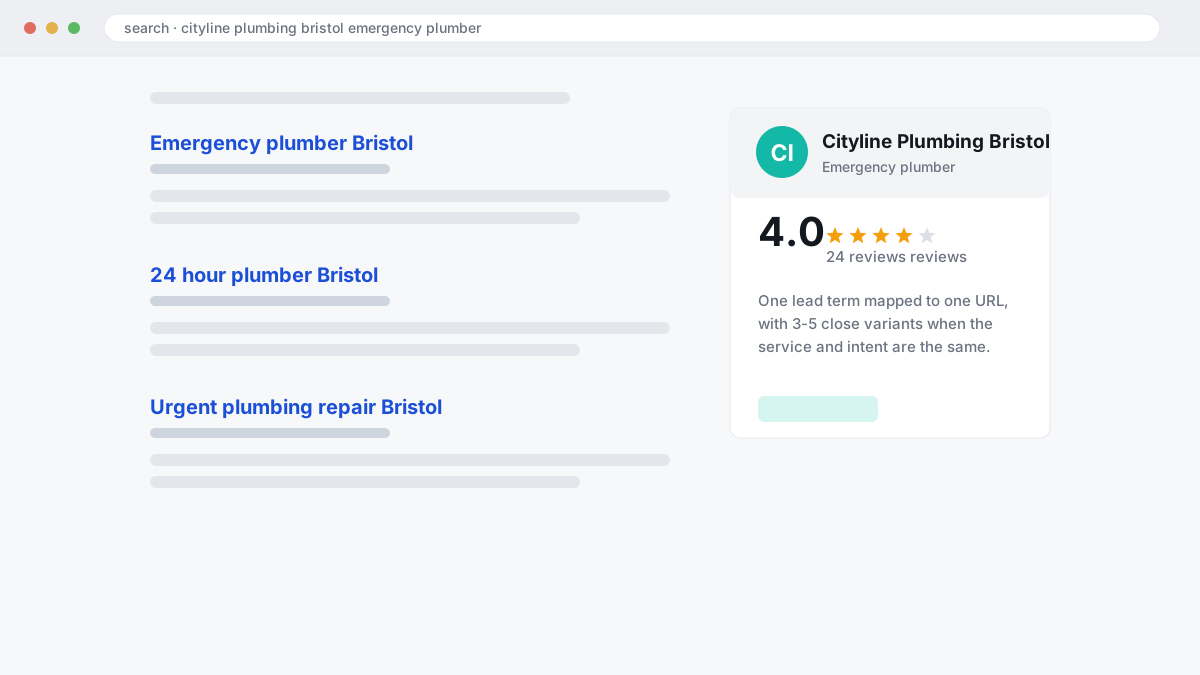
The wrong approach is building one page for every phrase variation, then cloning that format across local landing pages until you have five versions of the same idea. Before BGR Review starts a review package, with delivery beginning in 24-48 hours, we map each target URL to a single lead term such as “emergency plumber Bristol” plus near-match variants like “24 hour plumber Bristol” and “urgent plumbing repair Bristol” if the service and intent are the same. That works because one page can stay tightly relevant for the map pack and organic results without forcing Google to guess which version should rank.
Separate pages when the service changes, the location changes, or the intent changes enough to deserve different proof, pricing, FAQs, and calls to action. That is where service pages help: “boiler repair” and “boiler installation” should usually live apart, and Bristol should not share a page with Bath just because both towns are nearby. Location page cannibalisation usually shows up after city-page cloning at scale, where thin near-duplicates split click-through rate, weaken branded search demand, and send the wrong page into the local pack.
What local keyword mistakes waste budget and weaken visibility fastest?
Three local keyword mistakes burn budget fastest: forcing city names real customers never search, letting NAP consistency drift across your site and Google Business Profile, and spraying near me queries across pages that still do not match the service or location intent.
Most guides push more keyword variants. What actually works is tighter alignment between your local entity, the page, and the profile. If your customers search “boiler repair in South London” and you optimise for an official borough name nobody says, your service area keywords can rank for impressions and still produce zero qualified calls. In BGR Review’s dataset of trades businesses with complete enquiry-source data, observed February–July 2026, 70–80% of calls and bookings came through a Google Business Profile or Yelp listing, so bad local targeting hits conversions before it hits vanity traffic.
If you are stuffing near me queries into every title tag, check relevance first. Google already understands near me queries from the searcher’s location; repeating the phrase rarely fixes a weak service page, the wrong business categories, or mismatched NAP consistency between citations, footer details and GBP. Clean address, phone and business name data support trust around local entity signals. Extra variants do not.
How should multi-location businesses split keywords across location pages and service pages?
Multi-location businesses should divide keywords by real service coverage, not by cloning the same page into every city. Give each branch one primary local landing page, assign it a tight keyword set, and keep a clear line between branch targets and central service pages.
The wrong approach is scaled page cloning: one template, ten cities, the same service copy with place names swapped. That fails because Google sees thin duplication, your branch pages compete with each other, and location page cannibalisation starts as soon as two pages chase the same city-plus-service term. The fix is structured location-service targeting. One branch page owns the broadest query for that office, such as “emergency plumber in Bristol”, then supporting service pages pick only the jobs that branch actually fulfils and can prove with branch-level reviews, staff detail, photos, opening hours and matching Google Business Profile data.
If your Manchester branch does boiler repairs but your Stockport branch only does installations, use city-plus-service only on the page for the branch that truly serves that area. In BGR Review’s dataset of 1,485 businesses observed February–July 2026, trades businesses with complete enquiry-source data attributed 70–80% of calls and bookings to a Google Business Profile or Yelp listing, which is why false service-area targeting usually hurts conversions before it hurts rankings. Review wording helps here: branch-specific phrases from Google reviews often expose the service modifiers customers actually use, and those belong on the right service pages, not copied across every location.
Audit page overlap every 90 days after you add a new branch, new service page or new service-area keyword. Check Search Console queries, map-pack clicks, internal links, page titles and duplicate headings; if two URLs attract the same lead-intent phrase, merge, narrow or reassign one fast. That structure works because each page has a job: one page wins the local intent for the branch, the others support it without stealing its traffic.
What should your local keyword research template track from first idea to page assignment?
An action-ready local keyword sheet tracks the term, its search intent, the page it belongs to, who owns the work, the live SERP notes, and a four-stage status so ideas move from research to measured results instead of dying in a tool export.
A keyword dump fails because it treats every phrase as equal. You end up mixing “emergency plumber”, “boiler repair cost” and “plumber near me” in one tab with no page fit, no owner, and no way to spot competitor keyword gaps or search intent modifiers that belong on separate service pages. The planning sheet works because it forces a decision: assign one primary target, one page type, one priority, and one next action. If you use outside help such as BGR Review for review-driven GBP wording or page targeting, put the owner’s name in the sheet so nothing stalls between research and implementation.
Use a compact template like this.
| Column | What to record |
|---|---|
| Keyword | Core term plus local modifier and intent variant |
| Intent | Commercial, urgent, informational, comparison |
| Page type | GBP service, service page, location page, blog |
| Priority | High, medium, low based on lead value and fit |
| Owner | Internal marketer, agency, developer, BGR Review |
| SERP notes | Map pack present, top competitors, dominant content format |
| Status | Research, assigned, optimised, measured |
What should you optimise next after choosing your local keywords?
After you finish keyword research, change the page elements, the internal link path, and the Google Business Profile fields that match that intent. Then track calls, form leads and map actions for 8 to 12 weeks before you change course again.
The wrong move is stopping at the spreadsheet. That fails because rankings, click-through rate and conversions do not improve from a keyword list sitting in a tool export; they improve when your title tag, H1, service copy and internal links all point to the same query on the right local landing pages. Start with the terms closest to revenue, update the service page title first, tighten the H1, add service-location internal links from related pages, and check NAP consistency so the page and profile do not send mixed local signals.
Your Google Business Profile needs the same alignment. If you want to rank for “emergency plumber Brooklyn”, but your primary category, secondary categories and GBP services lean toward general plumbing, Google gets a weaker relevance match in the map pack. We usually tell clients buying review support from BGR Review to mirror real customer wording across GBP services, page headings and review request prompts, because that lifts map-pack clicks and lead quality more reliably than publishing another thin location page.
Give the changes time. In BGR Review’s dataset of 1,485 businesses observed from February to July 2026, trades enquiries with complete source data came mainly through a Google Business Profile or Yelp listing rather than a website, so watch direction requests, calls and website clicks inside the profile as closely as form fills. If a local landing page gets impressions but no leads after 8 to 12 weeks, fix the offer or page fit before you add more keywords.
Where to go from here
Start with your top three service-plus-location terms, not a master list of every phrase you could rank for. Map each term to one clear asset: your Google Business Profile category or service, one service page, and one local landing page if that area justifies its own demand. Then check the support signals around those terms: page title, on-page copy, NAP consistency, internal links, and the review language customers already use when they describe the job.
If your reviews are thin, outdated, or focused on the wrong service, fix that before you scale content or build more location pages. Weak review signals drag down map pack click-through rate and conversions even when relevance is decent. In BGR Review’s day-to-day work, the fastest gains usually come from tightening review themes and GBP services before expanding local page coverage, because that reduces page cannibalisation and makes the profile match the query more cleanly.
Your next step is simple: build a one-sheet keyword map for the next 30 days and assign one owner to update the profile, pages, and review request prompts. You should expect clearer targeting first, then better-qualified calls, bookings, and form fills as search intent lines up with what Google and the searcher both see.