

Quick answer
Libel is defamation in a fixed form, which usually means written words, screenshots, video captions, emails or online reviews; slander is spoken defamation. For your business, the real test is whether the statement makes a false statement of fact, was published to a third party, and caused reputational or commercial harm. “They stole my deposit” can be actionable if false; “awful service” is usually opinion. In the US, platforms are generally protected by Section 230, so the practical first move is usually to build evidence and use the platform’s review policy or legal-removal channel rather than threaten the site itself.
This guide comes from the review-dispute work we handle at BGR Review across Google, Trustpilot, Yelp, Clutch and TripAdvisor, including cases where a first in-platform flag failed because the business never proved the factual claim was false. The difference between a weak complaint and a usable evidence pack is usually simple: dated invoices, booking logs, refund records, message threads, and a clean timeline that ties the review text to what actually happened.
We also sell review growth and removal services, so the commercial angle is clear: if a review breaches platform rules, removal is often faster than a legal route, and our removal model is $0 upfront and $449 per removed review link, paid only after success. Across 12,000+ negative review cases logged June 2025 to June 2026, we recorded outcomes as success, unresolved or unknown, which is a stricter way to track results than calling every unconfirmed case a failure.
When does a bad review cross the line from opinion into libel?
A bad review turns into potential libel when it tells other people a false, checkable fact that can damage your reputation. Comments like “rude staff” or “slow service” usually read as opinion; claims like “they billed me twice” or “they forged my signature” can move into defamation because they assert a false statement of fact.
The wrong approach is arguing that any harsh review is defamatory. That fails because review platform policies and courts both separate opinion from fact. Google reviews, a forum thread, and a Facebook post all count as publication to a third party because someone other than you and the writer can read them, but publication alone is not enough. You need a factual accusation that can be tested against records. In BGR Review’s log of 12,000+ negative review cases recorded June 2025 to June 2026, a rejected report was never treated as proof that the review was true; platforms often leave up content simply because the business did not show the factual claim was false.
This contrast is the one that matters in practice:
| Review wording | Usually treated as | Why |
|---|---|---|
| “Slow service. I won’t return.” | Opinion | Subjective judgement, hard to prove false |
| “They billed me twice for one job.” | Potential libel | Verifiable against invoices, card records, refund logs |
| “This clinic posted my records online.” | Potential libel | Specific factual accusation with reputational harm |
The right approach is narrower. Match the wording to a record, then decide whether the issue belongs under a platform rule, a legal complaint, or both. That is why a clean removal brief starts with the sentence you can prove false, not a general complaint that the review feels unfair.
Why do business owners lose by arguing over definitions instead of proving facts?
Most owners do not lose a libel dispute because they used the wrong legal word. They lose because they cannot show falsity, customer mismatch, or a review-platform policy breach fast enough for a first review report to pass.
Textbook guides stop at the elements of defamation. A live dispute turns on proof and platform fit. If your report says “this is libel” but does not attach an evidence pack, Google Business Profile support, Yelp’s reporting flow, and Trustpilot’s flagging process usually treat it as an unsupported complaint rather than a verifiable content issue under their review platform policies.
The wrong approach is arguing definitions in the text box. That fails because the first pass is built to assess concrete signals: did this person appear in your CRM, booking log, invoice trail, call record, visitor log, or order history, and does the wording contain a checkable false statement of fact. The right approach is a review removal workflow that pairs screenshots of the live review and profile URL with dated business records, a short falsity note, and the exact policy category that fits the content.
In BGR Review’s dataset of 12,000+ negative review cases logged June 2025–June 2026, roughly 90% of businesses who came to us after a failed self-filed attempt had used only the in-platform report button, and 70–80% of those initial requests had been rejected. First-round rejections usually happen because the business says “defamation” without proving the factual claim is false.
How do you tell a false statement of fact from protected opinion in review wording?
The practical test is whether the wording can be checked against records. If a reviewer describes something you can verify against invoices, call recordings, site visits, booking history or staff logs, you may be dealing with a false statement of fact; if the wording reads as judgement, sarcasm or exaggeration, it is more likely opinion versus fact, and context decides more than one loaded word.
The wrong approach is to argue that a harsh review “feels defamatory” because it uses ugly language. That usually fails on the first pass, including under the Google Business Profile review policy, because “rude”, “terrible”, “cowboys” or “worst company ever” are often treated as subjective judgements or rhetorical hyperbole, not statements a platform or court can test for truth. The right approach is narrower: isolate each verifiable event claim and ask whether it is true, false, or unsupported by your records. “They never turned up on 14 May”, “they charged me twice”, or “the engineer entered my property without permission” can be checked against dispatch logs, payment records and staff notes. Truth as a defence matters here: if your own file confirms the event, the wording may hurt your click-through rate and conversions, but it is still harder to attack as libel.
“Scam” sits in the middle, which is where owners often misclassify it. Used alone in a rant, it often reads like opinion; tied to specific allegations such as fake invoices, forged signatures or taking payment for work never booked, it can imply a false statement of fact. Across 12,000+ negative review cases logged by BGR Review from June 2025 to June 2026, roughly 90% of businesses that came to us after a failed self-filed attempt had used only the in-platform report button with no supporting documentation, and 70–80% of those first requests had been rejected. That is why a review with local pack impact needs line-by-line classification before you flag it.
What proof actually shows a review is false and harmful?
The strongest evidence pack ties the review text to your records, shows exactly why the claim is false or inaccurate, and records visible commercial damage. One clean file of screenshots, logs, dates and internal notes usually beats a long angry rebuttal.
The wrong move is an emotional response saying the reviewer is lying, abusive or “trying to ruin us”. That fails because platforms and solicitors look for a proof trail, not outrage. If truth is a defence, your job is to show why the factual claim cannot be true: no customer record for that name, no booking on that date, no invoice matching the service described, no call log, and staff notes made at the time. Put timestamps, screenshots of the live review, transaction records and staff notes into one evidence pack so the reviewer’s allegation sits beside the business record that disproves it.
If the review changes after you report it, preserve every version. Google and Trustpilot can leave the original post live while a flag is reviewed, and a quiet edit after rejection can matter because the first wording may contain the false statement of fact your second filing needs to address. In BGR Review’s dataset of 12,000+ negative review cases logged June 2025 to June 2026, roughly 90% of businesses who came to us after a failed attempt had used only the in-platform report button with no supporting documents, and 70–80% of those first requests had been rejected.
You also need to show harm to reputation in business terms. Track the timing against lead drops, cancelled bookings, lower form fills, weaker map-pack click-through, or a fall in branded search demand after the review went live. A review does not become actionable just because it is harsh; it becomes stronger as a complaint when the false claim is documented and the commercial damage is dated.
Is removing the review usually faster than pursuing a libel claim?
For one false review, platform removal is usually faster and cheaper than a libel claim. You can start the report the same day, while litigation usually runs for months, needs legal counsel, and still may not make a platform remove user content quickly.
The wrong move is treating every damaging post like a lawsuit first. That fails because Google, Trustpilot and Yelp act on review platform policies, not on broad accusations of defamation, so a bare claim of “this is libel” often stalls while the review keeps affecting map-pack click-through, conversions and branded search demand. The right move is to run the review removal workflow first when the post shows impersonation, a non-customer account, a conflict of interest, doxxing, or another named policy breach that the platform can verify.
A compact comparison makes the trade-off clearer.
| Route | Best fit | Speed and cost |
|---|---|---|
| Platform report | Impersonation, non-customer review, policy breach | Can start immediately; at BGR Review, removal is $0 upfront and $449 per removed link after success |
| Libel claim | False statements of fact repeated across platforms or causing ongoing commercial harm | Usually months, legal fees, and a separate fight over platform compliance |
Across 12,000+ negative review cases logged by BGR Review from June 2025 to June 2026, reviews raised within 28 days of posting and backed by an identifiable policy issue resolved successfully in roughly 90% of cases; comparable cases raised later fell to approximately 25–30%. A cease and desist letter earns its keep when the same false factual allegation keeps appearing on multiple sites, because then you are building a record against the reviewer as well as protecting local pack performance.
Which is easier to prove in practice: libel or slander?
Libel is usually easier to prove than slander because written words can be saved, dated and checked against your records. Spoken accusations in a defamation dispute often turn on witness credibility, missing recordings and arguments over the exact wording that reached a third party.
The wrong approach is to treat both the same and file a bare complaint saying “this is defamatory”. That fails because a screenshot of a Google review, a review URL and the posting date preserve the statement itself, while a spoken claim may leave you arguing about memory, tone and whether there was clear publication to a third party at all. A saved review text usually gives cleaner wording than a witness summary.
The better approach is to preserve the written record first, then match each factual claim to business records. For review disputes, that means full-page screenshots, the profile link, the reviewer's name, the date stamp and the document that disproves the statement. Across 12,000+ negative review cases logged by BGR Review from June 2025 to June 2026, roughly 90% of businesses who came to us after a failed first attempt had used only the in-platform report button with no supporting documentation. That is why written libel claims often move faster through a removal workflow than slander claims ever do through witness disputes.
Is pursuing libel worth it for one bad review?
Pursuing a libel claim over one bad review usually makes sense only when it accuses you of serious misconduct, stays prominent, and is affecting real revenue. For an ordinary complaint, your first moves should be evidence preservation, a measured reply, and a review removal workflow rather than a lawsuit.
The wrong reaction is emotional: you read one angry post, feel the harm to reputation immediately, and start pricing solicitors before you check whether anyone is even seeing it. That fails because legal spend can outrun the commercial damage from a low-visibility review buried under newer feedback, especially if your map pack click-through rate, calls and branded search demand have not moved. If the post does allege crime, fraud, licensing problems, or patient or client harm, triage changes fast because those claims can depress conversions even when rank holds.
The better approach is business-impact triage. Save screenshots, note the URL, capture dates, compare pre/post enquiry quality, and put the review through a removal workflow first if there is a policy angle or a provably false factual claim. Across 12,000+ negative review cases logged June 2025 to June 2026, reviews raised within 28 days and backed by an identifiable policy issue resolved successfully in roughly 90% of cases in our records; beyond 28 days, the observed rate fell to approximately 25–30%.
Can you sue over a Google review without running into platform limits?
You can sometimes sue the reviewer over a Google review, but in the US you usually cannot make Google liable for hosting it because Section 230 broadly protects platforms that carry user-generated content. The viable claim, target and remedy depend on the facts and the country, and this is general information rather than legal advice.
Most owners pick the wrong defendant first. They threaten Google, Yelp or Trustpilot for publishing the review, then hit a wall because Section 230 usually blocks liability for the platform's hosting decision in the US, while the real defamation claim usually sits against the person who wrote the allegedly false statement of fact. That route still has limits: if the review reads as opinion, or if your dispute touches a public issue and actual malice becomes relevant, a weak claim burns time that could have gone into a removal file or a measured response.
The practical split looks like this.
| Target | Why owners try it | Why it usually fails or works |
|---|---|---|
| Google / Yelp / Trustpilot | The platform hosts the review and controls the page | In the US, Section 230 usually shields the platform from liability for user reviews; your better route is often the platform's own review platform policies and evidence process |
| The reviewer | The reviewer made the statement | This is usually the viable legal target if you can show falsity, publication and harm, but you still need proof strong enough to survive beyond accusation |
Platform removal and legal action solve different problems. A flag asks whether the content breaches named policies such as impersonation, conflicts of interest, harassment or deceptive content; a claim asks whether a court would treat the words as defamatory under the law in your jurisdiction.
How do healthcare and law firms face higher libel risk when they respond?
Healthcare and legal practices carry extra risk because a forceful public rebuttal can expose protected health information or client confidences. In regulated sectors, the safer route is usually a brief public reply, a full internal record, and quick escalation into a documented review removal workflow rather than a public fight.
The wrong move is to answer point by point to defend against harm to reputation. A clinic that writes “you missed your 14 March appointment and refused treatment” may think it is disproving a false review, but it has now created a HIPAA problem even if the review itself was invented. A law firm makes the same mistake when it denies the facts of a matter, names the case, or hints at fee terms; that can trigger confidentiality issues and bar-rule complaints while doing little to prove libel to Google or another platform.
The better move is narrow and factual in public: “We take feedback seriously and cannot discuss patient or client matters here. ” Then keep the detail in your evidence pack: identity mismatch, no matching file, timeline records, engagement records, screenshots, and the exact sentence that states a false fact.
What should a libel complaint letter say without overreaching?
A usable libel complaint letter names the exact review, quotes the false statement of fact, gives the URL and posting date, points to the records that disprove it, asks the recipient to preserve evidence, and sets a clear deadline for correction or removal. Precision beats anger because a platform report and a legal notice are judged on what you can prove, not how strongly you object.
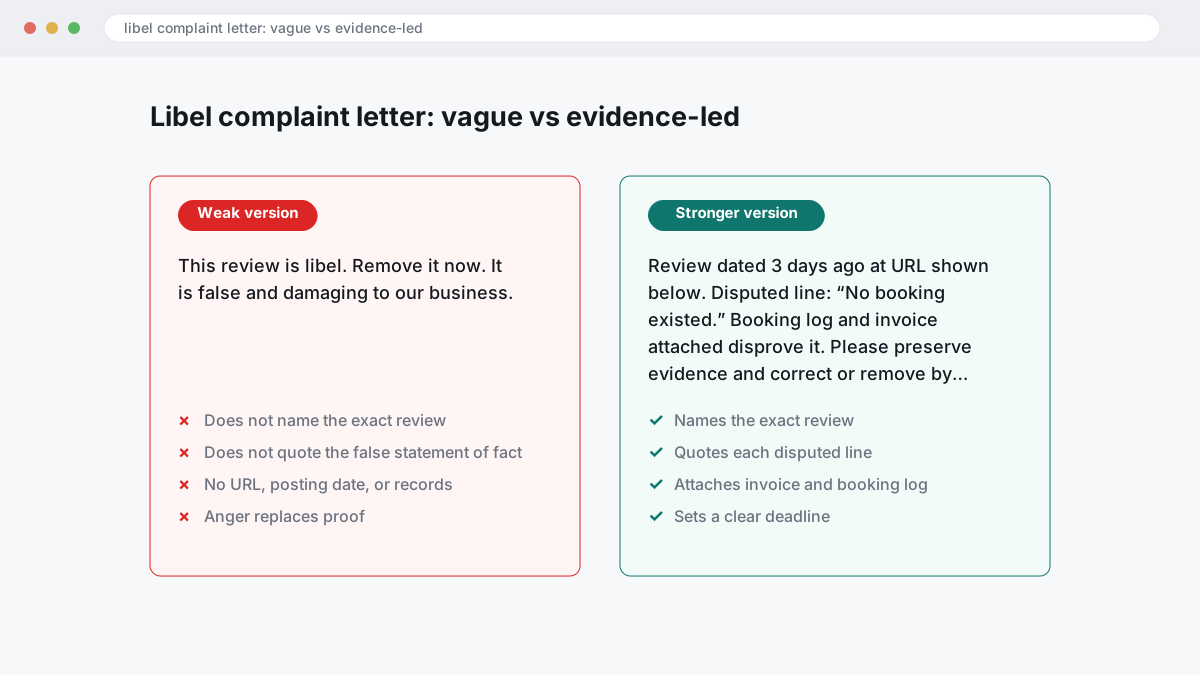
” That usually fails because it does not identify what is false, and Google Business Profile or Trustpilot moderators will not infer the missing facts for you. The stronger version reads more like an evidence pack cover note. Quote each disputed line, explain why it is false, attach the invoice, booking log, call record, CCTV still, or staff roster that answers it, and request preservation of account data, timestamps, edits, and any communication tied to the review. If you send a cease and desist letter, keep the tone factual and give a short deadline such as 7 days. Do not threaten claims you are unlikely to file.
What do you do after a platform or legal first pass rejects your claim?
After a rejection, do not resend the same argument with louder wording.
The wrong approach is repeating the first report and insisting the review is “defamatory”. That usually fails because review platform policies care about category fit as much as factual weakness: impersonation, conflict of interest, non-customer content, harassment, or regulated claims each need different proof. In BGR Review’s records of negative review cases with prior self-filed attempts, logged June 2025 to June 2026, roughly 90% had used only the basic in-platform report button with no supporting documents, and 70–80% of those first requests were rejected; that rejection did not prove the review was legitimate.
The right approach is a tighter review removal workflow. Rebuild the file with dated screenshots, order or booking records, CRM notes, call logs, location history, and a simple customer mismatch sheet showing why the reviewer does not match any real transaction. Timestamps matter. A same-day screenshot of the live review, your customer ledger, and the platform form submission usually carries more weight than a long accusation with no records.
If the legal route was rejected, check whether the problem was evidence or jurisdiction. UK defamation and consumer law apply different tests from US practice, and a solicitor may need to assess serious harm, publication, and whether truth is a defence; this is general information, not legal advice. If neither policy nor legal thresholds are strong, post a careful owner response and shift to review recovery, because preserving map-pack click-through and conversions usually matters more than arguing a dead file.
How do platform rules and country laws change your options?
Your options change a lot by platform and country: a review that is difficult to pursue as libel may still break platform rules, and a paid or deceptive review can create a separate regulatory problem. Rules vary by country and platform, and this is general information rather than legal advice.
One-size-fits-all legal advice fails because Google Maps, Trustpilot and Yelp do not moderate the same way or ask for the same proof. Google Business Profile usually turns on its prohibited and restricted content policy and the review report flow inside Maps or Search; Trustpilot separates flagging for policy breaches from disputes over reviewer experience; Yelp routes most complaints through its support and recommendation systems, where weak evidence rarely moves anything.
The platform path changes the first move, so this comparison matters before you send a legal notice.
| Platform | What usually matters | Best first step |
|---|---|---|
| Google Maps | Policy breach, account signals, factual proof | Flag the review and attach an evidence pack |
| Trustpilot | Reviewer eligibility, invitation trail, policy category | Use the business portal dispute route |
| Yelp | Content policy and reviewer activity history | Report through support with precise documentation |
The same review can trigger different laws too. If it was incentivised without disclosure, the FTC Endorsement Guides and the FTC's 2024 Rule on Fake Reviews and Testimonials matter more than a defamation argument. In the UK, defamation claims face the serious-harm threshold under the Defamation Act 2013, while UK and EU consumer law can support a complaint where the review is a misleading commercial practice. That is why the right approach is to match the route to the problem: policy breach for removal, regulator-facing evidence for deceptive endorsements, and legal counsel only where you can prove false fact and measurable harm.
Where to go from here
Start with the statement itself. If the review reads as opinion, treat it as a response problem. If it states a false fact that can be checked against records, dates, invoices, messages or access logs, treat it as a proof problem. Build one file with the review URL, screenshots, timeline, customer lookup result, platform correspondence and the single document that best disproves the claim. That file gives you something useful whether you flag the review, send a cease and desist letter, or ask a solicitor to assess defamation under the rules that apply in your country.
Try the platform route before you fund a claim. A review flag and a legal notice do different jobs, and platforms usually reject first-round defamation complaints when the business argues harm to reputation but does not prove the factual statement is false. Your next step is simple: assemble the evidence pack, flag on policy grounds, then escalate legally only if the facts and the economics still support it.