


Quick answer
You can remove a Glassdoor review only when it fits a provable breach of Glassdoor's Community Guidelines or a valid legal takedown ground; a negative opinion on its own will usually stay live. The practical route is to report it through the Employer Centre, choose the exact violation category, and attach evidence that proves that specific breach. If the first report is rejected, sending the same complaint again rarely helps. A tighter evidence pack does. BGR Review handles removals on a pay-after-success basis at $449 per removed review link, with $0 upfront.
This page is written for employers weighing a DIY report against outside help, and it is built from the way these cases actually move after submission. The part most guides miss is simple: the outcome often turns on whether your second submission maps each screenshot, HR record, timestamp and reviewer-identity check to one named policy breach, because vague complaints are the ones that get parked or rejected.
Across 12,000+ negative review cases logged by BGR Review from June 2025 to June 2026, outcomes were recorded as removal success, unresolved or unknown, and unknown cases were never counted as failures. That matters if you are deciding what to do with a Glassdoor post today, because honest timelines, evidence quality and rejection recovery tell you more than another generic instruction to “flag it”.
Can this Glassdoor review actually be removed, or is it just damaging?
A Glassdoor review comes off only when it breaks a specific rule and your evidence proves that rule break. A harsh but genuine opinion usually stays; a post from a non-employee, a conflict-driven review, or a review built on factual falsity gives you a real removal path under the Glassdoor Community Guidelines.
The wrong approach is filing a complaint that says the review is unfair, damaging, or bad for hiring. That usually fails because Glassdoor moderates against named policy violation categories, not against employer frustration. The right approach is to read the post line by line and match each problem to one guideline category first, then decide whether you can prove it with records you already hold. “This manager was abusive” is usually opinion. “I worked there for six months in the London office” becomes a factual claim if you have no record of that person in payroll, HR, contractor logs, or applicant records.
Evidence quality decides whether a report has a chance. In BGR Review’s dataset of negative review cases with prior self-filed attempts, logged June 2025 to June 2026, roughly 90% of businesses came to us after using only the basic in-platform report button, and 70–80% of those initial requests had been rejected. That is why a provable violation beats a persuasive complaint every time. If you cannot name the breach before you report it, do not report it yet.
Which Glassdoor rule does the review appear to break?
The strongest Glassdoor reports pick one primary policy violation category first, then attach proof that matches that category. If you allege harassment, quote the wording against the Glassdoor Community Guidelines; if you allege non-employment, show payroll or contractor records; if you allege conflict of interest, show the relationship.
Most failed reports do the opposite. They throw in harassment, factual falsity, bullying, fake account claims and defamation in one moderation request, which gives Glassdoor no clear policy path to act on. Across 12,000+ negative review cases logged by BGR Review from June 2025 to June 2026, roughly 90% of businesses who came to us after a failed self-filed attempt had used only the basic in-platform report button with little or no supporting documentation, and 70-80% of those initial requests had been rejected; that rejection did not prove the review was legitimate.
A line-by-line table works better because policy labels matter. Glassdoor reviews anonymous posts against named policy violation categories, so your evidence has to fit the alleged breach rather than your frustration with the post.
| What the review says | Best policy ground | What you attach |
|---|---|---|
| "HR manager threatened me in DMs" | Harassment or abusive content | Quoted lines, screenshot, date, sender identity |
| Reviewer names a workplace you do not operate | Non-employee review claims | Staff roster, location list, payroll gap |
| Post comes from a recruiter, vendor or rival | Conflict of interest | Contract, email domain, LinkedIn link, supplier record |
Your report should read like a moderation brief, not a complaint. Name one breach, map each document to that breach, and only add a secondary ground if the same evidence supports it.
How do you tell a fake review from a real ex-employee complaint?
You usually cannot prove who posted on Glassdoor; you prove that the claimed work or interview relationship could not have existed. Test the review’s dates, role details and employment claims against payroll, applicant tracking records, contractor lists and candidate logs before you call it fake.
The wrong approach is to argue from tone: “this sounds invented”, “the wording is too polished”, “the reviewer is hostile”. That fails because anonymity on Glassdoor limits certainty by design, and Glassdoor will not remove a post because it feels suspicious. A real ex-employee complaint can be angry, vague or badly written. A non-employee review claim only gets traction when your evidence pack shows a contradiction Glassdoor can verify against its Community Guidelines, such as no employee, applicant or contractor matching the claimed team, job title or employment window.
Start with records that fix the relationship question. Check payroll dates for anyone in that role, your ATS for applicants who reached interview stage, contractor and agency rosters, and internal candidate logs for withdrawn or rejected applicants. If the review says “worked here from March to June in sales” and you had no sales hires, no sales applicants and no outsourced sales contractors in that period, that is usable evidence. Across 12,000+ negative review cases logged by BGR Review from June 2025 to June 2026, roughly 90% of businesses who came to us after a failed self-filed attempt had used only the in-platform report button with no supporting documents. That is why non-employee review claims fail so often: companies suspect the post is false, but they cannot prove no relationship existed.
What evidence gives a Glassdoor report its best chance?
The strongest evidence pack links each alleged breach to one document a moderator can check quickly. Build a short chronology, add labelled screenshots, pull the matching employment or applicant record, and show on one summary page how each exhibit supports one named breach in the Glassdoor Community Guidelines.
The weak approach is an angry rebuttal about the reviewer being dishonest, bitter, or “obviously fake”. That usually fails because Glassdoor can assess documentary proof faster than motive, and factual falsity needs evidence it can verify without guessing. Across 12,000+ negative review cases BGR Review logged from June 2025 to June 2026, roughly 90% of businesses who came to us after a failed first attempt had used only the basic in-platform report flow with no supporting documentation, and 70–80% of those initial requests had been rejected.
The stronger approach is one chronology with dates and source documents in order: the review post date, the claimed job title or interview stage, the relevant roster or applicant-tracking entry, and the screenshot that shows the exact statement you say is false. If the reviewer says “worked here for two years as Head of Sales”, attach the review screenshot, your HR record showing no employee by that name or role in that period, and any organisation chart or payroll extract that proves the role claim does not match your records. Keep opinions out of it. Moderators act faster when each file answers one checkable question.
A two-column exhibit list reduces friction for the first review and gives you a cleaner base if you need to escalate later.
| Exhibit | What it proves |
|---|---|
| A1: Screenshot of review with timestamp and highlighted passage | Exact wording reported under the Glassdoor Community Guidelines |
| A2: HRIS, payroll, or applicant-tracking record for the stated period | Role claim, employment claim, or applicant claim does not match internal records |
| A3: One-page chronology linking dates, records, and policy breach | Lets the moderator verify the evidence pack in sequence without filling gaps |
How do you remove a Glassdoor review step by step in Employer Centre?
To remove a Glassdoor review, go into Employer Centre, find the review, pick the nearest policy breach, submit a short evidence-led explanation, and save the case details. The clicks are easy. The result usually turns on whether your report matches one named rule in the Glassdoor Community Guidelines and whether your proof fits that rule.
Most employers stop at the basic “flag” action and write that the review is unfair, fake or harmful. That usually fails because Glassdoor reviews policy violation categories, not how damaging the post feels to your hiring pipeline, branded search demand or conversion rate from career traffic. In BGR Review’s case file of negative review disputes with prior self-filed attempts, logged June 2025 to June 2026, roughly 90% arrived with only the in-platform report and no supporting documents, and 70–80% of those initial requests had been rejected; that is why a policy-matched report matters more than a stronger adjective.
Inside Employer Centre, open the employer review feed, select the post, choose the closest violation category, then write to that category only. If the issue is a non-employee review, say that and attach roster, contractor or applicant records that show no employment link. If the issue is conflict of interest, map your proof to that point instead. Mislabel a factual falsity complaint as spam, or an anonymity issue as “false information”, and you weaken otherwise solid evidence because the reviewer team tests the report against the category you picked.
Submit the report, then record the submission date, the review link, the exact reason chosen and brief case notes for follow-up after Glassdoor’s initial decision window. Keep that log simple: one line for what you filed, one line for what you attached, one line for the reply. If you later need outside help, BGR Review handles removals on a pay-after-success basis at $449 per removed review link with $0 upfront, so your notes from Employer Centre directly affect how fast a rejected report can be rebuilt.
What should your Glassdoor removal template actually say?
A strong Glassdoor report starts with the exact Community Guidelines category, gives a one-line breach summary, and points to labelled exhibits. Short, verification-friendly wording usually beats a long complaint because a moderator can match the claim to evidence faster inside Employer Centre.
The weak version reads like a grievance letter: paragraphs about unfairness, damage to morale, and guesses about who wrote it. That fails because Glassdoor does not remove a post for being harsh. In BGR Review's dataset of negative review cases with prior self-filed attempts, logged June 2025 to June 2026, roughly 90% came with only the basic in-platform report and little or no supporting documentation; in that group, 70-80% of initial requests were rejected. The stronger version names one policy category, states one factual reason, and maps each point to an evidence pack exhibit.
Policy category: Non-employee / false affiliation.
Breach summary: This review appears to have been posted by a person who was never employed by [Company] in any capacity during the period described.
Evidence: Please see Exhibit 1, payroll roster for [date range]; Exhibit 2, HR termination and starter log; Exhibit 3, org chart for the named department; Exhibit 4, internal incident check showing no matching event on [date].
Request: Please review this report under the named policy category and remove the review if the attached records confirm false affiliation.
Keep the body under about 150-250 words when you submit through Employer Centre. If you need three screenshots and two HR records to prove the point, cite them by exhibit number rather than pasting them into the narrative.
Should you post a public response while Glassdoor reviews the report?
Yes, you should often post a public reply while Glassdoor reviews your report, provided you stay calm and disclose nothing private. A short, factual response can protect employer-brand trust while the removal outcome is still uncertain.
The wrong move is a defensive argument with the reviewer. That usually fails because response management on Glassdoor is read by candidates, not by the moderator deciding your report, and a combative tone can depress click-through rate on your employer profile before it affects applications and branded search. If the post alleges false facts, answer the claim category instead: say the company disputes the description of pay, role scope or interview process, has raised the review for policy review, and invites concerns through an internal HR contact.
Keep anonymity on Glassdoor intact even if you think you know who wrote it. Do not mention dates of employment, teams, sickness, disciplinaries or any detail that narrows the person down, because privacy and retaliation risks are real and that public reply can create a second problem after the original review.
What if Glassdoor rejects your report the first time?
A first rejection usually means your report did not match the right Glassdoor policy breach with the right proof. Your second attempt should narrow the allegation, add fresh evidence to the evidence pack, and use the appeal and escalation path through Employer Centre instead of sending the same unsupported claim again.
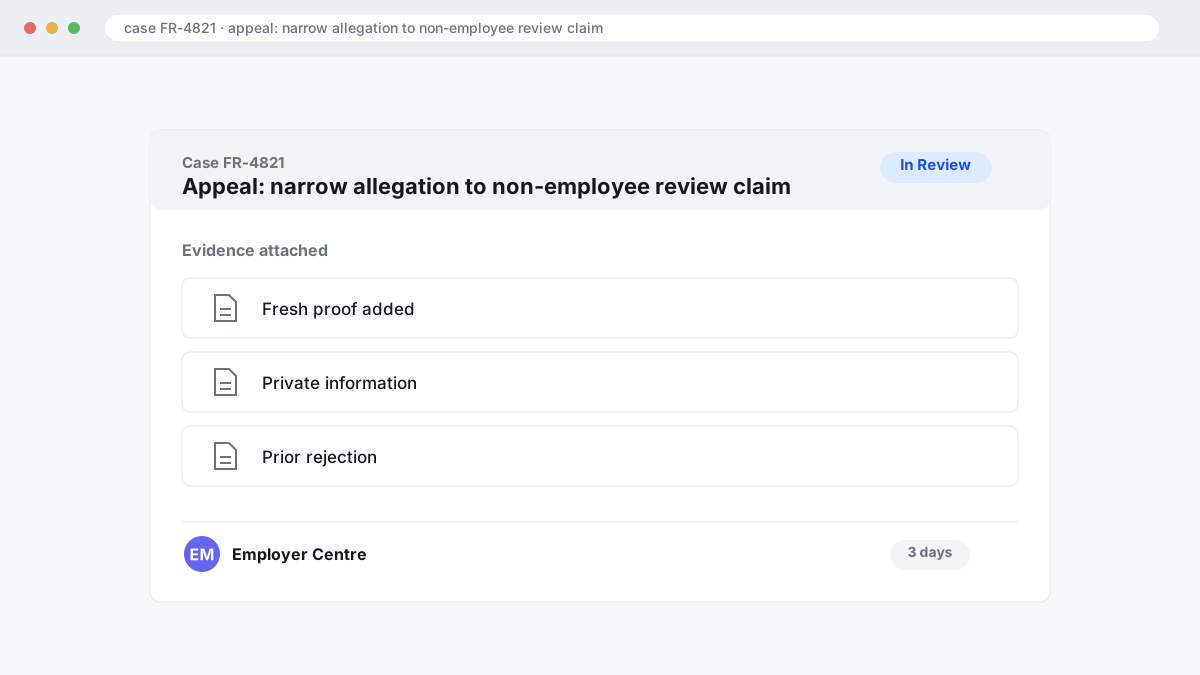
The wrong move is to hit report again and restate that the review is “false” or “unfair”. That fails because Glassdoor does not remove posts for damage alone; it looks for a named Community Guidelines issue such as a non-employee review claim, conflict of interest, impersonation, or disclosure of private information. In BGR Review’s dataset of negative review cases with prior self-filed attempts, logged June 2025 to June 2026, roughly 90% had used only the basic in-platform report button with no supporting documentation, and 70–80% of those first requests were rejected. A rejection did not prove the review was legitimate.
The better move is to fix the weakest assumption in your first report. If you claimed “this person never worked here”, do not resubmit that line without payroll records, HRIS extracts, contractor lists, or start-and-end-date confirmation that maps directly to the review date; if your first flag said “fake”, but the real issue is conflict of interest, show the reviewer’s link to a competitor and explain why that link breaches policy. In Employer Centre, attach the revised evidence pack, cite one policy ground only, and escalate once through support with a short chronology of what was already reviewed and what is newly supplied.
That tighter refile works because support can assess a single breach against documents, screenshots, and dates instead of parsing a broad complaint. If the second submission still fails and you still cannot prove a policy fit, stop there and manage the page with a measured employer response rather than chasing a third copy-and-paste report.
When does a Glassdoor problem become a legal takedown issue?
A Glassdoor dispute turns into a legal takedown issue when the post alleges false facts, hides a paid or conflicted endorsement, or falls into unlawful commercial practices under the rules that apply where you operate. Platform reporting usually comes first through Glassdoor's own review process; legal action depends on jurisdiction, evidence, and the exact wording of the review.
The wrong approach is to treat every harsh review as defamation and send legal threats before you have matched the post to either a named Glassdoor policy breach or a recognised legal claim. That fails because policy and law run on different tracks: Glassdoor may leave up a review that sounds unfair if it does not breach its Community Guidelines, while a lawyer will need proof of factual falsity, actual damage, and who the statement refers to. The right approach is narrower. If the review says something verifiably false, such as a fabricated redundancy process or a made-up wage dispute, document the false statement and the records that disprove it; if the post hides a conflict of interest or paid placement, that moves toward FTC endorsement issues in the US or misleading-practice rules in the UK and EU.
Country rules matter. In the US, undisclosed endorsements can raise FTC problems; in the UK and EU, misleading commercial practices and fake consumer content can trigger a different route; and defamation thresholds vary across jurisdictions. This is general information, not legal advice.
Can Glassdoor penalize employers for trying to manipulate reviews?
Yes. You create real risk when you pressure staff, seed conflicted reviews, or try to game the platform. The safe line is evidence-led reporting through Employer Centre and careful public responses, not influence campaigns dressed up as genuine employee feedback.
The wrong approach is treating a bad Glassdoor page like a ratings problem you can wash out with volume. Asking managers, recruiters, friends or family to post as neutral reviewers runs straight into conflict of interest issues under the Glassdoor Community Guidelines, and anonymity on Glassdoor does not make that safe. Anonymous posting protects the reviewer’s identity from you; it does not turn a connected person into an independent source, and it does not stop platform enforcement if the account activity looks coordinated.
The right approach is narrower. Keep your reporting workflow separate from HR outreach, keep response management separate from any employee feedback process, and document who had contact with the reviewer before you file. That structure avoids the pressure campaign trap and gives you a cleaner record if Glassdoor reviews your report or later escalation.
Is removing Glassdoor reviews worth it for hiring outcomes?
Removing a Glassdoor review is worth the effort when the post is recent, believable enough to sway applicants, and timed badly for an open hiring push. The best return usually comes from reviews that skew your rating mix, sit near the top because of recency, or hit just as candidate conversion starts to soften.
The wrong approach is treating every negative review as equal. That fails because one old, isolated complaint buried under newer balanced feedback rarely changes hiring conversion impact in the same way as a fresh, specific, unanswered post about pay, management or interview conduct. In BGR Review's case file of 12,000+ negative review cases logged June 2025 to June 2026, reviews raised within 28 days of posting and supported by an identifiable policy issue resolved successfully in roughly 90% of cases, while comparable cases raised beyond 28 days fell to approximately 25–30%; that is our observed outcome profile, not a Glassdoor rule.
The better approach is to line up removal priority with visible recruiting damage. If application drop-off starts after a reputation shock, and the trigger is a recent review that dominates the first screen, weakens the rating mix, and has no employer response, act fast. Response management still matters because a calm public reply can protect trust, branded search clicks and careers-page conversions while the review is under review, but it will not fix a post that keeps poisoning recency during an active campaign.
When does DIY stop making sense compared with a Glassdoor removal service?
DIY is sensible when you have one review, one named Glassdoor Community Guidelines breach, and clean internal records to prove it. A removal service becomes the better option after a rejection, when your team cannot build the evidence pack properly, or when hiring conversion impact justifies deeper appeal and escalation work.
The wrong approach is to treat a complex employer-profile issue like a simple flag. That fails once the first report is rejected, because the problem usually is not the button you clicked in Employer Centre; it is that the submission did not map each document to one specific breach, such as a non-employee claim or conflict of interest. In BGR Review's dataset of negative review cases with prior self-filed attempts, period June 2025 to June 2026, roughly 90% came to us after using only the basic in-platform report button, and 70-80% of those initial requests had been rejected.
This comparison is where the trade-off usually becomes obvious.
| Route | Cash cost | What you control | Where it usually breaks |
|---|---|---|---|
| DIY report | Platform filing is free | You gather records, write the report, manage the appeal and escalation path | Weak evidence pack, no legal coordination, limited follow-up after rejection |
| Removal service | Fixed price per removed link | You supply source documents; the service structures evidence, policy mapping and escalation | Poor fit for reviews that are harsh but policy-compliant |
The right approach is to keep DIY for a one-off report with obvious proof and use specialist help when several reviews point to the same source, the reviewer identity is disputed, or legal takedown issues cross into false factual claims. That works because the value sits in packaging and sequence: evidence first, named policy breach second, escalation only when the first decision leaves a real opening. If the review is hurting applicant quality, branded search clicks, or form-fill conversion from your careers page, the internal time cost usually exceeds the filing fee you thought you saved.
Where to go from here
Classify the post against one named rule in the Glassdoor Community Guidelines before you do anything else. “False facts”, “non-employee review”, “conflict of interest” and harassment do not use the same proof. Your second submission needs that match. A weak report says the review is unfair; a strong one maps each document to the breach, such as payroll records for a non-employee claim, interview logs for a fabricated candidate account, or internal records that disprove a dated factual allegation.
If the case is strong and Glassdoor still rejects the first report, move to a managed removal review rather than filing the same note again through Employer Centre. That usually means rebuilding the evidence pack, tightening the chronology, and showing why anonymity on Glassdoor does not block verification of policy breach. In the cases we handle, the difference between a failed first attempt and a viable second attempt is usually evidence quality, not louder wording.
Your next step is simple: identify the exact violation, gather the documents that prove it, and decide whether DIY still makes sense after one rejection.