


Quick answer
Hotel reputation management is the work of improving how your property shows up on Google Business Profile, Tripadvisor, online travel agencies and social channels so more searchers click, trust you and book. The fastest gains usually come from three actions: answer new reviews faster, add fresh verified guest reviews at a steady pace, and dispute fake or policy-violating reviews with a proper evidence file. For removals, BGR Review charges $449 per removed review link with $0 upfront and bills only after success. Review growth has to follow each platform’s rules and local advertising law.
This guide is written from live review-growth and removal work, not software theory. We deal with the practical points generic guides skip: what happens after you hit a platform’s report button, why a bare flag usually fails, and which evidence actually matters when a review mentions a stay that never appears in the PMS or booking log.
That matters for hotel reputation because Google, Tripadvisor and OTAs do not handle disputes the same way, and response workflows break down fast across franchise and multi-property operations if nobody owns timing, templates and escalation. BGR Review sells review and removal services openly, including a 30-day free replacement guarantee on review packages, so you can judge the advice with the commercial interest in plain view.
Which hotel reputation channels move bookings first when time is limited?
Put your first effort into the channels guests check closest to booking: Google Business Profile for local intent, online travel agencies for rate-check moments, and Tripadvisor for trust validation. Hotels that split equal effort across every review site usually thin out response speed and work on the wrong booking bottleneck first.
The wrong approach is a flat checklist where your team replies everywhere in the same order. That fails because Google Business Profile affects the local pack and map-pack click before a guest even reaches your website, especially on last-minute mobile searches for terms like “hotel near me” or “airport hotel tonight”. In BGR Review’s operating flow, Google sits first for single-property hotels because faster owner responses there support click-through rate from branded and non-branded local searches, and those clicks are closest to a call or direct booking.
Tripadvisor comes next when the guest is still comparing options rather than ready to book. Its traveller ranking and review recency shape trust during the research stage, often before branded search demand appears, so neglecting it can depress booking conversion even if your direct site is strong. We treat Tripadvisor as a persuasion channel, not a pure customer-service inbox.
OTAs deserve priority whenever ADR pressure is high and the guest is rate-checking across tabs. A weak score, stale management replies or visible unresolved complaints on Booking.com or Expedia can cut conversion at the exact moment the guest is comparing your rate against two nearby hotels. If you later hit a false or policy-violating review on one of these high-impact channels, BGR Review’s removal model is pay after success at $449 per removed review link with $0 upfront, which matters when you need to protect margin before a busy period.
Why do Google, Tripadvisor and OTA reviews need different handling instead of one policy?
Google Business Profile, Tripadvisor and online travel agencies are different operating environments. Each one uses its own verification signals, dispute route and guest intent, so a single reply script usually slows response time, weakens booking recovery and cuts your odds when a review needs to be challenged.
The wrong approach is one universal policy: same owner responses, same evidence file, same escalation step. That fails because Google rewards fast public responses on the profile where map-pack click-through starts, while Tripadvisor readers are comparing service detail, cleanliness and management credibility before they convert, and OTAs such as Booking.com and Expedia anchor review visibility to completed stays and reservation data rather than open public posting.
Google Business Profile needs speed first. A short public reply within a day or two helps you protect local-pack clicks and branded search demand, and if the review looks fake or policy-violating you then route it through Google Business Profile review reporting with screenshots, timeline notes and the policy point that actually applies. Using only the basic report button is weak: across 12,000+ negative review cases logged by BGR Review from June 2025 to June 2026, roughly 90% of businesses who came to us after a failed attempt had filed with minimal evidence, and 70-80% of those initial requests had been rejected.
Tripadvisor needs specificity. A vague apology under a complaint about bedbugs, overbooking or staff conduct looks evasive there, and disputes usually stand up better when you match the content to stay records, incident logs and the platform rule you are relying on. OTAs need a different lane again because Booking.com and Expedia reviews are tied to reservation systems, so the first check is whether the stay completed, whether the room type and dates match, and whether the property can evidence a mismatch through folio or PMS data before escalating.
The right approach is a channel-based workflow: Google for response speed and visibility recovery, Tripadvisor for category-specific rebuttal and evidence, online travel agencies for reservation-led verification and partner-support escalation. That works because it matches how each platform decides trust, which is what protects conversions instead of just generating more owner responses.
How do you improve hotel reputation online without creating another manual task pile?
Run a weekly operating loop, not a reporting exercise: check ratings, review recency, response time and repeated complaint themes on your three booking-critical channels, route service failures fast, then ask for post-stay feedback after checkout. The target is fresher reviews, faster service recovery and fewer unresolved complaints that drag down booking conversion, not another dashboard your team ignores.
Theory-heavy ORM advice fails because it treats reputation work like a monthly marketing task. A hotel loses bookings in the gaps between shifts. If your Google Business Profile, Tripadvisor profile and main online travel agencies are reviewed once a month, the same breakfast complaint can sit unanswered across three channels while your map-pack click-through rate softens and branded search demand leaks to a competitor with newer owner responses.
The workable version is simple enough to run every week. Audit your top three channels for four points only: current rating, newest review date, median response speed, and unresolved themes pulled from light sentiment analysis. Then send each issue to one owner within 24 hours: housekeeping for cleanliness and room-condition complaints, front desk for check-in, billing or staff conduct, and F&B for breakfast, bar or room-service issues. That routing step matters more than a polished report because service recovery fixes the next review before it is written.
This is the minimum workflow to keep it moving without creating a manual pile.
| Step | Timing | Owner |
|---|---|---|
| Channel audit: rating, recency, response time, unresolved themes | Weekly | Marketing or GM |
| Complaint routing to housekeeping, front desk or F&B | Within 24 hours | Department head |
| Guest feedback collection by SMS | 24 hours after checkout | CRM or PMS trigger |
| Follow-up email request | 72 hours after checkout | CRM or PMS trigger |
Brand mention monitoring closes the loop. Watch for direct mentions on social posts, local forums and travel threads, then connect them back to the same complaint themes in your review queue.
Does a stronger hotel reputation actually raise bookings, or just look good in reports?
A stronger hotel reputation lifts bookings when it improves trust at the moment a guest chooses where to click: fresh reviews, credible owner responses and a rating mix that looks believable. The payoff usually shows up first in click-through rate and booking conversion, long before a sentiment dashboard gives you a flattering monthly average.
The wrong approach is to chase sentiment analysis scores and celebrate a tiny average-rating lift while your Google Business Profile, Tripadvisor listing and branded search results still show stale complaints from three months ago. That fails because guests compare before they compare rates. If your review velocity has stalled and half your recent feedback has no owner response, the listing looks unattended, which depresses map-pack clicks and weakens direct booking intent even if the overall score barely changed.
The better approach is to fix what the guest actually sees in sequence: recent review coverage, reply coverage, then the star-rating distribution. A hotel with a believable spread of 5-star, 4-star and the occasional resolved 1-star often converts better than a profile with a slightly higher average and obvious gaps, because the second profile looks filtered or neglected. For direct bookings, branded searchers need fresh reassurance on page one; they do not need to land on an old complaint thread and work out whether the problem was ever handled.
How fast is too fast for new hotel reviews before patterns look unnatural?
Safe review growth should track your occupancy pattern. A weekend jump after a sold-out event can look normal; a thin property producing dozens of fresh reviews overnight can look manipulated. Pace review velocity to real check-outs, seasonality and channel mix instead of chasing a monthly quota.
Monthly targets are the wrong approach because they ignore room count and occupancy. A 200-room resort can support far more weekly guest feedback collection than a 20-room inn, especially in peak season, and the review pattern will still look natural if requests follow departure dates. The failure point comes when staff push every guest at once after a meeting, promo or complaint run; that creates sudden clusters, a skewed star-rating distribution and a footprint that can reduce trust even before any platform filter steps in.
The safer setup is operational. Trigger requests from your PMS or CRM after checkout, vary timing by stay type, and let low-occupancy weeks stay quiet. If you use BGR Review to build review volume, delivery starts in 24-48 hours, but the pace still needs to mirror actual stays rather than an arbitrary quota, because a steady pattern helps booking conversion and protects map-pack click-through better than a sharp burst followed by silence.
What should hotel managers say in review replies when they need speed, empathy and legal safety?
A hotel reply should do four jobs in under 100 words: acknowledge the guest’s stay, state the next step, move the details into private contact, and reassure the next person reading. Fast, specific owner responses beat long apology paragraphs that sound copied, reveal too much, or create legal risk.
Generic replies fail because they try to soothe the reviewer and forget the real audience is the next guest comparing your Google Business Profile with two nearby hotels. Post negative replies within 24 to 48 hours on priority channels, especially Google and Tripadvisor, because delayed service recovery reads like indifference and can drag map-pack click-through before it ever touches bookings.
Use this structure every time.
- Acknowledge: “Thank you for sharing this after your stay with us.”
- Own the next step: “I’ve asked our front office manager to review what happened today.”
- Move details private: “Please email us so we can verify the booking and resolve this directly.”
- Reassure future guests: “We are checking the issue and tightening the process for arriving guests this week.”
Keep legal safety tight. Never publish booking details, health information, room numbers, payment history, or any staff disciplinary action in owner responses, even when the guest already mentioned them. On Google Business Profile, a calm reply that avoids those facts usually protects trust better than a point-by-point rebuttal.
When should a hotel remove a review, and when is a public response the smarter move?
Remove a review when it breaks platform rules or states false facts you can document; reply when the complaint is harsh but plausible. Hotels waste time by flagging every bad review instead of separating fake or policy-violating reviews from service-recovery complaints that future guests need to see handled well.
The wrong approach is to report anything below four stars and hope the platform cleans up your profile. That fails because Google Business Profile, Tripadvisor and OTA systems do not remove a review for being damaging, emotional or unfair on tone alone; they look for a rule breach such as impersonation, conflicts of interest, threats, extortion, or a factual claim you can disprove. Across 12,000+ negative review cases logged by BGR Review from June 2025 to June 2026, roughly 90% of businesses that came to us after a failed attempt had used only the in-platform report button with no supporting documents, and 70-80% of those initial requests had been rejected.
The smarter move is to build the file before you choose the path. If the review says “we were charged twice”, “there was no booking under our name”, or “staff entered our room at 2am”, pull the folio, CCTV timestamps, PMS or reservation record, staff notes and message logs first. If those records show a stay mismatch, no reservation, a different timeline, or direct threats in chat, flag it under the platform’s policy route and keep the evidence ready for appeal; if the stay happened and the complaint is plausible, your owner response should show service recovery, name the corrective step, and invite an offline resolution without arguing facts in public.
Speed matters. In BGR Review’s case file of 12,000+ negative review cases from June 2025 to June 2026, reviews raised within 28 days of posting and backed by an identifiable policy issue resolved successfully in roughly 90% of cases, while comparable cases raised after 28 days fell to approximately 25-30%; that is our observed outcome profile, not a platform guarantee.
What does a hotel fake-review evidence pack need before you dispute Google, Tripadvisor or an OTA?
A useful hotel evidence pack ties one review to one provable defect: no matching stay, a false factual claim, a conflict of interest, or a breach of platform rules. Add dates, folio or reservation data, access records, screenshots, and a short platform-specific explanation before you dispute anything.
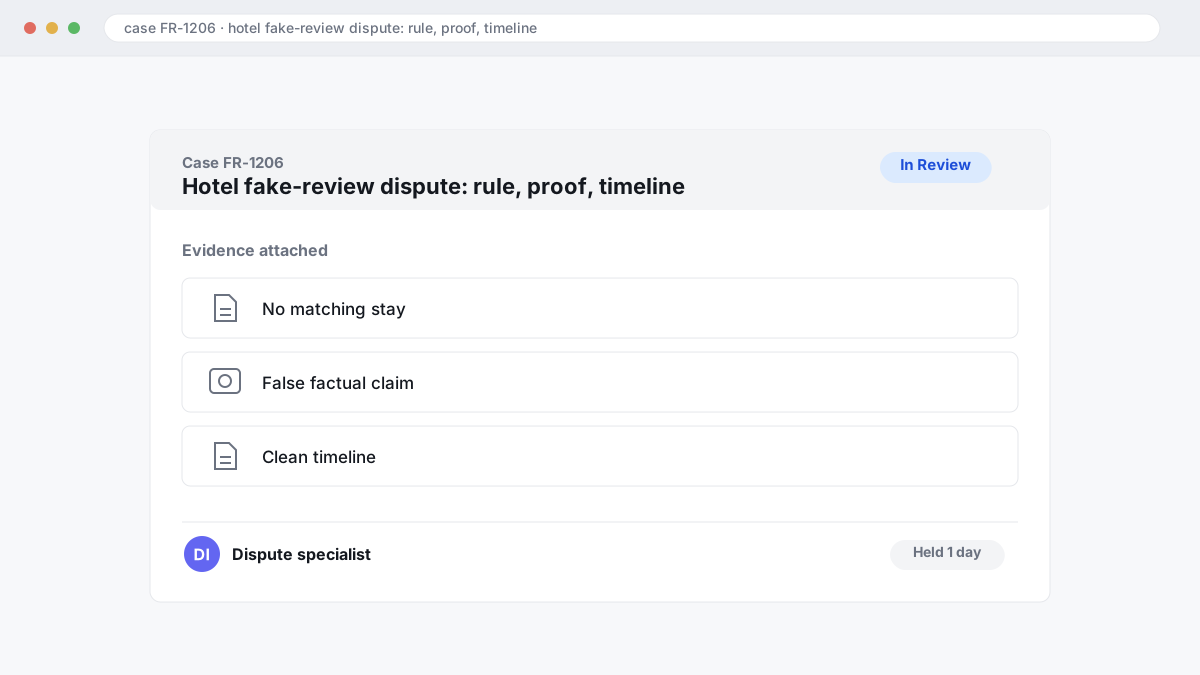
The wrong move is the email managers write at midnight: “this review is unfair, please remove it”. Moderators cannot verify feelings, so those complaints usually fail. At BGR Review, we hold a dispute until the file shows a rule, the proof for that rule, and a clean timeline; across 12,000+ negative review cases logged June 2025 to June 2026, roughly 90% of businesses that came to us after a failed attempt had used only the basic report button with no supporting documentation, and 70–80% of those initial requests had been rejected.
The evidence you submit should change by platform because Google Business Profile, Tripadvisor and online travel agencies check different signals.
| Platform | What to include | What usually persuades moderation |
|---|---|---|
| Google Business Profile | Booking search result showing no matching stay, timestamped CCTV or door-access logs, staff notes, screenshots of the review, and the exact Google review policy ground you rely on | A short explanation tied to one policy breach, such as impersonation, off-topic content or a false factual claim |
| Tripadvisor | Reservation check, folio gap, guest-name mismatch, staff incident notes, and proof of a prohibited connection if the reviewer appears to be staff, a competitor or someone with no genuine stay | Evidence that the reviewer never stayed, or had a conflict that makes the review ineligible |
| Online travel agencies | Reservation record, extranet messaging history, check-in or keycard logs, refund notes, and any pre-arrival cancellation record | A documented mismatch between the review claim and the OTA’s own booking trail |
File the pack in the same order every time: review link, booking lookup, timeline, screenshots, policy citation, first submission, then appeal route. That sequence matters.
Should you buy hotel reputation software, hire a managed service, or combine both?
Choose software when your team can monitor, respond and escalate on time every day. Choose managed help when review volume, fake-review disputes or cross-channel workload outrun internal capacity. A hybrid setup usually fits regional groups that need central oversight with property-level accountability.
The wrong buy is a dashboard without an operator. Software will centralise Tripadvisor, Google Business Profile, OTA alerts and brand mention monitoring, but it does not assign response ownership, chase late owner responses or build a dispute file when a review appears to breach platform rules. You still need someone to decide who replies within the shift, who escalates to the GM, and who pushes a removal case when a review is false or policy-violating.
Managed service makes sense when that capacity is missing. The useful part is not “monitoring”; it is drafting replies that protect booking conversion, spotting which reviews need service recovery, and handling disputes that staff rarely have time to document properly.
Use a hybrid model for franchise and multi-property operations where head office wants reporting, templates and escalation rules, while each hotel still owns the final owner responses.
| Model | Best fit | Where it breaks |
|---|---|---|
| Software only | One property with a disciplined manager and clear rota | Alerts pile up, replies slow down, disputes stay unfiled |
| Managed service | Lean team, high review volume, recurring dispute work | Less useful if your staff already respond well in-house |
| Hybrid | Regional groups needing central reporting and local execution | Fails if head office and properties share no response rules |
What changes when reputation management has to work across a franchise or hotel group?
Group reputation management works when head office sets one operating standard for every property, then gives each hotel a named local owner for replies, service-recovery follow-up and escalation inside a fixed 24-48 hour window.
The wrong approach is to copy a single-property playbook across the whole estate and judge every location by one average rating. That fails because franchise and multi-property operations carry different complaint mixes: an airport hotel gets parking, shuttle and late-arrival friction; a resort gets pool, noise and family-expectation issues; an extended-stay property gets housekeeping frequency, kitchen equipment and billing disputes. Your SOP should lock the non-negotiables: tone for owner responses, approval rules for compensation language, who handles legal-risk reviews, and when a disputed post moves from property level to a central removal queue.
The right approach is central comparison with local flexibility. Each month, your brand team should review response time, rating trend and recurring themes by property, then use sentiment analysis to separate one-off incidents from location-specific failures. That works because group standards protect the brand, while local managers still answer with facts from the stay record instead of bland templates that hurt booking conversion and map-pack click-through.
Are guest review requests legal for hotels, or can they create compliance risk?
Hotels can ask guests for reviews if the request stays neutral, honest and within platform rules. The main compliance risks are review gating, undisclosed incentives and selective guest feedback collection that filters out unhappy stays; rules differ by country, platform and offer type, so this is general information rather than legal advice.
The wrong approach is sending happy guests to Google Business Profile or Tripadvisor while routing unhappy guests into a private survey. That creates review gating risk because it biases the public record, and it can also cause trouble on online travel agencies if staff push only certain guests to leave OTA reviews after a resolved complaint. The safer approach is one neutral post-stay request sent to all checked-out guests on the same timetable, with no language that asks for “5-star” feedback and no branch that suppresses negative sentiment analysis or owner responses.
The FTC’s Endorsement Guides and the FTC’s final rule on fake reviews and testimonials, issued in 2024, draw a clear line around undisclosed incentives tied to public endorsements. A free drink voucher, upgrade draw or loyalty credit can create risk if disclosure is missing or if the reward depends on a positive rating. BGR Review sells review and removal services, so our compliance advice to hotels stays plain: ask everyone, disclose any incentive, and keep the request platform-specific only where that platform permits it.
What should your team do in the next 30 days to lift hotel reputation where it affects revenue fastest?
Run a 30-day sprint around the channels that move bookings first: benchmark your main profiles, fix response ownership, collect fresh post-stay reviews, and dispute only reviews with clear policy grounds. Track rating mix, review recency, reply coverage and booking conversion together, because isolated vanity metrics miss what changes reservations.
Random reputation activity fails because your team ends up answering whichever alert lands first, while Google Business Profile, Tripadvisor and online travel agencies affect demand in different ways. In week 1, compare those three channels against your top three local competitors: average rating, recent review count, response speed, owner-response coverage, and the last ten reviews by theme. Google usually shifts map-pack click-through and call intent first, Tripadvisor shapes research-stage trust, and OTA reviews hit booking conversion closest to checkout, so one blanket policy wastes time.
Week 2 is an ownership fix. Give Google replies to the front-office lead, Tripadvisor to the guest-relations manager, and OTA reviews to whoever already handles channel-manager issues, then set a 24-to-48-hour service-level target with approved response templates and one escalation route for legal or safety claims.
Weeks 3 and 4 should reduce manual work, not add to it. Trigger post-stay requests from your PMS or CRM after checkout, review dispute candidates against the platform rule before filing, and log whether stronger recency and reply coverage coincide with booking conversion changes on direct and OTA bookings.
Where to go from here
Start where bookings move first: your Google Business Profile, Tripadvisor and the online travel agencies that already sit in front of ready-to-book guests. Check rating, recency, owner responses and review velocity on those channels before you spend time on lower-impact mentions. Then fix your response handling. A hotel that replies quickly, routes complaints to the right manager and asks for guest feedback at the right point in the stay usually improves click-through from the map pack and keeps more direct booking intent from leaking to OTAs.
If false or policy-violating reviews are pulling down performance, assess removal before you build a wider hotel reputation plan. Your next step is simple: pull the last 90 days of disputed reviews, match each one to reservation records and staff notes, and sort them by platform and policy issue. Expect to separate removable cases from reviews that need a public response and service recovery.