


Quick answer
You can request removal of a Google review only if it appears to breach Google’s prohibited and restricted content policy, such as spam, fake engagement, off-topic content, impersonation or a conflict of interest. A harsh but genuine customer complaint usually stays live. The practical sequence is simple: flag it inside Google Business Profile, prepare an evidence pack, then escalate if Google rejects the first report. If you want managed help, BGR Review handles removals on a pay-after-success basis at $449 per removed review link with $0 upfront. Rules also vary by country and platform.
This page is written for operators deciding whether to spend time on a removal request, escalate it, or stop and respond publicly. Across 12,000+ negative review cases logged by BGR Review from June 2025 to June 2026, outcomes were recorded only as removal success, unresolved or unknown, so denied requests and unconfirmed endings were not dressed up as clean wins.
That matters because the weak point is usually evidence, not the flag button. In BGR Review’s records, roughly 90% of businesses that came to us after a failed self-filed attempt had used only the basic in-platform report flow with no supporting documents, which is why this guide focuses on policy fit, proof, escalation routes and realistic timelines for google reviews.
Why are so many bad Google reviews impossible to remove?
Most bad Google reviews stay live because Google removes policy breaches, not criticism. A one-star post calling your service slow or rude will usually remain; a fake, off-topic, or conflict-of-interest review has a removal path if you can show how it breaches Google’s prohibited and restricted content policy.
The wrong approach is to treat every negative review as removable, flag it inside Google Business Profile, upload a few screenshots, and expect the star rating to bounce back. That fails because Google is judging policy fit, not whether the comment feels unfair. In BGR Review’s log of 12,000+ negative review cases from June 2025 to June 2026, roughly 90% of businesses who came to us after a failed attempt had used only the basic in-platform report button, and 70–80% of those initial requests had been rejected.
The right approach is to diagnose the review before you act: is it alleging a real service problem, or does it show spam signals such as fake engagement patterns, repeated wording across profiles, irrelevant location mentions, or a reviewer with no plausible customer link. That works because overlap in phrasing, timing, and account behaviour can support a spam claim in a way “this is false” usually cannot. If the review is ordinary poor feedback, your better move is response strategy and new review generation, not another weak removal request.
Which Google review problems actually match Google's removal rules?
Google removes reviews that fit a named rule in its prohibited and restricted content policy, such as spam, off-topic content, conflicts of interest, impersonation, or other restricted content. Reviews that feel unfair, rude, false in tone, or damaging to your click-through rate in the map pack usually stay live unless you can tie them to a policy ground.
The wrong approach is filing a request that says the review is “untrue” or “defamatory” and stopping there. That fails because Google moderates against its own policy categories first, not against your sense of fairness, so a one-star insult with no slur, threat, or policy breach can remain visible even if it hurts conversions and branded search demand. The right approach is narrower: identify the exact rule the review appears to breach, then frame your request around that rule alone.
Use this yes-no check before you file inside Google Business Profile.
| Review problem | Likely policy fit | Worth filing? |
|---|---|---|
| “Terrible service” with no details | No clear breach; opinion | No |
| Review talks about politics, parking next door, or another firm | Off-topic content | Yes |
| Staff member, ex-employee, competitor, or owner posts praise or criticism | Conflict of interest / self-reviewing | Yes |
| Reviewer pretends to be a customer and uses another person’s identity | Impersonation | Yes |
| Review appears after a discount, gift, or incentive request | Incentivised content | Yes |
BGR Review charges nothing upfront for removals and bills $449 per removed review link after success, so this triage matters: if the issue is weak service feedback rather than a named violation, a response strategy usually protects click-through and calls better than a bad request that gets denied.
How do you file a removal request inside Google Business Profile without missing the basics?
Submit the first request from the affected Google Business Profile review screen in Google Maps, not through scattered support pages. Save the review URL, reviewer name, posting date, and the profile ID before you hit report, because a later appeal often depends on that record.
The weak approach is ad hoc flagging from whoever notices the review first. That fails because the report goes in without a clean audit trail, the owner account is missing, and nobody can prove which review was reported or when. In BGR Review's dataset of negative review cases with prior self-filed attempts, logged June 2025 to June 2026, roughly 90% of businesses had used only the basic in-platform report button with no supporting documentation, and 70-80% of those initial requests were rejected. The better move is simple: sign in with owner access, open the live review on the correct Maps listing, report that exact review, and log the submission date the same day.
If you run multiple locations, one shared workflow matters more than speed. Use one owner-led process, one tracker, and one person accountable at each location for gathering the review link and reviewer details before escalation; otherwise duplicate requests, missed deadlines, and wrong-location reports creep in fast. A basic tracker should tie each review to its Google Business Profile, location manager, report date, and current status, which also makes it easier to decide later whether another request is worth the effort or whether a public response will protect map-pack click-through and conversions better.
What should your evidence pack contain before you ask Google to remove anything?
A strong evidence pack connects the review to a named rule in Google’s prohibited and restricted content policy with dated proof. The most useful bundle is usually 1 to 3 pages plus attachments: screenshots, transaction checks, staff notes, and a short explanation that links each item to the policy breach.
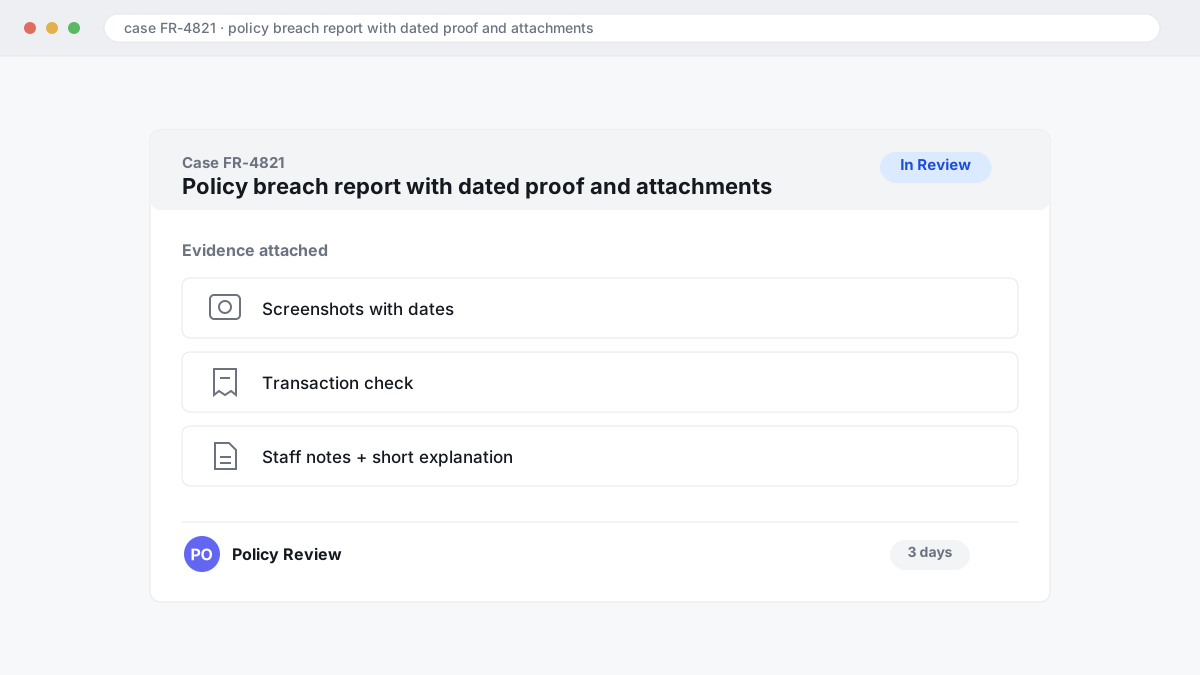
The weak approach is a generic complaint: “this review is fake”, “we never met this person”, “please remove it”. Google often rejects that because the report gives no verifiable trail. In BGR Review’s records of negative review cases with prior self-filed attempts, logged June 2025 to June 2026, roughly 90% had used only the basic in-platform report button with no supporting documentation, and 70–80% of those initial requests had been rejected. The stronger approach is an evidence-linked claim: “No booking exists under this name, phone, or email on 14 March; the reviewer says they visited our Bristol site, but this Google Business Profile is for Leeds; the service described requires a signed work order, and none exists.” That gives a reviewer something to test.
Your pack should read like a clean incident file. Put the review text first, then a dated event timeline, then the proof: booking-system search results, payment or invoice records, staff notes from the claimed date, CCTV or access log references if you have them, and screenshots of impossible visit details such as the wrong city, a closed day, or a service your profile does not offer. If you are dealing with a multi-location business, add the correct branch details and the profile URL or CID for the right location, because location mismatch is easier for Google to assess than a broad allegation of defamation. Keep each attachment named by date. A cluttered bundle slows the decision and increases the chance you end up replying publicly to protect map-pack click-through and conversions while the request stalls.
When is the redressal complaint form the right escalation path?
Use Google's redressal complaint form after your first review report fails and you can restate the policy breach with stronger documentation. It is a merchant appeal route after Google's initial outcome, not a way to skip the first report inside Google Business Profile.
A second blind flag is usually wasted motion. Google already saw the review once, and if you send the same weak signal again, you often get the same result. In BGR Review's log of 12,000+ negative review cases from June 2025 to June 2026, roughly 90% of businesses who came to us after a failed attempt had used only the basic in-platform report button, with no evidence pack, and 70-80% of those first requests had been rejected. The better move is a structured appeal: cite the relevant rule in Google's prohibited and restricted content policy, attach the screenshots or transaction records, and explain why the first decision missed the policy fit.
Track removal timelines by stage so you know when to escalate and when to stop chasing.
| Stage | What you do | What to watch |
|---|---|---|
| First flag | Report the review in Google Business Profile | Record the date, review URL, profile ID, and policy reason |
| Appeal submission | Use the redressal complaint form after the first outcome | Upload the evidence pack and restate the violation clearly |
| Support follow-up | Chase only if the appeal stalls or Google misreads the evidence | Keep one case thread; fragmented follow-ups slow decisions |
If the review still stands after a proper appeal, your next move belongs in the denial section, not in another duplicate flag. That matters for conversion as well as admin time: unresolved attacks can depress map-pack click-through, but repeated weak submissions do nothing for calls, bookings, or branded search demand.
What do you do when Google rejects the request the first time?
After a first rejection, do not send the same complaint again. Check the exact policy category, rebuild the evidence around that single rule, and escalate once with a cleaner file; repeated weak submissions usually waste time and can complicate later review of the same review.
Most failed retries break down for two reasons: weak policy fit, weak evidence, or both. In BGR Review's case file of negative review cases with prior self-filed attempts, logged June 2025 to June 2026, roughly 90% had used only the in-platform flag and 70–80% of those initial requests were rejected. Google's support flow will often leave a review live if your complaint jumps between fake engagement patterns, defamation, conflict of interest and harassment without proving any one of them properly.
The wrong move is resubmitting unchanged screenshots and adding three new accusations in the text box. That fails because the file still does not map cleanly to one part of Google's prohibited and restricted content policy, and inconsistent follow-ups can create review reinstatement risk if Google later reassesses a temporarily removed review and decides the record was overstated. The better move is to pick the strongest rule, strip out the weaker claims, add dated evidence, and escalate once with a tight chronology. If you still cannot show a clear policy breach, stop chasing removal and switch to a response strategy instead.
Should you post a public reply while Google is reviewing the case?
Yes, usually post a reply while the case is pending unless your solicitor or legal counsel tells you to stay silent. A short, factual response limits conversion damage, shows you are active on your Google Business Profile, and covers the gap if Google leaves the review live for days or weeks after the first flag.
The wrong move is a defensive argument: accusing the reviewer of lying, naming appointments, posting screenshots, or threatening action. That fails because it can expose private details, make the review look more credible to the next person reading it, and hurt click-through from the map pack while the complaint sits unresolved. The better response strategy is calm and brief — under 80 words, no private facts, no blame.
For a fake review, say you cannot match the account to a real customer and have asked Google to review it. For a mixed review, acknowledge the experience and offer an offline contact route. For a defamation allegation, avoid arguing point by point in public; state that the claims are disputed, that you take accuracy seriously, and that you have started a formal review.
DIY flagging or a removal service: which route fits your case and budget?
DIY flagging usually fits one review with a clear policy match and simple proof. A managed removal service fits better when the facts are messy, the reputational risk is high, or several Google Business Profile listings need one consistent submission and escalation path.
The wrong approach is treating a complex reputation event like a single bad comment. If one ex-employee posts across three locations, or a director's name is being targeted in review text, the basic report button inside Google Business Profile rarely carries enough context, and your removal timelines stretch because each denial has to be rebuilt from scratch. The right approach is to self-file only when the violation is obvious on its face — impersonation, irrelevant content, or a review tied to a transaction you can disprove with one invoice, one booking record, or one message thread. In BGR Review's dataset of negative review cases with prior self-filed attempts, covering June 2025 to June 2026, roughly 90% arrived after the business had used only the in-platform report button with no supporting documentation, and 70–80% of those initial requests had been rejected.
This side-by-side is the practical split most owners need before spending money.
| Route | Best fit | Cost | Evidence and escalation |
|---|---|---|---|
| DIY flagging | One obvious policy breach on one profile | Your time only | Basic report flow in Google Business Profile; limited room to frame evidence; slower if rejected |
| Managed help | Repeat attacks, executive risk, or multi-location volume | Fixed price per removed link | Structured evidence pack, denial review, and escalation handling; stronger when removal timelines matter for map-pack click-through, conversions and branded search demand |
If the likely upside is one saved reply and a minor dent in click-through, DIY is often the cheaper call. If the review set is suppressing calls, bookings or local pack trust across several locations, the extra handling usually pays for itself faster than another rejected flag.
Which review problem should you fix first if you want the fastest business impact?
Start with the review issue most likely to change customer decisions this week: recent false factual claims, visible one-star clusters, or attacks that push one location below a key rating threshold. An old isolated complaint from 12 months ago usually does less damage than a fresh review that says you overcharge, cancel bookings, or create a safety risk.
Most owners chase the most offensive review because it feels personal. That fails when the review has low visibility and no effect on calls or bookings. The better move is the review creating the biggest decision friction now: a false claim about pricing, opening hours, staff behaviour, or unsafe work, especially if it sits near the top of your Google Business Profile and drags map-pack click-through. In BGR Review's dataset of trades businesses with complete enquiry-source data, observed February-July 2026, 70-80% of calls and bookings were attributed to a Google Business Profile or Yelp listing, so factual distortion on a live profile can hit conversions fast.
For multi-location businesses, fix the branch closest to a threshold drop first. A fall from 4.3 to 4.2 often hurts more than cleaning up a 4.8 branch with one ugly comment, because the weaker location loses more trust at the moment a searcher compares nearby options.
Is removing Google reviews legal in the US, UK, and EU?
Removing a Google review is usually lawful when you are reporting a real breach of Google's prohibited and restricted content policy or a false factual claim, but the rules change by country and by platform. Deceptive suppression, undisclosed incentives, and other misleading review practices create legal and compliance risk, so treat this as general information rather than legal advice.
The wrong approach is trying to wipe out criticism by buying removals that rely on false claims, staff-written complaints, or pressure on genuine reviewers. That fails because Google can reject weak reports, and the legal risk sits outside Google as well: in the US, the FTC endorsement guides matter when a review involves undisclosed payment, gifts, or other incentives; in the UK and EU, misleading commercial practice rules can catch fake review activity, selective suppression, or undisclosed endorsements.
The right approach is narrower. Report reviews that contain false statements of fact, impersonation, conflicts of interest, or fake engagement patterns, and keep your evidence pack tied to one claim at a time. Defamation can matter where a review states a false fact that harms your business, but legal standards vary sharply between the US, UK, and EU, so a solicitor or attorney should handle the legal call while your Google Business Profile request stays focused on platform policy and proof.
What should a Google review removal request actually say?
A strong removal request is brief, rule-based and evidence-led. Cite the exact ground in Google’s prohibited and restricted content policy, state the factual mismatch in one or two sentences, and point to the proof in your evidence pack; long emotional complaints usually weaken the request.
Most failed submissions read like a grievance: “This review is unfair, damaging, and clearly fake.” Google does very little with that because it does not map to a policy rule. A request works better when you write: “We request removal under deceptive content. No order, booking, or customer record exists for the reviewer name or details shown. Attached: POS search dated 14 May 2026, CRM export for that date, staff rota confirming no employee served this person.”
Use dated proof wherever you can. Good examples are an order record absent from your POS or CRM, a rota showing the named employee never served that reviewer, or an opening-hours log proving the location was closed that day. That is what turns a complaint into an evidence pack.
Keep the wording custom enough that you can adapt it in five minutes to the actual facts. Copied templates often fail because the policy ground, date, and attached proof do not line up, which creates review reinstatement risk if Google later checks the record.
How do you rebuild review strength after cleanup or a failed removal?
The safest recovery move is to earn more legitimate recent Google reviews through your normal customer request flow, then track rating, recency and reply rate for 30 to 90 days. Recovery usually comes from dilution and trust signals inside your Google Business Profile, not from one removal win on its own.
A panic spike campaign is the wrong move. If you push a sudden burst of review asks straight after cleanup, the review velocity after cleanup stops matching real customer flow, the star pattern looks unnatural, and you raise review reinstatement risk if any replacement reviews break Google policy or the FTC endorsement guides on disclosure. The better move is a steady request rhythm tied to real jobs, checkouts or completed bookings, with the same ask volume you would use in a normal month.
Your response strategy matters as much as the new review count. Reply to fresh reviews consistently, keep the tone practical, and watch whether newer four- and five-star reviews are pushing older negatives down the scroll, lifting map-pack click-through and improving calls or form fills from branded search. In BGR Review's dataset of 1,485 businesses observed February to July 2026, new trades and local service businesses that reached 20-30 reviews over the first three months were associated with improved local visibility, though other ranking factors were active at the same time.
Where to go from here
The rule is simple: remove reviews that clearly break Google policy, answer the rest in public, and escalate with evidence when the first request fails. That is the part generic guides miss. A rejection from the report button often means your request lacked policy fit or proof, not that the review is automatically valid. In BGR Review's case file of 12,000+ negative review cases logged June 2025 to June 2026, reviews raised within 28 days and backed by an identifiable policy issue resolved successfully in roughly 90% of cases; beyond 28 days, the observed success rate fell to approximately 25–30%.
Your next step is an assessment of each review link against Google Business Profile rules, with screenshots, transaction records, account signals and timeline notes gathered into one evidence pack. Expect a blunt answer: removable, weak but arguable, or better handled with a response strategy to protect map-pack click-through, conversions and branded search demand.