

Quick answer
G2 still matters in 2026, but the working change is stricter moderation around review quality, reviewer authenticity and disclosure. You will get better results from verified customer outreach sent close to product use, with specific prompts that produce detailed feedback, than from volume-first email blasts. Treat incentivised reviews carefully and disclose the incentive in line with platform rules and the FTC's endorsement requirements. Expect low-detail, duplicate-style or mismatched category submissions to face review verification checks. If a review is rejected, change the evidence, reviewer context and wording before resubmitting rather than sending the same copy again.
This page is written from live review operations, not from reading a help centre and paraphrasing it. At BGR Review, we handle both review collection and negative-review disputes across platforms, and the same pattern comes up repeatedly: the first rejection usually follows a thin submission, then the second attempt fails because the team reuses the same screenshot pack and the same reviewer wording.
We are commercially involved here and should say that plainly. BGR Review sells verified review packages with a 30-day free replacement guarantee, and we handle removals on a pay-after-success basis at $449 per removed review link with $0 upfront, so this guide focuses on what changes your day-to-day process rather than describing the platform in abstract terms.
What changed on G2 in 2026 that actually affects review performance?
G2’s 2026 changes affect review performance because volume alone no longer carries the process. Publish rate now leans harder on review verification, disclosure, review detail and profile completeness, so if your request flow stayed the same, lower approval and weaker conversion are the usual outcome.
Most news-style recaps talk about interface tweaks, category pages and badges. That fails because your result lives upstream: review moderation now bites earlier, weak reviewer signals get filtered faster, and thin submissions do less for sales even when they publish. If your team still sends the same generic ask to every contact, then chases once a month later, you end up with fewer live reviews and less usable proof on the profile.
The workable response is operational. Audit every request template, your disclosure wording around any incentive, and your follow-up sequence inside 30 days, because that is where review verification and moderation checks collide with reviewer drop-off. Also check profile completeness before you drive traffic to the page; missing product detail, weak category fit and thin vendor information make published reviews work less hard once prospects land.
BGR Review sells review collection and negative review removal, so this is commercial advice as well as editorial guidance. For G2 in 2026, the checklist is simple: tighten who you ask, tighten what you ask them to write, tighten how you disclose, and clean the profile before the next batch goes out. That gives you a better chance of turning approved reviews into clicks, branded search demand and form fills instead of a profile that looks active but does not convert.
Why do some G2 review programs publish smoothly while others stall or get rejected?
G2 review results usually break on three things: reviewer identity, review substance, and whether your profile looks credible to a buyer. Sending more requests does nothing when verification signals are weak, the wording repeats, or the category fit is off.
Most teams try to fix a slow programme by widening the send list and removing friction. That fails because review source quality matters more than volume on G2. Reviews from personal email accounts, brand-new reviewer profiles, or contacts with a thin public work footprint tend to attract more moderation attention than requests sent to real users through a work address with a clear product relationship. If you are paying for help collecting reviews, this is the point to audit first; BGR Review’s 30-day free replacement guarantee on review packages helps with attrition, but it does not turn weak verification into publishable submissions.
The second mistake is letting reviewers copy the same prompt structure. Duplicate or low-detail reviews look manufactured even when the user is genuine. Short entries that repeat phrases like “great support” and “easy to use” without naming a workflow, team use case, or comparison point often stall or get filtered for extra checks.
Publication is only half the job. A live review on a thin profile still loses trust if the listing sits in the wrong category, misses basic product detail, or sets the wrong buyer expectation. Category fit affects how believable the feedback feels after publication, which is why a smaller but specific batch usually does more for conversions than a larger batch of vague praise.
How do G2 reviews work now from request to publication?
A G2 review now moves through four working stages: request, identity verification, moderation, and publication. Approval usually improves when you ask real users at a clear success point such as onboarding completion, first measurable use, or renewal, and when the review includes enough product detail to clear quality checks under G2’s 2026 workflow.
The wrong approach is the old submit-and-post assumption: blast every contact, send the ask on day one, and hope volume carries the profile. That fails because review request timing now matters more than raw send count; weak prompts produce low-detail reviews, and review verification often asks the reviewer to prove they are a genuine business user through a work email or LinkedIn-style identity signals before anything goes live. At BGR Review, when we set up G2 outreach for software firms, the cleanest batches come from customer success triggers tied to adoption milestones rather than generic newsletter lists.
The right approach is staged. First, ask the customer when they can describe a real use case, team size, problem solved, or buying reason. Then make the route easy: one link, one reminder, and no pressure to copy brand language. If moderation sees duplicate phrasing across submissions, missing detail, or a conflict between the reviewer profile and the product claim, publication can pause for manual checks instead of posting straight away.
That pause is where most teams misread the process. A held review is not a final rejection, but it usually means the source quality looked thin or two reviews from the same company overlapped too closely. If you want outside help, BGR Review sells review collection support with a 30-day free replacement guarantee on review packages, but for many teams the cheaper fix is simply better timing and cleaner reviewer context before the next batch goes out.
When are G2 incentives allowed, and where do teams cross the line?
Incentives can be acceptable only when you disclose them clearly and follow the campaign rules in force. The version that creates risk is a hidden gift card, selective outreach aimed only at happy users, or any setup that makes a compensated review look independent.
The wrong approach is the one generic guides keep implying: offer a voucher to anyone who leaves feedback and assume the reward itself is the only issue. That fails because review moderation looks at context, not just the payout amount: was the incentive disclosed, did you ask for a positive review, and does the review read like an unbiased account of product use. The US FTC Guides Concerning the Use of Endorsements and Testimonials in Advertising require clear disclosure of a material connection, and country rules differ beyond that; in the UK, consumer-protection rules around misleading commercial practices raise similar issues. This is general information, not legal advice.
The safer approach is neutral outreach with plain disclosure in the request and, where the platform expects it, in the review flow itself. Say the reviewer may receive a reward for completing the review, make clear that positive and critical feedback are equally welcome, and check the live platform terms before launch because G2, Capterra and TrustRadius do not police incentivised reviews in exactly the same way. If you use a managed campaign, the practical limit stays the same whether you buy directly or through BGR Review, which offers review packages with a 30-day free replacement guarantee: disclosure and neutrality decide compliance, and they reduce avoidable removals later.
Why was a G2 review rejected, and what evidence fixes the fastest cases?
Most rejected G2 reviews fail for four practical reasons: identity doubts, duplicated wording, low-detail content, or a policy conflict. The quickest recoveries happen when you answer the exact moderation objection with proof for review verification, instead of sending the same review text back through support.
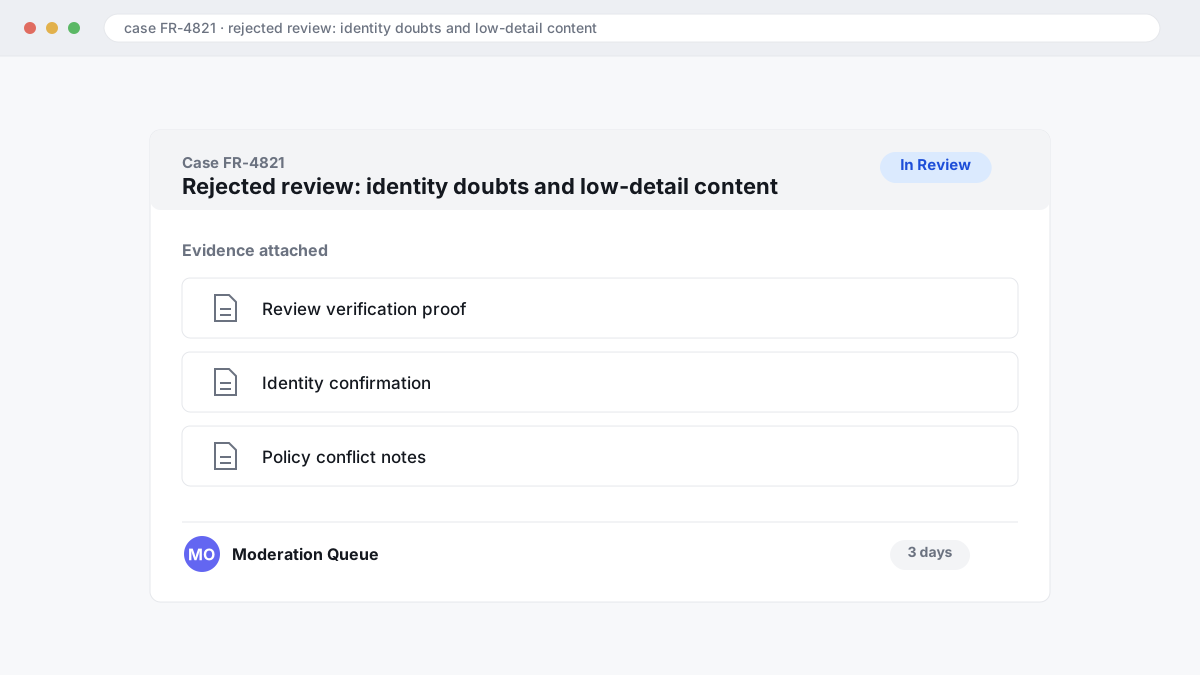
The wrong move is simple and common: resubmit the original wording, swap a sentence, and hope a second pass publishes it. That fails because duplicate or low-detail reviews still look manufactured, and unverifiable identity still leaves moderation with the same gap. In BGR Review's dataset of negative review cases with prior self-filed attempts, logged June 2025 to June 2026, roughly 90% of businesses came to us after using only the basic in-platform report or support route with no supporting documentation, and 70–80% of those initial requests had been rejected.
The faster route is to build a small evidence pack that matches the rejection reason line by line. If G2 questioned identity, send the reviewer’s company email, job title, LinkedIn or public team page, and the business domain that matches the buyer account. If the issue was weak detail, add product usage specifics: which feature the reviewer used, how long they used it, what team used it, and a concrete workflow such as implementation, reporting, ticketing, or billing.
This is the format that usually moves appeals and support routes forward.
| Rejection reason | What fails | Proof that helps |
|---|---|---|
| Identity doubt | Free email and no role context | Company email, role, employer domain match |
| Duplicate phrasing | Near-identical reviews from one batch | Fresh wording written by each reviewer |
| Low detail | Generic praise with no usage evidence | Feature used, team context, timeframe, outcome |
If G2 removed a review after publication, treat it the same way: identify the stated trigger, answer that trigger directly, and change the next request batch before sending more. That usually means slowing the send volume, avoiding template-heavy prompts, and asking reviewers to write in their own words from their real usage rather than from your marketing copy.
How much effort should you put into G2 before Capterra or TrustRadius?
Start with G2 when buyers already compare vendors in your software category and your team can keep review collection running month after month. Split effort toward Capterra or TrustRadius when category fit, lead quality, or the amount of detail buyers need is stronger on those platforms.
The wrong approach is treating one review site as the universal winner. That fails because buyer journeys differ: G2 often captures high-intent B2B software comparison traffic, Capterra can work better when the search starts at category shopping, and TrustRadius usually pays off when procurement or technical buyers want longer, more detailed review content before they book a demo. If you spread requests evenly across all three from day one, you usually dilute review recency, leave profiles half-complete, and end up with weak star-rating distribution everywhere instead of a credible position on one channel.
This is the budget split we usually recommend before you buy any review package with BGR Review's 30-day free replacement guarantee.
| Platform | Best use | What to check first |
|---|---|---|
| G2 | Vendor-comparison journeys and shortlist traffic | Does your category already attract active buyer comparisons and can your team sustain ongoing requests? |
| Capterra | Category shopping and broader software discovery | Does your category fit search-led browsing rather than brand-led evaluation? |
| TrustRadius | Deeper buyer research and technical validation | Can your customers write detailed reviews that support conversions later in the cycle? |
The right approach is to allocate effort by lead quality, category fit, and team capacity. If G2 profile views already turn into calls, demo requests, or form fills, prioritise it first; if Capterra sends better-fit opportunities in your segment, back that channel harder; if TrustRadius content improves branded search clicks because buyers keep researching your product after first touch, invest there. Cheap volume is the wrong win here. One strong profile that stays current will usually do more for conversions than three neglected profiles with stale review source quality.
Are G2 reviews worth it if you care about pipeline, not vanity metrics?
G2 reviews pay off when they lift buyer trust, comparison-page visibility, and sales conversations. The return usually comes from recent, specific reviews on a complete profile that your revenue team actually uses, not from pushing the count higher for its own sake.
Most teams chase volume. That fails because a profile with stale reviews, thin product details, weak category fit and no current screenshots can look neglected even if the headline number is high. Review recency usually moves comparison click-through before raw count does, and profile completeness does the same for conversions because buyers can verify pricing cues, integrations, use cases and company details without leaving the page. If you pay for help, judge the work the same way BGR Review judges any review package with its 30-day free replacement guarantee: by publish quality and practical sales use, not by a vanity total.
A perfect 5.0 can also work against you. A balanced star-rating distribution with detailed 4-star and 5-star reviews often reads as more credible in live deal cycles, especially when a prospect is comparing you against Capterra, TrustRadius and your own branded search results at the same time. G2 badges and reports help when a sales rep can drop them into an active buyer journey — proposal, procurement pack, renewal deck, outbound follow-up — because they shorten trust checks and support demo-booking decisions. Left sitting on the profile alone, they are decoration.
Which customers should you ask first, and when does timing lift approval and quality?
Ask the customers most likely to write specific, defensible reviews: activated users, recent success stories, and happy renewals. Timing matters as much as volume, because requests sent after visible value usually earn better detail, stronger review source quality, and fewer moderation issues on G2.
Blasting your whole customer base is the wrong approach. It fills the queue with low-intent users, old accounts, and people who barely remember onboarding, which leads to thin answers, weak product detail, and a star-rating distribution that looks inflated rather than trusted. A better sequence starts right after onboarding completion, then moves to users who hit a meaningful milestone, closed a support ticket with a clear win, or renewed successfully; if you use BGR Review to support collection, delivery on review packages starts in 24-48 hours, so the shortlist needs to be ready before any outreach goes out.
Power users give you the best raw material because they can explain category fit, implementation context, and what changed after adoption. That depth improves approval odds and helps the review do real work later in G2 reports, branded search demand, and conversion-focused page visits, while fresh review recency also keeps the profile from looking abandoned. Cold batch outreach to six-month-old leads rarely does that.
Keep the first wave small and recent. Ask the last group that reached proof of value in the previous 30 days, then expand only after you see published reviews with concrete use cases rather than duplicate, low-detail wording; that is usually a better use of budget than paying for volume and then relying on BGR Review's 30-day free replacement guarantee to patch weak submissions.
What should a G2 review request email actually say in 2026?
A good G2 request email in 2026 is short, neutral and clear about who should reply and what detail helps. Ask for honest feedback, send the direct review link, and prompt real examples that review moderation can recognise as genuine product use.
Polished marketing copy fails here. Lines like “We’d love your support” and “please share your experience” produce duplicate or low-detail reviews because every recipient gets the same vague cue, and the finished submissions often read the same. Plain prompts work better: ask the reviewer to name their team role, one use case, and one measurable outcome such as time saved, tickets reduced, or faster onboarding. If you are offering an incentive, keep the email disclosure-ready from the start and make clear the reward is for leaving a review, not for leaving a positive one. That matters for platform policy and for FTC endorsement rules.
Subject: Could you review [Product] on G2?
Hi [Name] — if you use [Product] in your day-to-day work, could you leave an honest G2 review here: [link]
The most helpful reviews mention your role, what you use the product for, and one result you can actually describe. If there is an incentive, add the disclosure line in the request and in the review flow. Keep the note neutral. If you use BGR Review for outreach support, our 30-day free replacement guarantee covers package delivery, but it does not rescue templated requests that generate thin, repetitive submissions.
What should you do after new G2 reviews go live?
Once a G2 review goes live, put it to work in three places straight away: your G2 profile, your sales journey, and your ongoing request system. Publication is the start; the real job is to keep review recency moving while turning fresh proof into buyer confidence.
The weak approach is to collect a batch, admire the star rating, and stop. That fails because an incomplete profile wastes the traffic you send there, and a stale review timeline makes even strong feedback look old. Before you point paid traffic, outbound prospects, or comparison-page visitors to G2, tighten profile completeness: update product descriptions, pricing visibility where appropriate, screenshots, integrations, category fit, and your current positioning so G2 badges and reports sit next to a page that actually converts.
The better approach is operational. Lift your best lines into sales decks, competitor comparison pages, proposal follow-ups, and onboarding proof so reps can use buyer language that already passed review moderation. Then check review recency every month. A one-off burst fades quickly, while a steady flow keeps branded search demand warmer, improves click-through from third-party review pages, and gives prospects a reason to trust the next call or form fill. If you are using a BGR Review package, the 30-day free replacement window helps protect delivery, but you still need a monthly request rhythm after that.
What does a practical G2 rejection-to-resolution workflow look like?
Start with the rejection reason G2 gave, collect only the proof that answers that reason, and send one clean appeal. If the issue touches incentivised reviews, false statements or missing disclosure, check G2’s current rules plus your local law before you escalate; this is general information, not legal advice.
The wrong approach is arguing that the review is genuine and opening three vague tickets through different appeals and support routes. That usually fails because review moderation teams work reason-first: if the rejection cites unverifiable identity, duplicate or low-detail content, or an incentive disclosure problem, a generic defence does nothing. In BGR Review’s case file of 12,000+ negative review cases logged June 2025 to June 2026, roughly 90% of businesses that came to us after a failed self-filed attempt had used only the basic in-platform report button, with no supporting documentation.
The right approach is a short evidence pack tied to the exact rejection code. Log the submission date, the reviewer’s work email or LinkedIn-style identity proof if G2 asks for verification, the product used, the trigger email you sent, and any incentive wording shown to the reviewer. If the review mentioned a gift card, discount or reward, include the disclosure text exactly as displayed; undisclosed incentivised reviews create compliance risk under the FTC’s endorsement rules in the US and the UK’s consumer-protection regime under the DMCC Act.
Send one escalation with attachments that match the reason, then stop. If support rejects it again, change the next batch before resubmitting: tighten category fit, ask for more specific usage detail, remove duplicate prompts, and pause any incentive campaign until the disclosure language is fixed. If you want outside help, BGR Review’s removal work on supported platforms is pay after success at $449 per removed link with $0 upfront, but a clean first appeal is usually the cheaper move.
Where to go from here
Start with a one-week audit of your G2 process. Pull your last review request emails, in-app prompts and CRM triggers, then mark three things: when you ask, which customer segments you ask first, and where reviews were rejected, ignored or published. That gives you the real bottleneck. On G2, weak timing, thin reviewer detail and repeated low-information submissions usually waste more effort than a small budget does.
If you are short on volume, fix channel mix before you chase scale. Keep G2 for software-buyer proof, buyer-intent comparison pages, badges and reports; use Google, Capterra or TrustRadius where they fit the way your buyers actually search and where click-through rate and conversions matter sooner. Review recency and profile completeness help branded search demand over time, but only if the reviews stay publishable.
If you want outside help, move to the BGR Review service page that matches the job: verified review growth or problem-review removal.