

Quick answer
The FTC fake review rule makes buying, selling, suppressing or disguising reviews far riskier for both the seller and the business using them. The FTC’s final rule took effect in October 2024, so by 2026 the issue is day-to-day compliance: stop undisclosed incentivised review requests, remove review gating, block employee, manager and family testimonials unless the relationship is clearly disclosed, and keep a written record of how each review was requested. If a review provider cannot explain its sourcing method in writing or show its disclosure process, pause the campaign.
This page is written from the operator side of the problem. BGR Review handles review acquisition, platform-policy checks and negative review disputes across Google, Trustpilot, Yelp, Clutch and TripAdvisor, and the same failure pattern keeps turning up: a vendor pushes reviews too fast, no disclosure trail exists, the profile gets complaints, and the business has nothing usable to show a platform or lawyer.
Across 12,000+ negative review cases logged by BGR Review from June 2025 to June 2026, most failed self-filed requests arrived with only the in-platform report button used and no supporting evidence pack. That is why this ftc fake review rule guide is built as a cleanup and vendor-audit workflow, with the documents, questions and pause points you actually need.
Where do businesses actually trip the FTC fake review rule first?
Most businesses breach the FTC final rule on fake reviews and testimonials through ordinary marketing steps, not one cartoonishly fake stunt. The usual trigger is an outsourced review push, a gated request flow that only asks happy customers, vague incentive wording, and missing records that make routine collection of consumer testimonials look deceptive once anyone asks for proof.
The wrong approach looks harmless on paper: a vendor sends review requests in bulk, your staff approve a script that hints at a discount or future perk, unhappy customers get diverted to a private form, and nobody saves the exact message, landing page, or approval trail. That fails before a review is even posted, because the exposure sits inside the request logic, the disclosure gap, and the internal sign-off chain. The right approach is slower and less glamorous: one request path for all customers, clear disclosure where any incentive exists, no filtering by sentiment, and a saved record of the script, send date, recipient list, and any edit approval. That works because you can show intent, process, and remediation instead of scrambling after platform complaints.
Poor records are what turn a fixable mess into a harder FTC, platform, or state inquiry with possible civil penalties. In BGR Review’s case file of 12,000+ negative review cases logged June 2025 to June 2026, roughly 90% of businesses that came to us after a failed attempt had used only the basic in-platform report button, with no supporting documentation, and 70–80% of those initial requests had been rejected. A rejection does not prove the review activity was legitimate. It usually proves the file was thin.
Which parts of the FTC fake review rule matter most in day-to-day operations?
The highest-impact parts of the FTC final rule on fake reviews and testimonials are the bans on fake reviews, insider reviews, review suppression, and misleading social proof. The real test in 2026 is simple: if the FTC asked for your request script, disclosure wording, approval trail, and vendor records, could you produce them fast and would they make sense.
Press-summary reading fails because it treats the rule as a legal article you read once. Day-to-day compliance is process work. If your team, agency, or review vendor can trigger Google, Trustpilot, Yelp, or Clutch requests without a signed script, a disclosure rule, and a record of who approved the campaign, you have a gap even before any complaint lands. The rule took effect in 2024, but the cleanup work continues into 2026 because old automations, gated feedback flows, and bought engagement still sit inside CRMs and review tools.
This is the operational split that matters most.
| Rule area | What you must change | Why the press-summary approach fails |
|---|---|---|
| Fake or insider reviews | Ban staff, founders, relatives, and undisclosed paid reviewers from leaving testimonials. | A policy memo does nothing if your outreach tool still sends review links to employees. |
| Review suppression | Stop filtering unhappy customers into private forms while only happy ones reach public platforms. | Generic guides rarely force a script and form audit. |
| Fake social influence | Block bought followers, likes, views, and similar social proof from campaign reporting. | Those numbers often sit in monthly reports with no source check. |
Knowing violations can trigger civil penalties, but the exact exposure depends on the facts and FTC enforcement posture, so treat this as general information rather than legal advice. If you hire a service like ours to earn verified reviews or remove false ones at $449 per removed link with $0 upfront, the safe question is still operational: what evidence, disclosures, and reviewer-source records exist before anything goes live.
How do outsourced review campaigns create risk even when you never bought a fake review directly?
You can inherit FTC and platform risk from a vendor even if you never told them to buy reviews. If an agency used gated requests, hidden incentives, employee accounts or fabricated profiles, your business still owns the exposure under the FTC fake review rule and under platform terms.
The wrong approach is treating “we outsourced it” as a defence. It fails because the regulator and the platform will look at the consumer testimonials published for your brand, the request flow used to get them, and the records you kept. That is why BGR Review separates service delivery from compliance records: our 30-day free replacement guarantee on review packages does not replace audit evidence, and our removal work is priced separately at $449 per removed review link with $0 upfront because cleanup is a different process from generation.
The right approach is documented vendor due diligence before any campaign goes live. Your contract should ban purchased reviews, selective solicitation, undisclosed incentives, employee or family posting, and any fulfilment method the vendor cannot verify with records. Ask for the audit trail in writing: who was contacted, when they were contacted, the exact disclosure language, the request channel used, and proof that the method fits platform terms on Google, Yelp, Trustpilot or Clutch rather than a generic “reputation campaign” label.
If a vendor cannot produce outreach lists, timestamps, sample review-request messages and the source of each reviewer account, pause the campaign immediately. In BGR Review’s dataset of 12,000+ negative review cases logged June 2025 to June 2026, roughly 90% of businesses that came to us after a failed self-filed attempt had used only the basic in-platform report button with no supporting documentation; across that group, 70-80% of initial requests were rejected. Vendor oversight works because it gives you something to prove: what was asked, what was disclosed, and whether the reviews were earned in a platform-safe way.
What should a compliant review request flow look like in 2026?
A compliant review flow asks broadly, discloses any incentive before a review is written, avoids rating-based filtering, and keeps proof. If your staff can follow one written script across locations and channels, your exposure under the FTC’s 2024 final rule on fake reviews and testimonials drops fast in 2026.
The wrong setup is selective happy-customer outreach: staff text the smiling customer, skip the awkward one, and send a different link after hearing “we loved it”. That is how review suppression starts, even if nobody says “only leave five stars”, because you are shaping which consumer testimonials get collected. The safer setup is one neutral request sent to all customers at the same post-transaction stage such as job completion, discharge, delivery confirmation, or closed ticket, with the same wording, same delay, and the same destination link.
Incentives need plain disclosure before the review is posted, not buried after submission or hidden in a voucher email. “Leave a review for 10% off” can be workable only if the offer is available on equal terms whatever the rating says, while “Leave us a positive review for 10% off” turns into an undisclosed paid endorsement problem and invites platform complaints as well as FTC risk. For managed campaigns BGR Review requires one approved script per location before any Google, Trustpilot, Yelp, Clutch, or TripAdvisor package goes live, because ad-lib staff language is where conditional wording slips in.
Keep records for the full campaign and through your internal retention-policy review cycle. Save the script version, incentive copy, landing-page screenshots, CRM trigger, send log, suppression controls, and any vendor brief; if a complaint lands two months later, that file is what lets you show equal treatment instead of panic-editing the workflow after the fact.
When does an incentive cross the line from allowed promotion to prohibited endorsement practice?
Incentivised reviews are not automatically banned, but undisclosed incentives are high risk, and rating-conditioned rewards are riskier. If a discount, free product, refund, or account credit could affect a review, disclose that material connection clearly before the customer writes anything.
The mistake usually starts with a shortcut: “Leave us a five-star review and we’ll send 10% off your next order.” That fails because it steers the outcome, turns ordinary consumer testimonials into positivity-conditioned endorsements, and creates the exact disclosure problem the FTC final rule on fake reviews and testimonials was built to police. The FTC Endorsement Guides still matter in 2026 as well, because the fake review rule did not replace the older endorsement framework; it sharpened the enforcement risk around undisclosed paid endorsements and deceptive testimonial practices.
The safer version is plain. Offer a neutral thank-you, ask every eligible customer rather than only happy ones, and never tie the reward to five stars, “positive feedback”, or pre-written language. If you use a review service at all, including BGR Review review packages that carry a 30-day free replacement guarantee, your vendor should be able to show the exact request copy, disclosure wording, send trigger, and suppression controls before anything goes live.
Rules also vary by country and platform: US FTC standards, Google and Trustpilot terms, and UK/EU consumer-protection rules do not use identical language. This is general information, not legal advice, but the practical test is consistent: if the incentive is hidden, selective, or conditioned on praise, fix it before it damages trust, map-pack click-through, and conversion quality.
Why are insider reviews and family testimonials still one of the easiest ways to get this wrong?
Insider reviews are risky because the relationship changes how a reader judges credibility. A review from an employee, director, officer or family member is not independent customer feedback, and under the FTC final rule on fake reviews and testimonials that connection cannot be hidden or treated as an ordinary consumer testimonial.
The wrong approach usually starts with an internal launch push: staff get a Slack message, reviews land inside 24 to 72 hours, and several accounts mention the same service points in the same tone. The defence is usually, “they really like our service.” That fails because they are not independent reviewers, and the missing relationship changes how those stars affect click-through from the map pack, conversions on branded search, and trust in the review profile itself. If you are buying managed review help from a provider like BGR Review, this is one of the first things your vendor audit should ban in writing before any package starts delivering in 24-48 hours.
The right approach is simple: keep employees, officers and relatives out of customer review asks unless a platform explicitly allows that format and the disclosure sits with the review, not buried on a staff page. Even then, platform terms may still block it. Yelp generally bars reviews tied to your business, Google can remove conflict-of-interest content under its fake engagement rules, and Trustpilot’s platform terms expect transparent, genuine experience claims. This is general information, not legal advice; the platform rule often bites before the regulator does.
How do Google, Yelp, and Trustpilot rules differ from the FTC rule?
The FTC decides whether your conduct is deceptive; Google, Yelp and Trustpilot decide whether review content can remain on their systems. A review programme can therefore create legal exposure, platform removal risk, or both, even when your vendor says the disclosure wording is fine.
A side-by-side check prevents the usual mistake: treating legal compliance as platform safety.
| System | What it targets | What trips businesses up |
|---|---|---|
| FTC rule | Deceptive practices such as fake testimonials, insider reviews, undisclosed paid endorsements and review suppression | You can face civil-penalty risk even if the reviews stay live for a while |
| Google policies | Fake engagement and content that violates Google Business Profile review policy | A sudden burst from low-context accounts can trigger filtering or removals even where a marketer claims the campaign was “disclosed” |
| Yelp guidelines | Solicitation patterns and content quality under Yelp’s recommendation software and review policies | Reviews can be de-emphasised or stopped from surfacing if your request flow looks engineered |
| Trustpilot rules | Misleading invitations, selective invitations and misuse of verification flows | Inviting only happy customers can breach Trustpilot rules even if no review text was fabricated |
Most guides say “disclose and you are covered”. That fails because platform terms are separate contracts with separate remedies. Google may remove reviews, Yelp may suppress visibility, and Trustpilot may question invitation integrity. If your reviews arrive too fast or only after a rating gate, pause the campaign first, pull invite logs and CRM triggers, then decide whether you need legal advice, a platform appeal, or both.
What should be in a fake-review evidence pack before you investigate or escalate anything?
A useful evidence pack ties each review to who asked for it, what script or incentive sat behind it, and exactly when it went live. Screenshots on their own are weak; the files that hold up link posts, payment records, account links, and the internal approval trail in one place.
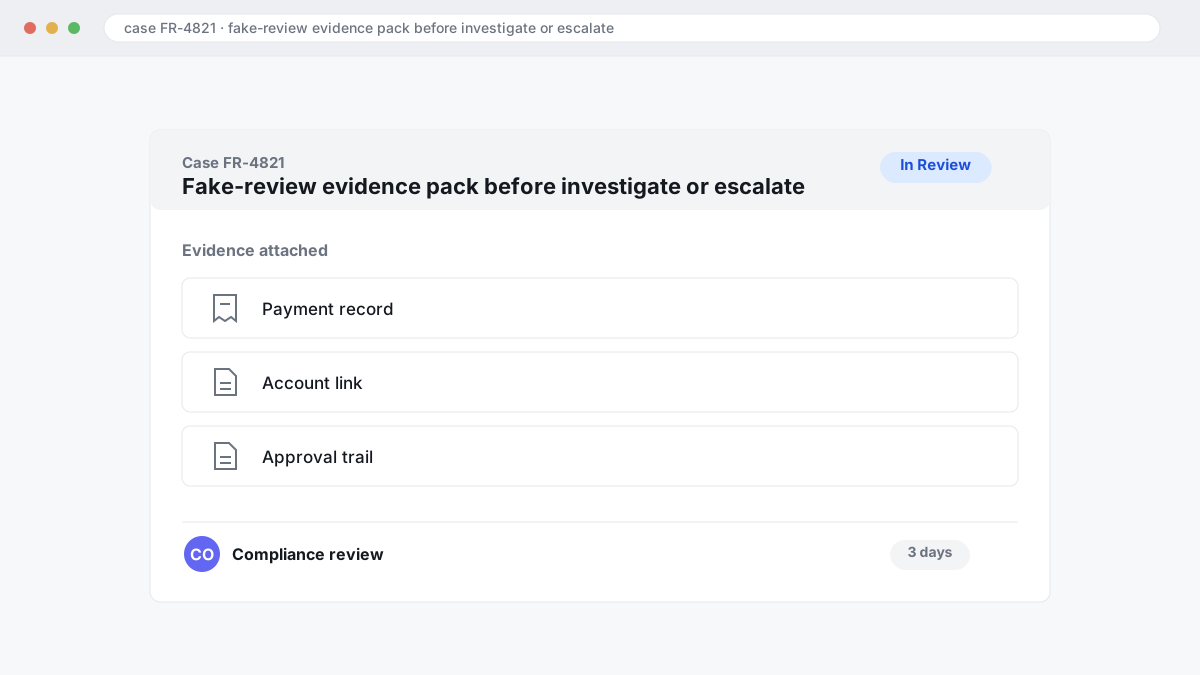
The wrong approach is a folder full of cropped images and angry notes. That usually fails because Google Business Profile support, Trustpilot's reporting flow, and your own legal or compliance review cannot infer authorship, payment, or workflow from a star rating and a username. In BGR Review's case file of 12,000+ negative review cases logged June 2025 to June 2026, roughly 90% of businesses who came to us after a failed attempt had used only the basic in-platform report button with no supporting documentation, and 70-80% of those initial requests had been rejected.
Build one evidence pack per incident. Put the live review URL, profile URL, screenshots with visible timestamps, the date and time the review first appeared, any invoice or card charge that shows a review vendor was paid, CRM or email records showing who was solicited, and account links that connect the reviewer to a staff member, contractor, agency login, or family contact. If an incentive was offered, save the voucher message, landing page, and staff script exactly as used.
Then write a plain chronology: request sent, review posted, problem discovered, action taken, outcome. That sequence exposes the difference between a genuine customer testimonial and an undisclosed paid endorsement or insider review. It also lets you pause the right campaign fast, cut off a vendor before more reviews land, and show remediation if complaints start affecting map-pack click-through, conversions, or branded search demand.
What should you do in the first 14 days after discovering fake reviews were already posted?
Freeze the review campaign at once, preserve every record, and identify each affected review by source, platform and date. Deleting posts or message threads before you document them usually destroys the trail you need for platform reports, vendor disputes and any later FTC response.
The first mistake is panic cleanup. A manager asks staff to remove screenshots from Slack, the agency deletes outreach logs, and somebody edits the CRM trigger that sent the review requests. That fails because your evidence pack now has gaps: no original brief, no payment trail, no reviewer list, no disclosure language, and no way to show whether the issue was an undisclosed paid endorsement, an insider review, or a burst of reviews that hit Google Business Profile, Yelp or Trustpilot too fast.
Use the first 14 days to classify, not improvise. Build one working sheet with platform, review URL, posting date, vendor or staff source, incentive used, disclosure status, insider connection, and whether the text contains defamation and false factual claims that need legal review rather than a simple policy flag. Across 12,000+ negative review cases logged by BGR Review from June 2025 to June 2026, reviews raised within 28 days of posting and backed by an identifiable policy issue resolved successfully in roughly 90% of cases; beyond 28 days, the observed success rate fell to approximately 25–30%.
Start platform reports in parallel with customer communication and counsel review. If a review contains a false statement of fact, preserve the exact wording before you report it, because a defamation analysis needs the original text, timestamps and business records. If fake testimonials, review suppression or undisclosed endorsements were part of a paid campaign, treat civil penalties as a real risk under the FTC final rule and get legal advice early; this is general information, not legal advice.
If you need outside help, keep the scope narrow and documented.
Should you run review compliance in-house or use a managed service with tighter controls?
Running review compliance in-house costs less and lets you change scripts fast. Managed help usually wins on audit trails, platform-specific policy handling, and consistency across several locations. Your decision comes down to how many profiles you run, who owns staff training, and how much risk you can carry if a bad workflow slips into live use.
The cheapest route often fails for a simple reason: nobody owns the whole chain. A branch manager edits the review request text, another teammate adds an incentive, someone filters unhappy customers into a separate form, and you have review suppression without anyone calling it that. If one owner controls the script, staff training, weekly record checks, and vendor due diligence, in-house can work well for a single location. If that owner leaves, the control usually leaves with them.
This comparison is the one that matters before you choose a workflow.
| Model | Lower cost / lower risk trade-off | Best fit |
|---|---|---|
| In-house | Lower cash cost, faster script changes, thinner audit trail unless you log requests, disclosures, staff approvals, and platform terms checks every week | One location, one accountable owner |
| Managed service | Higher spend, tighter controls, clearer escalation path when Google Business Profile policy, Yelp recommendation software, or Trustpilot flagging rules create a platform-specific issue | Multi-location brands and agency-led review programmes |
The safer operating model is the one that leaves evidence behind. If you only need a compliant request script and one person can enforce it weekly, keep it in-house. If you need audits across several locations, use managed controls.
Which compliance fixes usually pay off first in trust, lead quality, and cleanup speed?
Fast returns usually come from three changes: stop gated review requests, fix any missing incentive disclosure, and tighten vendor oversight. Those moves cut off new breaches straight away and make later cleanup, platform reporting, and staff retraining far easier.
The wrong approach is a policy rewrite on its own. It fails because the risky workflow stays live: staff still steer happy customers to public review links, unhappy customers into private forms, and that is review suppression by process even if your written policy now says the right thing. The better move is operational. Change the request template, remove any “only if you had a great experience” language, add clear disclosure where an incentive exists, and push the same script into your CRM trigger on job completion.
Second, check hidden sources before you chase old posts. Weak vendor due diligence and insider activity create the hardest cleanup because the account trail is thin, disclosures are absent, and your own team often cannot say who requested what. In BGR Review’s case log of 12,000+ negative review matters recorded June 2025 to June 2026, roughly 90% of businesses coming to us after a failed attempt had used only the in-platform report button with no supporting documents. Weekly monitoring pays off here. It catches suspicious review bursts, missing disclosures, and employee or agency activity before platform complaints, FTC exposure, or possible civil penalties turn a repair job into a legal one.
What should your staff checklist include before any review campaign goes live?
A one-page pre-launch checklist works because it blocks launch until the basics are approved. It should confirm neutral solicitation, disclosure wording, platform destination, who keeps the records, and the monthly audit date so your staff can act without legal guesswork.
The wrong approach is a 20-page policy in a shared drive. Staff do not read it before sending review requests, vendors improvise, and consumer testimonials go live with missing disclosures or sloppy incentive wording. The better control is a single page your manager signs before any Google, Yelp or Trustpilot campaign starts, with the vendor name on it and one owner accountable for retention.
Use this as the minimum live-check document:
- Campaign owner and final sign-off
- Vendor name and vendor due diligence check completed
- Approved request script attached
- Incentive wording reviewed and confirmed compliant for the destination platform
- Disclosure placement approved for any paid, gifted or insider testimonial content
- Platform destination confirmed: Google, Trustpilot, Yelp, Clutch or TripAdvisor
- Retention rule: where screenshots, message logs and approvals are stored for the evidence pack
- Monthly audit date and reviewer assigned
This format works because staff can complete it in minutes, and if a complaint lands later, your evidence pack already starts with the launch record.
What do you fix next after the policy is updated and disclosures are live?
Once your policy is updated, the real work starts: clean every live platform listing, retrain staff, and assign weekly monitoring. A policy file does nothing if old request templates stay in your CRM, risky reviews remain on Google, Yelp or Trustpilot, and nobody owns checks across each active profile within the next 30 days.
The wrong move is treating the rewrite as the finish line. That fails because the same banned language keeps firing from old email sequences, front-desk staff keep asking the wrong way, and disclosures go missing on fresh testimonials while yesterday's reviews still conflict with platform terms. The right move is blunt: remove risky scripts from email, SMS, QR cards and job-completion triggers; review affected listings one by one; then retrain anyone who requests, approves or republishes reviews inside a 30-day window. If a review contains false factual claims, separate that from fake-review issues early, because defamation and false factual claims follow a different route from standard moderation and often need cleaner evidence.
If you're operating across the US, UK or EU, do not apply one rulebook to every location. The FTC rule is one layer, but platform terms still control what stays live on Google Business Profile, Yelp and Trustpilot, and UK and EU consumer protection rules can catch misleading review practices even where your US wording looks acceptable. Set a weekly check for new reviews, response quality, reviewer account oddities and sudden review velocity spikes; then get legal advice where the issue crosses borders, involves employee or competitor allegations, or turns on defamation rather than platform policy.
Where to go from here
Start with a 30-minute audit of every review source you use: staff prompts, CRM automations, QR cards, post-purchase emails, agency workflows, and any outside vendor promising fast review volume. Pull the last 90 days of requests, check where disclosure was missing, where unhappy customers were filtered out, and where review velocity spiked on one platform. Then pause the risky parts first. That usually means incentive-led asks, gated feedback forms, insider requests, and any campaign you cannot document with consent, timing and source records.
Expect two outcomes from that audit. First, you cut the chance of FTC trouble, platform complaints and sudden review losses that damage map-pack click-through, branded search trust and conversions. Second, you keep the parts that still work: clean request timing, proper disclosures and a record trail if a platform asks questions. In our removal work, the cases that move fastest usually come with a clear evidence pack from day one; across 12,000+ negative review cases logged June 2025 to June 2026, reviews raised within 28 days and backed by an identifiable policy issue resolved successfully in roughly 90% of cases.