


Quick answer
Yes, legal action against fake reviews can work, but only in a narrow set of disputes: a review states a false fact, you can show actual business harm, and the reviewer can be identified or traced. Most cases move faster through platform rules than through court. Google Business Profile policy bans fake engagement and misrepresentation, and US disputes can also involve defamation law and the FTC Endorsement Guides for undisclosed paid endorsements. If a report is rejected, the usual next move is a stronger evidence pack and escalation, not an immediate lawsuit.
This page is written from the removal side of the desk, where weak reports fail for boring reasons: no dated screenshots, no transaction check, no policy match, no proof the reviewer was never a customer. Across Google, Trustpilot, Yelp and Clutch disputes, the field that often decides the outcome is the simple mismatch between the review claim and your business records, then whether support can tie that mismatch to a named policy rather than a general complaint. BGR Review handles both policy-based removals and pay-after-success negative review removal at $449 per removed link with $0 upfront, so the route set out here follows the real order of attack rather than a law-school version of the problem.
Should you start with a lawyer, or can platform rules remove the review faster?
Start with platform-policy removal in most cases. Legal action usually makes sense only when a review states false facts, you can identify the reviewer, and the damage to your calls, bookings or map-pack click-through is serious enough to justify a process that can run for weeks or months.
The wrong move is treating every fake review like a defamation claim. That fails because Google Business Profile and the Trustpilot dispute process both look first at platform policy violations, not at your solicitor's opinion, and courts do not move at platform speed. In BGR Review's dataset of negative review cases with prior self-filed attempts, logged June 2025 to June 2026, roughly 90% of businesses came to us after using only the basic in-platform report button, and 70–80% of those first requests had been rejected; the weak point was usually missing evidence, not the lack of a legal threat.
The better route is to test removal grounds the platform already recognises. On Google Business Profile, that usually means prohibited and restricted content such as spam, conflict-of-interest posting, off-topic content or a business-records mismatch that shows the reviewer was never a customer; on Trustpilot, it usually means a verification challenge, harmful or unlawful content, or evidence that the experience described could not have happened. That path often protects conversions faster because a clean profile improves local-pack trust before any formal legal step lands.
Reserve legal escalation for narrower files: identifiable false factual claims, repeat coordinated abuse, or a reviewer who keeps reposting after a policy removal. That is where defamation analysis, jurisdiction and a formal notice start to matter. If you want outside help before paying a lawyer, BGR Review handles removals on a pay-after-success basis at $449 per removed review link with $0 upfront, which is often the cheaper first test before litigation.
How do you prove a review is fake before anyone takes you seriously?
You prove a review is likely fake by showing a verifiable mismatch, not by arguing with it. If there is no customer record, the service date is impossible, the staff name is wrong, the location does not match, or the wording appears copied, evidence that no transaction happened will usually carry more weight than denial alone.
The weak move is writing “we never saw this customer” in the flag form and leaving it there. That usually fails because platforms do not know your customer list, and a bare denial looks like opinion. In BGR Review’s case file of negative review cases with prior self-filed attempts, logged June 2025 to June 2026, roughly 90% of businesses came to us after using only the basic in-platform report button with no supporting documentation, and 70–80% of those initial requests had been rejected. A rejection did not prove the review was genuine. It proved the file was thin.
The stronger move is to build the evidence pack around a business records mismatch. Pull the order record, CRM log, booking calendar, call log, invoice trail, staff rota, and service-date history, then mark the exact point that breaks: no appointment on that date, no job at that address, no employee by that name, no sale under that email or phone number. If the review also makes a false factual claim that could damage your reputation, that starts to touch defamation, but you still need the same records first because a solicitor cannot do much with a vague hunch.
Capture everything on day one. Save screenshots of the review, the full URL, the posting timestamp, the reviewer profile details, the business profile it appeared on, and your response history if you already replied on Google Business Profile or Trustpilot. If the review later edits, disappears, or gets reposted, that first-day record is often the difference between a clean escalation and a dead end.
What should a fake-review evidence pack include before you flag, appeal, or sue?
A usable evidence pack has four parts: a clean capture of the review, a transaction check against your records, the exact policy or legal ground you are relying on, and a dated timeline. If a neutral stranger could verify the file in five minutes, it is strong enough for a Google Business Profile appeal, a Trustpilot dispute, or a solicitor review.
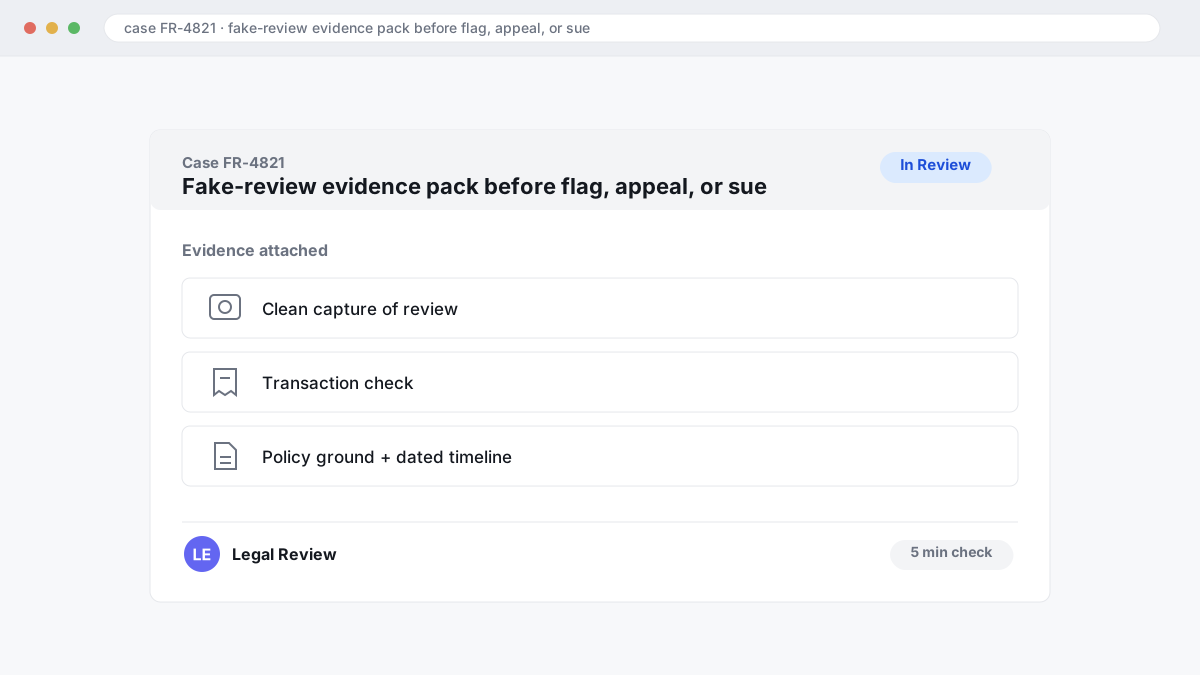
Scattered screenshots usually fail because support teams and legal reviewers cannot tell what they are looking at or why it breaches a rule. In BGR Review's dataset of negative review cases with prior self-filed attempts, logged June 2025 to June 2026, roughly 90% had used only the basic in-platform report button with no supporting documentation, and 70-80% of those first requests were rejected. A rejection did not prove the review was genuine. It usually meant the file never showed a clear business records mismatch.
Build one dated packet tied to one removal ground. For a Google Business Profile case, include the review URL, full screenshot, date and time captured, reviewer handle, the reviewer profile capture, and the business profile URL. Then add your transaction check: invoice search, call logs, CRM extract, booking calendar, refund history, and short signed staff statements confirming no matching customer, visit, order, or complaint.
Finish with a one-page timeline: review published, internal checks completed, flag submitted within 24 hours, any reply posted, and any appeal reference number. That timeline matters because across 12,000+ negative review cases BGR Review logged from June 2025 to June 2026, reviews raised within 28 days and backed by an identifiable policy issue resolved successfully in roughly 90% of cases, while comparable cases raised later fell to approximately 25-30%.
Which platform-policy violations actually remove fake reviews on Google and Trustpilot?
Platform-based removal works when you tie the review to a named rule. On Google Business Profile, that usually means fake engagement, conflict of interest, impersonation or spam content; in the Trustpilot dispute process, the strongest grounds are failed consumer verification and unsupported claims of a real buying or service experience.
The wrong move is to argue that the review is unfair, harsh or damaging to your conversions. Support teams do not remove content for tone. They remove content that breaches policy. In BGR Review's negative review cases with prior self-filed attempts, logged June 2025 to June 2026, roughly 90% had used only the basic report button with no supporting documentation, and 70–80% of those initial requests were rejected. The right move is narrower: quote the exact rule, then attach the proof. On Google, cite the Google reviews policy section that fits the text or account behaviour, such as fake engagement, conflict of interest, impersonation or spam and fake content. On Trustpilot, cite the dispute reason that the reviewer cannot be verified as a genuine customer, or that the account makes factual experience claims your business records cannot match.
This is the practical mapping to use before you file.
| Platform | Policy ground to cite | What proof usually helps |
|---|---|---|
| Google Business Profile | Fake engagement, conflict of interest, impersonation, spam and fake content | Reviewer has no matching transaction, uses a staff name falsely, posts across rivals, or repeats templated text |
| Trustpilot | Consumer verification failure, unsupported experience claim | No order, booking, email thread or service record matching the dates, names or facts in the review |
That framing works because it gives the platform a policy box to tick. A vague complaint gives them nothing.
What happens if Google rejects removal even when the review still looks fake?
A Google rejection usually means your first Google Business Profile report did not match a prohibited-content rule closely enough, or the file lacked proof Google could verify. The next move is a tighter escalation with better evidence, not repeated flags saying the same thing.
The wrong approach is hammering the same report button and rewriting the story each time. That fails because Google often treats repeat submissions with no new support as duplicates, and the review stays judged on the same weak policy ground. In BGR Review's records of negative review cases with prior self-filed attempts, logged June 2025 to June 2026, roughly 90% arrived with only the basic in-platform report used and no supporting documentation; in that group, 70-80% of first requests had been rejected.
The better response strategy is to keep one evidence file, add new proof, and escalate once on a cleaner rule match. If the issue is impersonation, conflict of interest, or a business records mismatch showing the reviewer was never a customer, say that directly and attach the matching records, screenshots, timestamps, and any prior contact history. Then move from the initial flag into a documented support thread, profile troubleshooting if the review is tied to a listing issue, and repeat reporting only when you are adding fresh evidence of platform policy violations. That works because the second pass gives Google something verifiable to review instead of the same accusation twice.
When does fake review content cross into defamation rather than platform abuse?
A fake review becomes a stronger defamation candidate when it alleges a provably false fact rather than a negative opinion. “The service was awful” usually reads as opinion; “they billed me twice” or “they forged my signature” is a factual claim you may be able to disprove with records.
The wrong move is to treat every fake review as defamation and run straight to a lawyer. That fails because courts usually look for the basics of defamation: a false statement of fact, publication to a third party, and measurable harm, while platforms will still remove many reviews faster under abuse rules if you can show the reviewer was never a customer, the account is impersonating someone, or the claim conflicts with business records. In BGR Review’s dataset of 12,000+ negative review cases logged June 2025 to June 2026, reviews raised within 28 days and backed by an identifiable policy issue resolved successfully in roughly 90% of cases; beyond 28 days, comparable cases fell to approximately 25–30%.
If the review says “avoid this place”, you usually have a platform-abuse or response-strategy problem; if it says “they charged my card after cancellation” and your billing logs show no such transaction, you may have both a policy case and a defamation case.
Jurisdiction decides a lot. US state law, UK defamation law, and EU standards differ on harm, procedure, and available remedies, and Section 230 limits in the US usually protect the platform from liability for user content even when the reviewer may still be exposed. This is general information, not legal advice, and cross-border reviews often need a solicitor or attorney once the statement is factual, identifiable, and causing losses in calls, bookings, or branded search demand.
How do cease and desist letters work when the reviewer is anonymous or hiding behind a platform?
A cease and desist letter works best when you know who wrote the review or can tie it to a rival, ex-staff member or former supplier. If the reviewer is anonymous, the letter usually works as a preservation notice and identity-demand first, before any subpoena or court application starts.
The wrong move is threatening Google, Trustpilot or Yelp as if they published the review themselves. In the US, Section 230 of the Communications Decency Act usually shields platforms from liability for user review content, so a letter aimed at the platform often gets routed back to the same policy queue you already used. The stronger move is narrower: send a cease and desist letter to any identifiable reviewer or connected business, demand withdrawal or correction of the false factual claim, require preservation of account and message records, and put the platform on notice to preserve logs if later disclosure is needed.
If you want anonymous reviewer identification, the file has to be built for court, not for a support form. That means dated screenshots, the review URL, timestamps, your business records mismatch, and any link to a competitor or non-customer before a solicitor looks at jurisdiction, because the steps differ by country and sometimes by state. Across 12,000+ negative review cases logged by BGR Review from June 2025 to June 2026, roughly 90% of businesses arriving after a failed self-filed attempt had used only the basic in-platform report button, and 70–80% of those first requests had been rejected. A bare accusation rarely moves identity disclosure; subpoenas and account-record requests need a tighter evidence pack.
How do lawyer-led claims compare with review-removal services on cost, speed, and fit?
Lawyers are usually the stronger route for defamation claims, subpoenas and repeat malicious actors. Managed review-removal services are usually stronger when your goal is fast takedown through platform policy violations, evidence packaging and support escalation rather than court relief.
The wrong comparison is price alone. That fails because a cheap cease and desist letter does very little if the reviewer is anonymous, outside your jurisdiction, or posting through a platform that will only act on its own policy standards; the letter may still help later, but it rarely removes the review by itself.
A better comparison is route, timeline, enforceability and evidence threshold together. In BGR Review's record of 12,000+ negative review cases logged June 2025 to June 2026, reviews raised within 28 days of posting and backed by an identifiable policy issue resolved successfully in roughly 90% of cases observed, while comparable cases raised beyond 28 days fell to approximately 25–30%; that is an observed outcome in our file, not a platform rule.
This is the practical split.
| Route | Best fit | Cost and timeline | Main limit |
|---|---|---|---|
| Managed policy-led removal | Google or Trustpilot reviews with clear business-record mismatch, conflict of interest, impersonation or other platform policy violations | Fixed price per removed link | No court order, no damages, and weak evidence usually means rejection |
| Lawyer-led claim | Identifiable reviewer, false factual allegations, repeat abuse, defamation or disclosure demands | Fees can escalate fast once identity, jurisdiction or pleadings are contested | Slower, harder to enforce across borders, and often excessive for a single removable fake review |
If the reviewer is identifiable and the post alleges specific false facts, legal action may fit. If the account is anonymous and the content already breaches Google Business Profile or Trustpilot rules, a policy-led removal usually gets you to a yes or no faster.
Does legal action against fake reviews actually pay off, or is there a better priority order?
Legal action pays off when a review is highly visible, states false facts, causes real commercial damage, and points to an identifiable person or rival. If those factors are weak, a policy-led removal attempt and profile recovery work usually give you a better return first.
The wrong move is to spend by emotion. A buried one-star post on page three of a low-traffic platform rarely justifies solicitor time, tracing work, and a long defamation timeline if the reviewer cannot be identified. A one-star fake on your Google Business Profile is different, because it can hit map-pack click-through, calls, and bookings before a lawyer has even sent a letter. In BGR Review's log of 12,000+ negative review cases from June 2025 to June 2026, reviews raised within 28 days and backed by a clear policy issue resolved successfully in roughly 90% of cases; for comparable cases raised later, observed success fell to approximately 25–30%.
Rank each case by four factors: visibility, severity, identity, and removal probability. If the review names a service you never sold, conflicts with your business records, and sits near the top of a Google Business Profile, fast policy escalation usually beats paid legal work on cost and timeline. If it alleges fraud, malpractice, or criminal conduct and you can tie it to a real competitor or ex-customer, legal action against fake reviews becomes commercially sensible.
Can suing over a fake review backfire and make the reputation problem worse?
Yes, legal threats can backfire. If your case is weak or your tone is aggressive, the dispute can spread beyond the original review, push the allegation into branded search results, and raise costs without lifting trust, click-through rate, conversions or map-pack performance.
The wrong move is a public threat first. A hostile reply or posted solicitor letter gets screenshotted, shared in local groups, and sometimes picked up by trade press, which turns one fake review into a wider reputational blowback problem; if platform policy could have removed it faster, you have created noise for no gain.
Your public response strategy should de-escalate. A short reply that says you cannot match the reviewer to your records, invites offline contact, avoids admitting fault, and reveals no customer data protects privacy while you keep the legal file clean for Google Business Profile, Trustpilot, or solicitor review.
Rules change by jurisdiction and by platform. In the US, undisclosed paid endorsements can trigger FTC endorsement guides issues; in the UK and EU, fake-review enforcement sits under different consumer-protection regimes and platform terms, so this is general information rather than legal advice. If the legal footing is mixed, a calm reply and evidence-led removal request usually protects trust better than a public threat.
What should you do after a fake review comes down so the profile actually recovers?
After a fake review is removed, switch straight into recovery: log the outcome, restart compliant review generation, and tighten monitoring before the next hit lands. Removal fixes one listing; your response strategy, review recency and follow-up speed are what protect the profile after that.
The wrong move is to celebrate and stop. That fails because a Google Business Profile with a recent gap in review activity can still lose click-through from the map pack, and old unanswered criticism can keep dragging conversions even after the fake post has gone. Update your tracking sheet within 24 hours of any removal or status change, note the review URL, platform, date, and whether the case ended as removed, unresolved or unknown; BGR Review uses that same three-state outcome model across 12,000+ negative review cases logged June 2025 to June 2026.
The right move is to close the gap fast with fresh, policy-compliant reviews, owner replies on surviving negatives, and basic profile hygiene such as service lists, photos and opening hours. Keep the evidence pack as-is, because repeat abuse often reuses the same account style, wording pattern or business records mismatch, and a saved file makes the next escalation much faster than starting from scratch.
How practical path from first flag to legal escalation if removal still fails actually works
Use a staged sequence: preserve the review, file a policy-matched removal request, escalate once with a stronger evidence pack, then look at legal notice or court only if identity, harm and cost line up. Jumping straight to a lawsuit usually fails because the reviewer may be anonymous, the platform may remove first, and your best proof often disappears if you did not capture it on day one.
Day 1 is evidence day. Save full-page screenshots, the review URL, profile ID, date, star rating, account name, and any reply already posted; then check your CRM, booking log or till record for a customer-record mismatch before you write a word. Across 12,000+ negative review cases logged by BGR Review from June 2025 to June 2026, reviews raised within 28 days and tied to a clear policy issue resolved successfully in roughly 90% of cases, while comparable cases raised later fell to approximately 25-30%, so review removal timelines matter early.
Days 2 to 7 are for one strong report, not five weak ones. Match the facts to the platform rule you can actually prove, submit once, and prepare appeal materials in case the first decision is an auto-rejection; in BGR Review's records for June 2025 to June 2026, roughly 90% of businesses that came to us after a failed self-filed attempt had used only the basic report button with no supporting documentation. That is why improvised flags stall and why a preserved evidence pack works better.
If the escalation still fails, the next move depends on what you can identify and what remedy you need.
| Option | When it fits | Practical limit |
|---|---|---|
| Cease and desist letter | You know who posted it and the false statement is specific | Weak against anonymous accounts or offshore posters |
| Subpoena | You need reviewer identity from a platform or ISP for a defamation claim | Cost and delay rise fast if the court will not compel disclosure |
| Injunctions and damages | Ongoing harm, repeat posts, clear falsity, measurable business loss | Higher legal spend; many owners choose removal work first, then legal action |
A legal notice becomes worth sending when platform appeals are exhausted, the reviewer is traceable, and the review is hurting map-pack clicks, branded search demand or conversions across one or more locations.
Where to go from here
Start by classifying the review within the next 24 hours. Save the live URL, screenshots, date posted, star rating, reviewer name, account details, and any business-records mismatch that shows the person was never a customer, booking, diner or guest. Then map the facts to the platform rule first: impersonation, conflict of interest, non-customer content, harassment, prohibited incentives, or another named policy breach. Legal action belongs in the second file, for identifiable false factual claims, repeat abuse, or a reviewer you can plausibly trace across jurisdictions. This is general information, not legal advice.
That order matters because delay weakens removal prospects. Across 12,000+ negative review cases logged by BGR Review between June 2025 and June 2026, reviews raised within 28 days and backed by a clear policy issue resolved successfully in roughly 90% of cases; beyond 28 days, the observed success rate fell to approximately 25–30%. If the review is already hitting calls, bookings, form fills or map-pack click-through, get an evidence-led removal assessment done before you spend on a solicitor letter.