

Quick answer
Online reviews win more local calls for electricians because they shape trust before anyone taps Call, requests a quote, or compares profiles in the map pack. Put most of your effort into Google Business Profile, send the request straight after job completion or once the invoice is paid, and answer complaints publicly within a day where possible. Do not buy or incentivise reviews without proper disclosure. Google’s fake engagement policy prohibits content intended to manipulate ratings, and false or policy-breaching reviews are removed through evidence, policy matching, and appeals, not a basic report button alone.
This page is written from live reputation work, including review acquisition, response management, and negative review removal across Google, Trustpilot, Yelp, Clutch, and TripAdvisor. We track what actually gets rejected, and one repeated failure point is simple: the first flag often goes nowhere because the business submits no proof pack beyond the in-platform form.
BGR Review has served 15,000+ businesses and logged 12,000+ negative review cases between June 2025 and June 2026, with outcomes recorded as removed, unresolved, or unknown rather than padded into a success claim. That matters if you are comparing providers, because the real question is not whether reviews matter; it is which platform moves bookings first, how review velocity affects click-through rate, and when a removal case is genuinely worth pursuing at $0 upfront and $449 only after success.
Why does an electrician need a review system instead of just asking everyone everywhere?
Electricians do not need to ask on every platform at once. They need a simple review system that matches the platform to the job source, the ask to the right moment, and the response path to what happens if a review is false, filtered, or policy-breaching.
Generic advice says ask every customer everywhere. That fails because Google Business Profile and Yelp do different jobs. In BGR Review’s dataset of 1,485 businesses observed from February to July 2026, trades firms with complete enquiry-source data attributed 70–80% of calls and bookings to a Google Business Profile or Yelp listing, which means your first priority is the profile that wins local pack clicks and map-pack conversions in your service area, not a scattergun campaign across five sites. Yelp adds another complication: its recommendation filter can hide reviews that look heavily solicited, so the same review request timing that works on Google can leave you with fewer visible Yelp reviews and weaker click-through rate.
Timing changes output faster than volume. A same-day SMS sent after the job is signed off usually gets posted while the customer still remembers the engineer, the price and the result; a week-late email often gets ignored or turns into a complaint thread. Bad reviews also need a clock on them: across 12,000+ negative review cases logged by BGR Review from June 2025 to June 2026, reviews raised within 28 days and backed by a clear policy issue resolved successfully in roughly 90% of cases, versus approximately 25–30% for comparable cases raised later. That is why a review system needs three lanes from day one: request, response management, and removal triage.
Which review platform should electricians push first when local jobs are the goal?
For most electricians, Google Business Profile deserves first priority because it drives map-pack clicks, calls and direction requests at the exact moment someone searches nearby. Trustpilot and Yelp can help, but they answer different buying moments and need different request methods if you want reviews to stick.
Most guides tell you to ask every customer on every platform. That fails because job intent is different on each site, and service-area businesses usually win the booking before a prospect ever reaches a full website. In BGR Review’s dataset of 1,485 businesses observed February–July 2026, trades businesses with complete enquiry-source data attributed 70–80% of calls and bookings to a Google Business Profile or Yelp listing rather than a standalone site, so the first push should go where local pack visibility and conversions happen fastest.
Google Business Profile fits urgent local intent. A homeowner searching “emergency electrician near me” is deciding from the map pack, star rating, review recency and whether your profile looks active enough to trust, so a steady review flow there usually lifts click-through rate before any broader brand effect shows up in branded search.
Trustpilot fits a slower research journey. It works better when you send email invitations after completed work, maintenance plans or commercial jobs where the buyer compares brands, reads longer-form feedback and may search your company name directly; that can support branded search demand, but it rarely beats Google for immediate local calls.
Yelp matters in some metros, especially where homeowners already use Yelp for home services, but the Yelp recommendation filter changes how you ask. If you push hard for Yelp reviews from every customer, many will post from low-activity accounts and the filter may hide them, so the safer play is to make Yelp available as an option rather than running the same review-link automation you use for Google.
| Platform | Best use for an electrician | Practical caveat |
|---|---|---|
| Google Business Profile | Map-pack visibility, calls, direction requests, local conversions | Needs consistent review velocity and recent replies to hold trust at search time |
| Trustpilot | Brand research, email-led follow-up, broader reputation checking | Usually weaker for urgent local intent and same-day bookings |
| Yelp | Useful in Yelp-heavy cities and for some homeowner audiences | Yelp recommendation filter can suppress solicited reviews from thin accounts |
The right mix is simple: push Google first, add Trustpilot when you want deeper brand proof, and treat Yelp as market-dependent. That platform-by-platform approach produces cleaner review distribution, better map-pack performance and stronger conversions than one-platform dogma or spraying every customer across three sites at once.
How do electricians get more Google reviews without creating a messy follow-up process?
Electricians get more Google reviews with a simple two-step process: ask face to face when the job is finished, then text a direct Google Business Profile review link within about 2 hours. If nothing lands, send one reminder 3 to 5 days later and stop there.
Most guides tell you to ask whenever you remember. That fails because occasional asking depends on memory, the link is hard to find, and the follow-up turns into a messy mix of texts, emails and verbal promises. BGR Review sets this up as review link automation instead: generate the direct review URL from your Google Business Profile once, then save that same link in your SMS template, your email template and your invoice footer so every completed job runs through the same path.
The difference is easier to see when you compare the two approaches side by side.
| Approach | What happens | What to do instead |
|---|---|---|
| Ad hoc asking | You mention reviews on some jobs, forget on others, and send links late or not at all. | Ask at handover, while the fix is fresh and the customer still has you in front of them. |
| Too many follow-ups | Multiple chasers feel pushy, hurt response rates, and create admin work. | Send one SMS within 2 hours, then one reminder after 3 to 5 days if no review appears. |
| Different links in different places | Staff copy the wrong URL or send customers to a search result instead of the review box. | Use one direct Google review link everywhere: text, email and invoice. |
This works because review request timing matters more than long copy. In BGR Review's dataset of 1,485 businesses observed February to July 2026, new trades and local service businesses typically saw first reviews around two weeks after launch, which tells you momentum comes from a repeatable request cadence rather than occasional asks. Keep the message short, keep the link direct, and keep the workflow to two touches so you lift map-pack click-through and bookings without building a follow-up job your office will hate.
When should you ask for the review so it feels natural and still gets posted?
The best time to ask for a review is usually just after the job is finished, when the customer has seen the result and the details are still fresh. Emergency callouts usually convert better with a delayed ask the next morning, while invoice-based commercial work often lands better when the approver signs off rather than when your engineer leaves site.
Most guides tell electricians to ask immediately every time. That fails because review request timing changes with the job type, and service-area businesses feel pushy fast if the message lands at the wrong moment. A homeowner who has just had a consumer unit fixed at 4pm can leave a clean Google Business Profile review before memory fades; a landlord dealing with a midnight outage often ignores a 2am SMS and may mark it as spam, which hurts response rates and makes your review velocity look erratic instead of steady.
The better approach is simple. Ask residential customers on completion, after you have shown the fix and before you drive off; ask commercial accounts when the invoice or work approval email goes out, because that is when the person with authority actually judges the job. In BGR Review's own dataset of 1,485 businesses observed from February to July 2026, new trades and local service businesses typically saw first reviews appear around two weeks after launch, and reaching 20–30 reviews in the first three months was associated with better local visibility. That only works if the requests arrive naturally. Forced bursts create messy follow-up, weaker posting rates, and a review pattern that looks manufactured rather than earned.
What review request template can an electrician send today by SMS or email?
A good electrician review request is brief, job-specific, and sent straight after the completed visit. Mention the work, thank the customer, and use one direct link to one platform instead of asking them to pick between Google Business Profile and Trustpilot.
The weak version is the generic blast: “Hi, please review us on Google, Yelp or Trustpilot.” It fails because the customer has to stop, choose a platform, and remember what job you even did. The stronger version names the technician, the completed job, and sends one link generated through review link automation. For local pack visibility and map-pack click-through, that link is usually your Google Business Profile, not a three-option menu.
SMS: Thanks for choosing [Business]. [Technician] has completed your consumer unit repair. Could you review us here: [direct Google link]
Email subject: Thanks for today’s electrical work
Hi [Name], thanks for having [Technician] out to complete your socket replacement today. If you can spare a minute, please leave a review here: [direct link].
Keep the SMS body under 160 characters before the link where possible. Email can run longer, but one CTA converts better than splitting attention across Google Business Profile and Trustpilot.
Which review fix usually brings booked jobs fastest for electricians?
The quickest return usually comes from the most obvious trust gap: stale recency, ignored low-star feedback, or one false review pulling your average down. If you want more calls and booked jobs, fix the clearest conversion blocker before you spend on more volume.
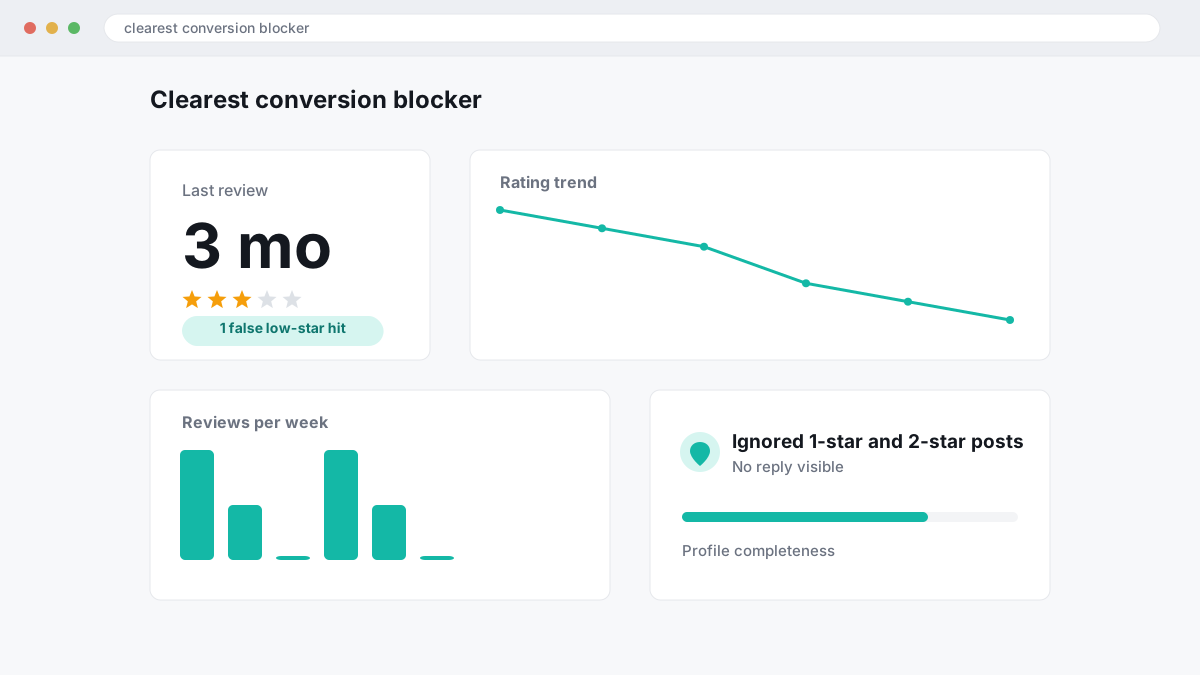
Most guides push electricians to collect another 50 positives first. That often fails because the map pack click-through problem is already visible on your profile: your last review is 3 months old, your star-rating distribution shows a cluster of 1-star and 2-star posts with no reply, or one false low-star hit drags the average below the point where a householder feels safe calling. In BGR Review’s dataset of 1,485 businesses observed from February to July 2026, new trades businesses typically saw first reviews around two weeks after launch, and reaching 20–30 reviews in the first three months was associated with stronger local visibility. That finding helps with review velocity, but it does not cancel a live trust blocker.
This is the order that usually moves conversions fastest.
| Visible issue | Fix first | Why it changes bookings faster |
|---|---|---|
| Last review is older than 3 months | Restart review requests and restore steady review velocity | Fresh activity improves confidence before a searcher clicks, which helps map pack CTR and form fills |
| Unanswered 1-star or 2-star reviews | Repair response management now | Two calm, factual replies can recover trust faster than dozens of new positives buried below |
| One false review is depressing the average | Build a proof pack and pursue removal | Removing a fake low-star post often lifts trust faster than volume-building; BGR Review handles removals at $0 upfront and $449 per removed link after success |
If the low-star post is false, removal can beat review generation on speed. Across 12,000+ negative review cases logged by BGR Review from June 2025 to June 2026, reviews raised within 28 days of posting and backed by an identifiable policy issue resolved successfully in roughly 90% of cases; comparable cases raised after 28 days fell to approximately 25–30%. That is why the smarter move is often to answer genuine criticism, remove policy-breaching content quickly, and only then push hard on new positives.
What should you do after a bad electrician review if you still want the job pipeline protected?
After a bad electrician review, reply fast, acknowledge the issue, and move the fix offline. If the post looks genuine, protect future bookings by showing calm response management; if it looks false or policy-breaching, preserve the evidence and switch to the removal route instead of arguing in public.
The wrong move is to fight the reviewer line by line on your Google Business Profile. That usually drags the complaint back to the top of the profile, invites more scrutiny, and can hurt click-through from the map pack before it affects ranking. In BGR Review's dataset of 1,485 businesses observed February-July 2026, trades businesses with complete enquiry-source data attributed 70-80% of calls and bookings to a Google Business Profile or Yelp listing, so a messy public argument can damage conversions where the job lead actually starts.
The better move is simple: reply within 24 to 72 hours, state the facts you can verify, apologise for the experience if service fell short, and give one named contact plus a direct phone number. Keep it short. "Sorry to hear this. Please ask for Dan on 0207 xxx xxxx so we can check the job date, quote and completion notes today" protects your star-rating distribution far better than debating fault under the review.
Then document the outcome in your CRM or job sheet, because the same complaints tend to recur: lateness, pricing surprise, poor cleanup, and missed callbacks. Those patterns tell you whether you have a service problem, a quoting problem, or a follow-up problem. If the review later turns out to be from a non-customer or contains false statements, having the original quote, invoice, van log, call record, and completion notes ready gives you a usable proof pack for the next step rather than a guess.
When is a bad review removable instead of something you should simply answer?
A bad review is removable when it breaks platform rules or states false facts you can prove false. A harsh opinion about your price, punctuality or manner usually needs a measured reply, while impersonation, non-customer posts, undisclosed incentives and fabricated job claims can justify removal action.
The wrong approach is to treat the low rating itself as the problem and hit the report button with no file behind it. That usually fails because Google looks for a policy breach under its fake engagement policy or other review rules, not whether the review feels unfair, and in BGR Review's negative-review dataset of 12,000+ cases logged June 2025 to June 2026, roughly 90% of businesses who came to us after a failed attempt had filed only the in-platform report with no supporting documentation. A one-star review saying "too expensive" or "turned up late" is usually opinion. A review saying you never attended, charged for work not done, or damaged a consumer unit on a date when no job existed moves into false statements territory and may support a defamation argument depending on country and platform rules; this is general information, not legal advice.
The right approach is to build the verification and proof pack before you flag anything. Start with the job record, messages, invoice, call log and staff notes, then line each item up against the exact claim in the review so you can show "no booking under this name", "wrong address", or "invoice shows different scope" instead of sending a complaint.
How do you report fake, bought, or non-customer reviews without wasting weeks?
The quickest route for a fake or non-customer review is to match the post to a named policy breach, then file it with a verification and proof pack that shows no real transaction took place. Emotional flags usually stall because a moderator cannot verify anger, but they can verify records.
Most electricians waste time by reporting a review as “unfair” and writing three upset paragraphs in the text box. That fails because Google’s fake engagement policy targets fake, incentivised, and coordinated review activity, not hurt feelings. If the reviewer never booked, or the review pushes a competitor, or the account shows coordinated posting behaviour, say that plainly and attach evidence that matches the breach. In BGR Review’s dataset of negative review cases with prior self-filed attempts, logged June 2025 to June 2026, roughly 90% of businesses that came to us after a failed try had used only the basic in-platform report button with no supporting documentation, and 70–80% of those initial requests had been rejected.
Your proof pack should be boring and complete. Include the CRM record, invoice or estimate history, dispatch log, and customer communication such as SMS, email, or call notes. If the review contains false statements like “you took payment and never arrived”, but your job records show no booking, no payment, and no address match, that helps on both a non-customer argument and a false-statements argument; defamation can matter legally, but platforms usually act faster on their own policy grounds than on a broad accusation of defamation. This is general information, not legal advice, and the exact route varies by country and platform.
Track the flag date in a simple log and escalate once if no decision appears within 7 to 14 days. The escalation should repeat the policy ground, restate the missing customer record, and reattach the same proof pack in a cleaner order. If the review is older, the odds usually get worse: across 12,000+ negative review cases logged by BGR Review from June 2025 to June 2026, reviews raised within 28 days and backed by an identifiable policy issue resolved successfully in roughly 90% of cases, while comparable cases raised after 28 days fell to approximately 25–30%.
Are bought or incentivised reviews worth the risk for electricians?
Bought reviews, or incentives you do not disclose, are a poor trade for an electrician. They can breach Google’s fake engagement policy, create consumer-protection risk under the FTC endorsement guides, and leave you with reviews that damage map-pack click-through and trust once they are flagged.
The wrong approach is the obvious one: buy a burst of five-star posts or offer gift cards only to happy customers and hope the profile lifts. That can create a short-term star boost, but Google can remove deceptive or incentivised review activity under its fake engagement policy, and Trustpilot also scrutinises manipulated collection methods, selective invites and undisclosed bias in how reviews are gathered. Once that footprint looks engineered, your star-rating distribution stops looking natural, branded search trust drops, and the calls you wanted turn into a clean-up job.
The safer route is simple: ask every real customer, use review link automation after completed work, and disclose any material incentive wherever the law or platform requires it. In the US, the FTC endorsement guides require clear disclosure when an endorsement is materially incentivised; in the UK and EU, undisclosed incentives can also be treated as misleading commercial practice under consumer-protection rules. This is general information, not legal advice, and if you want durable conversions from Google Business Profile rather than removable reviews, plain requests beat clever schemes.
How should emergency electricians and multi-location firms change the review playbook?
Emergency callout firms and multi-location electricians need different review workflows. Urgent jobs usually get better response from next-day review request timing, while multi-branch teams need every customer sent to the correct Google Business Profile so local relevance and reporting stay clean.
Most guides tell you to use one review flow for every completed job. That fails fast. A midnight power-loss call often ends with relief, not patience, so the same-night SMS gets ignored or read as pushy; a planned rewire or consumer-unit upgrade can support a same-day ask because the customer has time to write. In BGR Review's dataset of trades businesses with complete enquiry-source data, observed February-July 2026, 70-80% of calls and bookings were attributed to a Google Business Profile or Yelp listing, which is why the location attached to the review matters to map-pack click-through and later conversions.
If you run several depots, do not push everyone to one central review page. Send the review link for the branch that quoted, dispatched or invoiced the work. A Birmingham customer reviewing your London profile weakens local pack relevance, muddies star-rating distribution by territory and makes branded search harder to read in your reporting. Review link automation should pull the correct branch URL from the job record, then fire after completion with the right technician name and town in the message.
If you are a service-area business without a shopfront, routing matters even more. Tie the request to the territory served, not the admin office, and check the dispatch log before sending anything; mismatched location requests create confused responses, lower reply rates and produce reviews that talk about one suburb on another profile. Once volume grows, this usually needs technician-level tagging and a verification trail in the CRM so your response management, removal evidence pack and location-level booking data all match.
Should you keep this in-house or use a managed review service once volume grows?
DIY review requests fit one location where you can keep asking, following up and replying without gaps. A managed service makes more sense once multiple technicians, service-area businesses or several locations start creating missed asks, slow responses and inconsistent compliance checks.
The wrong approach is keeping reviews in-house because the cash cost looks lower, while nobody owns the weekly work. That usually breaks at the same points: the review link automation never gets wired into your CRM, response management slips when the owner is on jobs, and flagged reviews sit untouched until the local pack and map-pack click-through rate start softening. DIY still works if one person checks Google Business Profile, Trustpilot or Yelp every week, logs every request, and knows the FTC endorsement guides and each platform's rules on incentivised or misleading reviews.
A managed service costs more than doing it yourself, but it removes operational drag. You get tighter routing, steadier review velocity, cleaner star-rating distribution across locations, and reporting that shows which technician, branch or territory is actually producing calls, form fills and branded search demand. The better comparison is below.
| Factor | DIY | Managed service |
|---|---|---|
| Control | Full control, but owner time carries the load | Shared control with setup and routing handled for you |
| Compliance checks | You monitor platform policy yourself | Checks are built into the process before requests go out |
| Response handling | Easy to miss during busy callouts | Faster coverage across technicians and locations |
| Removal support | You flag and appeal yourself | Fixed price per removed link |
If you only need a simple ask-and-reply routine, keep it in-house. If volume has grown to the point where consistency is dropping, a managed setup with review packages backed by BGR Review's 30-day free replacement guarantee is usually the cleaner choice.
Where to go from here
Your next move is simple: audit the last 30 days of jobs, map one review ask to your completion point, and check every public reply on your Google Business Profile for speed, tone and proof. For most electricians, that is where the first lift shows up: stronger map-pack click-through, more calls from branded search, and fewer lost bookings after a complaint sits unanswered for a week. If a review looks false, do not guess. Save the job record, messages, invoice trail, call log and site photos while they are easy to pull.
If that admin is already eating into quoting and sales time, get a managed assessment before the backlog grows. You should expect a platform-by-platform plan, a request-timing workflow, and a clear call on whether to flag, appeal or respond publicly first. com or call +1 561 461 0399.