

Quick answer
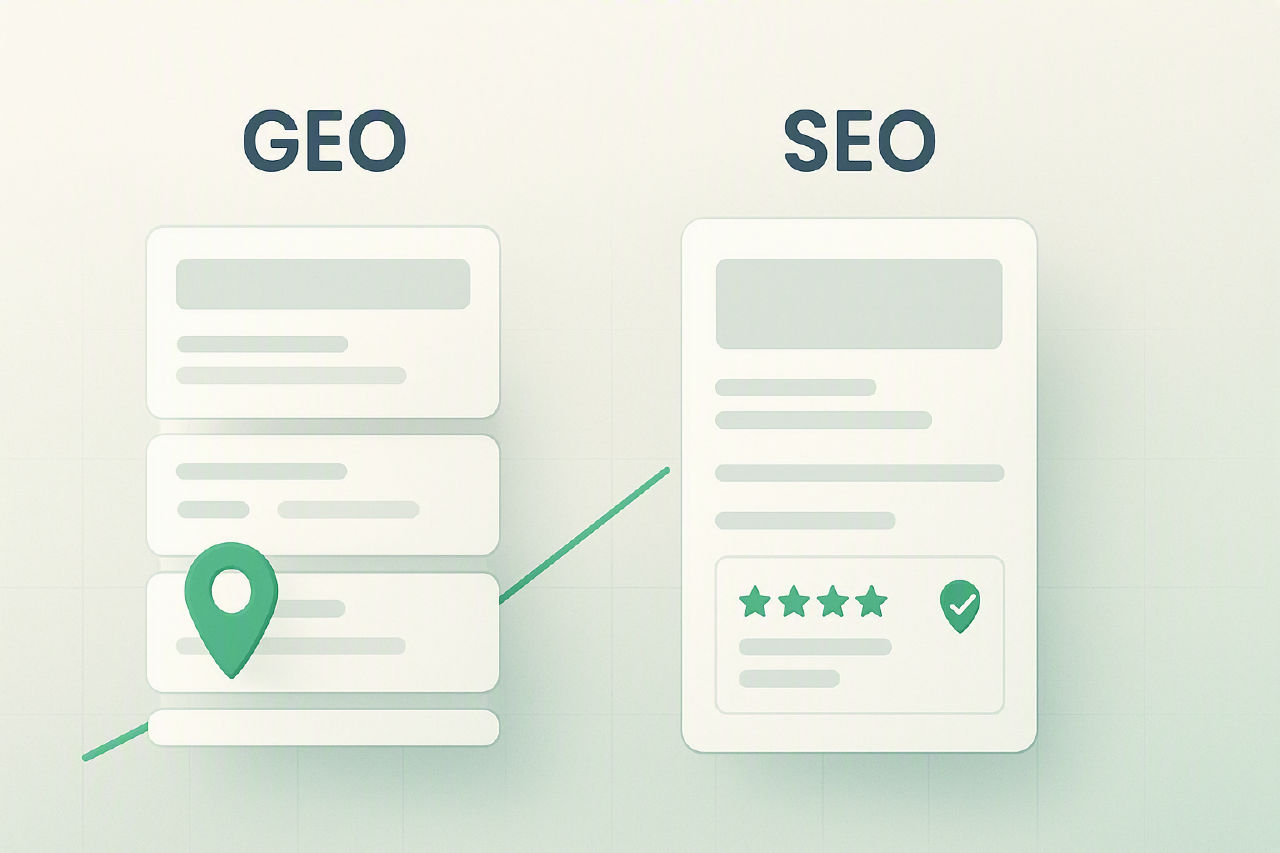
GEO usually means Generative Engine Optimisation: improving how your business gets cited, quoted and summarised inside AI search experiences such as AI Overviews, while SEO focuses on ranking pages in standard search results. The work overlaps, but the targets differ. SEO still covers crawlability, indexing, internal links, page quality and rankings; GEO covers answer eligibility, source clarity, citation formatting and trust signals such as reviews, brand mentions and consistent business facts. For most teams, the right move is to layer GEO onto SEO, then track branded search demand, assisted leads, citation visibility and map-pack clicks.
This page comes from live reputation and visibility work, not recycled definitions. At BGR Review, we handle review acquisition across Google, Trustpilot, Yelp, Clutch and TripAdvisor, and we also run pay-after-success removals at $449 per removed review link with $0 upfront, which means we see exactly where weak evidence, thin service pages and inconsistent business facts stop a brand being cited cleanly. The practical pattern is consistent: brands with clear first-party content, complete Google Business Profile data and stronger review language are easier for AI systems to summarise than brands relying on vague pages and scattered third-party signals.
Why is GEO not just SEO with a chatbot layer?
Generative Engine Optimisation is a different job from Search Engine Optimisation. SEO helps your pages rank and earn clicks; GEO helps your content get selected, quoted and cited inside AI-generated answers such as Google’s AI Overviews and other answer engines.
Most guides flatten that difference and treat GEO as SEO with a chatbot layer. That fails because ranking mechanics and citation selection are related, but they are not the same output: a page can rank and still never be quoted, while an AI answer can satisfy the searcher without sending a click at all. For brands using BGR Review to strengthen Google, Trustpilot, Yelp, Clutch or TripAdvisor visibility, that zero-click loss matters because visibility inside the answer now affects branded search demand and conversions before your site visit happens.
The comparison is simpler in a table than in another paragraph.
| Area | SEO | GEO |
|---|---|---|
| Main goal | Rank pages and win clicks | Earn inclusion and citation inside AI answers |
| Primary surface | Search results pages | AI Overviews and answer engines |
| Wrong move | Drop SEO for AI formatting alone | Assume citations appear because rankings exist |
The practical move is to layer GEO onto SEO, not swap one for the other. Keep the SEO foundations that drive rankings, crawlability and click-through rate, then add citation-focused work so your best facts can be lifted cleanly into AI responses; that is usually the cheaper route than rebuilding everything around prompts and hoping the map pack, organic traffic and form fills hold up.
How do GEO and SEO win visibility in different places?
Search Engine Optimisation wins visibility on search results pages you can rank in, while GEO wins visibility inside generated answers, citation panels and prompt-driven discovery where your brand may shape the outcome without receiving a visit.
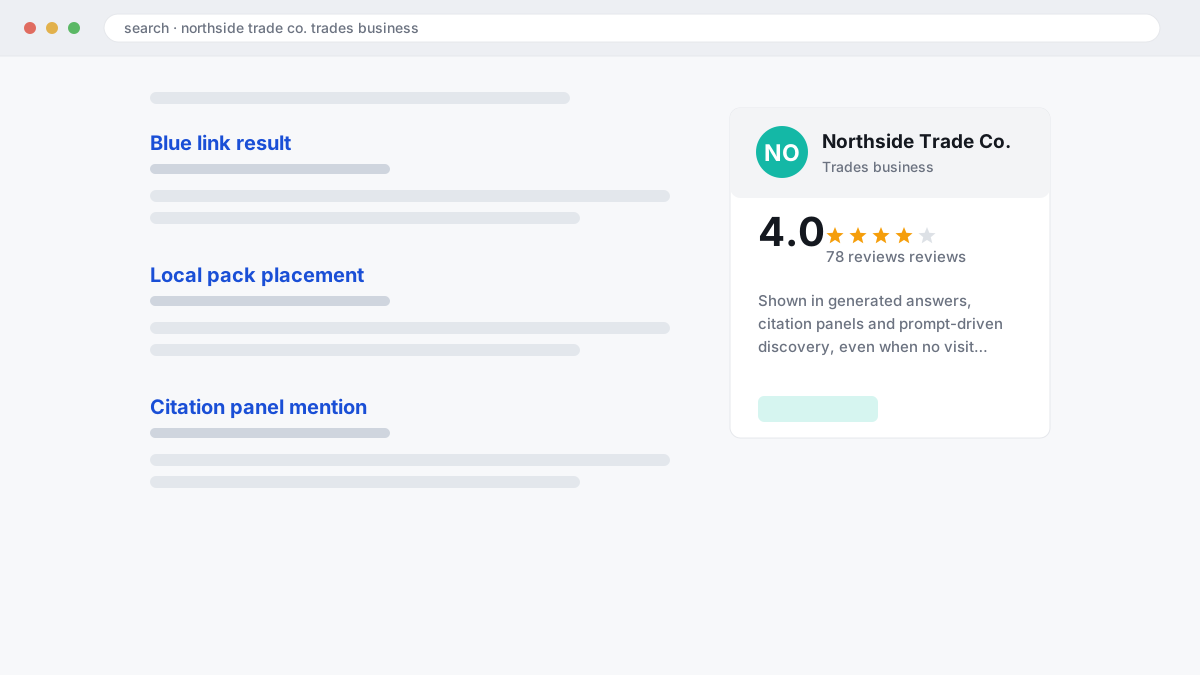
The wrong approach is to treat every impression as a click target. That fails because AI Overviews can use your page to inform an answer, cite you briefly, and still keep the reader on Google. SEO still matters for blue links, local pack placement and organic sessions from indexed pages; in BGR Review's dataset of trades businesses with complete enquiry-source data, observed February to July 2026, 70–80% of calls and bookings were attributed to a Google Business Profile or Yelp listing rather than a website.
The right approach is to split visibility by surface and outcome. GEO aims for answer inclusion, brand mentions and citation eligibility across prompt-led paths, while SEO aims for rankings that drive sessions, map-pack clicks and conversions on your own pages. That works because some readers will never click, but they still absorb your name, compare review language, and return later through branded search or a direct enquiry.
How do AI systems decide which pages deserve a citation?
AI systems usually cite pages that answer one narrow question fast, keep the facts consistent, and make the answer easy to extract. For citation eligibility in AI Overviews, a clear opening answer inside roughly the first 40-60 words beats a long introduction every time.
Most guides say longer content wins citations because it looks comprehensive. That fails when the page hides the answer under scene-setting, mixed intent and loose claims. A page that opens with a direct line such as “negative review removal is pay-after-success at $449 per removed review link with $0 upfront” gives the model a quotable unit; a 1,500-word page that circles around the point often gets skipped even if it ranks well in classic search.
Formatting changes how reliable extraction feels to a machine. Tables, FAQs and source-labelled sections reduce ambiguity because the model can separate the claim, the qualifier and the entity without guessing. On BGR Review pages, service facts like the 30-day free replacement guarantee and platform-specific package details are easier to parse when they sit in short blocks, not in promotional paragraphs.
Use structure to help parsing, then stop there. Structured data helps machines read entities, prices, locations and service relationships, but it does not guarantee citation if the visible copy is vague, outdated or inconsistent with the page title.
This is the difference that usually matters most:
| Page style | What AI systems can extract | Likely result |
|---|---|---|
| Long prose, answer buried low | Loose summary, weak entity match | Lower citation eligibility |
| Clear opening answer, table, labelled facts | Specific claim with supporting context | Stronger fit for AI Overviews |
Why do reviews shape GEO more than most guides admit?
Reviews shape generative visibility because they give AI systems recent, third-party wording about what you do, where you do it and whether people trust the experience enough to describe it in plain language.
Most guides treat reviews as a map-pack conversion factor and stop there. That fails because an LLM answering a prompt like “best emergency plumber in Brooklyn open late” does not rely on your service page alone; it looks for language it can safely mirror, and review sentiment gives it phrases such as “arrived in 30 minutes”, “fixed leak same night” or “clear quote before work” that static copy rarely earns. Thin first-party content forces vague summaries. Strong review text makes the answer more specific.
Google Business Profile reviews matter here because they reinforce entity consistency in a place Google already trusts for service area, category, opening hours and location evidence. In BGR Review’s dataset of 1,485 businesses observed February to July 2026, trades businesses with complete enquiry-source data attributed 70–80% of calls and bookings to a Google Business Profile or Yelp listing, which shows how closely review-rich profiles sit to real conversions as well as click-through from the local pack.
If your newest review is six months old, your facts are stale. Reviews from the last 30–90 days keep content freshness higher than a brochure page updated once a year, especially when they confirm current staff, pricing style, response speed or service coverage.
How does GEO actually work from prompt to citation?
A practical Generative Engine Optimisation workflow starts with prompt research, turns repeated questions into single-purpose answer pages, then raises citation eligibility with structure, fresh evidence, review-backed trust signals and tight entity consistency across every source a model can compare.
The wrong approach is to publish generic AI content first and hope a chatbot finds something useful in it. That fails because prompt-driven discovery looks for pages that answer one question cleanly, with verifiable first-party content such as service areas, pricing approach, turnaround details, named platforms and policy-backed claims. If your page says “we help with reviews” but your Google Business Profile, Clutch profile and third-party mentions describe different services or locations, the model has no stable entity to cite.
Build the workflow from real prompts. Pull the exact questions prospects ask in sales calls, support emails and branded search, then map each recurring question to one page. Add the answer block first, then a comparison table, then named examples, then tighten the prose.
This is the order worth following:
| Step | What you publish | Why it gets cited |
|---|---|---|
| Prompt clustering | One page per repeat question | Matches query intent cleanly |
| Answer asset | Direct answer, table, named platform example | Easy for AI Overviews to extract |
| Consistency check | Site, profiles and mentions use the same facts | Improves entity consistency and trust |
Check the final version against your own site, your Google Business Profile and the third-party pages people quote in reviews. A model will trust the page that repeats the same phone number, service scope and brand description everywhere; it will sidestep the one with drift.
Which assets move GEO fastest if your site already ranks?
If your site already ranks, the fastest GEO gains usually come from tightening high-intent first-party content you already own — service pages, FAQs and comparison pages — before you spend another month building a fresh blog cluster.
Starting another blog series is the slow route because generic articles rarely answer the prompt a buyer actually asks, and they often bury the service facts an AI system needs to lift into a citation. A ranking service page with a concise intro, a visible last-updated date, tighter entity consistency between page title and on-page copy, and valid structured data is often a one-week fix. If you are already investing in review generation, do this before new reviews start landing; BGR Review review delivery typically starts within 24-48 hours, so your strongest pages should be ready to absorb the extra branded search demand and convert the clicks.
The right move is to tighten pages that already sit near the money: core services, pricing explainers, FAQ blocks and comparison pages such as “X vs Y” or “best option for Z”. Those assets outperform blog rewrites because they contain first-party content with clear claims, scannable answers and stronger citation eligibility. Brand mentions on trusted third-party sites then do the verification work your own site cannot do alone, especially when Clutch, Trustpilot, Google Business Profile or reputable directories repeat the same facts in similar wording.
How should local businesses split effort between GEO and SEO?
For most local businesses, Search Engine Optimisation and Google Business Profile work should get funded first, with GEO added after those basics are secure. GEO matters more once buyers start asking detailed service questions in prompt-driven discovery, rather than simply searching a category or your brand name.
Moving budget out of local SEO and into GEO too early usually fails because the local pack still drives the call, the map tap and the direction request. In BGR Review's dataset of trades businesses with complete enquiry-source data, observed February to July 2026, 70-80% of calls and bookings were attributed to a Google Business Profile or Yelp listing rather than a website. If your profile categories, services, photos, hours and review replies are weak, an AI mention will not fix the missing conversion path.
The split that works for most local firms is simple: secure profile basics first, build review flow second, publish citation-ready pages third. That means a complete Google Business Profile, then a steady review request process tied to job completion, then service pages with clear locations, pricing cues, exclusions, FAQs and consistent business details that an AI system can quote cleanly. GEO starts paying back faster in higher-consideration categories such as legal, dental, cosmetic or specialist home services, where buyers compare options in longer prompts before they click.
This is the budget order we would use before spending on broader AI visibility work.
| Priority | What to fund first | Why it comes before the next step |
|---|---|---|
| 1 | Google Business Profile basics | Drives map-pack visibility, calls and direction requests directly. |
| 2 | Review flow and reply process | Improves click-through from local results and gives both searchers and AI better trust signals. |
| 3 | Citation-ready local pages for GEO | Helps with conversational prompts once the profile and review foundation already converts. |
What changes when one brand manages 20 or 200 locations?
Once you manage 20 or 200 locations, GEO stops rewarding a single national explainer page and starts rewarding clean location-level entities that AI systems can match to a real branch, a real service area and a real Google Business Profile.
The wrong approach is one master page with a city swap in the heading, the same service list, and the same customer language copied across every branch. That fails twice. Search engines treat the pages as thin local duplicates, and AI Overviews struggle to cite them because the brand facts blur together instead of forming distinct entities. If your Manchester, Bristol and Leeds pages all claim the same response times, the same testimonial phrasing and the same catch-all service scope, citation eligibility drops because nothing proves which branch actually does what.
The right approach is separate location pages with consistent NAP, a matching Google Business Profile, branch-level service scope and first-party content that only that office could publish: local team details, area-specific jobs, parking or access notes, and replies to reviews that mention the location by name. Entity consistency does the heavy lifting here. When the page, profile, brand mentions and review text line up, both map-pack visibility and conversions usually improve because the reader lands on a branch that feels verified rather than generic.
Can GEO work be measured without fooling yourself?
You can measure Generative Engine Optimisation indirectly by combining prompt tracking, citation checks, Search Console query movement and assisted conversions. The target is a repeatable measurement and attribution model over 8-12 weeks, not one neat score that pretends every mention inside AI Overviews can be counted perfectly.
Most guides push you towards one dashboard. That fails because Google Search Console will show impression, click and query shifts, but it will not label every appearance inside AI Overviews or every answer surfaced through prompt-driven discovery in ChatGPT, Gemini or Perplexity. Use Search Console for the directional signal instead: more non-brand service queries, more comparison terms, and later a lift in branded search demand after people see your name cited and search for you directly.
The cleaner approach is to pair visibility evidence with outcome evidence. Log a fixed set of prompts, the same locations, the same devices and the same dates each week; if you change “best emergency plumber in Brooklyn” to a different phrasing or switch from London to New York, your comparison breaks. Then check assisted conversions in GA4, call tracking, form fills and referral patterns, because GEO often shows up as a first touch that leads to a branded search or a map-pack click later rather than an immediate last-click conversion.
BGR Review handles this by treating citation sightings and business outcomes as separate layers of proof, the same way our research methodology keeps unknown outcomes separate from failures across 12,000+ negative review cases logged June 2025 to June 2026. That discipline matters here as well: if a citation appears but calls, bookings and form fills stay flat after 8-12 weeks, your visibility improved but your offer, reviews or landing page trust signals still need work.
Can GEO hurt SEO if you publish for bots instead of people?
Yes — publishing pages built to satisfy AI summaries rather than human readers can weaken Search Engine Optimisation by duplicating search intent, cannibalising rankings, and attaching policy risk to content or review tactics that looked efficient on a brief.
Most guides say more AI-shaped pages always help. What actually happens is that thin service rewrites, location clones and FAQ pages with the same commercial intent often compete with your stronger originals, especially when the only change is wording tuned for prompt-driven discovery. Google Search Central's spam policies and scaled content guidance matter here because hidden rewrites and low-value page multiplication do not create better citation eligibility, better content freshness or better conversions; they just split signals across too many URLs.
The safer approach is fewer pages with clearer facts, visible authorship, current offers and stronger review sentiment pulled from real customer language on platforms such as Google Business Profile or Trustpilot. That gives AI systems cleaner source material and protects your existing organic pages at the same time.
Compliance risk sits outside rankings. The FTC's 2024 final rule on fake reviews and testimonials, Google's review policy, and UK consumer rules including the DMCC Act all treat hidden endorsements and misleading review practices seriously, but the exact rule set varies by country and platform, so this is general information rather than legal advice.
Is GEO worth the budget, and what should you fix first?
GEO earns budget when your buyers ask layered, conversational questions before they call or fill out a form, and your brand can give clear answers an AI system can cite. Put money into high-intent service pages, fresh review sentiment, and basic measurement and attribution before you spend on wider brand mentions.
The wrong move is buying GEO as a standalone service while your core assets stay thin. That fails because AI Overviews and other prompt-driven discovery systems struggle to summarise vague claims, old testimonials, and pages with no comparison content, so extra brand mentions do little beyond inflate noise. Fix the pages that answer buying questions first, update stale reviews with recent language about outcomes and service details, and add citable assets such as pricing explainers, competitor-alternative pages, and FAQ sections written in plain English.
Attribution usually cleans up in stages. In BGR Review’s dataset of 1,485 businesses observed February to July 2026, trades firms with complete enquiry-source data attributed 70–80% of calls and bookings to a Google Business Profile or Yelp listing, which shows why direct revenue tracking often lags behind visibility signals. Expect cleaner leading indicators first: more citation eligibility, more branded search demand, stronger map-pack click-through, then better conversions once your answers and review sentiment line up.
What does a usable GEO checklist look like this quarter?
A usable GEO checklist starts with prompt coverage, then tests citation eligibility, review freshness, entity consistency and measurement setup. If a page cannot answer one recurring buyer question in a few seconds, it will struggle to earn citations in AI Overviews or other prompt-driven discovery surfaces.
Use this order first, because most teams waste time rewriting blogs before fixing the assets AI systems actually summarise: your main service pages, your profile facts and the opening answers on-page.
- Audit 10 recurring prompts your buyers actually ask, then map them to 5 core pages.
- Rewrite each page opening so the answer appears in the first lines, not halfway down.
- Add compact tables where comparison or pricing context helps citation eligibility.
- Check structured data, especially organisation, local business and review-related schema where valid.
- Refresh review signals: recent verified reviews, current replies and accurate Google Business Profile facts.
- Fix entity consistency across site copy, map listings, Trustpilot, Yelp, Clutch and brand mentions.
- Re-run the checklist every 30 days after any major page, profile or review-programme update. If you buy review support, keep the platform mix and replacement terms clear; BGR Review's packages carry a 30-day free replacement guarantee.
Where to go from here
Treat GEO as a second layer on top of SEO, because swapping one for the other usually leaves you with weaker search coverage and nothing reliable for AI systems to cite. The brands that are easiest to summarise tend to have the same basics in place: clear service facts on-page, matching business details across profiles, and review language that gives a model something concrete to quote instead of guess at.
Your next step is simple. Audit the pages and profiles that define your business: service pages, Google Business Profile, major review platforms, and the brand mentions that repeat your name, location and offer. Fix factual gaps first. Then tighten review generation and response quality, then track assisted demand through branded search, map-pack clicks, calls, bookings and form fills before you expand into broader prompt-driven discovery work.
Expect cleaner inputs first, then better citation eligibility and stronger trust signals over time.