

Quick answer
AEO means answer engine optimisation: preparing your pages so Google AI Overviews, ChatGPT, Perplexity and voice assistants can extract, trust and cite your answer. The work is practical: map real conversational queries, rebuild headings around direct answers, keep the page crawlable, add structured data where it genuinely helps, and publish evidence a machine can verify such as reviews, policies, service details and brand mentions. Start with pages already near page one, because a clear answer block and stronger trust signals usually move faster there than a full-site rewrite.
This page is written for operators who need leads, calls and form fills, not another SEO relabel. At BGR Review, we sell review growth and negative review removal openly, and the same trust layer affects whether a service page earns citations, local pack clicks and branded search demand after a recrawl.
The process here follows what we actually check when a page stops getting cited: query mapping first, then heading rebuild, evidence insertion, schema review, internal linking, and a citation check after Google reprocesses the page. That operating pattern comes from work across 15,000+ businesses, 1,240+ verified clients and review platforms where weak third-party signals often block visibility before the copy does.
Why does most AEO advice fail once a team needs pipeline, not pageviews?
AEO fails when you treat it as renamed SEO. Useful answer-engine work starts with extractable answers, clear entities, third-party trust and citation readiness, so AI Overviews can quote your page without guessing who you are or whether your claims deserve trust.
Most agency guides stop at definitions, a schema checklist and a promise that concise copy will win visibility. That fails once you need calls, bookings and form fills, because pageviews do not tell an AI system whether your service page has real E-E-A-T signals behind it. In BGR Review's dataset of trades businesses with complete enquiry-source data, observed February to July 2026 within a wider sample of 1,485 businesses, 70–80% of calls and bookings were attributed to a Google Business Profile or Yelp listing rather than a website alone. If your reviews are thin, your brand mentions are inconsistent, or your source pages hide pricing, location and policy details, citation loss follows even when the copy is tidy.
The workable model is tighter. You map the question, write the answer high on the page, define the service entity in plain language, add verifiable first-party details such as contact routes, delivery terms or BGR Review's pay-after-success removal model at $449 per removed review link with $0 upfront, and back that up with reviews and consistent off-site references. That mix gives answer engines something they can extract and something they can trust, which is what moves branded search demand and leads.
How does AEO actually work from query to citation?
AEO works when you match the query’s intent to a clean answer format, a crawlable page structure and credible proof around the claim. AI Overviews and other answer systems extract the shortest usable answer first, then check whether the page is accessible, current and supported by entities, sources and basic trust signals before they cite it.
Start by sorting queries into five classes: definition, comparison, how-to, local and recovery. Then give each page one dominant search intent and one answer shape. A definition page needs a direct opening paragraph; a comparison page needs a compact table; a how-to page needs ordered steps; a local page needs service-area and review evidence; a recovery page needs diagnostic checks. If you try to make one service page rank for every conversational query, featured snippets usually go to a cleaner page with less ambiguity.
Most guides tell you to publish more content. That fails because volume does not fix answer mismatch. The better route is to rewrite one page so the format matches the query class exactly: map the target query, rebuild headings, insert evidence such as platform names or review counts you can prove, review schema, tighten internal links, then check whether Google recrawls the page and whether citations return.
Track three surfaces every week: AI Overviews, featured snippets and brand-led queries such as your company name plus “reviews”, “pricing” or “legit”. In BGR Review’s own workflow, that weekly check often catches answer citation loss before it dents click-through rate, branded search demand or form fills. If a page drops out, check crawlability, heading clarity, stale proof and whether third-party trust pages now answer the query more directly than your site.
When should you treat AEO differently from SEO, and when are they the same job?
SEO and AEO overlap heavily, but they optimise different outcomes. SEO pushes for rankings and clicks; AEO pushes for extractable answers, citations and assisted discovery inside AI Overviews, featured snippets and chat-style search.
Most teams treat rank position as the finish line, then wonder why they appear on page one and still get ignored by answer engines. That fails because search intent can be satisfied before the click: if your service page buries the answer under brand copy, skips proof, or leaves key facts ambiguous, Google can index it yet decline to quote it. In BGR Review's dataset of trades businesses with complete enquiry-source data, observed February to July 2026, 70–80% of calls and bookings were attributed to a Google Business Profile or Yelp listing rather than a website, which is a useful reminder that discovery and conversion often start before a visit.
They become the same job at the foundation layer. You still need indexing, internal links, crawlable structure and enough topical depth for Google to understand what the page covers and which query it matches. AEO starts to diverge when citation eligibility becomes the goal: concise answer blocks near the top, transparent source language, scannable headings aligned to conversational queries, and machine-readable structure that helps systems lift the right passage without guessing.
The difference is easier to see side by side.
| Area | SEO focus | AEO focus |
|---|---|---|
| Primary win | Rankings, click-through rate, visits | Citation, extraction, zero-click visibility |
| Content shape | Comprehensive page targeting search intent | Clear answer formats that AI Overviews and featured snippets can lift cleanly |
| Technical base | Indexing, internal links, relevance signals | The same base, plus stronger source transparency and machine-readable structure |
If you need leads, treat both together and judge them by what they do for conversions, branded search demand and assisted discovery, not pageviews alone. That is also where review signals and third-party trust start to matter more than a standard SEO checklist admits, which is why BGR Review clients usually pair page rewrites with reputation cleanup rather than content edits on their own.
Which pages should you optimize first if you want AEO wins without rebuilding the whole site?
Start with pages already close to visibility and tied to revenue: service pages, pricing, comparison pages, and FAQs that already rank or already convert. A small group of extractable pages usually earns faster citation gains than a site-wide rebuild full of weak new URLs.
Most teams pick the wrong route. They rewrite the whole site, publish 50 thin pages, and split crawl budget across URLs with weak search intent, no proof, and no crawlable page structure for answer extraction. The better move is narrower: pull your first-party data from Search Console, CRM notes, sales calls, live chat, and support tickets, then find the five pages already sitting on page 1 or in the top 20 for buying queries.
Those pages are closest to impact because they already have relevance, and they usually feed calls, bookings, or form fills. In BGR Review's dataset of trades businesses with complete enquiry-source data, observed February to July 2026, 70–80% of calls and bookings were attributed to a Google Business Profile or Yelp listing; that makes service and location pages answering high-intent questions a better starting point than broad blog content. Fix five pages deeply, then expand. Thin scale rarely wins citations, branded search, or conversions.
| Approach | What happens | Priority |
|---|---|---|
| Full-site rewrite | More URLs, weaker internal focus, slower recrawl | Low |
| Upgrade 5 high-intent pages already near visibility | Cleaner answers, stronger citations, faster commercial lift | High |
How should a page be built so answer engines can quote it cleanly?
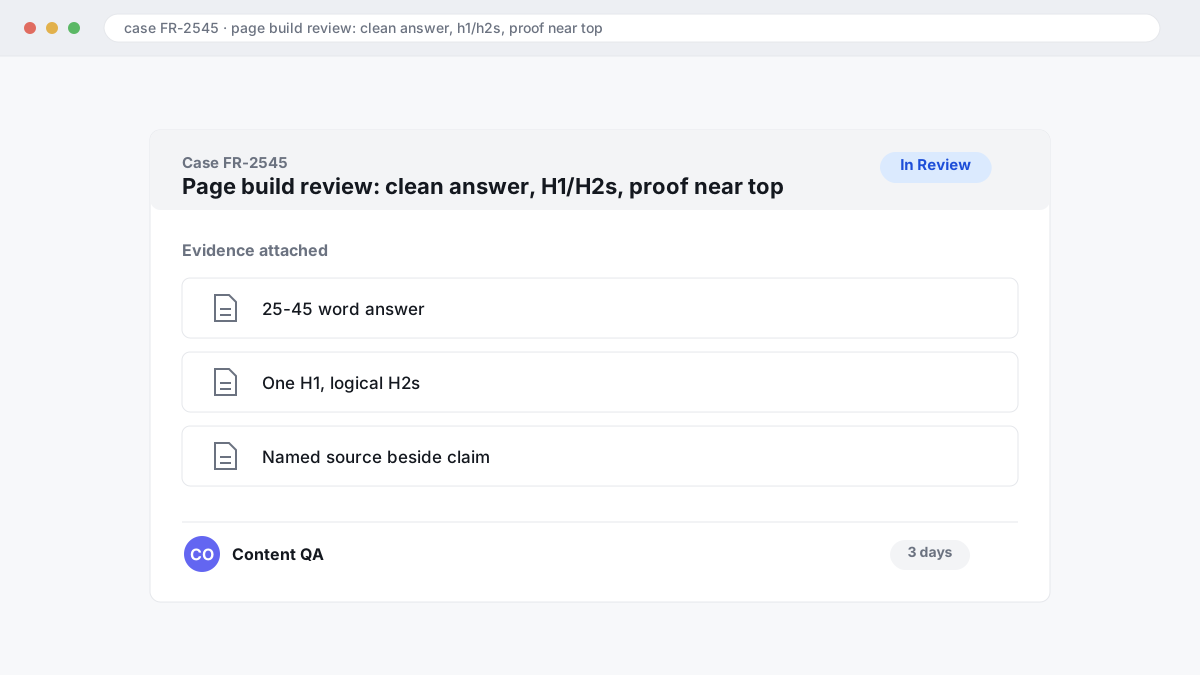
Answer engines quote pages that are easy to extract. Open each section with a 25-45 word answer, keep one H1 with logical H2s underneath, place tables after one setup sentence, and back key claims with named sources or first-party evidence a model can cite.
The wrong build is the polished one your designer likes: tabbed FAQs, hidden accordions, vague hero copy and proof buried three scrolls down. That fails because the crawlable page structure is thin in raw HTML, the answer sits behind interaction, and the page gives featured snippets or AI Overviews nothing clean to lift. If you sell review removal, say the claim plainly near the top and attach the proof beside it: pay after success, $0 upfront, $449 per removed review link.
The right build uses indexable HTML, one intent per page, and H2s that mirror conversational queries such as “Can Google remove a fake review?” or “How long does Trustpilot verification take?” FAQ content design works when each question is followed by a direct paragraph answer first, then the caveat, then the example. Named sources matter here. Put Google Business Profile Help, Google Search Central, the FTC or the CMA beside policy claims, and put your first-party data beside operating claims such as BGR Review’s 30-day free replacement guarantee on review packages.
Use a compact table only after a sentence that frames the comparison.
| Build choice | Why it loses citations | Extractable version |
|---|---|---|
| Accordion answer | Hidden until click | Visible paragraph under H2 |
| Claim with no source | Weak attribution | Named source or first-party evidence beside claim |
| Pretty comparison cards | Hard to parse | Simple HTML table after one context line |
Which schema and structured data help AEO, and which markup gets overcredited?
Structured data helps answer engines read page meaning, relationships and rich-result eligibility, but it does not create citations on its own. It supports extraction when your page already has direct answers, named evidence and a crawlable page structure, which is why BGR Review puts schema review after the heading rebuild and evidence insertion step, not before.
The wrong approach is to add every schema type your plugin offers and expect AI Overviews or featured snippets to follow. That fails because markup cannot rescue weak FAQ content design, hidden answers in tabs, or a service page with no clear entity signal about who you are, what you do and where you serve. The right approach is narrower: use Organization to define the brand, Article on editorial pages, FAQPage only where the page visibly contains those questions and answers, Product where a service is genuinely packaged like an offer, and LocalBusiness where address, phone and service area are accurate.
This is where teams overcredit schema. Google can read good HTML without heavy markup, but invalid or misleading structured data can strip rich-result eligibility and throw errors or warnings into Search Console, which then removes one of the few machine-readable trust cues you controlled. We see better extraction when the marked-up answer also sits under a plain-language heading, links to supporting proof such as platform reviews or policy pages, and matches the visible copy word for word.
The short priority list looks like this.
| Schema type | Use it when | Common mistake |
|---|---|---|
| Organization | Your brand, sameAs profiles and contact details are stable | Missing profile links or inconsistent names |
| Article | The page is editorial and has a clear author/source | Using it on thin sales pages |
| FAQPage | Visible Q&A appears on the page exactly as marked up | Marking hidden or duplicated answers |
| Product / LocalBusiness | The offer, location and service details are explicit | Inventing prices, reviews or locations |
Why do entities, brand mentions, and third-party trust matter more in AEO than many teams expect?
Answer engines choose sources they can verify across the open web, so a page with tidy headings but weak entity SEO, thin brand mentions and no credible third-party proof often loses citations to a less polished competitor with clearer corroboration.
The wrong approach is to treat on-page wording as the whole job: repeat service terms, add schema, then wait for AI Overviews or featured snippets to quote you. That fails when your brand, topic and expertise do not line up cleanly across Google Business Profile, Trustpilot, Clutch, Yelp or the business citations a model can crawl, because E-E-A-T signals are partly about identity resolution, not copywriting. Entity SEO fixes that by making your company name, service category, location and proof points say the same thing everywhere your buyer can check.
Unlinked brand mentions matter for the same reason. If your brand keeps appearing beside “roof repair”, “emergency plumber” or “reputation management” in directory profiles, local press, partner pages and review platforms, systems can build stronger co-occurrence around those subjects even when nobody links to you. That is why a bare mention on a credible page can help citation readiness more than another rewritten intro paragraph on your own site.
Third-party profiles also validate the claims buyers actually use before they call. In BGR Review’s dataset of 1,485 businesses observed from February to July 2026, trades businesses that shared complete enquiry-source data attributed 70–80% of calls and bookings to a Google Business Profile or Yelp listing rather than a branded search or website, which makes review signals part of conversion and click-through rate work, not a side task. If your site says “same-day service” but your latest reviews, replies and profile details do not support it, answer engines have less reason to cite you and buyers have less reason to convert.
How can local businesses use AEO to win visibility beyond the map pack?
Local AEO works when your service pages, Google Business Profile data, reviews, and location entities all confirm the same facts. AI Overviews and other answer surfaces trust businesses whose service, place, and proof signals match on-site and across third-party profiles.
Generic city pages fail because they read like search bait: one plumbing template copied across ten towns, no named service area evidence, and no review signals tied to that location. That weak entity SEO, so Google can rank your GBP in the local pack yet skip your site for branded searches, organic click-through, and answer citations. The stronger setup is one page for one service in one location with one proof set: a clear service statement, matching GBP category and address/service area, review excerpts from that market, and internal links back to the parent service page.
If you're trying to win visibility beyond the map pack, check whether your reviews help a reader verify the page claim. On branded searches, a page that says “boiler repair in Croydon” and shows Croydon-specific review language, consistent NAP data, and the same service terms used in your GBP gives answer engines more confidence than a clean page with no local corroboration. In BGR Review's dataset of 1,485 businesses observed February to July 2026, trades firms that shared complete enquiry-source data attributed 70–80% of calls and bookings to a Google Business Profile or Yelp listing; that same trust layer also lifts click likelihood when your brand appears in organic results and AI Overviews.
Is AEO worth the effort if your team already invests in SEO and content?
AEO earns its keep when you apply it to high-intent, repetitive buyer questions on service and location pages, because the payoff usually appears first in AI Overviews citations, assisted conversions and cleaner branded search demand rather than a same-week traffic spike.
The wrong ROI model counts only sessions. That fails because answer engines often solve part of the query before the click, so a page can influence calls, bookings and form fills without producing a big lift in organic visits. In BGR Review’s dataset of 1,485 businesses observed from February to July 2026, trades firms that shared complete enquiry-source data attributed 70–80% of calls and bookings to a Google Business Profile or Yelp listing, which is a useful reminder that visibility and conversion support often matter before website traffic does.
The better model starts with search intent and your own first-party data: sales-call notes, chat transcripts, CRM objections and quote-request questions. Rebuild the pages that answer “price”, “how long”, “what’s included” and “near me” queries, then measure 30-, 60- and 90-day changes in citation pickup, branded search quality, local pack click-through and assisted conversions. If your content already targets broad research terms, keep doing SEO. Put AEO effort where buyers ask the same question every week.
Can AEO hurt rankings or trust if you over-optimize for answer engines?
AEO can damage performance when you chase extractable snippets with thin pages, unsupported claims, manipulative structured data, or artificial trust signals. Safe execution keeps answers short, keeps evidence on the page, and keeps your compliance aligned with platform rules and local law.
Most teams over-template the answer block, strip out proof, and end up with pages that look interchangeable in AI Overviews, featured snippets, and normal search results. That weakens E-E-A-T signals because the page stops showing who said the claim, what first-party data supports it, and why your service is different, which usually hurts click-through rate before it helps conversions. A better build gives the direct answer in two or three lines, then adds specifics: pricing, process, exclusions, review signals, and the supporting paragraph the model can cite.
Misleading markup creates a faster trust problem than weak copy. Schema that claims FAQs, ratings, or organisations inaccurately, fake reviews that breach the FTC's 2024 rule on fake reviews and testimonials, or claims that conflict with the Google Business Profile review policy can trigger manual distrust from readers even before any platform action lands. BGR Review sells review and removal services, so this is the practical boundary: use real evidence, avoid invented ratings, and treat country-by-country rules and platform terms as separate checks; this is general information, not legal advice.
Why did AI search stop citing your site, and what should you check first?
Answer citation loss usually comes from search intent drift, stale answer blocks, weaker corroboration, or a changed results page, not a single technical fault. Start with the exact queries that lost visibility in AI Overviews, compare the pages now being cited, then update answers, evidence, structure, and entity clarity in that order.
The wrong move is treating every drop like a sitewide penalty and rewriting whole service pages on day one. That fails because most losses are query-level replacements: Google still ranks you for one phrasing, but AI Overviews switch to a competitor whose page answers the revised intent more cleanly, adds a comparison table, or carries stronger E-E-A-T signals such as clearer authorship, fresher dates, stronger review signals, and better brand mentions on third-party profiles. If you sell a local service, check whether the lost query now leans informational, local pack, or transactional before you touch copy.
Review the affected queries over 14 to 28 days first. That window is long enough to spot a real replacement after recrawl and short enough to avoid six weeks of wasted edits. Check three things in order: whether your core rankings dropped, whether the cited answer on your page is dated or buried under weak headings, and whether the SERP layout changed to favour tables, FAQs, or list-style extractable blocks.
Then audit the pages now winning citations. If a competitor added a tighter definition, a cleaner table, and outside corroboration from reviews or directory mentions while your page still makes unsupported claims, the fix is evidence and formatting, not a full rewrite.
What does a practical AEO checklist look like for the next 30 days?
Use a 30-day AEO sprint: pick five high-intent pages, rewrite the opening answers, tighten headings and tables, add proof and structured data, then track citations and assisted conversions every week before you scale. That sequence gets you from crawlable page structure to answer reuse faster than a 40-page content plan.
Large AEO plans usually fail because they spread effort across too many URLs and delay the pages that already drive calls, bookings and form fills. A focused sprint works because you start where trust already exists: service pages, location pages and comparison pages that can carry review signals, brand mentions and first-party data without a rebuild. For local teams, that matters quickly; in BGR Review's dataset of trades businesses with complete enquiry-source data, observed February to July 2026, 70-80% of calls and bookings were attributed to a Google Business Profile or Yelp listing rather than a website.
Copy this into your task board and work it in order.
- Week 1: group conversational queries by intent, then choose five priority pages with clear commercial value. Favour pages tied to map-pack demand, branded search and recurring sales questions.
- Week 2: rewrite the first 2-3 sentences on each page so they answer one query cleanly, rebuild headings around extractable sub-answers, and add one comparison table where buyers need a fast choice. Use FAQ content design sparingly; only add questions you can answer with evidence.
- Weeks 3-4: add structured data that matches the page type, publish proof from first-party data such as pricing, process steps or service areas, strengthen internal links from related pages, and log every citation picked up or lost after recrawl. If answer citation loss starts after an edit, check whether the new copy removed specifics, third-party corroboration or review-platform references.
If your pages are ready but your trust layer is weak, fix both together.
Where to go from here
AEO pays off when a page can be extracted in seconds and your brand still looks trustworthy after the click. That means clean answers on the page, consistent entity signals around the web, and review coverage that does not leave obvious gaps on Google, Trustpilot, Yelp, Clutch or TripAdvisor. If AI Overviews stop citing you after a rewrite, check the basics first: missing first-party evidence, weak brand mentions, stale review profiles, broken internal links, or local citations that no longer match your service and location data.
Your next move is simple. Pick one money page, map five real conversational queries, rebuild the headings so each one answers a specific intent, add proof under every claim, review the structured data, then check whether your reviews and citations still support the page after recrawl. Give it one cycle before scaling the format site-wide.
Expect cleaner citations, stronger click-through from search, and better odds of turning branded search and map-pack visits into calls or form fills.