

Quick answer
Google AI Mode is Google Search's conversational results layer. It answers broader queries, expands them through follow-up prompts, and cites source pages it can extract cleanly. To optimise for google ai mode, tighten one core search task per page, make your brand entity consistent across your site and Google Business Profile, add structured data where it helps interpretation, and write short citation-ready passages that stand on their own. For local businesses, complete GBP fields, recent review text, and accurate service-area data affect trust, clicks, and map-pack visibility before new blog content does.
This page comes from the same operator workflow we use when a profile has weak visibility, thin review text and a service page that says plenty but gives Google nothing quotable. In live review-removal work, the field that usually decides the next step is the policy match and evidence pack, not the first flag itself; across 12,000+ negative review cases logged June 2025 to June 2026, we also saw how weak documentation kills otherwise valid requests.
BGR Review works in New York, London and Thornhill, and we sell review growth and pay-after-success removals at $449 per removed link with $0 upfront. That commercial interest is obvious, so this guide stays practical: what you can fix on your own this quarter, what to measure, and where reputation signals change discovery, click-through rate and leads.
Why do some pages get surfaced and cited while similar pages stay invisible?
Google AI Mode appears to favour pages Google can identify quickly, cite cleanly, and reuse when the search turns into follow-up questions. Clear entities, trustworthy supporting signals, and genuinely new information usually matter more than another generic on-page checklist.
Most optimisation guides tell you to add keywords, lengthen the page, and call it done. That fails because AI Mode has to decide who you are before it decides what to quote. If your brand name, service wording, author details, and location signals drift between your site, your Google Business Profile, and review platforms, Google gets a fuzzy brand entity instead of a stable one. BGR Review sees the same problem before review campaigns start: a service page says “reputation help”, the profile says “review management”, and the author box says nothing useful, so the page gets indexed but rarely earns source citations.
The pages that surface tend to answer a narrow point in a way Google can lift directly. A paragraph explaining how you handle a fake Google review appeal, what evidence the form actually needs, or why a weak service page limits citation chances gives AI Mode something quotable. Generic 1,000-word SEO copy does not survive follow-up prompts because it adds no information gain. In BGR Review’s dataset of 1,485 businesses observed from February to July 2026, local visibility improved when profiles accumulated credible review activity, but the practical takeaway was simpler: pages and profiles that said the same thing, in the same terms, were easier for Google to trust and reuse.
Your better move is tighter page structure, sharper examples, and cleaner entity matching across every public touchpoint. That is the difference between being crawled and being cited.
How do you rank in Google AI Mode without rebuilding your whole site?
Improve visibility in Google AI Mode by fixing the pages Google already crawls and trusts, then making each one easier to quote. Answer-first openings, tighter entity signals, and one piece of original proof on each page usually outperform a full site rebuild.
The wrong move is redesigning everything first. That fails because AI Mode often pulls from pages that are already indexed and relevant, and passage retrieval rewards a clean, quotable block near the top more than a new menu, new colours or 40 rewritten low-intent pages. If your crawlability and indexing are already sound, the faster win is five pages only: your top three money services, your strongest location or category page, and one branded demand page such as pricing, contact or reviews.
Start each of those pages with a standalone answer of about 40 words. On a Google review removal page, say exactly what you do: pay after success, $0 upfront, $449 per removed review link, and where the request fits platform policy. On a review package page, say delivery starts in 24-48 hours and the replacement term is 30 days, then explain the review platform, the buyer intent and the expected action such as a call or form fill.
Within 14 days, add one original proof element to every priority page. That can be a short workflow, a real policy constraint, or a dated operational detail: for example, that a weak removal request usually fails when it uses only the in-platform report button with no evidence pack, or that Google Business Profile pages with thin review text give AI systems less first-hand experience signals to cite. This works because AI Mode needs a clear entity, a quotable passage, and a reason to trust the brand behind the citation.
When should you optimise for AI Mode versus AI Overviews?
AI Overviews answer a query inside the regular results page. AI Mode works more like a conversational research layer with follow-up prompts, so breadth, citation strength and sub-question coverage matter more there.
Most guides treat both products as the same optimisation job. That fails because AI Overviews can surface a page that gives a tight one-shot answer on the main SERP, while AI Mode keeps expanding the task through query fan-out, pulling sources for the next question, the objection after that, and the local variation after that. If your page only explains one service in isolation, Google can index it and still skip it for the longer path.
This comparison is easier to see side by side.
| Surface | User behaviour | What content tends to work |
|---|---|---|
| AI Overviews | One-shot summary on the main results page | Clear answer blocks, strong relevance to the primary query, clean page structure |
| AI Mode | Multi-turn research with follow-up prompts | Deeper pages that cover steps, comparisons, caveats and adjacent sub-questions Google can cite as the conversation expands |
The right approach is to optimise for AI Overviews when you need visibility on a single high-intent query, then build for AI Mode when the buyer journey naturally branches. A local service page that answers pricing, timing, proof, reviews and common objections in separate passages gives Google more usable material for source selection across those follow-ups, and that usually does more for branded search, map-pack clicks and form-fill quality than another thin page targeting a slightly different keyword.
Why does query fan-out change what content gets pulled into AI Mode?
Query fan-out means Google can split one prompt into several hidden follow-up questions, then build an answer from multiple documents. Pages that cover the nearby decisions a searcher will ask next have more chances to be pulled by passage retrieval and shown in source citations.
The wrong approach is writing one page to hammer a single keyword string such as google ai mode and stopping there. That fails because the system may expand the prompt into sub-queries like pricing, risk, setup steps, local intent modifiers, or examples before it chooses passages, so a thin page often gets indexed but never cited.
The better approach is mapping headings to the likely follow-ups behind the main query. If your page includes short, citation-ready sections on pricing, compliance risk under the FTC’s 2024 rule on fake reviews, and a practical local example alongside the main explanation, Google has more usable passages to choose from, which improves source citation coverage without rebuilding your whole site.
What makes a page easy for Google to cite instead of just index?
Indexing puts a page into Google’s systems; citation-ready formatting makes parts of that page reusable inside generated answers. Short direct openings, verifiable specifics, and clean entity signals raise the chance that a passage is pulled as a source citation rather than left as a blue link.
Most guides stop at crawlability and indexing. That fails because a page can be fully crawlable, sit in the index, and still give Google nothing quotable for passage retrieval. The stronger approach is to write in small answer blocks: one claim, one proof point, one named entity. That structure gives Google clear language to lift.
Google Search Central’s structured data guidance says schema helps search engines understand page meaning, and that matters for entity clarity. Schema still does not carry the citation load on its own. Clear prose does. If your paragraph names the service, the location, the condition, and the outcome in plain English, AI Mode has something to cite; if it is stuffed with headings, FAQs, and vague sales copy, AI Overviews may ignore it even when the page is indexed.
Which technical fixes matter before content improvements can pay off?
Fix crawlability and indexing before you write another page, because Google AI Mode cannot surface or cite content that sits behind a stray noindex tag, a wrong canonical, a blocked robots rule or a soft-404 template.
Most guides tell you to publish more content. That fails when your best service page points its canonical at a broader location page, returns thin placeholder copy that Google treats as a soft 404, or hides the main headings and body text until JavaScript loads and then breaks. The right move is boring and first: inspect target URLs in Google Search Console, check robots.txt, meta robots, canonicals and rendered HTML, then make sure your structured data, headings and body copy appear in the rendered source even if a script fails.
If you have already rewritten the page, request reindexing on the priority URLs and watch them for 7 to 21 days rather than touching ten things at once. That works because AI Mode pulls from pages Google can fetch, render and trust as the primary version; a blocked or diluted page will stay invisible however much fresh copy you add, including pages you expect to support map-pack clicks and branded search demand.
How can local businesses improve their chances of appearing in AI Mode?
Local businesses show up in Google AI Mode more often when your site, Google Business Profile and location signals match each other cleanly. Aligned business details, specific service-area language and branch-level proof make it easier for Google to trust the match and cite you.
Start with your Google Business Profile. Your primary category, secondary categories, services, hours, phone number and landing-page URL need to match the page you want surfaced. If your profile says “Emergency plumber” but the linked page leads with boiler installs in a different city, you weaken brand entity consistency and lose map pack clicks before you lose rank. In BGR Review’s dataset of 1,485 businesses observed from February to July 2026, trades businesses with complete enquiry-source data attributed 70–80% of calls and bookings to a Google Business Profile or Yelp listing rather than a website alone, so these profile fields deserve the same attention as on-page copy.
Use local intent modifiers where a customer would expect them: service + city on the location page, neighbourhood references in FAQs, and opening-hours details that match the profile. A generic template copied across 20 city pages fails because the passages look interchangeable, give Google nothing unique to retrieve, and rarely build branded search demand in that branch. The stronger approach is local proof by branch or city: the real team name, parking or service-area notes, city-specific before-and-after examples, and reviews that mention the place naturally. That gives AI Mode a cleaner passage to cite and gives the click a better chance of turning into a call or form fill.
Where do reviews and reputation signals influence AI Mode most?
Reviews influence AI Mode most when Google has to decide whether your business is a credible local answer, because fresh review text on your Google Business Profile helps confirm service entities, local intent modifiers and trust at the same time.
The wrong approach is treating reviews as proof for humans after the click. That fails because AI Mode and related retrieval systems can use review signals as machine-readable context before the click, especially on searches like “emergency plumber near me” or “implant dentist open Saturday”. A recent review that says “they fixed a burst pipe at 11pm” reinforces emergency plumbing far more clearly than a generic five-star rating, and a 4.8 average with fresh review activity usually supports selection better than a stale profile when local pack and map pack choices look similar.
The right approach is to shape review acquisition around service language, recency and profile completeness on Google Business Profile. In BGR Review’s dataset of trades businesses with complete enquiry-source data, observed from February to July 2026, 70–80% of calls and bookings were attributed to a Google Business Profile or Yelp listing rather than a website, which is why review themes can affect click-through rate, conversions and later branded search demand. Owner responses still matter because they steady conversion once someone lands on the profile, but for retrieval context Google gets more value from repeated review phrases tied to the job, place and urgency.
Does Google AI Mode increase leads or just change where credit shows up?
Google AI Mode can lift leads, but the gain often shows up indirectly. You will usually see it first in branded search, assisted conversions and higher-intent visits, rather than a neat last-click report tied to one AI answer.
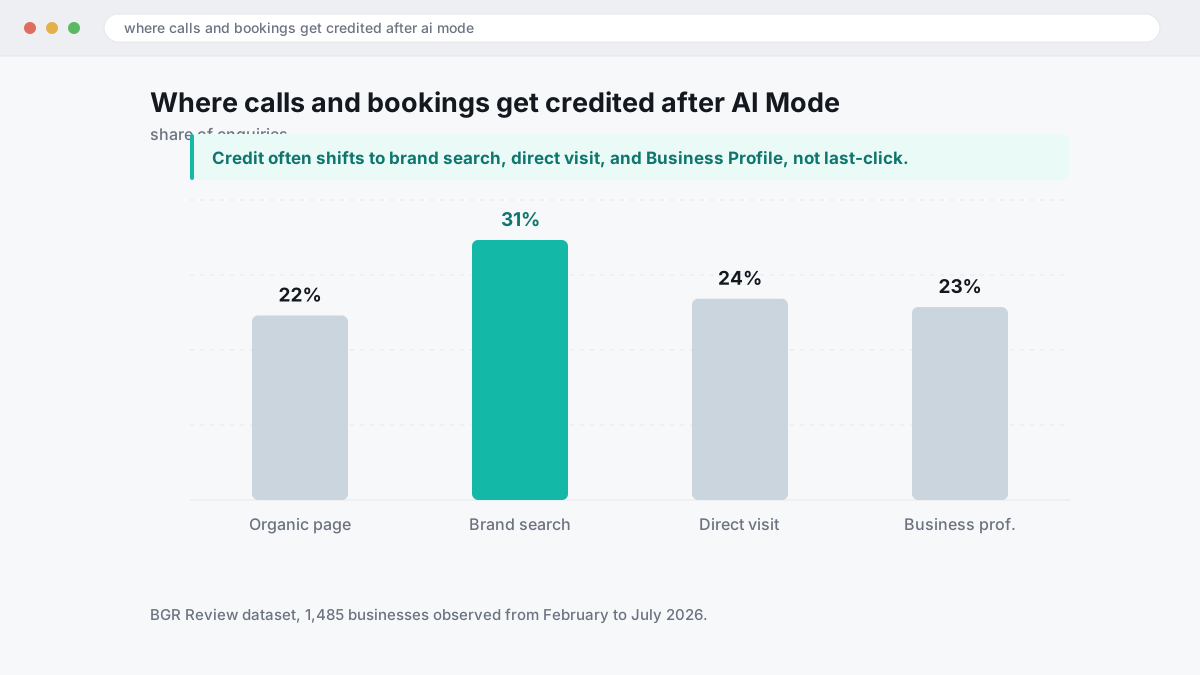
The wrong approach is to judge it only by last-click attribution from organic landing pages. That fails because source citations often do the trust-building work early, then the prospect returns later through a brand search, a direct visit, your Google Business Profile, or a saved tab and converts there. In BGR Review’s dataset of 1,485 businesses observed from February to July 2026, trades firms with complete enquiry-source data attributed 70–80% of calls and bookings to a Google Business Profile or Yelp listing rather than a website, which is a useful reminder that visibility and credit rarely sit in the same place.
The better measurement and reporting model is simple: track calls, form fills and direction requests for 4 to 8 weeks after you improve citation-ready sections, review text and entity consistency, then compare branded-search sessions, map-pack actions and close quality against the prior period. If AI Mode surfaces your business with clear source citations, you may see fewer obvious first-click wins and more “already decided” leads when people finally call or submit a form. That is usually better traffic.
Can AI Mode hurt your traffic even when visibility improves?
Yes, Google AI Mode can cut clicks, especially on simple how-to and definition queries. The better test is whether those lost low-intent visits are replaced by stronger branded search, better recall, and visitors who arrive closer to a call, booking or form fill.
The wrong read is “traffic fell, so AI Mode failed”. That fails because informational visits are the easiest clicks to lose when Google answers enough on the results page, while the visitors who still click often come with local intent modifiers, compare providers faster, and convert better once they reach your service page or Google Business Profile. If you sell reputation work like BGR Review does, a thinner top-of-funnel can still produce better lead quality when your cited brand earns trust before the click and lifts map-pack click-through later.
The right approach is tighter measurement and reporting. In BGR Review’s dataset of trades businesses with complete enquiry-source data, observed February to July 2026, 70–80% of calls and bookings were attributed to a Google Business Profile or Yelp listing rather than a website, which means AI Mode can assist demand that never shows up as a neat organic session. If your reporting ignores branded-search assists, call tracking, and offline conversions, you will undercount the gain and overreact to the traffic loss.
How do you track AI Mode visibility when Search Console does not label it cleanly?
Track Google AI Mode with proxies rather than waiting for one perfect report. Use prompt-level citation checks, branded-search movement, page engagement and assisted conversions together so you can see whether visibility is rising and whether that visibility is feeding leads.
Waiting for Search Console to label AI Mode cleanly is the wrong approach because you lose months and still learn very little about trust or lead quality. The workable approach is a weekly baseline snapshot: branded clicks, non-brand clicks to the pages you rewrote for citation-ready passages, and Google Business Profile actions such as calls, direction requests and website visits. In BGR Review's dataset of trades businesses with complete enquiry-source data, observed February to July 2026, 70–80% of calls and bookings were attributed to a Google Business Profile or Yelp listing rather than a website, so measurement and reporting that ignores GBP usually misses the real lift.
This is the minimum tracking sheet we use to separate AI Mode discovery from ordinary demand shifts.
| Signal | How often | What to record |
|---|---|---|
| 20 recurring prompts | Weekly | Whether your brand is cited, on mobile and desktop, from your target locations |
| Search Console page groups | Weekly | Branded clicks, non-brand clicks, CTR and landing pages influenced by AI answers |
| Google Business Profile | Weekly | Calls, website clicks, direction requests and map pack interactions |
| GA4 plus CRM notes | Monthly | Assisted conversions, form fills, bookings and source notes such as “found in Google answer” |
If citations rise but last-click traffic stays flat, check assisted-conversion reports before you call it a failure. AI Mode often shifts credit away from the first touch, so the monthly fix is simple: require sales or front-desk staff to add a CRM source note on every lead, then compare that note with GA4 assisted conversions and GBP actions. That works because you are measuring the path to calls and bookings, not waiting for a native report Google has not given you yet.
What should your Google AI Mode optimisation checklist include first, second, and third?
Start with crawl access and entity clarity, then make your money pages easy to quote, then measure assisted impact for 30 days. That sequence stops you polishing copy Google can index but still cannot trust, cite, or connect to the right business.
The wrong approach is doing everything at once: rewriting service pages, adding FAQs, chasing reviews and tweaking schema on a site whose key pages are weakly indexed or tied to inconsistent business details. That fails because broken dependency chains stay broken. Fix indexation first, align brand entity consistency across your site, Google Business Profile and key citations, and use structured data that matches the real business name, service area, phone and sameAs profiles; then open revenue pages with direct answer-first lines that can survive passage retrieval.
Second, make those pages quotable. Add original job examples, local proof, before-and-after situations, and service language that mirrors review signals on your GBP, because thin praise like “great service” gives AI Mode little to cite. If you use BGR Review’s review packages, the 30-day free replacement guarantee helps you keep recency steady while you build richer review text, but review growth will not rescue a page with vague openings or missing location evidence.
Third, track what moved. Use measurement and reporting that logs citation appearances over 30 days, branded search lifts, map-pack click-through, and assisted leads such as calls, bookings and form fills. AI Overviews may still take more informational clicks, while AI Mode can support higher-intent discovery, so judge the work by assisted conversions and branded demand, not last-click traffic alone.
Where to go from here
Start with one revenue page and your Google Business Profile, because AI Mode rewards clear entities, usable passages and visible trust signals before it rewards volume. Tighten the service-page intro so it names the service, place, proof and next step in plain English, then expand your profile with matching categories, services, photos and review replies that mention the real job. After that, ask for a small run of detailed reviews tied to completed work, because thin praise gives Google less to cite than specific service language.
Track three things for the next 30 days: branded search demand in Search Console, assisted calls or form fills from profile and organic visits, and local-pack visibility for your core service plus place terms. That gives you a cleaner read than rankings alone. In the review and removal work we handle at BGR Review, the pages that improve first are usually the ones where the site copy, citations and review text finally say the same thing. Expect clearer citations, stronger click-through and better-qualified leads before you expect a dramatic traffic spike.