

Quick answer
To appear in ChatGPT answers, your business needs three things: pages that can be crawled and indexed, brand details that match across the web, and third-party proof that makes the entity easy to trust and cite. ChatGPT Search rolled out broadly in late 2024 and can pull from live web pages, so stale pages, robots blocks, noindex tags and weak citation sources all slow you down. The fastest gains usually come from fixing indexation, tightening structured data and NAP consistency, and strengthening review profiles, comparison pages and authoritative mentions before you publish more content.
We handle the reputation layer that generic GEO guides usually skip. In live review-removal work, the first failed attempt is often just a basic in-platform flag with no evidence pack attached; across 12,000+ negative review cases logged June 2025 to June 2026, roughly 90% of businesses that came to BGR Review after a failed attempt had filed that way, and 70–80% of those requests had been rejected.
That matters here because source selection follows the same pattern: first-party pages surface, then review profiles and third-party mentions validate the business, then the cleanest citation pages get reused across similar prompts. BGR Review sells review growth and pay-after-success removals at $449 per removed link with $0 upfront, so this page is written from that operational angle rather than as a neutral SEO explainer.
Why do most ChatGPT SEO guides miss what actually gets you cited?
Most ChatGPT SEO guides miss the mark because they treat ChatGPT Search like a blog-ranking channel, when citation usually depends first on whether your brand is validated across trusted third-party pages with consistent brand mentions and review signals.
The wrong approach is publishing three more articles on your own site and waiting for mentions. That fails because ChatGPT often pulls from review platforms, comparison pages and directory profiles before it trusts a brand-owned claim, especially when your own domain is young. A polished services page helps, but a live Google Business Profile, a complete Trustpilot or Clutch page, and matching business details across those sources give the model something safer to cite.
The right approach is fixing source priority first: your key first-party pages, then the third-party profiles that confirm the entity, then the citation-worthy pages you want reused across similar prompts. That is why BGR Review sells verified review work across Google, Trustpilot, Yelp, Clutch and TripAdvisor, and negative review removal at $449 per removed link with $0 upfront — buyers usually need trust signals and clean validation before one more blog post will move branded search, click-through rate or conversions.
How does ChatGPT choose which brands and pages to mention?
ChatGPT Search chooses sources by answer fit, source trust and crawlable availability, not by classic rankings alone. Pages with direct answers, clean headings, consistent brand signals and supporting third-party citations get mentioned more often than broad pages that never land the point.
Most guides tell you to chase the highest Google position. That fails because ChatGPT Search is trying to assemble the best-supported answer candidate for the prompt in front of it, often with live web citations when the query is fresh or time-sensitive, such as pricing, “best” comparisons or location-led service searches. A page sitting lower in Google can still win a mention if it gives a direct answer, links to the source it relies on, and matches the same entity details your site, review profiles and company pages use elsewhere.
Authoritative citations help because they reduce ambiguity. If your comparison page names the brand exactly the same way across the title, on-page copy, schema and linked profiles, and the citation formatting is clean enough to show where a claim came from, ChatGPT has less work to do and less reason to skip you. Vague thought-leadership posts usually lose here.
The practical test is simple: can one passage answer the prompt on its own, and can the model verify who said it. If yes, that passage can be cited even when the page is not your top Google performer.
What makes a page easy for ChatGPT to quote instead of skip?
ChatGPT quotes pages that answer a narrow question straight away, use explicit headings, and place the proof beside the claim. Clean comparison tables, dated facts and visible attribution beat broad thought-leadership copy because the model can lift a precise passage without guessing what you meant.
Most guides push long opinion pieces. Those pages fail because they bury the answer under brand story, vague benefits and unsupported claims, so there is nothing clean to cite.
Structured data helps the page make sense to machines, but schema alone does not rescue weak copy. If the visible page lacks attributable facts, ChatGPT Search usually skips it and leans on clearer third-party summaries instead. Comparison pages earn mentions fastest when the table removes buying friction and the reader can verify the claims without opening six tabs.
This is the format that tends to get reused across similar prompts.
| Page type | Usually skipped | More quoteable |
|---|---|---|
| Service page | “We deliver trusted solutions” | Price, guarantee and platform named together |
| Comparison page | Wall of prose | Table comparing platforms, risks and buying criteria |
Can ChatGPT cite you if Bing cannot crawl or index your site?
No. If Bing cannot discover, render or index the pages that explain your brand, ChatGPT has less material to cite. Check robots.txt, meta noindex, canonicals and Bing indexation in Bing Webmaster Tools before you spend on content refreshes, digital PR, or any review campaign.
Most guides tell you to write a better explainer page first. That fails when the service page, location page or comparison page sits in a disallowed folder, carries a stray noindex tag, or relies on blocked JavaScript so Bing never renders the main copy. In Bing Webmaster Tools, confirm which URLs are indexed, which are excluded, and whether the fetched page matches what a visitor sees. If your London or New York location page is missing there, rewriting it will not fix citation absence.
Fix crawl access first because robots and noindex rules decide whether Bing can store the page at all. Then check canonicals, parameter handling and any template rule that points several pages back to one generic URL. We tell clients this before they buy anything from BGR Review, including review packages with a 30-day free replacement guarantee, because authority signals help only after the right pages are actually visible to Bing.
Why do brand mentions on third-party sites often matter more than one more blog post?
Third-party citations often beat one more owned article because they confirm that your brand exists beyond your own site, and ChatGPT can reuse that external validation when branded search demand is still weak or your domain has little authority.
The wrong approach is publishing a tenth opinion post and expecting volume alone to make you citeable. It fails because owned media can only repeat your own claims. A low-traffic blog post about your service says you are credible; an industry list, a news quote, a Clutch profile, or an expert roundup gives ChatGPT brand mentions from sources that are independent enough to count as authoritative citations.
The right approach is to build corroboration around the same entity. Keep entity consistency tight across your site, company profiles and press mentions: the same brand name, service labels, founder or spokesperson attribution, and contact details. If BGR Review appears one way on its site and another way on a directory, the mention is weaker; if it appears consistently alongside its New York, London and Thornhill offices, review-platform profiles and contact details, the entity is easier to recognise and safer to cite.
One quoted expert comment can outperform a low-traffic opinion post for a simple reason. A journalist, association page or ranked vendor list already has trust, so your quote inherits context your own blog has not earned yet. That is why young brands often get mentioned in ChatGPT sooner from a roundup or trade publication than from another article published on their own domain.
Do reviews and trust profiles change whether ChatGPT treats a business as mention-worthy?
Reviews and trust profiles do change whether ChatGPT treats your business as mention-worthy, because the model leans harder on corroborated credibility across Google reviews, Trustpilot and other third-party brand mentions than on a perfectly optimised page that nobody else validates.
The wrong approach is polishing title tags, adding schema and publishing another service page while your Google Business Profile shows old reviews, your Trustpilot name uses a different trading format, and your city appears three different ways across citations. That fails because weak entity consistency creates doubt about whether all those mentions describe the same business, so the model has less reason to surface you as a safe citation. A 4.8-star profile with reviews from the last 30 days usually looks more dependable than a 4.8 average built on stale social proof from last year.
The stronger approach is to align your trading name, location wording, phone details and rating signals across the places ChatGPT can cross-check quickly. Google reviews and Trustpilot do real work here because they are public, regularly updated and easier for a model to treat as review signals than a testimonial block you wrote yourself. This is one reason BGR Review sells verified review campaigns on Google and Trustpilot with a 30-day free replacement guarantee: fresh, consistent trust profiles help a brand look citeable sooner than one more on-page edit.
How is optimising for ChatGPT different from optimising for Google AI Overviews?
Optimising for ChatGPT is a different job from optimising for Google AI Overviews. Google leans harder on its own search signals and page relevance, while ChatGPT Search more visibly rewards quotable structure, corroborating third-party mentions, and a wider mix of authoritative citations around your brand.
Most guides tell you to run one GEO playbook for both channels. That fails because Google AI Overviews usually inherit more confidence from Google's existing search ecosystem: ranking pages, query relevance, internal linking, and whether your page already competes in search results. ChatGPT can answer the same commercial query with a different source stack, especially when your own site says one thing and third-party review profiles, directory listings, or comparison pages say another.
The better approach is channel-specific source priority. For Google, fix indexation, page targeting, and on-page comparison content first. For ChatGPT Search, make your first-party page quote-ready, then strengthen third-party trust evidence so the model can verify the entity quickly through authoritative citations. That works because a commercial prompt often triggers a validation chain: your site introduces the offer, review platforms and comparison pages confirm you are a real option, then the same sources get reused across adjacent prompts.
| Channel | What usually carries more weight first | What gets missed |
|---|---|---|
| Google AI Overviews | Search visibility, page relevance, existing ranking signals | Weak commercial landing pages |
| ChatGPT Search | Quotable pages, source diversity, third-party corroboration | Thin review profiles and absent comparison-page mentions |
What usually improves ChatGPT visibility fastest when you need results sooner?
The quickest lift usually comes from fixing Bing indexation, removing accidental noindex rules, and rewriting key pages so they answer buyer questions in the first lines. Third-party mentions and review signals usually take 30-90 days to build, but they do more of the trust work when ChatGPT compares brands.
The wrong move is publishing five new blog posts and waiting. That fails because ChatGPT Search cannot reuse pages that Bing has not indexed, and it rarely cites thin pages that bury the answer under sales copy, weak headings or walls of text. Check robots.txt, page-level noindex tags, canonicals and render issues first, then test whether your core service pages actually appear in Bing for branded and category searches.
The right move is repairing source eligibility before you add more content. Rewrite the pages most likely to be cited: service pages, buyer-focused comparison pages and FAQ sections that answer one commercial question at a time, with clean citation formatting, scannable subheads and entity consistency across your brand name, address and service descriptions. Content freshness helps here, but only on pages that already deserve to be cited; updating a dead blog archive does less than improving one strong “X vs Y” comparison page that matches the prompt people actually use.
After that, build validation around those pages. Fresh reviews, complete third-party profiles and brand mentions on platforms ChatGPT already trusts give your first-party claims something to lean on. Faster visibility comes from fixing eligibility first, then trust.
Why is your brand still missing from ChatGPT after you did the basics?
Brands usually stay absent from ChatGPT for a small set of fixable reasons: blocked or weak pages, messy entity consistency, thin third-party corroboration, or pages that miss the exact buying question. Check those in that order before blaming model randomness.
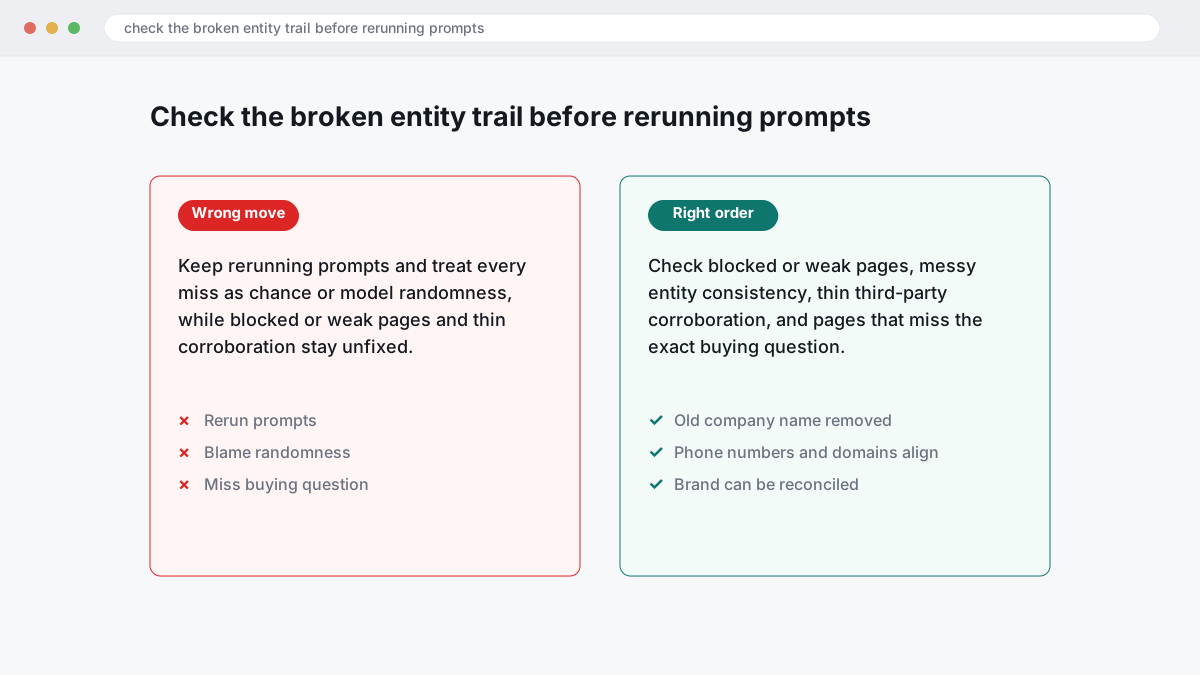
The wrong move is to keep rerunning prompts and treating every miss as chance. That fails because the absence usually traces back to a broken entity trail: one version of your brand on the site, another on your Google Business Profile, an old company name on Trustpilot or Clutch, and location pages that use different phone numbers or domains. ChatGPT Search tends to trust a brand it can reconcile across first-party pages and external profiles. If the model sees “Acme Digital”, “Acme Media Ltd” and a redirected .net domain tied to two offices, your mentions can split instead of reinforcing each other.
Your competitors can also win the citation even when your site is better written. If their authoritative citations are stronger on the same topic — a complete Clutch profile, recent Google reviews, a category mention on a trade directory, and comparison pages that state services, location and pricing clearly — they give the model more confidence than one more blog post on your domain. That is why BGR Review often starts diagnosis with third-party review profiles on Google, Trustpilot, Yelp and Clutch before touching on-page copy.
Stale pages are the third miss. A commercial page last updated in 2022 often loses to an updated 2026 alternative because content freshness affects whether a page still answers the buying query today, especially on comparisons, “best for” searches and local pack follow-up questions. In BGR Review's dataset of 1,485 businesses observed February to July 2026, agencies and digital service firms that built reviews across Google, Clutch, Yelp and Trustpilot accumulated trust signals more reliably than firms relying on one profile alone; that same spread also gives language models more current sources to cite. Trace the gap, fix the signal, then test the same prompt set again.
Is it safe to optimise for ChatGPT, or can it create spam and compliance risk?
Safe ChatGPT optimisation means making your real business easier to verify; it turns risky when you manufacture review signals, authoritative citations or expert quotes, because the same shortcuts that try to win mentions can breach platform rules and endorsement law.
The wrong approach is synthetic authority: fake Trustpilot or Google reviews, invented press mentions, bought “expert” quotes, or structured data that marks up awards, ratings or organisations you cannot prove. That fails twice. Large language models reuse third-party validation, so fabricated citations often collapse when the source page, reviewer history or entity details do not line up, and the US FTC’s endorsement guidance still applies to paid or undisclosed endorsements. Platform rules matter too. Google’s review policy, Trustpilot’s verification flow and Yelp’s recommendation software all look for authenticity, not volume.
The safer route is evidence-backed cleanup: publish accurate structured data, keep name-address-phone and brand descriptions consistent, earn real reviews on the platforms your buyers already check, and build citations on sites that actually vet listings. BGR Review sells verified review campaigns and removal work, but the boundary is simple: no fabricated reviews, no fake citations, no stuffed schema. Rules vary by country and platform — for example US FTC endorsement rules, UK consumer-protection rules on misleading commercial practices, and each platform’s own review policy — so treat this as general information, not legal advice.
What should a practical ChatGPT optimisation checklist include each month?
A usable ChatGPT checklist has four buckets: crawl access, answer formatting, corroborating third-party signals, and measurement. Miss one bucket and you can keep publishing without giving ChatGPT anything safer or easier to cite.
Most teams treat this like a one-off optimisation sprint. That fails because ChatGPT Search keeps leaning on what Bing indexation can reach now, what your canonical targets say now, and what third-party profiles still confirm now. The better approach is recurring maintenance across four signal buckets, with commercial pages refreshed every 30-60 days and profile checks run each quarter.
This is the monthly operating rhythm worth keeping in one sheet.
| Bucket | Cadence | What to check |
|---|---|---|
| Crawl access | Monthly | Confirm Bing indexation for priority URLs, test robots and noindex rules, and make sure canonicals point to the page you actually want cited. |
| Answer formatting | Monthly | Check structured data, visible headings, comparison tables and citation formatting so the page answers brand, service and comparison prompts cleanly. |
| First-party proof | Every 30-60 days | Refresh top commercial pages with dated facts, current service terms, and any changed pricing or guarantees such as BGR Review's 30-day replacement window. |
| Third-party trust | Quarterly | Audit Google, Trustpilot, Yelp, Clutch and other profiles for review recency, broken links, duplicate listings and brand-name consistency. |
Keep measurement separate from publishing. Log the prompts you care about, note whether ChatGPT mentions your brand, and compare that with clicks, form fills and map-pack demand. If the site is crawlable but absent, third-party corroboration usually needs work before another content batch does.
How do you track whether ChatGPT is mentioning your brand more often over time?
Track ChatGPT visibility with a fixed prompt library, a weekly log, and source-level notes. Record whether your brand appears in ChatGPT Search, which URLs it cites, how competitors are framed, and whether commercial prompts improve after each change you make.
Checking one prompt every few weeks is the wrong approach. It fails because answer outputs shift by date, location signals, account context, and the exact wording of the query, so a single branded search tells you almost nothing about whether your brand mentions are actually growing. Use the same prompt set every week instead: branded queries, category queries, and comparison queries. At BGR Review, this is the same measurement order we use before recommending more review-profile work or another citation page, because source selection changes faster than most site owners expect.
A simple tracking sheet works if the prompts stay fixed.
| Prompt type | What to log each week |
|---|---|
| Branded | Was your brand mentioned, which first-party or third-party URLs were cited, and whether the answer was neutral, positive, or absent |
| Category | Whether you appeared among alternatives, competitor share of mentions, and which review signals or comparison pages were reused |
| Comparison | Who was recommended, what proof was cited, and whether the answer pushed clicks, calls, or form-fill intent toward you or away from you |
Save screenshots every time. ChatGPT Search can cite a different source on Tuesday than it did on Friday, and once a citation disappears you need dated evidence to tie that drop back to a changed page, a noindex mistake, or a weaker third-party mention. If you want outside help, be clear-eyed about the commercial bit: BGR Review sells review and reputation services, with a 30-day free replacement guarantee on review packages, so the useful metric is whether those trust signals start earning more branded search demand and better conversion framing in the answers you track.
Where to go from here
Start with a citation-readiness sweep. Check that your key pages are crawlable, not blocked by robots or noindex rules, and indexed in Bing; then make your entity details match everywhere your brand appears — site footer, Google Business Profile, Trustpilot, Clutch, Companies House or LinkedIn, and the comparison pages people actually cite. That usually gives ChatGPT Search cleaner inputs within the next crawl cycle, and it gives branded search, click-through rate and map-pack trust a firmer base.
If the weak point is obvious, fix that next. Thin first-party pages rarely block citation on their own; inconsistent names, weak third-party trust and unresolved negative reviews do. In our review and removal work, the same pattern keeps showing up after a brand query: the site appears first, review profiles and mentions validate it, then the same citation-worthy sources get reused across similar prompts. If review quality is holding you back, address review acquisition. If sentiment is the issue, removal work comes before content polishing.