

Quick answer
AI search optimisation means making your brand easy for ChatGPT, Google AI Overviews and similar systems to verify, cite and compare across your site and third-party sources. That starts with crawlable service and location pages, clean indexation in Google Search Console and Bing Webmaster Tools, consistent business details, structured data, and review profiles that look trustworthy rather than thin or mixed. Google expanded AI Overviews to 200+ countries in 2024, so answer engines now intercept more buying journeys before a click. If your brand is missing, fix indexation first, then review signals, citations and comparison pages.
This page is written from live reputation and visibility work, where the pattern is usually obvious by the time a brand disappears from AI answers: the homepage is indexed, but service pages are weak, third-party citations conflict, and the review footprint is either sparse or carrying unresolved noise. In removal work, the difference between a rejected report and a successful one often comes down to the evidence pack, because the basic report button rarely gives Google, Trustpilot or Yelp enough context to act. BGR Review handles verified review growth, citation cleanup and pay-after-success removals at $449 per removed link with $0 upfront, so this ai-search guide stays tied to the signals that actually change brand inclusion, map-pack click-through rate and conversions.
Why do AI answers prefer corroborated brands over simply well-written pages?
AI search systems favour brands they can verify across multiple sources, not pages that simply read like polished SEO copy. When your business details, reviews and third-party mentions line up, an AI answer has far less risk in citing you.
Most SaaS guides treat ai-search like a content rewrite job. That fails because Google AI Overviews and ChatGPT search are trying to assemble a trustworthy entity, not reward whoever wrote the neatest 1,200-2,000 words. A strong service page can still be ignored if the same claims are missing from review platforms, directory listings, comparison pages and plain brand mentions on sites you do not control.
The weak approach is easy to spot: you rewrite headings, add FAQs, polish sales copy and call it done. The page may rank for some normal queries, but AI systems still hesitate if your E-E-A-T signals are thin outside your own site, your citation quality is poor, or one platform says you serve London while another says Greater London and a third lists no address at all. That gap kills confidence.
The stronger approach is corroboration. If your Google Business Profile, Trustpilot, Clutch, company site and third-party citations repeat the same core facts, and recent reviews support the same service claims, your brand becomes easier to include in an AI answer, easier to click in the local pack or map pack, and more likely to convert those clicks into calls or form fills.
At BGR Review, this is where missing-brand cases usually start: weak off-page proof, mixed review signals, thin comparison copy. Fixing the entity first usually does more for branded search demand and click-through rate than another round of page rewrites.
Where do Google AI Overviews and ChatGPT search pull evidence from differently?
Google AI Overviews and ChatGPT search do not judge the web the same way. Google leans on its own search ecosystem, query interpretation and pages it can cite from its web results, while ChatGPT search appears more sensitive to Bing visibility, citation-ready pages and broader brand mentions across the web.
The wrong approach is pushing one AI-search checklist everywhere: rewrite a few FAQs, add “AI-ready” copy, then expect both systems to mention you. That fails because AI Overviews usually follow Google’s understanding of the query, your page’s fit in Google Search, and whether the claim is backed by cited sources Google already trusts; ChatGPT search often tracks Bing indexation more closely, so a page missing in Bing or poorly rendered there can disappear even when Google Search Console shows it indexed and healthy. Prompt phrasing changes the output as well: “best emergency plumber near me” pulls stronger local-business evidence than a vague branded prompt, which is why at BGR Review we check comparison queries and local-intent prompts before we touch review acquisition or citation cleanup.
This is the split you need to map before choosing tactics.
| System | Indexing signal | Citation style | Local-business evidence |
|---|---|---|---|
| Google AI Overviews | Usually aligns with Google Search visibility, crawl status and query intent from Google’s own ecosystem, which you monitor in Google Search Console. | Often cites web pages already surfaced or understood by Google for that query. | Google Business Profile, review signals, map-pack prominence and corroborating third-party pages matter more on local-intent searches. |
| ChatGPT search | Commonly reflects Bing indexation and how cleanly Bing can fetch and understand the page. | Often prefers concise, citation-ready pages plus repeated brand mentions on third-party sources. | Local evidence still matters, but broad web corroboration usually does more work before branded search demand and conversions lift. |
The right approach is running two checks in parallel: confirm Google eligibility in Search Console, then confirm Bing can index and render the same pages cleanly, while your reviews, citations and comparison pages tell the same story. That works because AI answers reward corroborated entities; if your star rating, service area, brand name and third-party citations line up, you earn more mentions, higher click-through rate from cited answers, and better map-pack support instead of vanity visibility.
Why does your brand appear in normal search but disappear from AI answers?
Your brand can rank in normal search and still vanish from AI answers when the entity record does not line up. Conflicting names, locations, categories, weak review proof, missing citations or poor indexation usually block inclusion before page copy becomes the problem.
The wrong move is rewriting service pages because you already rank for your brand name. That fails because Google AI Overviews and ChatGPT search look for a corroborated entity, not a page that happens to sit on page one. If your site says “Acme Dental London”, your Google Business Profile says “Acme Dentists”, a directory uses an old address, and brand mentions point to two categories, the model has less reason to recommend you in comparison prompts or map-pack style local queries.
Check the plumbing first. In Google Search Console, confirm the key brand, location and comparison pages are indexed under the current canonical version, then search for brand aliases, old phone numbers and stale address variants. In Bing Webmaster Tools, inspect crawl and index coverage because ChatGPT search often surfaces Bing-linked evidence faster than a freshly updated page on your site.
Thin third-party proof causes the next failure. A brand with a decent website but few trusted citations, sparse review signals and barely any independent brand mentions can still rank for navigational searches, yet drop out when the prompt asks for “best”, “top” or “compare” because the system wants external confirmation. This is the audit step BGR Review runs before any review campaign starts, because fixing citation mismatches and weak corroboration usually moves visibility faster than another content rewrite.
What should you fix first when optimising for AI search?
Fix crawlability and entity clarity first, then strengthen proof. The quickest gains in AI search usually come from cleaning up indexation in Google Search Console and Bing Webmaster Tools, aligning your core brand facts, adding machine-readable evidence, and improving third-party trust signals before you publish another blog post.
Most teams do the opposite. They commission more top-of-funnel content, then wonder why Google AI Overviews or ChatGPT search still cite directories, review platforms, or a competitor’s comparison page. That fails because a well-written page without discoverability and proof gives an AI system very little to corroborate. Start by checking sitemap health, crawl errors, excluded URLs, duplicate canonicals, and pages discovered but not indexed in both webmaster platforms; if your main service pages are weak there, new content just adds more uncertainty.
Then tighten entity consistency across the pages that matter. Your business name, address, phone, service area, pricing language, guarantees, contact details, and review-platform links should match across your homepage, service pages, footer, schema, and third-party profiles. If one page says “review removal” and another says “content dispute help”, while your citations use an old phone number, E-E-A-T signals weaken because the web cannot agree on who you are or what you do. A structured evidence block helps here: clear company details, named services, platform coverage, support contacts, and any fixed commercial terms you are willing to stand behind.
Proof beats volume. Before you write new articles, strengthen reviews, claim support, and third-party citations that can confirm your brand independently. In BGR Review’s dataset of 1,485 businesses observed February to July 2026, local visibility improved after review accumulation in the early months for qualifying local-service profiles, which is why review recency and citation quality usually move click-through rate, branded search demand, conversions, and even map pack visibility faster than another awareness post. Publish fresh content after those foundations are stable.
How does structured data help AI systems trust what your page claims?
Structured data helps AI systems read who you are, what you offer, and which claims on the page are explicitly supported. It does not guarantee inclusion in ChatGPT search or Google AI Overviews, but clean schema gives machines clearer brand facts, source relationships, and evidence to trust.
Most guides treat schema as a ranking trick. That fails because markup cannot rescue a weak entity. If your Organisation schema names one business, your footer shows another, and your Google Business Profile, Trustpilot or Clutch URLs are missing from sameAs, you leave AI systems guessing which brand mention belongs to you. Organisation schema works when it confirms identity: legal or trading name, official site, logo, contact details, and the exact third-party profiles you actively maintain.
Review and FAQ markup help in the same way. They structure evidence already visible on the page. If you mark up reviews, the rating, count and source need to match what a user can read; if you mark up FAQs, the questions and answers need to appear on-page in full. Google’s structured data documentation and spam policies are clear on that point, and it lines up with E-E-A-T: supported claims beat decorative markup.
Validate after deployment in Google Search Console, then check the live page rather than a staging copy. Broken JSON-LD, orphaned fields and schema copied from an old template waste implementation time. We often find this during reputation-page rebuilds before a BGR Review campaign goes live, especially where a business has added new review sources but never updated sameAs or visible review totals.
How do review signals influence whether AI answers trust your business enough to mention it?
Review signals help AI systems decide whether your business looks credible, active and safe to recommend. A high star average on its own rarely carries enough weight; review count, recency and platform verification create the corroboration that AI answers and E-E-A-T systems respond to.
Most guides push the average rating first. That fails when the profile behind it is thin: a 5.0 from six reviews, last posted nine months ago, plus a few anonymous site testimonials, gives ChatGPT search and Google AI Overviews very little third-party evidence to lean on. A balanced profile works better: recent Google or Trustpilot reviews, clear reviewer histories, and steady volume across places where the platform can see the review is native rather than self-published.
Negative review suppression matters here as well. If your visible profile is dragged down by policy-breaching reviews, AI systems can treat the brand as disputed or lower-confidence even when your service is strong. In BGR Review's case file of 12,000+ negative review cases logged June 2025 to June 2026, reviews raised within 28 days of posting and backed by an identifiable policy issue resolved successfully in roughly 90% of cases; beyond 28 days, observed success fell to approximately 25–30%, which is why stale damage lingers in AI answers longer than most owners expect.
This is the practical weighting to use when you audit review signals for AI-search visibility.
| Signal | Strong when | Best use case |
|---|---|---|
| Rating strength | Solid average with some critical reviews and business replies | Improving click-through rate from branded search and comparison queries |
| Count strength | Enough native reviews to show market credibility in your category | Winning map pack trust and supporting conversions from local intent |
| Freshness | New reviews arriving consistently over recent weeks or months | Staying mentionable in AI answers that favour active, current businesses |
Verified or platform-native reviews usually do more for mention likelihood than polished testimonials on your own site. If you need to strengthen that layer, BGR Review sells verified review packages with a 30-day free replacement guarantee, while removal work stays separate on a pay-after-success basis at $449 per removed review link with $0 upfront.
Which third-party citations actually increase your odds of being cited in AI answers?
AI answers trust third-party citations that identify your business clearly, fit your category, and carry fresh details that support your claims. Thin directories built for old SEO tactics add noise, and that noise can weaken entity confidence rather than help it.
The wrong approach is citation volume: submit your name, address and phone to fifty low-value directories, spin a few brand mentions, and hope AI Overviews or ChatGPT search treat that as authority. It fails because those sources rarely say enough to corroborate who you are, what you do, where you operate, or why a reader should click. The right approach is category-relevant corroboration from profiles that hold real identity fields, service detail, review signals and recent activity. That is why BGR Review's review packages focus on Google Business Profile, Trustpilot, Yelp, Clutch and TripAdvisor, with a 30-day free replacement guarantee, rather than directory spam.
The platform mix matters, so use the profiles that match the query type you want to win.
| Platform | Best fit | Why AI systems cite it |
|---|---|---|
| Google Business Profile | Local pack, map pack, service-area and near-me queries | Strong identity data, category relevance, opening hours, location detail and fresh reviews |
| Trustpilot | Brand trust, complaints, legitimacy and comparison queries | Clear business identity, public review history and branded search reinforcement |
| Clutch | B2B vendor, agency and software comparison queries | Category-specific positioning, service focus and richer company descriptions |
If your brand shows in normal search but disappears from AI answers, check whether your strongest citations agree on business name, category, service scope and review freshness. Clean three strong profiles before you build thirty weak ones. Fresh, consistent third-party citations improve click-through rate from comparison results, help branded search demand hold, and give AI systems cleaner evidence to quote.
How can you turn reviews, citations, and schema into one repeatable AI-search workflow?
Build one page, one claim set, and one proof set at a time. AI inclusion gets more plausible, and easier to measure, when your page copy, structured data, review signals, and third-party citations all confirm the same entity details instead of drifting apart.
Most guides split the work: content team updates the service page, SEO adds schema, someone else asks for reviews, and directory listings get ignored. That fails because AI systems check corroboration, not effort. If your “emergency plumber” page says 24/7 callouts, your Google Business Profile says different hours, and your third-party citations barely mention the service, Google AI Overviews and ChatGPT search have no clean evidence stack to trust. At BGR Review, this is also where a review package with a 30-day free replacement guarantee helps; you can keep the proof set consistent while the page and citation layer catch up.
Start with one priority service page that already matters for calls, bookings, form fills, or map-pack clicks. Pull every commercial claim from the page into a worksheet: service offered, location served, turnaround, credentials, price framing, and any comparison promise. Then match each claim to one on-site proof source and one third-party proof source. On-site proof usually means visible copy plus structured data such as LocalBusiness, Service, FAQPage, or Review markup where it fits Google's Search Central rules. Third-party proof means review text, profile categories, Clutch or Trustpilot wording, or consistent business details across citations.
Use this sequence:
- Audit the page and fix entity consistency first: name, address, phone, service labels, and schema fields must match your main profiles.
- Strengthen weak claims with review request timing and prompt phrasing that pull usable proof, such as asking customers to mention the completed service and location in their own words rather than feeding a script.
- Wait 4-8 weeks, then recheck branded queries and live prompts in ChatGPT search and Google AI Overviews. Ask direct comparison prompts, service-plus-location prompts, and branded prompts. If the answer cites competitors or ignores you, the missing proof is usually in review text, citation quality, or mismatched schema rather than the page copy itself.
Does AI-search optimisation actually drive leads, or just vanity visibility?
AI-search optimisation drives leads when it wins visibility on decision-stage prompts rather than broad educational searches. The payoff usually shows up first on branded, local and comparison queries, where the buyer is already close to calling, booking or filling a form.
The wrong approach is counting impressions from generic prompt phrasing such as “what is reputation management” and treating AI Overviews or ChatGPT search mentions as success on their own. That fails because informational visibility often lifts curiosity, while commercial prompts like “best review management company for dentists near me” or “BGR Review vs Trustpilot review service” sit much closer to conversions, branded search demand and local pack clicks. In BGR Review’s dataset of 1,485 businesses observed February to July 2026, trades businesses that shared complete enquiry-source data attributed 70–80% of calls and bookings to a Google Business Profile or Yelp listing rather than a website, which is why shortlist-stage visibility beats vanity traffic.
The right approach is to judge value the way your sales team feels it first: assisted-conversion tracking in Google Search Console and CRM notes, a lift in branded search, and sales-call mentions such as “I saw your name in ChatGPT” or “Google’s AI answer listed you with two competitors”. Brand mentions on trusted third-party pages usually help more here than another rewritten blog post, because they support comparison answers where buyers are weighing options. If you sell high-consideration services, give this work 30 days before judging it; BGR Review’s own review packages use a 30-day free replacement window for the same reason — trust signals need time to settle and influence click-through rate.
Where do safe optimisation tactics end and spam or compliance risk begin?
Safe AI-search optimisation means making your evidence easier to verify, your pages easier to index, and your brand easier to corroborate across trusted sources. Risk starts when you invent review signals, buy fake mentions, or use misleading schema to overstate reputation or expertise to platforms, users, or regulators.
The wrong approach is manufacturing proof: posting bought reviews on Google or Trustpilot, placing undisclosed paid endorsements, spinning fake brand mentions on low-quality directories, or marking up pages with aggregate ratings that do not reflect real customer feedback. That fails for two reasons. Platform filters and manual reviews are built to catch weak citation quality and unnatural review patterns, and consumer-protection rules sit behind them. In the US, the FTC's Endorsement Guides require disclosure when an endorsement is paid or incentivised; in the UK, fake or misleading review practices can raise issues under consumer-protection law.
The right approach is strengthening proof: collect genuine reviews, disclose any material connection where the law or platform requires it, clean up inconsistent citations, and use structured data that matches what a reader can verify on the page. That works because AI answers favour corroborated entities, not synthetic popularity. If a review states false facts about your business, a defamation angle may exist alongside a platform-policy complaint, but outcomes depend on jurisdiction, wording and evidence. This is general information, not legal advice.
What does a practical AI-search checklist look like for the next 30 days?
A practical AI-search plan starts with crawl and index access, then fixes entity consistency, then adds trust signals. In 30 days, you can complete a credible first pass without rebuilding your whole content strategy or rewriting every service page.
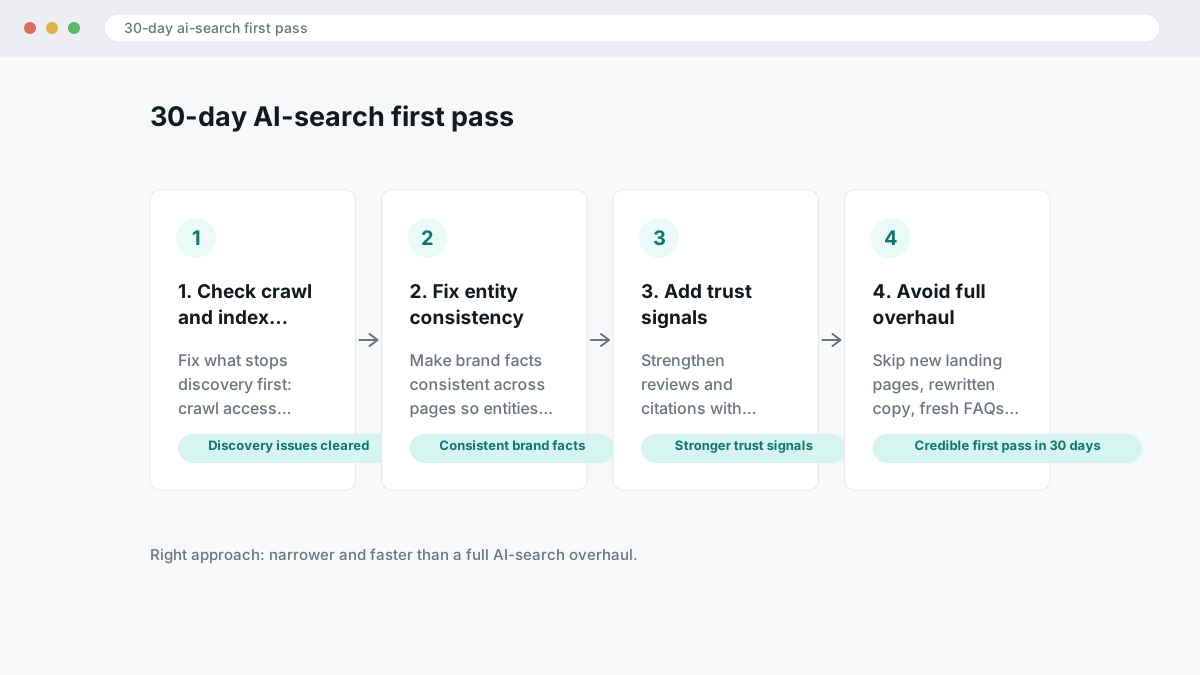
The wrong approach is a full AI-search overhaul: new landing pages, rewritten copy, fresh FAQs, and no technical cleanup. That fails because Google AI Overviews and ChatGPT search still look for corroborated entities, clean canonical signals, and matching third-party evidence. The right approach is narrower and faster. Fix what stops discovery first, then make your brand facts consistent, then strengthen reviews and citations so your pages have something to be trusted against.
Use this sequence.
- Days 1-7: check Google Search Console for index coverage, submitted sitemap status, and pages excluded by duplicate or canonical conflicts. In Bing Webmaster Tools, confirm the sitemap is fetched and inspect key URLs for crawl or rendering issues.
- Days 8-14: standardise your business name, address, phone, category, and service descriptions across your site and priority profiles. Add Organisation schema to your homepage and core commercial pages so structured data supports the same facts your citations carry.
- Days 15-30: improve review recency, tighten third-party profiles, and test weekly prompts such as “best [service] near me” and “compare [brand] vs [competitor]”. If you outsource review growth, BGR Review starts delivery in 24-48 hours and includes a 30-day free replacement guarantee on review packages.
If your brand already ranks in normal search but drops out of AI answers, this checklist usually fixes the gap faster than a content rebuild. It also improves map-pack click-through, branded search demand, and conversions because the same trust evidence supports both search results and AI citations.
Where to go from here
Treat AI search as an entity-trust problem first. If ChatGPT search, AI Overviews or Bing-cited answers keep skipping your brand, start by checking indexation in Google Search Console and Bing Webmaster Tools, then clean up entity consistency across your main citations, then tighten the pages where buyers compare you with alternatives. That order usually moves click-through rate, branded search demand and map-pack visibility faster than publishing another batch of generic articles.
Your next step is simple: audit three things this week — which key pages are indexed, whether your Google and third-party review profiles tell the same story, and whether your comparison pages contain real proof, clear positioning and current structured data. You should expect gaps to show up quickly. Missing citations, mixed review signals and thin comparison copy are usually visible within a single review pass.
If the foundation is clean, decide whether the next job is review growth or removal.