


Quick answer
AI Overviews choose sources one query at a time, not from a fixed whitelist. Google says the feature uses its core ranking systems and can draw supporting information from across the web, often from a specific passage rather than an entire page. Since the US rollout in May 2024, the pages that surface most often are the ones with direct answers, verifiable facts, clean entity signals, and evidence Google can crawl in its Search index. There is no submission form. Your practical route is to tighten passages, reconcile brand facts, and publish citable proof on pages already indexed.
We work where source trust breaks down: business profiles, review platforms, and the evidence trail behind public claims. In our removal workflow, the difference between a rejected report and a successful one often comes down to whether the first filing included a policy-grounded explanation and supporting screenshots, because the basic in-platform report button rarely carries enough context on its own.
This matters if you want visibility from ai overviews without guessing. BGR Review sells review-growth and negative review removal services, so we are close to the pages, profiles, and brand facts Google has to reconcile across Search, the Knowledge Graph, Google Business Profile, Trustpilot, Yelp, Clutch, and TripAdvisor.
Why do generic AI Overviews checklists miss how source selection actually works?
AI Overviews do not choose one “best site” and keep sending it traffic. They assemble answers query by query, often through passage-level retrieval, favouring text that fits the task, matches the entity being asked about, and lines up with other sources that say the same thing.
Most checklists tell you to optimise one page for every overview opportunity. That fails because query intent matching is narrower than page-level SEO: a reader searching “Google review removal cost” needs a direct passage about a pricing model, while “are paid reviews allowed” needs policy-grounded text about the FTC’s rule on fake reviews and platform terms. On BGR Review’s own pages, a sentence like “$0 upfront, $449 per removed review link” can be citable for a removal-cost query, while the same page can be ignored for a compliance query if it does not answer the policy question cleanly.
The better approach is to build distinct passages for distinct query tasks. A reputation page earns citations when each block resolves one job clearly: what the service is, what the limit is, what the proof is, and which entity it refers to — Google reviews, Trustpilot reviews, Yelp recommendation software, or Clutch verification. Source corroboration often beats generic domain authority here; if your brand facts, review platform entities, and contact details stay consistent across your site and external mentions, Google has less ambiguity to reconcile and more reason to cite you today, then cite a different source tomorrow for a different task.
How do AI Overviews decide which passages deserve a citation?
AI Overviews usually cite passages that answer the query in the first line, sit under a clear heading, and carry supporting facts close by. A tight paragraph on a smaller site can beat a vague block on a stronger domain because Google is often retrieving at passage level, not rewarding brand size by default.
The wrong approach is broad thought-leadership copy: long introductions, soft claims, and facts buried three scrolls down. That fails query intent matching. If your heading says how review removal works, then the lead sentence wanders into brand story, Google has little clean text to extract for an overview or a featured snippet. The right approach is blunt and structured: heading, one definition-style answer, then the proof. On a BGR Review page, a line such as “negative review removal is pay after success at $449 per removed review link with $0 upfront” gives the system both the answer and the supporting detail in one place.
Passage-level retrieval also rewards nearby evidence. A clean section works when the heading matches the search, the first sentence resolves the question, and the next lines add specifics such as a named platform, a policy route, or a timeline like BGR Review’s 30-day free replacement guarantee on review packages. That layout reduces ambiguity. It tells Google which sentence to quote and which surrounding facts support it.
This is why a smaller domain can win a citation over a bigger one. If the larger site has a woolly paragraph about “building trust online” and your page has a section headed “How Google review removal pricing works” followed by a direct answer, the extractable section is often the better fit. Strength still matters at page and domain level, but weak paragraphs waste it. Clean, answer-first writing gives AI Overviews something usable.
Why can smaller sites appear in AI Overviews ahead of bigger brands?
Smaller sites win AI Overview citations when their facts are clearer, tighter and easier to verify across the web. On narrow queries, precision and entity clarity often beat raw brand size.
The wrong approach is to assume a big domain and strong homepage authority will carry every query. That fails because source corroboration works at claim level: Google looks for a passage it can reconcile with other indexed sources, the Knowledge Graph, and consistent brand references across review platform entities such as Google, Trustpilot or Clutch. If your company name, service wording and location details drift between pages, Google Business Profile and third-party listings, brand mention consistency breaks, E-E-A-T signals weaken, and the bigger brand can lose the citation.
The better approach is to publish a narrower answer with claims that line up everywhere your brand appears. That kind of passage can outrank a larger brand’s vague “online reputation solutions” copy because it answers the exact query, supports conversions better, and can lift click-through rate when the citation matches what the searcher asked.
How are AI Overviews different from featured snippets when Google chooses a source?
Featured snippets usually pull a direct answer from one page, while AI Overviews can merge passages from several sources into one response. Both reward clean, extractable writing, but AI Overviews lean harder on source corroboration before Google decides which citations to show.
The wrong approach is to treat AI Overviews as featured snippets with a new label and chase one perfectly formatted block. That fails because snippet logic is often single-source extraction, whereas an overview can cite your pricing explanation, another page's definition, and a third source's supporting fact if your page gives only a partial answer. In BGR Review's content workflow for reputation pages, we still write snippet-friendly blocks of roughly one direct answer per heading, but we also add evidence that can survive comparison against review platform entities, brand profiles, and Google Business Profile details.
This comparison is easier to see side by side.
| SERP feature | How Google tends to use sources | What to optimise |
|---|---|---|
| Featured snippets | Often extracts one passage from one page | Short answer blocks, strong heading-to-answer match, clean lists and tables |
| AI Overviews | Can synthesise several pages and show multiple citations | Passages that answer clearly, plus corroborated facts, consistent entity details and supporting context |
The right approach is to optimise for synthesis and extraction at the same time. Structured data still helps because it clarifies page type, organisation details and review information for Google's index, but schema alone will not earn a citation if the visible copy makes claims no other reliable source supports. That is why we tighten headings, reconcile brand facts across platforms, and then monitor citation changes by query cluster rather than celebrating one featured-snippet style win.
What has to be true before your page can even be considered as a source?
Your page can only be considered for an AI Overview citation if Google can crawl it, place it in the Google Search index, and treat that URL as the canonical source of the answer rather than a duplicate or a script-heavy shell.
Most guides tell you to chase prompts first. That fails because prompt testing does nothing for a page that sits outside the index, points its canonical at another URL, or loads its key claims through JavaScript that never becomes reliable HTML. On BGR Review content audits for reputation and review-service pages, the first checks are always URL inspection, rendered HTML, robots directives, and whether duplicate city or service pages are competing with each other.
The safer route is boring technical work. Put the core answer in stable HTML, keep one indexable canonical URL, and use structured data to reinforce entity facts such as brand name, contact details, review platform entities, and service type. Structured data will not force a citation, but clean markup plus clean canonicals gives Google one consistent source to retrieve, cache, and cite.
Which reputation signals make a business easier for AI Overviews to trust?
AI Overviews trust businesses that present the same identity across their site and third-party profiles, because consistent names, locations, services, authorship and cited facts give Google clearer entity matches in the Search index and Knowledge Graph.
Most reputation-led teams treat reviews as conversion proof only. That fails when your homepage says one service mix, your Google Business Profile shows another, and your Trustpilot or Clutch profile uses a shortened brand name or an old office address. Those mismatches blur brand mention consistency, weaken review platform entities as evidence, and make your page harder to cite even if your map-pack click-through rate is healthy. If you buy or earn reviews through BGR Review, the first cleanup step is usually factual alignment across the site, Google, Trustpilot, Yelp or Clutch before any new package starts its 30-day free replacement window.
The stronger approach is to make every mention verifiable. Use a named author on reputation pages, cite primary sources such as Google Search Central or platform policy pages, and repeat the same legal business name, service area and service labels across your site and profile ecosystem. That builds E-E-A-T signals Google can reconcile, helps review platform entities reinforce your service context, and lifts the chance that an overview cites you for brand facts that later support conversions, branded search demand and local pack visibility.
What should a business fix first to improve AI Overview visibility?
The fastest gains usually come from three fixes: get the page indexed under the right canonical, turn key sections into direct answer passages, and add evidence other sources can verify. Technical eligibility plus passage quality beats cosmetic tweaks every time.
Most checklists start with schema alone. That fails because structured data does not rescue a page that Google has deindexed, split across duplicate URLs, or assigned to the wrong canonical in the Search index. Before you rewrite a single block, check that one live URL is indexable, self-canonical, and internally linked from the page you actually want cited; this is the same order we use before we touch review-platform content for clients buying Google, Trustpilot, Yelp or Clutch review campaigns through BGR Review.
Once the page is eligible, rewrite weak sections for passage-level retrieval. A vague paragraph like “we help manage online reputation” gives Google nothing stable to lift into an overview, while a lead sentence such as “Google usually cites the passage that answers the query in the first line and supports it with named evidence” gives it a clean extractable answer. That structure strengthens E-E-A-T signals because the claim, the scope, and the support sit together instead of being scattered across the page.
Evidence comes next. On volatile topics such as fake-review policy, platform removals, or endorsement rules, add named sources and an update date like “Updated July 2026”, then cite the relevant source directly, such as Google Business Profile Help or the FTC’s 2024 rule on fake reviews. Freshness and change frequency matter most where rules move; if your citations stay old, your passages lose trust first, then clicks, then branded search demand.
What does an AI Overview source audit checklist need to catch?
A useful audit checks three layers in order: whether Google can index the page, whether its systems can pull a clean answer passage, and whether other trusted sources back up the facts. Miss one layer and your citation chances fall, even if the page still ranks.
The wrong audit looks only at rankings, then asks why a page in position three lost the citation to a bigger brand or a smaller niche site. That fails because source selection is narrower than ranking: Google may find your URL in the Search index, then skip it because the passage is vague, the evidence is thin, or your brand facts differ from your Google Business Profile, Trustpilot, Clutch or Yelp listings. In the workflow we use before a reputation page is ready for review-package delivery starting in 24-48 hours, we audit one query set, one target page and one competing cited source side by side.
Use the checklist below to score query intent matching, passage clarity, evidence depth and brand mention consistency. Add structured data to help entity reconciliation, but do not expect schema to rescue a weak passage. Measurement and monitoring matter here: rerun the same query cluster weekly and log which citation changed, because AI Overview source choices move more than standard blue links.
The fastest way to make this usable is to compare your page against one source Google already cites for the same query.
| Eligible | Extractable | Corroborated |
|---|---|---|
| Indexed URL, crawlable page, accurate title, relevant to one query set, structured data present where it genuinely fits. | Direct heading-answer match, short answer block, specific claims, scannable passage, no filler between question and answer. | Facts align with review platform entities, brand name/address/phone stay consistent, claims backed by named sources or first-hand evidence. |
This works because it separates eligibility from extractability and corroboration.
How should you build passages that AI Overviews can cite with confidence?
Build passages so the answer comes first, the proof follows in the next line, and every entity reference is explicit. A clean lead sentence with named evidence leaves AI systems less guesswork, less ambiguity, and less citation risk.
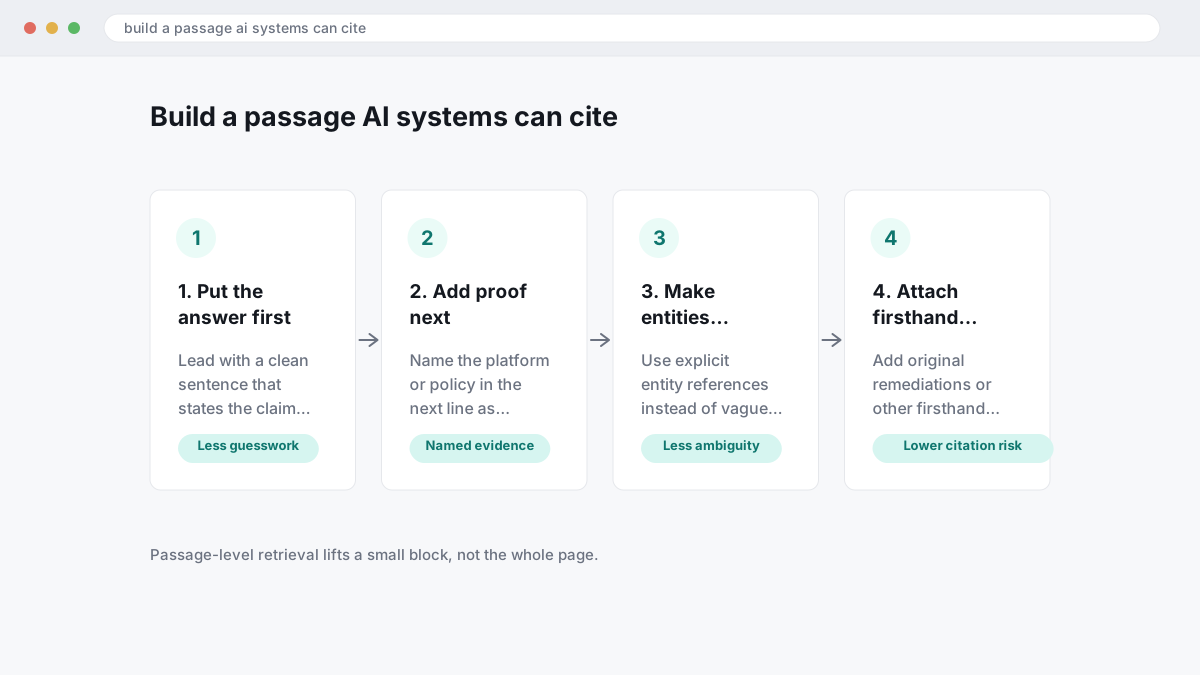
Most guides still bury the answer after brand context, service history, and broad claims. That fails because passage-level retrieval lifts a small block of text, not your whole page, and a vague paragraph about “trusted review management” gives Google’s systems nothing firm to cite. If you want a reputation page quoted, state the claim in the first sentence, name the platform or policy in the second, then attach original firsthand content such as your actual removal workflow: report, evidence pack, platform submission, outcome check.
The comparison is easier to see side by side.
| Passage style | Why it loses or wins citations |
|---|---|
| “Online reviews matter for modern brands because trust drives decisions.” | Too generic. No named entity, no source corroboration, no evidence the claim belongs to your business. |
| “Google review removal requests fail when the report includes no policy evidence; our removal service charges $0 upfront and $449 per removed review link after success.” | Clear answer first, explicit entity, commercial fact the reader can verify, and a specific process context. |
Structured data helps only when it matches the visible page. Mark up your organisation, sameAs profiles, and review platform entities, then keep brand facts identical across the page, your Google Business Profile, Trustpilot, and Clutch. On pages we rewrite for citation, the workflow is simple: tighten headings, add named evidence, reconcile brand facts, then monitor citation changes by query cluster.
Can AI Overviews cite wrong, outdated, or harmful sources?
Yes. AI Overviews can cite incomplete, stale, or harmful sources because the source set shifts by query and can change across days, devices and users. You need to monitor citations directly, because a bad source can surface even while your core rankings and map-pack visibility look stable.
Most checklists treat one citation win as durable. That fails because citation volatility is built into passage selection: Google can swap a support thread, an old pricing page, a forum post, or review platform entities such as Google Business Profile, Trustpilot or Yelp when the query wording changes slightly. If your brand facts differ across those entities, or an old review attack still ranks, the overview can amplify brand confusion, depress click-through rate and push more branded search demand toward the wrong claim.
Freshness and change frequency matter most where the cost of being wrong is highest: policy, health, pricing and breaking topics. A page updated last week with clear dates, corrected rates and matching entity details usually holds up better than an undated evergreen explainer, but only if the changes are visible in the indexed page. The practical fix is simple: reconcile your current offer pages with your review profiles, then watch risky query clusters every few days.
Harmful citations are often easiest to fix early. In BGR Review's dataset of 12,000+ negative review cases logged June 2025 to June 2026, reviews raised within 28 days of posting and supported by an identifiable policy issue resolved successfully in roughly 90% of cases; beyond 28 days, the observed success rate fell to approximately 25–30%.
How do you track AI Overview mentions without fooling yourself?
Track AI Overviews with a fixed query set, the same location and device settings, and a simple weekly log of cited domains over time. One screenshot tells you almost nothing; repeatable checks show whether your visibility is actually improving or whether citation volatility is just moving citations around.
The wrong approach is checking one query after a ranking jump, saving a screenshot, and calling it progress. That fails because source selection is query-by-query, answer formats change, and the same brand can appear on Monday, disappear on Wednesday, and return under a different query intent match the next week. In our editorial workflow at BGR Review, we only treat an Overview mention as meaningful when it holds across a query cohort for several weekly checks, not a single branded search after a page edit.
The right approach is boring and reliable. Keep one sheet and log four fields every week: the query, the query class, the cited domains, and the answer format. Add whether your domain appeared, because a list-style answer, a comparison answer, and a local reputation answer can pull different sources even when the core topic looks similar.
Manual measurement and monitoring still matter because many tools record that an Overview appeared but miss citation nuance inside the answer.
What should you do if competitors keep getting cited instead of you?
When a competitor keeps getting cited, compare the exact passage Google appears to use against your nearest equivalent section, not the whole page. The gap is usually clearer query intent matching, better source corroboration, or cleaner entity signals such as consistent brand names across your site, review profiles and business listings.
The wrong move is publishing five new pages and hoping one lands. That fails because AI Overviews are passage-led, so a weak paragraph stays weak even if you surround it with more content. Put the competitor’s cited block beside yours and mark the first losing factor: does their heading answer the query more directly, do they attach original firsthand content such as a real process note or dated screenshot, or do they reconcile facts that your page leaves fuzzy, like office location, service scope or review platform entities? At BGR Review, this is the same clean-up sequence we use before retesting a reputation page: tighten the heading, add evidence, then fix brand mention consistency across Google Business Profile, Trustpilot, Clutch and the site itself.
The right move is to improve the losing passage first and only then widen the page. After meaningful edits, retest the same query cluster in 2 to 4 weeks. Shorter checks usually catch citation volatility, not a settled result, and longer waits slow down fixes that could lift click-through rate, branded search demand and conversions from the map pack.
Where to go from here
Start with one query cluster, not your whole site. Pull the searches that already mention your brand, category and location, then review the pages Google could cite for them: your service page, about page, contact details, review profiles and any comparison or FAQ content. Tighten the headings, add evidence under each claim, reconcile your business name, address, phone and review-platform entities, and make sure the same facts appear across Google, Trustpilot, Yelp, Clutch or TripAdvisor where relevant.
The result you should expect first is cleaner citation behaviour, not instant rankings. AI overviews shift source choices query by query, so the early win is less citation volatility, steadier branded search demand, stronger map-pack click-through rate and better conversion quality from people who arrive already trusting the source. If your reputation pages are thin or inconsistent, fix those before broader AI-search work.
That is usually the first audit we run at BGR Review before any review or removal work: passage clarity, evidence gaps and brand mention consistency. If you do the same review internally this week, you will know which pages can become citable and which ones are still giving Google mixed signals.