

Quick answer
Google review removal works when a review breaches Google Business Profile rules on prohibited and restricted content, usually spam and fake content, conflict of interest, impersonation, harassment, or reviews that are plainly off-topic. A harsh one-star review usually stays live if it reflects a real customer experience. The deciding factor is proof: order records, staff logs, location data, screenshots, or evidence the reviewer named the wrong business or stated false facts. If you hire a provider, pricing varies. BGR Review charges $0 upfront and $449 per removed review link only after success.
Most pages stop at “flag the review” and leave out the part that decides the case: the policy bucket and the evidence pack behind it. In the disputes we handle, the reviews that move are usually the ones filed within 28 days, matched to a specific rule breach, and backed by documents rather than a single report-button click.
This guide is built from real Google review removal workflow, not policy paraphrasing. We track outcomes across 12,000+ negative review cases logged from June 2025 to June 2026, and one pattern is hard to miss: once a request is rejected, the next step is usually escalation with the original case ID, not filing the same weak report again.
Which bad Google reviews are actually removable, and which usually stay live?
Google removes a narrow set of review types most often: spam, impersonation, wrong-business posts, undisclosed conflicts, and some false factual claims. A harsh but genuine customer opinion usually stays live, so your first job is to match the review to the right Google Business Profile policy bucket.
Most guides treat any unfair one-star post as a dispute. That fails because Google enforces prohibited and restricted content, not your sense of fairness. The right approach is narrower: check whether the review fits spam and fake content, an undisclosed employee or competitor conflict, or an off-topic review aimed at the wrong business. If it does not, you are usually in a response vs removal decision, not a removal case.
The table below is the practical split we use before anyone spends time on a flag or $449 on BGR Review's pay-after-success removal service.
| Review type | Removal likelihood | What usually decides it |
|---|---|---|
| Spam, fake lead-gen, copied text, bot-like posting | High | Clear spam signals, repeated wording, reviewer account patterns, no customer record |
| Impersonation or hacked-account posting | High | Identity mismatch and account evidence |
| Wrong-business or wrong-location review | Medium to high | Proof the reviewer meant another company, branch or service visit |
| Current or former employee review, undisclosed competitor conflict | Medium | Conflict-of-interest proof tied to the reviewer |
| False factual claim inside an otherwise real review | Medium | Verifiable records, dates, invoices, call logs, booking history |
| Generic one-star complaint, rude opinion, “bad service” | Low | Usually stays live unless another policy issue is documented |
A review can hurt your local pack click-through and conversions and still be non-removable. If the post sounds like a real customer, even an unreasonable one, a fast public reply and a steady review acquisition plan usually do more for map-pack performance and branded search demand than forcing a weak removal argument.
Should you reply publicly or try removal first?
If the reviewer appears to be a real customer describing a service problem, reply in public first; if the review points to impersonation, competitor motives, or a branch the person never visited, treat it as a removal case first.
Most guides push every bad review into the same dispute process. That fails because a service recovery issue and a policy-enforcement issue need different moves. A missed appointment, rude staff complaint or billing frustration usually stays live even when you disagree, so your best response is a calm public reply that shows future searchers you are fixing it; that can steady click-through rate and conversions from your map pack listing within hours, long before Google decides anything. An off-topic review about politics, a rival posting from a fake customer account, or a complaint aimed at the wrong location belongs in a policy report instead.
The practical response vs removal decision is speed plus fit. In BGR Review's dataset of 12,000+ negative review cases logged June 2025 to June 2026, reviews raised within 28 days and backed by an identifiable policy issue resolved successfully in roughly 90% of cases, versus approximately 25-30% for comparable cases raised later. If the review is genuine and on-topic, save your money and answer it well.
Which Google policy bucket gives your report the best chance?
The strongest Google review removal reports name a precise policy bucket under Google prohibited and restricted content, because Google acts on spam and fake content, conflict of interest and off-topic reviews far more readily than on a general claim that a review feels unfair.
Most failed reports start with the wrong complaint. “This is false” or “this hurts my business” gives Google nothing to map to a rule, so the report often dies at the first pass. In BGR Review’s dataset of negative review cases with prior self-filed attempts, logged June 2025 to June 2026, roughly 90% had used only the basic in-platform report button, and 70–80% of those initial requests had been rejected. A rejection does not prove the review is legitimate. It usually means the policy fit was weak or unstated.
This is the policy match that usually gives the report a cleaner route.
| Policy bucket | What usually fits | What strengthens the report |
|---|---|---|
| Spam and fake content | Review farms, copied review text, impossible customer histories, reviewer accounts posting across unrelated cities or categories | Duplicate wording, booking mismatch, account pattern screenshots, proof the person never transacted |
| Conflict of interest | Current employees, competitors, or incentivised reviewers without disclosure | Payroll records, competitor link, message screenshots offering a reward, FTC endorsement concerns |
| Off-topic reviews | Wrong business, wrong branch, parking dispute at a shared site, landlord or neighbour complaints from non-customers | Branch records, address mismatch, proof the dispute was unrelated to the service |
The right report reads like a policy citation, not a protest. If a reviewer names the wrong branch, call it off-topic reviews. If the same text appears across ten profiles, call it spam and fake content. If a current staff member posts after dismissal, call it conflict of interest. That framing works because Google’s moderation route is built around rule categories, not your sense of fairness.
How do you remove a Google review step by step?
To remove a Google review, flag it in Google Maps, Search, or Business Profile Manager, choose the closest policy breach, save screenshots and URLs first, and log the case. Weak reports fail because they say “unfair” instead of matching the review to Google prohibited and restricted content.
The wrong approach is clicking “Report review” once and hoping Google works out the problem. That often fails because the flag review workflow is only as good as the policy rationale you attach to it, and the review text can be edited later, which changes what Google and you are looking at. Before you submit anything, capture full screenshots of the review, the reviewer name, the business profile URL, and the date and time visible on your screen. Save the direct listing URL too.
The right approach is using the same policy classification everywhere you file: Maps, Search, or Business Profile Manager. If the issue is spam and fake content, conflict of interest, or off-topic content, select that same rationale on each route rather than changing the story between submissions. Across negative review cases with prior self-filed attempts logged by BGR Review from June 2025 to June 2026, roughly 90% of businesses had used only the basic in-platform report button, and 70-80% of those initial requests were rejected.
Track each submission in a simple log with the review link, listing URL, submission date, policy bucket, and any case ID Google gives you. Check back after 3 to 7 days. If nothing moves, you need the dates and listing URL ready for follow-up rather than starting the report from scratch.
What evidence gives a Google review dispute the best chance of success?
The strongest evidence pack ties the review to records you can verify: CRM entries, invoices, booking logs, support tickets, screenshots, and a dated timeline mismatch. Google is more likely to act when your dispute shows the review could not describe a real customer interaction under its policy on spam and fake content.
The weak approach is a long emotional explanation about unfairness, lost bookings, or how the review hurt your map pack click-through rate and conversions. That usually fails because Google does not remove a review for being damaging; it looks for proof that the account, event, or claim does not line up. In BGR Review's dataset of negative review cases with prior self-filed attempts, logged June 2025 to June 2026, roughly 90% of businesses came in after using only the basic report button with no supporting documentation, and 70–80% of those initial requests had been rejected.
The stronger approach is a short chronology. Start with whether the reviewer existed in your CRM, invoice system, booking calendar, or helpdesk. Then test the timeline: were you closed that day, did no appointment slot exist, was the claimed technician in a different postcode, or did the reviewer mention a service area you do not cover. Add screenshots of the relevant records, with dates visible, and keep the explanation tight enough that a reviewer can follow it in under a minute.
Reviewer account patterns help when the content looks manufactured. If the same profile posts across distant cities within a short window, leaves near-identical wording, or reviews several businesses in unrelated categories on the same day, include those screenshots in the evidence pack because they support a spam and fake content argument. That matters most when the review is hurting branded search demand or depressing local pack clicks, but only if the account behaviour and your internal records point to the same conclusion.
What happens after Google rejects your report, and how do you escalate?
If Google rejects your removal request, rebuild the case around one policy ground, keep the case ID, and escalate through support with clearer proof. Sending the same weak flag again rarely changes anything; a tighter reconsideration request sometimes does.
A denial usually means your report was unclear, too broad, or filed under the wrong part of Google’s prohibited and restricted content policy. In BGR Review’s records of negative review cases with prior self-filed attempts, logged June 2025 to June 2026, roughly 90% arrived after the business had used only the in-platform report button, and 70–80% of those initial requests had been rejected. That does not prove the review was legitimate. It usually means the first pass through the flag review workflow gave Google too little to work with.
The wrong move is to repeat the same flag with the same wording. Google already saw that version and declined it. The better move is to use the appeal and reconsideration route with a narrower claim: one review, one policy bucket, one evidence pack. If the issue is off-topic, show the reviewer was never a customer; if it is conflict of interest, show the connection; if it is spam and fake content, show duplicate language, account patterns, or a burst across locations.
Keep four items together before you escalate through Google Business Profile support forms or profile help channels:
- the case ID from the first report
- the denial email or support reply
- dated screenshots of the review and profile
- proof tied to the exact policy ground you are asserting
This is where most recovery attempts either tighten up or die.
Can false factual claims or defamation get a Google review removed?
False factual claims can support a Google review takedown if you can evidence that a stated fact is wrong, while opinion usually stays live even when it is unfair, rude or commercially damaging.
The wrong approach is to label every harsh review “defamation” and send a long complaint. That fails because “they were rude” reads as opinion, but “they billed me twice”, “they never delivered”, or “this clinic is unlicensed” are factual claims you can test against invoices, job records, licence status or message logs.
Rules vary by country and platform, and this is general information, not legal advice. In the US, the FTC endorsement guides matter when a review is undisclosed paid promotion or a fake competitor attack; in the UK and EU, misleading commercial practice rules also bite on fabricated or deceptive reviews. A defamation claim gets stronger when the review states a false fact about your conduct, staff or compliance status, then ties it to a real-world harm such as lost bookings or weaker map-pack click-through.
Is Google review removal legal, and where are the compliance lines?
Removing a fake or policy-breaking Google review is generally lawful; the compliance line is crossed when you falsify evidence, hide a conflict of interest, or try to manufacture positive review signals instead of disputing a real policy breach.
The wrong approach is to dress manipulation up as a dispute: forged invoices, edited screenshots, staff reviews posted through personal accounts, or paid endorsements with no disclosure. That fails twice. Google can treat it as spam and fake content or conflict of interest, and in the US the FTC endorsement guides require material connections to be disclosed. If you pay for help, keep the scope to evidence gathering, reporting and escalation.
The lawful route is narrower. You identify the policy bucket, submit real records, and leave the review signal itself alone. Country rules matter here: the UK and EU misleading commercial practice rules create separate exposure around fake or undisclosed reviews, whether they are positive or negative. This is general information, not legal advice.
Is removing bad Google reviews worth it before you spend time or money?
Removal is worth pursuing first when a review is recent, prominent in your Google Business Profile, and likely to depress calls, bookings or form fills faster than it drags your average rating down.
Chasing every bad review is the expensive approach, because most low-damage complaints sit too deep in the profile to affect click-through from the map pack or conversions once a reader opens the listing. The better response vs removal decision is triage: start with fresh one-stars, reviews that surface on branded search or high-intent category terms, and allegations people believe quickly such as “fake invoices”, “never showed up” or “unsafe work”. In BGR Review’s case file of 12,000+ negative review cases logged June 2025 to June 2026, reviews raised within 28 days and backed by a clear policy issue resolved successfully in roughly 90% of cases; beyond 28 days, comparable cases fell to approximately 25–30%.
If your evidence is thin and the post reads like a subjective opinion, a calm public reply usually beats paying for a weak dispute.
How do DIY removal and paid services compare on cost, effort, and odds?
DIY review removal costs less cash at the start, but it is slower and heavier on staff time. Paid help should add evidence prep, policy matching and appeal handling; it cannot guarantee deletion or give anyone special access to Google.
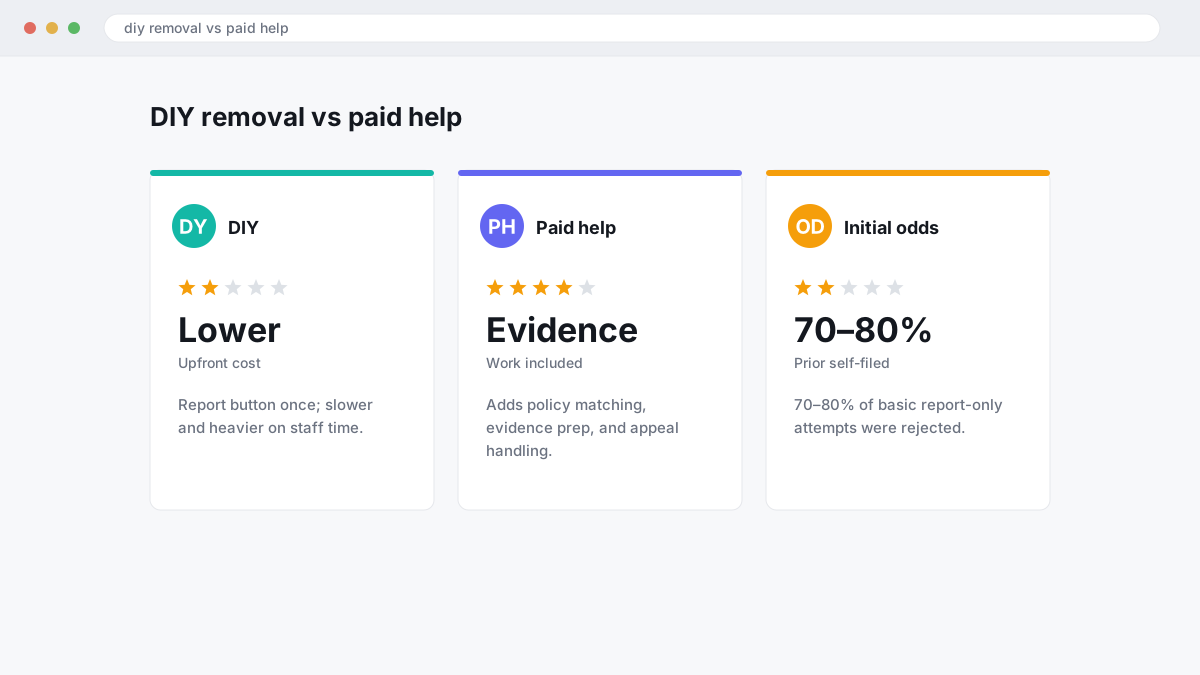
The cheap but weak approach is to hit the report button once, write “fake review”, and wait. That fails because Google usually wants a clear policy fit plus an evidence pack that survives the appeal and reconsideration route. In BGR Review's dataset of negative review cases with prior self-filed attempts, logged June 2025 to June 2026, roughly 90% had used only the basic in-platform report button with no supporting documentation, and 70–80% of those initial requests had been rejected.
This is the practical comparison.
| Route | Cash cost | Work on your side | What changes the odds |
|---|---|---|---|
| DIY | Low direct cost | Collect screenshots, timestamps, order records, staff statements, then chase case IDs | Strong documentation and disciplined follow-up |
| Fixed price per removed link | Fixed price per removed link | Lower admin load once documents are handed over | Better policy matching and tighter escalation file |
| Managed, retainer or flat fee | Varies by provider pricing model | Usually moderate | Depends on whether the provider actually builds a usable evidence pack |
The right test is simple: are you paying for process quality or for a sales claim. A credible provider improves the file, keeps the appeal route moving, and tells you when a public response and fresh review acquisition will do more for map-pack click-through, conversions and branded search demand than another removal attempt.
What changes when a multi-location brand faces repeat review abuse?
Multi-location brands need one removal system across the estate, not separate branch-level firefighting. Repeat attacks often hit several listings at once, so shared screenshots, branch-specific logs and duplicate-pattern tracking make Google review disputes faster and more consistent across 10, 50 or 200 profiles.
The wrong approach is treating each branch like a single-listing cleanup. That fails because multi-location abuse patterns usually repeat the same wording, reviewer account behaviour or fake service complaint across branches, yet local managers file isolated reports with no shared case ID trail. In BGR Review's case file of 12,000+ negative review cases logged June 2025 to June 2026, outcomes were recorded as removal success, unresolved or unknown, and a rejected first report often reflected weak documentation rather than a valid review.
The better approach is a central evidence pack with one shared case log for every location: review URL, profile URL, screenshot, posting date, service mismatch, city mismatch and prior report ID. Location mismatch carries extra weight when a reviewer names a city the branch does not serve or complains about a service that site does not offer, because the review starts to look off-topic rather than merely negative. A central library speeds repeat disputes, keeps appeals consistent and stops the same false review cluster from depressing local pack click-through and conversions branch by branch.
Where to go from here
Start with a simple triage. Put each Google review into one of three folders: likely policy breach, unclear, or legitimate but damaging. If it fits a named policy bucket such as spam and fake content, conflict of interest, off-topic content or a false factual claim you can document, build the evidence pack first and then file the flag and appeal route with the case IDs kept in one thread. If it does not fit a clear rule, stop chasing removal and write the best public response you can.
That decision saves time. A weak removal attempt usually ends with a rejection that tells you very little, while a precise response can protect click-through rate from the local pack, steady conversions from calls and form fills, and buy you time to improve review recency on the listing. In BGR Review’s own case file of 12,000+ negative review cases logged June 2025 to June 2026, reviews raised within 28 days and tied to an identifiable policy issue resolved successfully in roughly 90% of cases; older comparable cases dropped sharply.
If your review is not removable, your next move is still clear: respond well, ask happy customers for fresh verified feedback, and strengthen the profile that actually drives map-pack clicks and branded search demand.