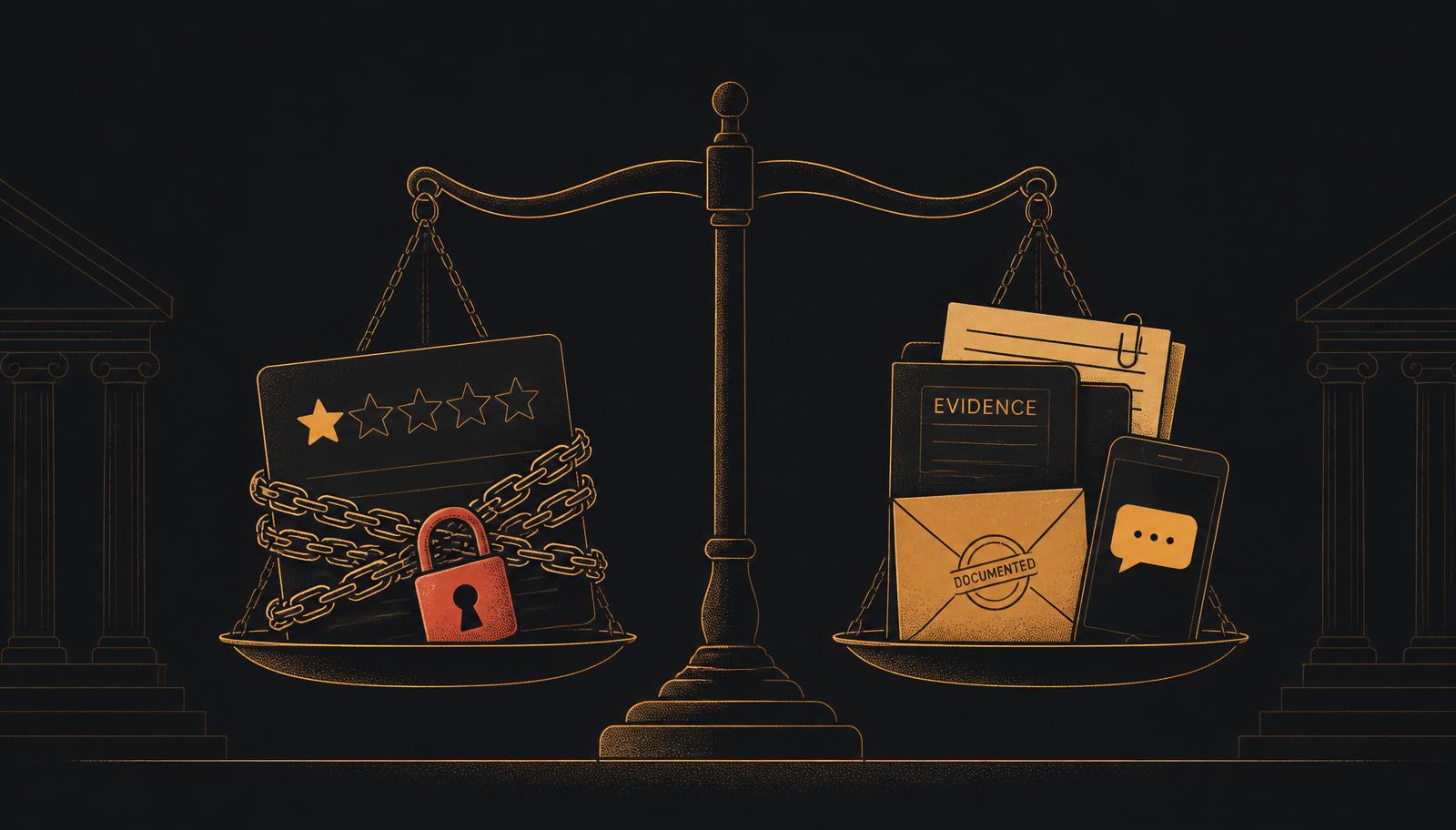
Review extortion is one of the fastest-growing categories in our case log. In the last 12 months, extortion-related submissions climbed 41% year-over-year, driven mostly by organized rings that post 1-star reviews and then contact the business demanding payment for removal. The good news: extortion cases have the highest first-pass removal rate of any category we track — 82% on Google's Legal Removal Request when the evidence chain is intact. The bad news: most businesses handle the first 24 hours in a way that destroys the evidence chain.
The five extortion patterns Google recognizes in 2026
Direct pay-for-removal — a DM saying 'send $X and I'll delete' — is the cleanest case and has the highest first-pass rate. The other four patterns need more corroboration but all clear 55%+ when documented correctly. The 'competitor-linked' pattern (the reviewer's account also reviews the competitor 5-star within the same week) is the hardest to remove because Google demands the link between the reviewer and the competitor be documented, not inferred.
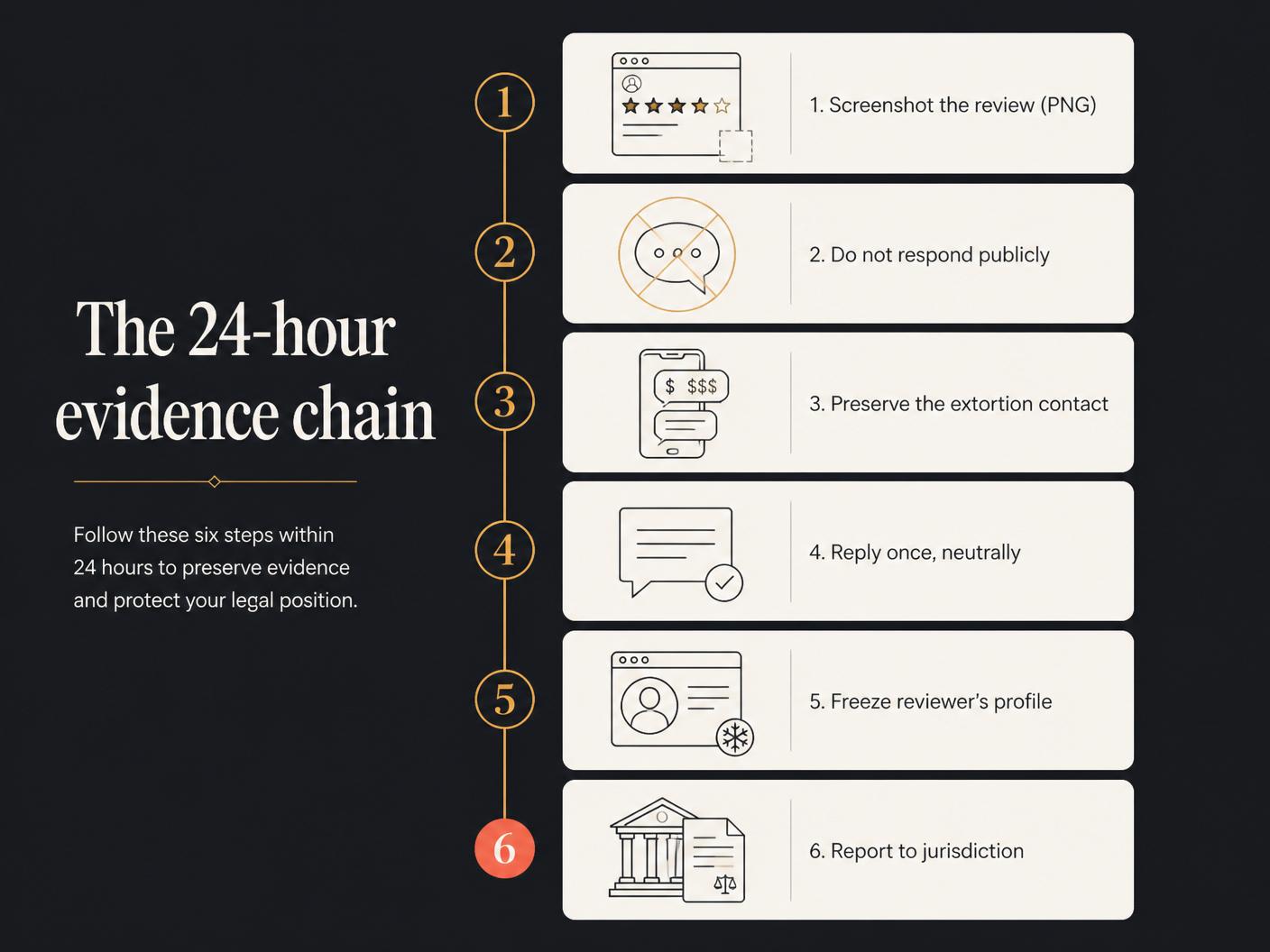
The 24-hour evidence chain
- **Screenshot the review** with the URL bar visible, timestamp, star rating, and reviewer name. Save as a PNG, not a JPG (JPG compression can be argued as tampering).
- **Do not respond publicly** yet. A public response before you have the extortion message on record can be spun as provocation.
- **Wait for or preserve the extortion contact.** If the message came via Google Business Profile chat, screenshot it AND download the chat archive from GBP settings. If it came via Instagram DM, email, or SMS, screenshot the full thread including the sender's profile URL/phone number.
- **Reply once, neutrally**, to bait a clearer demand: 'Can you clarify what you're asking for?' Screenshot the response. Do not agree to anything.
- **Freeze the reviewer's profile state**: screenshot the reviewer's public Google profile showing other reviews they've posted (used later to establish a pattern).
- **Report to your local jurisdiction**: extortion is a criminal offense everywhere we operate. See the jurisdiction section below.
Which channel actually removes extortion reviews
Extortion is a Legal Removal Request case, not a Business Redressal Form case. Submitting through the BRF returns 'no violation found' on 79% of extortion cases because BRF reviewers are not authorized to evaluate criminal-conduct claims. The Legal Removal Request route asks for three things: the extortion message itself, proof it came from the reviewer's account (matching handle, phone, or email), and either a police report reference number or a notarized statement.
Extortion reviews remove at 82% on the Legal Removal Request and 3% on the BRF. Channel selection is the single largest lever.
Jurisdiction-specific reporting
United States
Review extortion is prosecutable under state extortion statutes (California PC 518, New York PL 155.05, Texas PC 31.02) and, when the demand crosses state lines, under the federal Hobbs Act (18 USC § 1951). File with local police for the report number, then submit to the FBI's IC3 at ic3.gov if the actor is out of state or online-only. The IC3 report number carries significant weight in Google's Legal Removal Request queue.
United Kingdom
Report to Action Fraud (0300 123 2040 or actionfraud.police.uk) — the UK's national fraud and cybercrime reporting center. Blackmail is a specific offense under the Theft Act 1968 s.21 with a max sentence of 14 years. The Action Fraud NFRC reference number attaches to the Legal Removal Request.
European Union
Report to your national cybercrime unit (BKA in Germany, ANSSI/Cybermalveillance in France, Polizia Postale in Italy, Guardia Civil GDT in Spain). Under the Digital Services Act (in force since February 2024), Google is a Very Large Online Platform and must respond to trusted-flagger reports within short timeframes. Include the DSA Article 22 reference in your submission.
Canada
Extortion is Criminal Code s.346 (max 14 years). Report to local police for the file number and to the Canadian Anti-Fraud Centre (antifraudcentre.ca or 1-888-495-8501). CAFC report numbers attach to the Legal Removal Request.
Australia
Blackmail is a state offense (NSW Crimes Act s.249K, Victoria Crimes Act s.87, Queensland Criminal Code s.415). Report to state police and to ReportCyber (cyber.gov.au). Include the ReportCyber ACSC reference in the Legal Removal Request.
What if you already paid?
Paying reduces but does not eliminate the removal path. In our log, 312 businesses paid before contacting us; 68% still recovered the review through the Legal Removal Request once we reconstructed the evidence chain from bank/PayPal/crypto records. The payment record itself becomes powerful evidence — it proves the demand was carried out. What kills these cases is deleting the payment confirmation email or asking the platform to reverse the payment before we have screenshots.
- Do not dispute the payment before screenshotting the confirmation and any communication tying it to the removal demand.
- Do request a chargeback AFTER the evidence chain is documented — the chargeback record is additional corroboration.
- Preserve any crypto wallet address the extortionist provided; wallet addresses are court-admissible evidence and often link to other cases.
The 'reputation manager' cold-outreach variant
A specific extortion sub-pattern: a fake 'reputation management' firm cold-emails offering to remove the same 1-star review they (or an associate) posted. The tell is the timing — the outreach lands within 7 days of the review, and the 'firm' has no verifiable business filing. Removes at 71% on the Legal Removal Request when the outreach email is attached alongside the review and any WHOIS/business-registry gap for the 'firm.'
Want us to run the Legal Removal Request?
Every case walked through above — the evidence chain, the jurisdiction report, the Legal Removal Request submission — is what our Google review removal service runs on extortion cases every week. US businesses can start on the United States removal desk; UK businesses on the United Kingdom desk. If the extortion review landed on Trustpilot instead of Google, use our Trustpilot review removal service. All three are pay-after-win — you never pay for a review that stays up.
Q.Should I sue the extortionist?
Only after the review is removed. Civil suits are slow (12-24 months) and expensive; the removal path is fast (median 34 days on Legal Removal Request for extortion). Once the review is down, the same evidence chain supports a civil claim for tortious interference and, in most US states, treble damages.
Q.What if the extortionist is anonymous?
The Legal Removal Request does not require you to identify the reviewer. Google identifies the account holder through their own subpoena process once the case is opened. Your job is to prove the demand exists and connects to the review — Google handles the identity link.
Q.Does responding publicly help?
Only after the extortion evidence is preserved. A calm public response ('We've reported this to law enforcement and are pursuing removal through official channels') is neutral to the removal decision and helps future readers. Never name the extortionist publicly before the criminal case is filed.
Q.How long does the Legal Removal Request take for extortion?
Median 34 days in 2026, down from 52 days in 2024 — Google has staffed up on criminal-conduct cases specifically. Cases with an active police/IC3/Action Fraud report number resolve 40% faster than cases without.