
Quick answer
Brand visibility in AI search improves when search systems can match your brand across the same name, address, phone details, review profiles, website schema markup and third-party mentions, then find recent trust signals worth citing. A workable 90-day plan starts with entity cleanup, Google Business Profile fixes, duplicate listing checks and a steady flow of verified reviews with strong recency. Google started rolling out AI Overviews in the US in May 2024, which increased the value of citation-ready profile data. If false reviews suppress trust, removal can matter as much as new review growth; BGR Review charges $449 per removed review link with $0 upfront.
This page is written from live reputation work, not brand-theory shorthand. We handle review acquisition, review removal and profile cleanup across Google, Trustpilot, Yelp, Clutch and TripAdvisor, and the same failure keeps turning up: a business flags a false review through the basic report button, sends no evidence, then assumes the rejection means the review must stay.
Our process starts with the review URL, profile state, duplicate listing check, policy match and evidence pack before any flag goes in. BGR Review has served 15,000+ businesses, has 1,240+ verified clients and offers a 30-day free replacement guarantee on review packages, so the advice here stays tied to the operational details that actually move brand visibility.
Why does brand visibility in AI search depend on corroborated entities, not just reach?
Brand visibility in AI search comes from entity corroboration more than raw reach. Google and answer engines surface brands when the name, profile data, recent review activity and third-party references line up well enough to cite with confidence in AI Overviews or brand recommendations.
Most branding advice still pushes impressions, taglines and campaign reach. That fails when search systems cannot tell whether your Google Business Profile, site footer, directory listings and off-site brand mentions refer to the same entity, because Google Search then reformulates the query, blends you with another brand, or withholds a knowledge panel. Clean corroboration works because it reduces ambiguity: one trading name, one primary phone number, one canonical domain, and matching citations across the profiles you actually control.
Recent trust signals often decide the result set after the entity match is made. In BGR Review’s dataset of 1,485 businesses observed from February to July 2026, trades and local service firms that reached 20–30 reviews in the first three months were associated with stronger local visibility, with other ranking factors active at the same time. That is why a brand with modest reach but current reviews and credible third-party mentions often appears in AI Overviews before a louder brand whose data is fragmented, stale or thin.
How is AI search for brands different from classic SEO when you set priorities?
Classic SEO asks Google Search to rank your pages. AI search asks whether your brand is consistent and trusted enough to be cited across sources, so visibility depends more on entity accuracy, review credibility and off-site corroboration than on rankings alone.
The wrong priority is to spend the first 90 days pushing category pages and hoping that rankings will carry branded discovery with them. That fails because AI Overviews can pull from your site, review platforms, directories and press coverage in the same answer, and a strong page cannot fully offset bad citation consistency, duplicate business details or a weak third-party footprint. A category page may climb within 90 days if the site is already technically sound; branded queries often react sooner when you fix the entity first.
This comparison is where teams usually set the wrong order of work.
| Priority | Classic SEO | AI search |
|---|---|---|
| Primary target | Rank a page for a query | Earn citations across corroborating sources |
| What moves first | Content, links, on-page relevance | Entity cleanup, profile accuracy, review platform trust |
| Fastest recovery lever | Improve page quality | Fix mismatched listings; if false reviews are involved, BGR Review handles removal at $0 upfront and $449 per removed link |
The better approach is to treat rankings as one channel and citations as another. Google Search can rank your page and still let AI Overviews cite a directory or review profile beside it, so your first wins usually come from cleaning names, addresses, phone data and review-platform profiles until the same brand entity appears everywhere without contradiction.
What should you fix in the first 30 days if you want visible movement fast?
The fastest 30-day gains come from fixing the brand records search systems trust first: your main profiles, duplicate listings, and the few top citations that confirm who you are, where you are, and how customers reach you.
Audit-everything-at-once is the wrong move. It burns time on low-value directories while Google Business Profile, Yelp, Trustpilot or Clutch still show mismatched hours, weak categories, missing logos, or old phone numbers. Start week 1 by baselining the queries and actions you need to judge movement: branded search demand in Search Console, map impressions and clicks in Google Business Profile, review recency on each priority profile, and click-through from branded queries before you edit anything.
Then fix the few signals that unblock visibility. Suppress duplicate listings first, because duplicates split reviews, confuse the knowledge panel, and weaken citation consistency across the profiles AI Overviews are most likely to cite. Repair your core fields on the same pass: logo, primary and secondary categories, opening hours, website URL, booking link, and contact data. In BGR Review’s dataset of 1,485 businesses observed February to July 2026, trades businesses with complete enquiry-source data attributed 70-80% of calls and bookings to a Google Business Profile or Yelp listing, which is why profile accuracy usually moves faster than wider content work.
If a visibility dip follows a merger, rebrand, or address change, clean the old citations before pushing fresh review activity. New reviews help less when the entity is still split across stale NAP variants, and some recovery cases stall until that record is fixed first.
How do you clean the brand entity so search systems stop mixing, splitting, or guessing?
Entity cleanup means making every major source describe your brand in one consistent way. Organisation schema markup, sameAs links, matching profile fields, and suppression of duplicate listings help search systems connect your reviews, mentions, and locations to one entity instead of several weak ones.
Most guides tell you to publish more content when branded search starts looking messy. That fails when Google, directories, and AI Overviews are still guessing whether your company name, phone number, legal name, and location set refer to one business or three. The right move is cleaner entity data: add Organisation schema on the main site, point sameAs to your Google Business Profile, Trustpilot, Yelp, Clutch or other live profiles, and use the exact same business name, URL, phone and category wherever the brand appears. Cleaner citation consistency gives a knowledge graph something stable to corroborate, which helps the knowledge panel and improves branded-search click-through before you publish another article.
If your knowledge panel shows an old address, the wrong website, or a social profile you no longer use, check those details against your site footer, contact page, main directories, and every Google Business Profile field. A merged profile or stray duplicate can split review signals, divide map-pack relevance, and send mixed intent signals when someone searches your brand name plus a service. At BGR Review, this is one of the first checks we make before review work, because a clean entity lets fresh review signals, sentiment distribution, and brand mentions accrue to the same profile instead of being scattered across copies.
How should a multi-location brand handle Google Business Profile without creating entity chaos?
A multi-location brand keeps Google Business Profile clean by treating each branch as its own entity with shared naming rules, while controlling categories, photos, attributes and duplicate checks at location level so Google can rank the right page in the local pack.
The wrong approach is the master-profile mindset: one template, one category, one photo set, one stock description rolled across every site. That fails because Google Business Profile ranks on local relevance as well as brand recognition, so a plumber in Leeds and a bathroom showroom in Croydon should not carry the same primary category, service-specific attributes or gallery. In BGR Review's dataset of 1,485 businesses observed February-July 2026, trades firms that shared complete enquiry-source data attributed 70-80% of calls and bookings to a Google Business Profile or Yelp listing, which is exactly why location accuracy affects conversions and map-pack click-through so quickly.
The cleaner approach is standardise the parts that define the brand, then localise the parts that prove the branch exists. Franchises should lock naming rules, then let each location set its own hours, local description, manager responses and recent photos from that branch rather than head-office assets. Run duplicate listings checks every quarter. One bad merge can fold reviews, confuse the service area, and suppress local pack visibility until the profile is separated and the entity data matches the live location again.
Which visibility signals usually improve fastest in days 31 to 60?
Days 31 to 60 usually bring the quickest lift from fresher review signals, cleaner profiles and stronger third-party corroboration. In that window, branded-query trust and click-through rate often improve sooner from review recency and profile fixes than from publishing another long article.
Most teams spend this month adding blog posts. That fails when your Google Business Profile, Trustpilot page or Clutch profile already sits in front of the buyer and shows stale or lopsided feedback. A thin content gain takes time to earn links, brand mentions and crawl priority; a healthier sentiment distribution changes what people and AI Overviews already see on the page today, which shifts social proof before rankings materially move.
The better play is simple: ask for new, compliant reviews after completed work, spread them across the platforms that matter in your category, and keep the profile fields clean while they land. In BGR Review's dataset of 1,485 businesses observed from February to July 2026, new trades and local service businesses typically saw first reviews around two weeks after launch, and roughly 90% of those early reviews were positive; reaching 20 to 30 reviews over the first three months was associated with improved local visibility, though other ranking factors were active at the same time. That is why review recency usually outpaces long-cycle content production for map-pack click-through and early conversion lift.
Owner responses still matter, especially when a buyer reads two or three recent reviews before calling. They help conversion because they show a live operator behind the brand. New compliant reviews usually move perception faster than replies alone, though, because they alter the review signals themselves: volume, freshness and sentiment mix. Keep it compliant with the FTC's rules on endorsements and testimonials and the UK's fake review rules under the DMCC Act; this is general information, not legal advice. If you need help running the process, BGR Review sells verified review campaigns with a 30-day free replacement guarantee on review packages.
How do earned media and brand mentions turn into citations that AI systems trust?
AI systems trust off-site citations when several attributable sources repeat the same brand facts in compatible language, because named coverage, expert quotes and structured directory profiles give them something firmer than raw reach or vague buzz to cite.
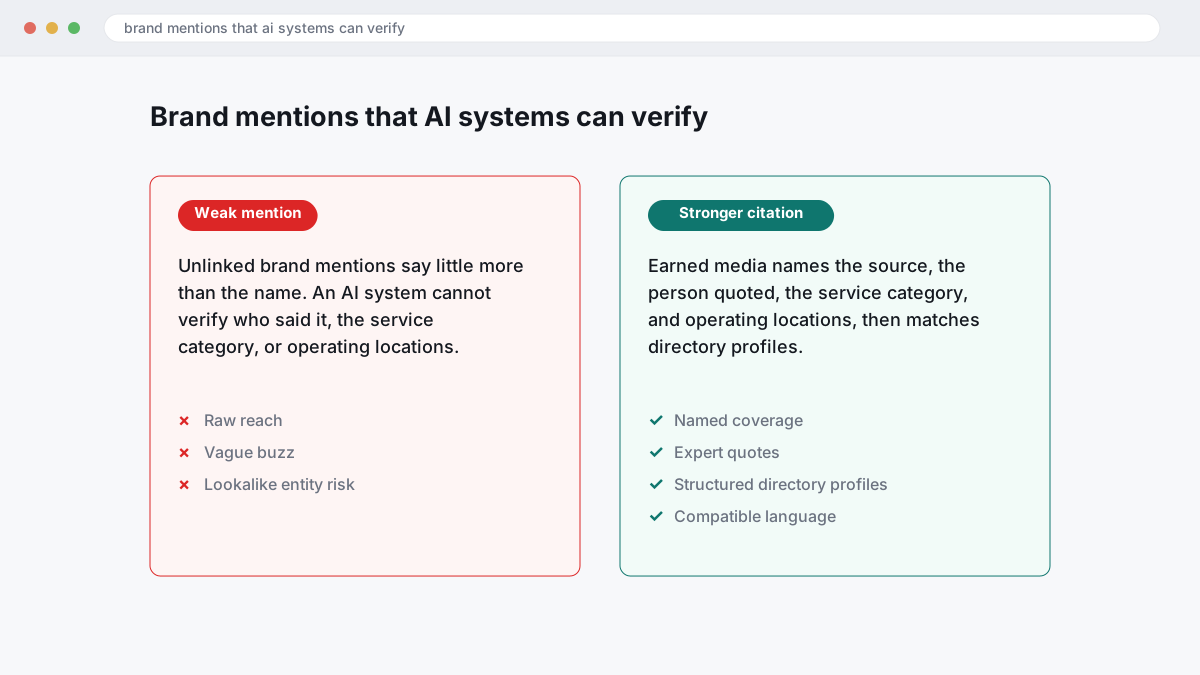
The wrong approach is chasing unlinked brand mentions that say little more than your name. That fails because an AI Overview or other summary system cannot verify who said it, what category you serve, or whether the mention refers to your brand or a lookalike entity. The right approach is earning media that names the source, the person quoted, the service category, and the operating locations, then backing it with directory profiles and press pages that repeat the same core entities. For a brand with offices in New York, London and Thornhill, that location string needs to match across citation sources instead of drifting between versions.
Use this check before you count a mention as useful.
| Source type | Weak version | Trusted version |
|---|---|---|
| Earned media | Generic company roundup with no named spokesperson | Attributed quote naming founder or team member, category and location |
| Press page | Logo wall with no context | Linked coverage page with publication name, date and topic |
| Directory profile | Thin listing with old phone or category | Consistent profile matching your live brand facts and differentiators |
Track whether brand mentions keep repeating the same founder, category, locations and differentiators. If those details drift, citation building stalls for the same reason review removal cases stall: the entity is still ambiguous, so the system hesitates to trust what it found.
What should you do after negative reviews start dragging brand visibility down?
When negative reviews start pulling visibility down, split removable reviews from reviews that need a public reply. Move within 48 hours, log any policy breach, answer calmly where service recovery is the real issue, then rebuild review recency with legitimate new feedback after you fix the cause.
The wrong move is arguing with every review in public. That tanks review signals twice: the unresolved complaint stays live, and your response thread starts confirming a messy story that AI Overviews, the local pack and branded searchers can all quote back to you. Triage works better. Put each item into one of three lanes: platform policy violation, factual dispute with evidence, or valid customer complaint that needs a response and an internal fix.
For Google reviews, start with policy before emotion. Google Business Profile only removes reviews that break its prohibited and restricted content rules; “unfair” on its own is weak. In BGR Review’s log of 12,000+ negative review cases from June 2025 to June 2026, reviews raised within 28 days and backed by an identifiable policy issue resolved successfully in roughly 90% of cases, while comparable cases raised later fell to approximately 25–30%. That is why review removal starts with screenshots, order records, timestamps, staff notes, and a clear sentence showing which rule was broken.
If the review stays up, answer it once and stop. Then close the review gap with fresh, legitimate feedback from recent customers only after the service issue, booking delay or staff error is fixed; otherwise you just add newer negative sentiment distribution on top of the old problem.
When can AI search hurt brand visibility instead of helping it?
AI search hurts visibility when AI Overviews pick up stale complaints, old addresses, duplicate listings or mismatched profile data and then repeat them faster than your own site, Google Business Profile or knowledge panel can correct the record.
Most guides treat extra AI exposure as a win by default. That fails when the source set is dirty. A closed branch, an old phone number, or a complaint thread that still outranks your current profile can become the shorthand answer for your brand, which drags map-pack click-through, branded search demand and conversions even if your service has not changed.
The safer approach is to fix the underlying entity and evidence first, then push for review removal where a review breaks a named platform policy. If a review alleges a false factual event, you may also have a defamation issue, but the route differs from a platform appeal and the threshold is higher. In our file of 12,000+ negative review cases logged June 2025 to June 2026, cases raised within 28 days of posting and backed by an identifiable policy issue resolved successfully in roughly 90% of cases; beyond 28 days, observed success fell to approximately 25–30%.
Rules also change by country and platform. In the US, the FTC’s 2024 rule on fake reviews and testimonials targets undisclosed incentives and deceptive endorsements; in the UK and EU, consumer-protection rules on misleading commercial practices take a different route; platform policy on Google, Trustpilot and Yelp adds its own enforcement layer. This is general information, not legal advice.
Which weekly checks belong on a brand visibility checklist your team can actually run?
A weekly brand visibility checklist works when it tracks four checks only — branded-query screenshots, map-pack presence, citation consistency and review recency — and gives each one a named owner plus a single SLA such as 24-hour response coverage.
Most teams hoard spreadsheets. That fails because nobody owns the gap between a bad screenshot on Monday and a fixed Google Business Profile or directory listing by Friday, so brand search demand softens while stale data keeps feeding AI Overviews and the knowledge panel.
Use a red-amber-green board so your team can act without debating the score.
| Check | Owner | SLA / status rule |
|---|---|---|
| Branded-query screenshots and map-pack presence | SEO or location manager | Weekly capture; red if the main profile drops, a wrong result appears, or branded clicks shift to a third-party page |
| Citation errors and duplicate listings | Operations or listings owner | Fix within 5 business days; red if NAP data conflicts across major directories |
| Review recency, ratings, mentions, profile completeness | Reputation lead | 24-hour response coverage; red if new reviews go unanswered or profile fields and photos fall behind |
What should happen in days 61 to 90 to compound gains and prove the program worked?
Days 61 to 90 should prove which fixes actually lifted demand and trust, then scale only the parts that held. Compare day-1 against day-90 branded clicks, citation accuracy, review recency and Google Business Profile stability before you copy the workflow into more locations.
Use a simple before-and-after table so your team can decide from evidence rather than momentum.
| Signal | Day 1 | Day 90 |
|---|---|---|
| Branded clicks | Baseline from Search Console and GBP insights | Higher, flat, or lower |
| Review recency | Old, irregular review pattern | Recent reviews arriving on a steady cadence |
| Profile completeness | Missing services, photos, categories, replies | Core fields complete and duplicates resolved |
The wrong move is scaling immediately because one pilot location improved. That usually fails when a secondary location has weaker entity data, older reviews or a half-complete Google Business Profile, so brand search demand lifts in one market and stalls in the next. Wait until the pilot holds steady for 2 weeks with no ranking swings, merged duplicates or fresh review issues, then expand.
Month 3 should also tell you where to invest next. If branded clicks rose after press mentions and unlinked citations started appearing in AI Overviews, push earned media. If visibility improved only after fresher reviews and owner replies, build review operations; BGR Review's packages carry a 30-day free replacement guarantee, which matters when you need cadence rather than a short spike. If the profile is clean, reviews are recent and demand still sits flat, move into deeper SEO on service pages, internal links and schema support.
Where to go from here
Start with a 30-minute audit of the places AI search pulls from first: your Google Business Profile, key citations, review profiles, and the name-address-phone details tied to your knowledge panel. If those records conflict, fix them before you chase mentions or publish more content. Clean entity data gives AI Overviews, the local pack and branded search results a stable version of your business to cite.
Then work on review recency and sentiment distribution. Ask for new, policy-compliant reviews from real customers, reply to recent feedback, and remove duplicate listings that split your signals. If a visibility dip lines up with a false, off-topic or policy-violating review, assess removal straight away; delay matters. In BGR Review's case file covering 12,000+ negative review cases logged June 2025 to June 2026, reviews raised within 28 days and backed by a clear policy issue resolved successfully in roughly 90% of cases, while comparable cases raised later fell to approximately 25-30%.
If reputation issues are blocking progress, the next step is a review audit and removal assessment. Expect a list of entity fixes, review gaps, duplicate-profile problems, and any review links worth flagging with an evidence pack before you spend on broader visibility work.