Of every review pattern we submit to Google's Business Redressal Form, wrong-company confusion has the highest first-pass removal rate — 71% across 2,314 submissions in our 2025–2026 log. It also has the largest gap between a well-built submission and a rushed one: the same underlying case removes at 22% when submitted as generic 'off-topic' and 71% when routed through the specialist evidence path. This post is the exact bundle we use.
What counts as wrong-company confusion
Wrong-company confusion is a review left on Business A that describes an experience with Business B, where a reasonable reviewer could have mixed them up. Google recognizes three sub-patterns, and each has its own removal rate:
Same-name is the strongest: two businesses share a name (often a common surname like 'Smith Plumbing' or 'Anderson Dental') within the same metro area. Franchise confusion is the review that names a corporate policy the local franchisee cannot control — pricing, promotions, warranty terms. Acquired/renamed is the review that describes an experience with the previous owner, sometimes years before the current owner took over.
The four-part evidence bundle
The single largest lever on removal rate is the evidence attached to the BRF submission. Cases with all four attachments remove at 71%. Cases with two attachments remove at 44%. Cases with the review text alone remove at 22%.
- **Same-name proximity proof**: a screenshot of Google Maps showing both businesses within 30 miles of each other, with both profile names visible. For franchise cases, a screenshot of the corporate site listing the actual location the reviewer visited.
- **Reviewer's exact text, quoted verbatim**: paste the full review into the BRF form. Do not paraphrase or summarize. Google's reviewers pattern-match on specific phrases.
- **The correct business's URL**: the Google Business Profile URL of the business the reviewer actually meant. For acquired businesses, the URL of the previous entity's archived profile (via Wayback Machine if it's been delisted).
- **A timestamped screenshot** of the reviewer's post as it appears on your profile, showing the review date, star rating, and reviewer name. This anchors the case to a specific piece of content and prevents Google from asking for it later.
Case walkthrough: two 'Anderson HVAC' shops, 14 miles apart
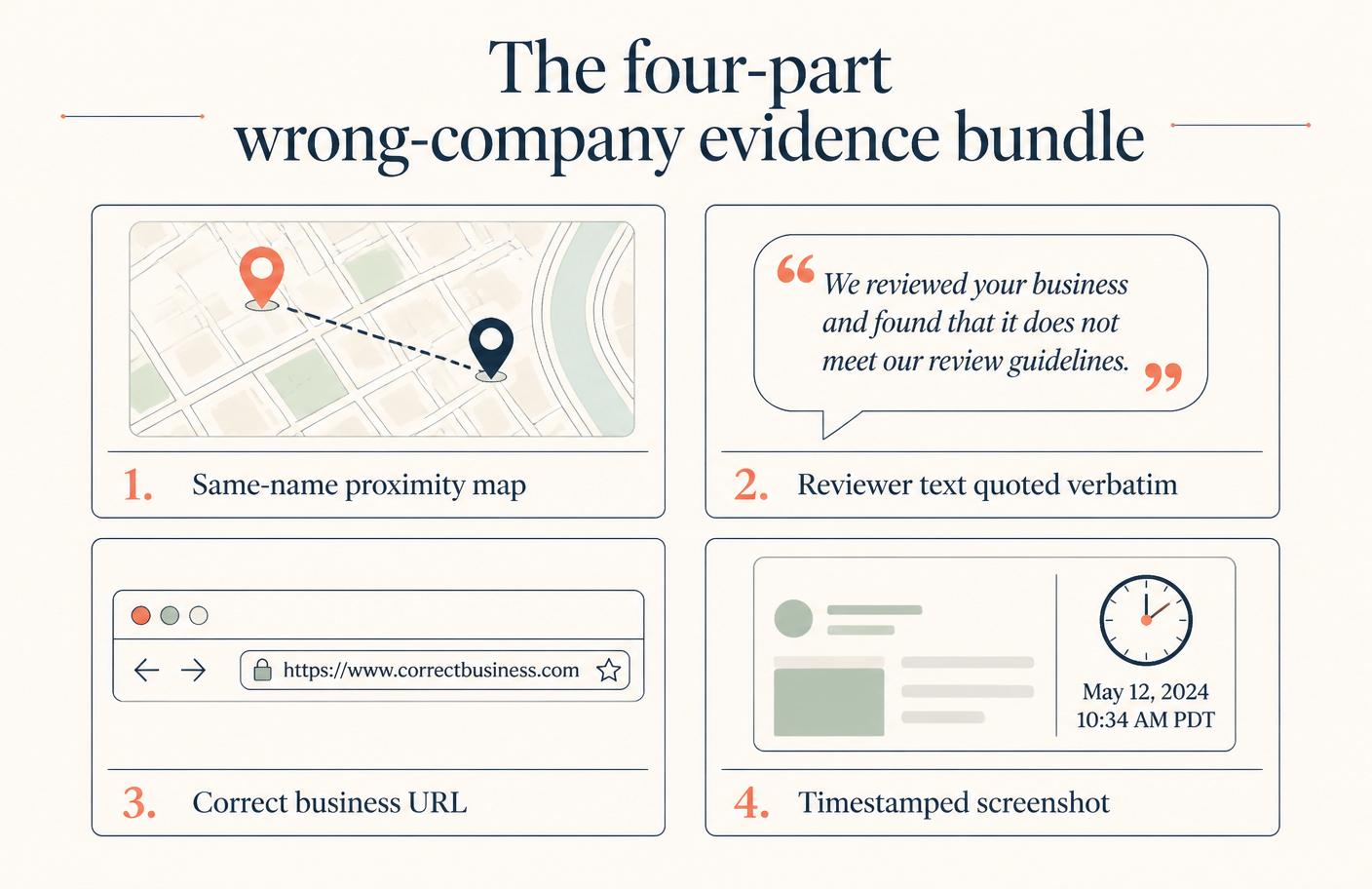
In April 2026 we handled a case where 'Anderson HVAC' in a Chicago suburb received a 1-star review complaining about a botched furnace install. The reviewer had actually hired 'Anderson HVAC & Refrigeration' — a different, unrelated business 14 miles away. The reviewer confirmed the confusion in a follow-up comment on the review itself.
First submission (no evidence bundle, generic off-topic classification): rejected in 3 days. Second submission with the four-part bundle plus a screenshot of the reviewer's follow-up comment: removed in 6 days. Same review, same reviewer, same underlying facts — the only variable was the evidence. This is exactly the workflow we run inside our HVAC review removal service and the parallel desks for restaurants, dentists, and lawyers.
Franchise confusion: the corporate-policy tell
Franchise wrong-company reviews follow a predictable pattern: the reviewer complains about a policy the local franchisee cannot set. Pricing that matches the corporate promotion, refund terms dictated by corporate, warranty scope defined by the manufacturer. First-pass rate: 68% when the submission includes a link to the corporate policy page showing the franchisee is not the decision-maker.
- Reviewer complains about corporate loyalty program terms → attach the corporate program T&Cs.
- Reviewer complains about product warranty → attach the manufacturer's warranty page, not yours.
- Reviewer complains about corporate-set pricing on a national promotion → attach the corporate promo page dated to the reviewer's visit.
Acquired/renamed businesses: the ownership-transfer proof
Acquired-business cases remove at 61% and require one additional attachment: proof of the ownership transfer date. A state business filing, an asset purchase agreement page (redacted for financials), or a press release announcing the acquisition. The submission opener changes to: 'This review describes an experience dated [X], which is before the current ownership took over on [Y]. Ownership transfer documented at [source].'
Google's moderators can verify a wrong business, but they cannot verify a wrong date without documentation. Acquired-business cases live or die on the transfer proof.
Common mistakes that drop the removal rate
- Submitting multiple reviews in one BRF form. Each review needs its own submission or the whole batch gets down-weighted.
- Arguing the reviewer's experience was wrong. Wrong-company is a routing argument, not a factual dispute — never contest the underlying experience.
- Naming the other business in the response to the review. This is fine as an FYI to future readers, but do it after the removal decision, not before — it can look coordinated.
- Submitting without attachments and re-submitting with attachments 24 hours later. Google treats the second submission as a duplicate. Wait 7 days between submissions on the same review.
Prefer we build the bundle for you?
The four-part evidence bundle is the same one our team assembles on every wrong-company case inside our Google review removal service. If Trustpilot is where the confusion landed, the parallel workflow lives on our Trustpilot review removal service. Both are pay-after-win — no removal, no charge.
Q.How long does a wrong-company case take in 2026?
Median 11 days on the specialist queue vs 4.6 days on the generic queue, but with a much higher removal rate. The extra week is worth it — a rushed generic submission returning 'no violation found' can lock the review for 30 days before you can resubmit.
Q.What if the reviewer refuses to update their review?
The reviewer's cooperation is not required. Google removes wrong-company reviews on the strength of the evidence bundle, not the reviewer's admission. That said, a public reviewer follow-up saying 'oops, wrong business' pushes the rate above 90%.
Q.Does this work for Yelp and Trustpilot too?
The pattern is the same, but the queues are different. Yelp removes wrong-business reviews at 34% (much lower — Yelp treats it as reviewer error, not policy violation). Trustpilot removes at 58% and requires the reviewer's order number or transaction proof, which most businesses cannot provide for a competitor's customer.
Q.Can I use this pattern for reviews about a former employee?
No — former-employee cases are named-defamation, not wrong-company. Route them through the Legal Removal Request, not the BRF. Different queue, different evidence standard, different first-pass rate (69%).