Quick answer: Trustpilot company reviews affect your public TrustScore, business profile, and Google Seller Ratings eligibility. Product reviews affect product-page conversion, product star snippets, and Shopping/product feed credibility. If you are under 100 company reviews in a key ad market, prioritize company reviews first.
The difference in one sentence
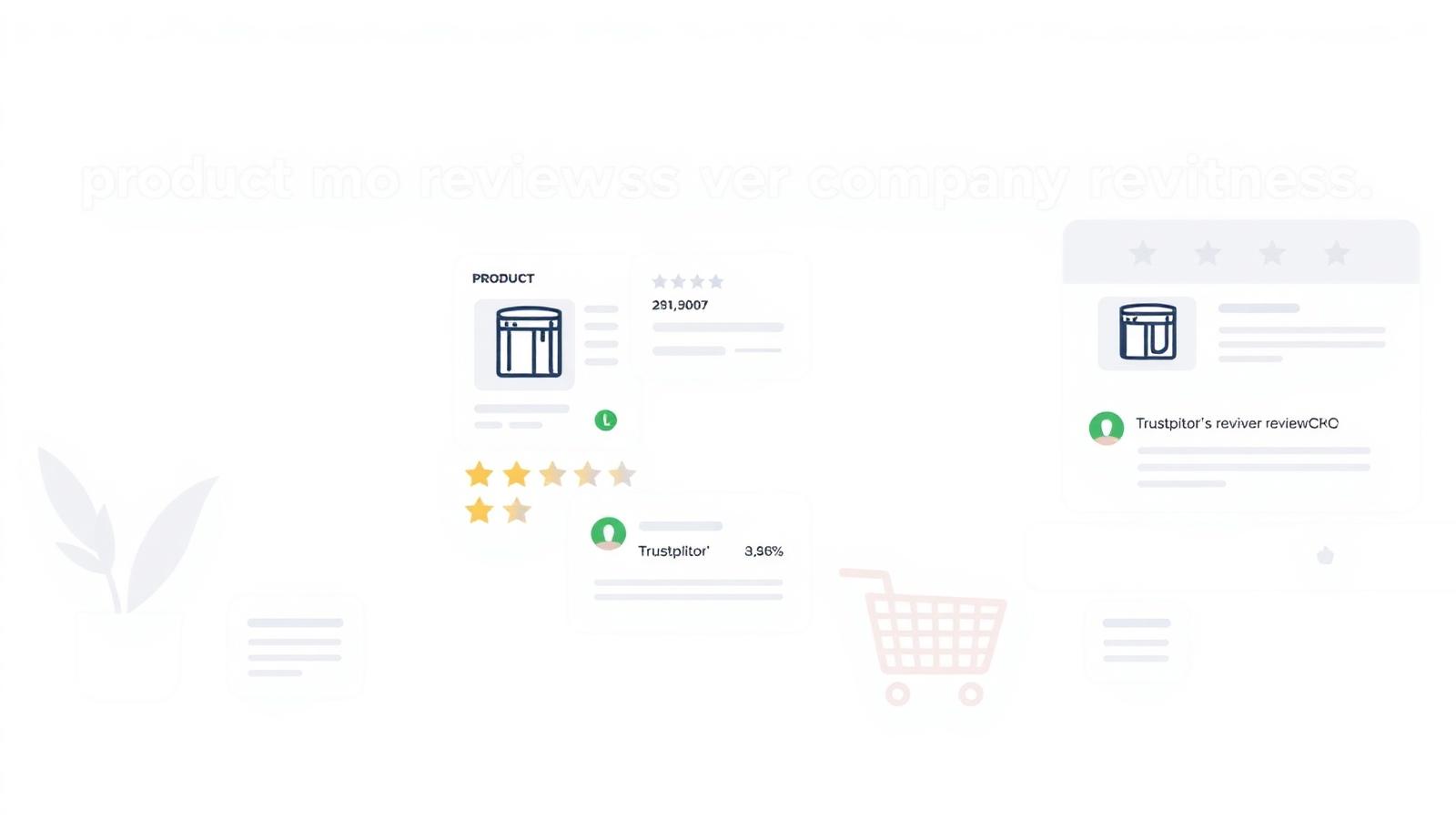
Company reviews evaluate the business experience: delivery, support, returns, communication, billing, and overall trust. Product reviews evaluate a specific item: quality, sizing, performance, packaging, durability, and whether the product matched expectations.
Trustpilot supports both, but they solve different problems. Company reviews build brand-level trust. Product reviews reduce hesitation on individual product pages. Treating them as interchangeable is the reason many ecommerce review programs look busy while failing to move revenue.
What company reviews do
Company reviews are the reviews visitors see on your main Trustpilot profile. They feed the TrustScore, appear in most TrustBox widgets, and are the review type that matters for Google Seller Ratings in Google Ads. If your goal is advertiser stars, homepage trust, or a stronger branded search result, company reviews are the priority.
They are also the reviews most reputation problems attach to. A fake allegation about customer service, delivery, fraud, or billing usually lands as a company review, not a product review. Your review removal and response workflow should be built around the company profile first.
What product reviews do
Product reviews attach to individual SKUs or product groups. They can be displayed on product detail pages, syndicated into product feeds, and used to show product-level social proof near size, color, price, or add-to-cart decisions. They are most valuable when a shopper is already interested in a specific item but needs confidence before buying.
Product reviews are less useful for broad brand trust. A five-star review for a blue linen shirt does not fix a weak company TrustScore, and it does not replace merchant-level review volume for Seller Ratings eligibility.
Company reviews answer: can I trust this business? Product reviews answer: should I buy this item?
Which one affects TrustScore
TrustScore is based on company reviews, not product-only reviews. Product reviews may influence product-page conversion, but they do not directly lift the main Trustpilot company score. If the executive goal is to raise the public TrustScore from 3.8 to 4.4, a product review campaign alone will not do it.
This matters during budgeting. Some teams buy a Product Reviews package expecting a better public profile and then discover they improved PDP widgets without changing the score shown in branded search or Trustpilot's company profile.
Which one helps Google Ads stars
Google Seller Ratings are merchant-level ad stars. They rely on company or seller reviews, not product-only reviews. For Google Shopping and product listing surfaces, product ratings can matter, but that is a different eligibility path with different feed requirements.
If your paid media team is asking for stars under Search ads, collect company reviews first. If the merchandising team wants stars beside individual products in Shopping or on product pages, then product reviews become the focus.
When product reviews are worth paying for
Product reviews are worth it when you have enough SKU traffic to use them. A store with 20 hero products, high product-page sessions, and meaningful paid Shopping spend can benefit quickly. A store with 3,000 low-volume SKUs often ends up with one or two reviews scattered across too many pages, which does not create persuasive density.
The sweet spot is a catalog where the top 20 percent of SKUs produce most revenue. Focus product review collection on those SKUs first rather than trying to review every item equally.
The best invitation sequence
For most ecommerce brands, the first invitation should ask for a company review after delivery is confirmed and the customer has had enough time to judge fulfillment. A product review request can follow later, once the customer has used the item. Asking for both in the same email usually lowers completion because the task feels too large.
A practical cadence is: company review 3-7 days after delivery for simple products, 10-21 days after delivery for products that require usage, then product review 7-14 days after the company review request. Adjust by category: apparel is faster, skincare and supplements need longer, furniture may need post-assembly timing.
SEO and rich result expectations
Product reviews can support structured data on product pages when implemented correctly, but they are not a guaranteed rich result switch. Google decides when to show product stars, and it may ignore markup if the reviews are thin, mismatched to the product, self-serving, duplicated, or not visible to users.
Company reviews can strengthen branded search trust and third-party profile visibility, but they do not automatically create product rich snippets. The two review types map to different search surfaces.
Common mistakes
The first mistake is collecting product reviews before the business profile has enough company reviews. If the brand has a weak TrustScore, shoppers may never reach the product page with enough confidence for product-level proof to matter.
The second mistake is creating duplicate or messy product catalogs inside Trustpilot. If product IDs, variants, URLs, or feed mappings change often, reviews can attach to the wrong item or fragment across variants. Clean product data matters as much as review volume.
The third mistake is using product reviews as a hiding place for negative feedback. If a customer complains about delivery or support in a product review, respond as a business issue. Do not ignore it because it does not affect TrustScore directly.
Decision framework
Choose company reviews first if you have fewer than 100 recent reviews in your main market, rely on Google Ads Seller Ratings, need a stronger TrustScore, or are dealing with reputation risk. Choose product reviews next if your company profile is stable, product pages get meaningful traffic, and top SKUs need conversion lift.
Run both only when the invitation flow is clean enough to avoid fatigue. Two poorly timed review requests can annoy customers and reduce completion. One well-timed company review and one later product review beats a combined request that gets ignored.
What to do this week
Audit your last 12 months of Trustpilot company review volume by country. If your main market is below 130 reviews, fix company review collection first. If you are above that threshold and your top 20 SKUs have strong traffic but low conversion, build product review invitations around those SKUs only. Do not pay for broad product review collection until your catalog mapping is clean.
Frequently asked
Q.Do Trustpilot product reviews affect TrustScore?
No. TrustScore is based on company reviews. Product reviews can improve product-page trust and product rating surfaces, but they do not directly lift the main company TrustScore.
Q.Are product reviews or company reviews better for Google Ads stars?
Company reviews matter for Google Seller Ratings in Search ads. Product reviews can matter for product rating surfaces such as Shopping, but they do not replace merchant-level Seller Ratings eligibility.
Q.Should I ask customers for a company review or product review first?
Most ecommerce brands should ask for the company review first after delivery, then ask for a product review later after the customer has used the item. Asking for both at once usually lowers completion.
Q.Can Trustpilot product reviews show on my product pages?
Yes, if product reviews are enabled and mapped correctly to your SKUs or product IDs. Clean catalog data is critical; otherwise reviews can fragment across variants or attach to the wrong product.
Q.Do product reviews help SEO?
They can support product structured data and product-level trust, but Google decides whether to show rich results. Reviews must be visible, relevant to the product, and correctly marked up.
Q.When are Trustpilot product reviews worth the cost?
They are worth considering when your company review base is already healthy, top products receive meaningful traffic, and product-page conversion is a bottleneck. If your company profile is weak, fix that first.